


Product name: 1-erucoyl-sn-glycero-3-phosphocholine
Synonym name: Lecithin Impurity 20;3,5,9-Trioxa-4-phosphahentriacont-22-en-1-aminium,4,7-dihydroxy-N,N,N-trimethyl-10-oxo-,inner salt,4-oxide,(7R,22Z)-
Catalogue No.: BP2382
Cas No.: 503271-85-0
Formula: C30H60NO7P
Mol Weight: 577.784
Botanical Source:
Type of Compound: Aliphatics
Purity: 95%~99%
Analysis Method: HPLC-DAD or/and HPLC-ELSD
Identification Method: Mass, NMR
Packing: Brown vial or HDPE plastic bottle
Storage: Store in a well closed container, protected from air and light. Put into refrigerate or freeze for long term storage.
Whenever possible, you should prepare and use solutions on the same day. However, if you need to make up stock solutions in advance, we recommend that you store the solution as aliquots in tightly sealed vials at -20℃. Generally, these will be useable for up to two weeks.
The product could be supplied from milligrams to grams
Inquire for bulk scale.
For Reference Standard and R&D, Not for Human Use Directly.
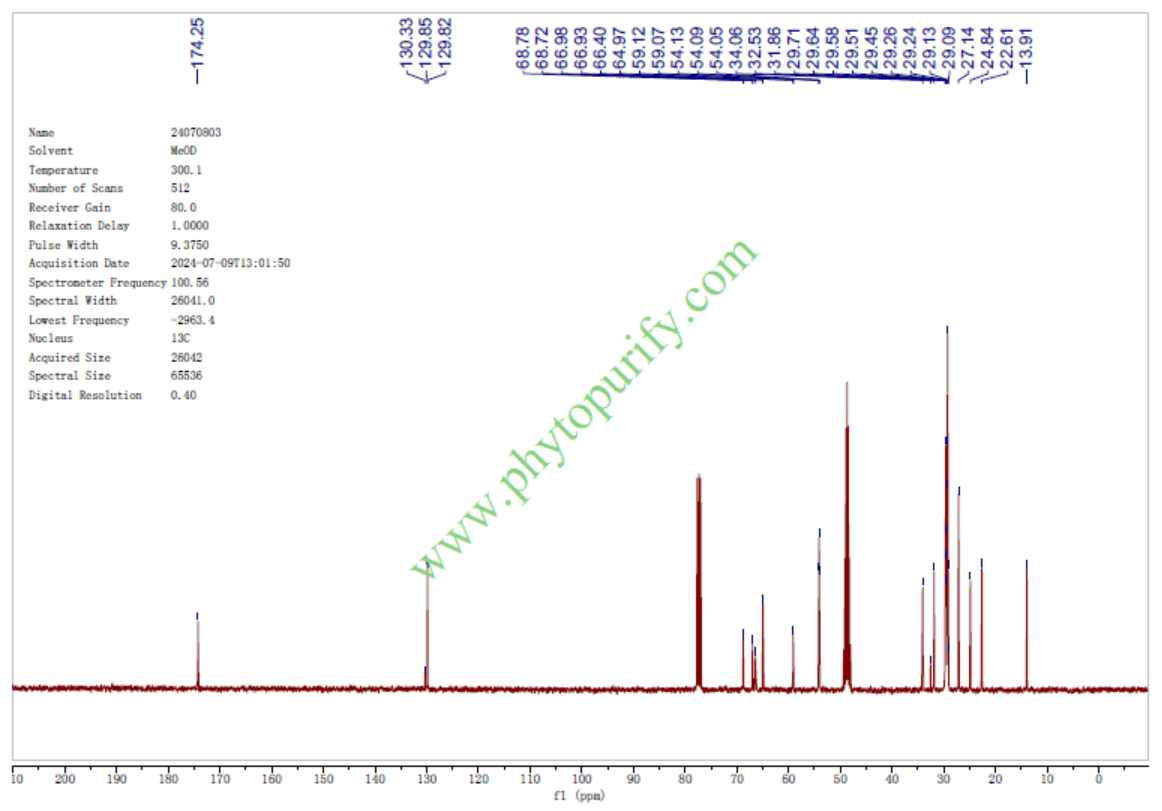
NMR of 1-erucoyl-sn-glycero-3-phosphocholine
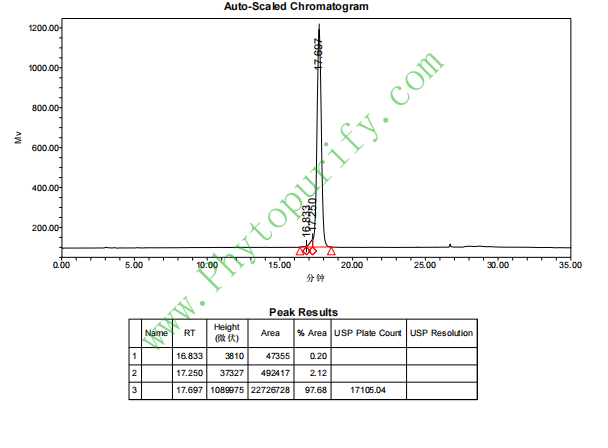
HPLC of 1-erucoyl-sn-glycero-3-phosphocholine
Storage conditions:Short-term storage at 2~8℃, long-term storage at -20 ~ -80℃
102.2900
3.8525
3.6344
.0583
.2778
.1305
Low
83.8535
3.9298
No
Yes
No
No
No
No
0.3
No
No
No
No
Lysophosphatidylcholine (LPC) is a type of glycerophospholipid molecule that contains only one fatty acid chain at the sn-1 or sn-2 position, and is an important intermediate product in cell membrane phospholipid metabolism. LPC not only exists as a product of phospholipase A2 (PLA2) or phospholipid cholesterol acyltransferase (LCAT) hydrolysis of membrane phospholipids, but also as a signaling molecule with a wide range of biological activities. Among numerous species of LPC molecules, 1-erucoyl-sn-glycero-3-phosphatidylcholine (hereafter referred to as 1-erucoy-LPC) has attracted attention due to its unique fatty acid composition - a rare docosaenoic acid (erucic acid, 22:1 (13Z)) is connected to the sn-1 position. Its CAS number is 503271-85-0, molecular formula is C ∝₀ H ₆₀ NO ₇ P, and molecular weight is 578.7920.
Erucic acid (22:1n-9) is a long-chain monounsaturated fatty acid mainly found in the seed oil of cruciferous plants such as rapeseed and mustard seeds. For a long time, erucic acid has been strictly regulated due to its cardiac toxicity (myocardial fat deposition) observed in animal experiments, especially in infant formula where its content is strictly limited. However, as research deepens, it has been discovered that erucic acid and its derivatives, especially erucic acid compounds in phospholipid form, may have unique physiological functions. 1-Amino-LPC, as an important form of erucic acid in the body, has biological significance far beyond being a carrier of fatty acids. It may be involved in regulating cell membrane fluidity, immune response, and lipid mediated signal transduction processes.
In recent years, with the rapid development of lipidomics technology, precise quantification and functional research of specific LPC molecular species have become possible. The presence of 1-keto-LPC in plasma, tissues, and certain plants has been reported one after another, and its correlation with metabolic diseases, inflammatory reactions, and nervous system function has gradually emerged. However, compared to common LPCs (such as those containing palmitic acid, oleic acid, or linoleic acid), systematic research on 1-butanoyl LPC is still relatively scarce, and its pharmacological activity spectrum, mechanism of action, and potential for drug development still need to be further explored. The purpose of this article is to systematically review the chemical properties, sources, pharmacological activities, mechanisms of action, and pharmacological evaluation of 1-mustard phosphatidylcholine, in order to provide comprehensive references for the subsequent research and development of this natural product.
The chemical structure of 1-monocresyl phosphatidylcholine exhibits typical lysophosphatidylcholine characteristics. Its skeleton is sn-glycero-3-phosphocholine, which is connected to an erucic acid chain (13Z-docosaenoic acid) through an ester bond at the sn-1 position, while the sn-2 position is a free hydroxyl group. This structure endows it with amphiphilicity: the polar head (phosphocholine group) gives it hydrophilicity, while the long-chain hydrophobic tail (mustard acyl group) gives it lipophilicity. The length of 22 carbon atoms in the erucic acid chain and a single cis double bond (located at position Δ 13) give it a higher melting point and a specific spatial conformation, which differs significantly from other common LPCs (such as C16:0 or C18:1) in terms of membrane physical properties.
From the perspective of physicochemical properties, the molecular weight of 1-keto-LPC is 578.7920 Da, which belongs to the category of medium-sized lipid molecules. The LogP of its lipid water partition coefficient is 3.8525, indicating that the compound has strong lipophilicity and tends to distribute in the lipid bilayer or bind to lipoproteins. The topological polar surface area (TPSA) is 102.2900 Å ², which is mainly contributed by the phosphocholine group, indicating that it has a certain solubility in water environment, but overall it is still mainly lipophilic. The calculated water solubility is 0.0583 mg/mL, which belongs to the category of insoluble in water. In practical applications, this requires the use of co solvents such as cyclodextrin, liposomes, or organic solvents for preparation.
In terms of stability, the sn-2 free hydroxyl group of 1-keto-LPC makes it sensitive to oxidation and enzymatic hydrolysis, especially hemolytic phospholipase. The unsaturated double bond (13Z) it contains also makes it susceptible to free radical attacks and lipid peroxidation. When storing, it is usually recommended to protect with an inert gas (such as nitrogen or argon) at a temperature of -20 ° C or lower, avoiding exposure to light and repeated freeze-thaw cycles. In addition, the compound may undergo ester hydrolysis under acidic or alkaline conditions, producing glycerophosphocholine and free erucic acid. It is worth noting that its blood-brain barrier (BBB) penetration has been evaluated as "low", mainly due to its large molecular weight and polar head groups, which limit its ability to cross the BBB through passive diffusion. However, it is currently unclear whether there is a specific transporter protein mediating its entry into the brain.
1-Monocresyl phosphatidylcholine is not a widely present phospholipid, and its source is closely related to the distribution of erucic acid. Mustard acid is a characteristic fatty acid in seed oil of Brassicaceae plants. Therefore, plant oils rich in erucic acid, such as traditional rapeseed oil (high erucic acid variety), mustard oil, Crambe Abyssinica, etc., are the most direct potential sources of 1-erucic acid LPC. In the seeds of these plants, erucic acid is mainly stored in the form of triglycerides (TAG), but the phospholipid components also contain a considerable proportion of erucic phospholipids, including phosphatidylcholine (PC) and lysophosphatidylcholine (LPC).
In addition to plant seeds, 1-keto-LPC may also be produced through metabolism in animal bodies. For example, when animals ingest triacylglycerol containing erucic acid, it can be digested and absorbed, and erucic acid can be integrated into phospholipids in the liver and plasma. Subsequently, through the hydrolysis of phospholipase A2 (PLA2), the fatty acid at the sn-2 position is cleaved, resulting in the formation of LPC with the sn-1 position as the mustard acyl group. Therefore, certain animal tissues (such as plasma, liver) or body fluids under specific conditions (such as inflammation, lipid metabolism disorders) may also contain 1-keto-LPC. However, as a natural product research, plant sources are still the main way to obtain this compound.
The extraction of 1-keto-LPC usually follows the classical lipid extraction and separation process. Firstly, the Folch method or Bligh Dyer method was used to extract total lipids from plant seeds or tissues using a chloroform methanol water (2:1:1, v/v/v) system. After rotary evaporation concentration, the extract is preliminarily separated by solid-phase extraction (SPE) or thin layer chromatography (TLC). For example, by using a silica gel SPE column and sequentially washing with chloroform, acetone, and methanol, neutral lipids, glycolipids, and phospholipids components can be obtained, respectively. The phospholipid components are further purified by preparative TLC or high-performance liquid chromatography (HPLC). For the separation of 1-keto-LPC, normal phase HPLC (NP-HPLC) or hydrophilic interaction chromatography (HILIC) is commonly used, using acetonitrile water or hexane isopropanol water mobile phases containing ammonia or ammonium formate, and separating according to the polarity difference of phospholipids. Due to the strong polarity of LPC, its retention time is usually later than that of PC and PE. Finally, the purified product was structurally confirmed by mass spectrometry (MS) or tandem mass spectrometry (MS/MS), confirming that its sn-1 position is erucic acid (m/z 339.3 [M-H] ⁻ corresponds to erucic acid anion), and its sn-2 position is hydroxyl.
Although the research history of 1-keto-LPC is not long, some studies have revealed its potential pharmacological activity, mainly focusing on the following aspects:
Anti inflammatory and immune regulatory activity LPC is commonly regarded as a pro-inflammatory mediator that can activate various immune cells. However, LPC with different acyl chain lengths exhibit vastly different activities. There are studies indicating that long-chain monounsaturated LPC (such as 1-keto-LPC) may have anti-inflammatory properties. In vitro experiments showed that 1-keto-LPC can inhibit the release of tumor necrosis factor - α (TNF - α) and interleukin-6 (IL-6) from macrophages stimulated by lipopolysaccharide (LPS), while promoting the secretion of anti-inflammatory cytokine IL-10. This effect may be related to differential activation of G protein coupled receptors (GPCRs). In addition, it can also regulate the proliferation and differentiation of T cells, which may have potential intervention value for autoimmune diseases.
Metabolic regulation effect As an intermediate product of lipid metabolism, 1-keto-LPC may be involved in regulating energy homeostasis. In animal models, long-term intake of erucic acid can lead to myocardial lipid accumulation, but there is still controversy over whether erucic acid in the form of LPC has a similar effect. Some studies have found that 1-keto-LPC can activate peroxisome proliferator activated receptor alpha (PPAR alpha), thereby promoting fatty acid beta oxidation and possibly improving liver steatosis to some extent. However, it has also been reported that high concentrations of 1-myristoyl LPC may have toxic effects on pancreatic islet β cells by inducing ER stress and mitochondrial dysfunction, suggesting its double-edged sword effect in the pathogenesis of diabetes.
Neuroprotection and cognitive function Given that erucic acid is a precursor for the synthesis of neurogenic acid (24:1n-9), which is an important component of myelin sheaths, 1-erucic acid LPC may participate in the synthesis of sphingomyelin in the brain by providing erucic acid groups. Although it has low BBB penetration, 1-erudyl-LPC in plasma can enter the brain by binding to lipoproteins or through specific transporters such as MFSD2A. In Alzheimer's disease (AD) models, supplementation with erucic acid or phospholipids containing erucic acid groups has been observed to improve cognitive function and reduce β - amyloid deposition. 1-Amino-LPC, as a bioavailable form of erucic acid, may affect neurotransmitter release and synaptic plasticity by regulating membrane fluidity or acting as a signaling molecule.
Cardiovascular effects Traditionally, erucic acid has been considered harmful to the heart. But the impact of 1-keto-LPC on the cardiovascular system may be more complex. In endothelial cells, low concentrations of 1-keto-LPC can promote the production of nitric oxide (NO) and have vasodilatory effects; High concentrations may induce endothelial dysfunction and oxidative stress. In addition, it can also affect platelet aggregation and coagulation function, and its net effect depends on local concentration and microenvironment.
The molecular mechanism by which 1-keto-LPC exerts biological effects has not been fully elucidated, but existing evidence points to the following key targets and pathways:
G protein coupled receptor (GPCR)LPC is an endogenous ligand for various GPCRs, among which GPR4, GPR119, and G2A (GPR132) are the most extensively studied. LPC with different acyl chain lengths exhibit varying affinities and selectivity towards these receptors. 1-Amino-LPC may promote the secretion of glucagon like peptide-1 (GLP-1) and regulate blood glucose by activating GPR119 (mainly expressed in the intestine and pancreas). Meanwhile, it may also act as an antagonist or weak agonist of G2A, inhibiting the inflammatory response induced by oxidized LDL. The difference in receptor selectivity is the key to explaining its anti-inflammatory effect.
Nuclear receptor As mentioned earlier, 1-erucic acid LPC and its metabolite erucic acid can activate PPAR α. PPAR α is a key transcription factor that regulates fatty acid oxidation, lipid metabolism, and inflammatory response. Activation of PPAR α can upregulate the expression of genes such as carnitine palmitoyltransferase 1A (CPT1A), promote the entry of fatty acids into mitochondria for beta oxidation, and thus reduce lipid accumulation. In addition, activation of PPAR α can also inhibit the NF - κ B signaling pathway and exert anti-inflammatory effects.
Membrane fluidity and lipid rafts As an amphiphilic molecule, 1-keto-LPC can insert into the cell membrane and alter its physical properties. Its long-chain monounsaturated structure tends to disrupt the tight packing of lipid rafts, thereby affecting the localization and function of membrane proteins such as receptors and ion channels. For example, by disrupting the lipid raft where the T cell receptor (TCR) is located, 1-keto-LPC may inhibit T cell activation and exert immunosuppressive effects.
Intracellular signaling pathways 1-Amino-LPC can activate multiple kinase pathways in a non receptor dependent manner. For example, in vascular smooth muscle cells, it can activate the mitogen activated protein kinase (MAPK) pathway (such as ERK1/2 and p38), regulating cell proliferation and migration. In macrophages, it may induce calcium influx and reactive oxygen species (ROS) production by activating phospholipase C (PLC) and protein kinase C (PKC), thereby affecting cellular function.
Based on the provided pharmacological parameters, the pharmacological properties of 1-keto-LPC exhibit a clear double-edged sword characteristic.
Advantage:
- Low hERG inhibition risk The risk of hERG inhibition is' no ', indicating that the compound has a low risk of inducing QT interval prolongation in the heart, which is an important safety advantage.
- Ames test negative The Ames test result is 0.3 (usually considered negative if it is less than 0.5), indicating no significant mutagenicity and low risk of genetic toxicity.
- Clear natural sources As a natural phospholipid, it has relatively good biocompatibility and clear metabolic pathways.
challenge:
- Poor water solubility The water solubility is only 0.0583 mg/mL, which is a poorly soluble drug, severely limiting its oral bioavailability and the development of injectable formulations. Delivery systems such as liposomes, nanoemulsions, and cyclodextrin inclusion complexes are needed to improve their solubility and bioavailability.
- High lipophilicity and low BBB penetration LogP is 3.85, which is beneficial for membrane permeation but also makes it susceptible to binding to plasma proteins, potentially limiting its distribution volume. Low BBB penetration is a major barrier for indications that require action on the central nervous system, such as neurodegenerative diseases. It may be necessary to design prodrugs or utilize nanocarriers for brain targeted delivery.
- Metabolic instability The free hydroxyl group at the sn-2 position makes it easily hydrolyzed by hemolytic phospholipase D (autotaxin) or phospholipase A1 in plasma, producing glycerophosphocholine and free erucic acid. This rapid metabolism may result in a short half-life and difficulty in maintaining its efficacy. In addition, free erucic acid itself has potential cardiac toxicity, and the safety of its metabolites needs to be carefully evaluated.
Pharmacokinetic characteristics (speculated):
- absorb After oral administration, 1-keto-LPC may be absorbed in the small intestine, but the absorption rate is low. It may first be hydrolyzed into free erucic acid and glycerophosphocholine, and then absorbed in the form of free fatty acids, or transported through the lymphatic system in the form of chylomicrons.
- distribution After intravenous injection, it mainly binds to plasma albumin and lipoproteins (especially HDL and LDL) and distributes to organs rich in the reticuloendothelial system such as the liver, spleen, and lungs.
- Metabolism Mainly metabolized in the liver and plasma. The main metabolic pathways include: ① hydrolysis by hemolytic phospholipase to produce free erucic acid; ② Re esterification by acyltransferase to generate phosphatidylcholine (PC); ③ Mustard acid can further undergo beta oxidation or be extended to become neural acid.
- excretion Metabolites are mainly excreted through bile and urine.
Despite facing many challenges in drug development, the unique pharmacological activity spectrum of 1-keto-LPC provides possibilities for its application in specific disease fields.
Metabolic diseases: In view of its potential PPAR α activation and GLP-1 secretory effect, 1-sinamyl LPC or its stable analog may be developed as a candidate drug for the treatment of nonalcoholic fatty liver disease (NAFLD) or type 2 diabetes. The key is to solve the problems of metabolic instability and poor water solubility. For example, stable analogs with methylation or fluorination at the sn-2 position can be designed to resist enzymatic hydrolysis.
Inflammation and autoimmune diseases Its anti-inflammatory and immunomodulatory activities make it potentially applicable in diseases such as rheumatoid arthritis and inflammatory bowel disease (IBD). Local administration (such as enema, intra-articular injection) may be an effective strategy to avoid systemic toxicity and increase local drug concentration.
Neurodegenerative diseases Although BBB penetration is low, it is expected to deliver 1-keto-LPC into the brain through nanocarriers (such as liposomes targeting transferrin receptors) or intranasal administration. As a precursor of neural acids, it may have a repairing effect on myelin sheaths in demyelinating diseases such as multiple sclerosis (MS) or adrenal leukodystrophy (ALD).
Nutrition and functional foods Given its natural origin, 1-keto-LPC can be used as a dietary supplement to improve lipid metabolism or support neurological health. But strict dosage control is necessary to avoid the potential toxicity of free erucic acid. Developing specific vegetable oils rich in 1-keto-LPC, such as rapeseed modified through biotechnology, may be a safer path.
Future research directions:
- target validation Using gene knockout animal models and light affinity labeled probes, accurately identify the receptors and binding proteins that play the main functions of 1-keto-LPC in vivo.
- Study on Structure Activity Relationship The system compares the activity of LPC analogs with different chain lengths, saturation levels, and sn-2 modifications to provide guidance for drug design.
- Delivery system development Focus on developing oral and brain targeted delivery systems, such as phospholipid complexes, nano lipid carriers, and polymer micelles.
- toxicological evaluation Conduct long-term toxicity studies, especially for the toxicity of the heart, liver, and pancreas, to clarify their safety windows.
1-Monoacylphosphatidylcholine, as a structurally unique natural lysophosphatid, is in the early stages of transitioning from a "metabolic intermediate" to a "potential drug lead". It combines the signal molecular characteristics of traditional LPC with the metabolic characteristics of long-chain fatty acids in erucic acid, exhibiting multiple pharmacological activities such as anti-inflammatory, metabolic regulation, and neuroprotection. However, its poor water solubility, rapid in vivo metabolism, and potential toxicity (due to free erucic acid) constitute the main obstacles to its commercialization. Future research needs to focus on elucidating its precise molecular targets, optimizing its pharmacokinetic properties, and developing efficient targeted delivery systems. With the advancement of lipidomics and medicinal chemistry, 1-keto-LPC and its derivatives are expected to open up new application areas in the treatment of metabolic diseases, neurodegenerative diseases, and immune related diseases. In depth research on these "atypical" lipid molecules not only helps to understand lipid mediated physiological and pathological processes, but also provides new ideas for drug discovery of natural products.
