


Synonym name: 2,3-Dihydroxypropyl tetradecanoate; alpha-Monomyristin; Glycerol 1-myristate; 1-Myristoylglycerol; 1-O-Tetradecanoylglycerol
Catalogue No.: BP0032
Cas No.: 589-68-4
Formula: C17H34O4
Mol Weight: 302.455
Botanical Source: the fruit of Serenoa repens
Purity: 95%~99%
Analysis Method: HPLC-DAD or/and HPLC-ELSD
Identification Method: Mass, NMR
Packing: Brown vial or HDPE plastic bottle
Can be supplied from milligrams to grams.
For Reference Standard and R&D, Not for Human Use Directly.
Inquire for bulk scale.
HPLC of 1-Monomyristin
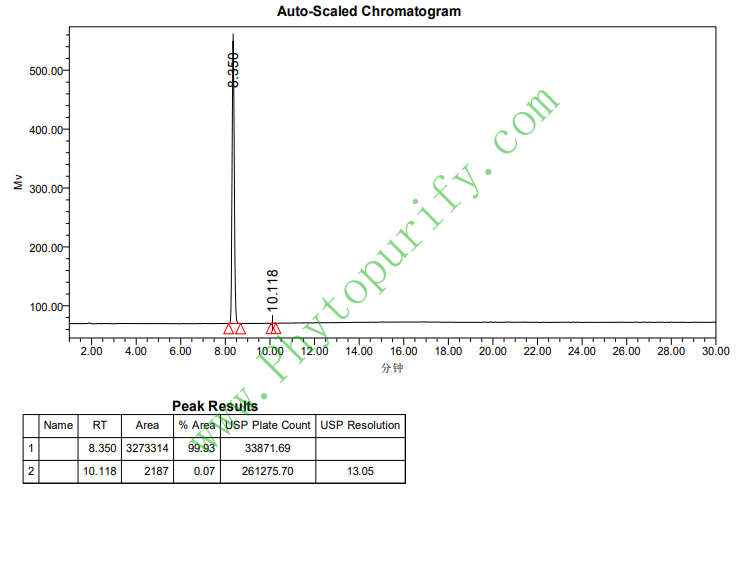
Storage conditions:Short-term storage at 2~8℃, long-term storage at -20 ~ -80℃
60.6900
4.5000
4.0000
Low
No
No
No
No
No
No
1-Monomyristin (CAS number 589-68-4), as a natural lipid compound, has received widespread attention in the field of natural product pharmacology in recent years. Its structure belongs to 1-monoglycerides, characterized by monoesters formed by esterification of glycerol skeleton with fourteen carbon saturated fatty acids (myristic acid). This compound was initially isolated from Serenoa repens and exhibits various biological activities, particularly in lipid metabolism regulation, antibacterial and antifungal properties, and neuroprotection, demonstrating potential pharmacological value. With the increase of incidence rate of metabolic diseases such as non-alcoholic fatty liver disease (NAFLD), 1-myristate monoglyceride has become a research hotspot because of its regulatory effect on related molecular targets.
This article aims to provide a systematic review of the chemical structure and physicochemical properties, plant sources and extraction methods, pharmacological activity and mechanism of action, pharmacological evaluation, and clinical application prospects of 1-myristic acid monoglyceride, aiming to provide scientific basis and theoretical support for the in-depth research and development of this compound.
The chemical structure of 1-myristic acid monoglyceride is formed by esterification of the 1-hydroxy group of a glycerol molecule with myristic acid (a fourteen carbon saturated fatty acid), with a molecular formula of C17H34O4 and a molecular weight of 302.45. Its structural features include:
In terms of physical and chemical properties, 1-myristic acid monoglyceride has good stability and is easily soluble in organic solvents such as ethanol and ethyl acetate, but has poor water solubility. The length of its fatty acid chains and the ester bonds of its glycerol backbone determine its affinity and metabolic stability in biofilms.
1-Myristic acid monoglycerides are mainly extracted from the fruit of Serenoa repens. Saw palm is a widely distributed palm plant in North America, traditionally used to treat prostate hyperplasia and urinary system diseases. Its lipid composition is rich, containing various monoglycerides and fatty acids.
Extraction methods typically include:
In recent years, supercritical CO2 extraction technology has also been applied to the extraction of lipid components from saw palm, which has the advantages of high efficiency and environmental protection, providing the possibility for the industrial production of 1-myristate monoglyceride.
The pharmacological activities of 1-myristic acid monoglyceride cover multiple aspects such as lipid metabolism regulation, antibacterial and antifungal effects, and neuroprotection.
Research has shown that 1-myristic acid monoglyceride can inhibit the hydrolysis of 2-oleoyl glycerol (IC50=32 μ M) and the activity of fatty acid amide hydrolase (FAAH) (IC50=18 μ M). FAAH is a degradation enzyme of endogenous fatty acid amide signaling molecules, involved in regulating neuroinflammation and metabolic homeostasis. Its inhibitory effect helps to increase endogenous levels of fatty acid amides, exerting anti-inflammatory and neuroprotective effects.
In addition, the compound has regulatory potential for non-alcoholic fatty liver disease (NAFLD) related targets such as AMPK, NFE2L2, NR1H4, etc., suggesting its potential value in improving liver lipid metabolism abnormalities, reducing liver inflammation, and oxidative stress.
1-Myristic acid monoglyceride exhibits significant inhibitory effects on various pathogenic microorganisms, especially against Staphylococcus aureus and Actinobacteria spp. It also shows antifungal activity against Candida albicans. Its mechanism of action may be related to the disruption of microbial cell membrane integrity and interference with lipid metabolism.
By inhibiting FAAH activity, 1-myristate monoglyceride can regulate the endogenous fatty acid amide signaling pathway, exerting neuroprotective and anti-inflammatory effects. Related studies have shown that it may alleviate neuroinflammation and pain responses, and has the potential to be developed as an adjuvant therapy for neurological diseases.
The pharmacological effects of 1-myristic acid monoglyceride involve multiple molecular targets and signaling pathways, mainly including:
In summary, 1-myristate monoglyceride regulates lipid metabolism, anti-inflammatory and antibacterial processes through multi target and multi pathway synergistic action, laying the foundation for its application in metabolic diseases and infectious diseases.
From the perspective of medicinal properties, 1-myristic acid monoglyceride exhibits excellent medicinal properties:
In terms of pharmacokinetics, there are few existing studies, suggesting that it has high lipid solubility and good oral absorption, but there may be first pass effects. The metabolic pathway may involve hepatic lipase mediated hydrolysis and β - oxidation metabolism. In the future, further systematic research is needed on its in vivo absorption, distribution, metabolism, and excretion (ADME) characteristics to guide clinical development.
1-Myristic acid monoglyceride, as a natural lipid compound, has broad clinical application potential due to its multi-target regulatory ability and good safety.
NAFLD, as a metabolic liver disease with rapidly rising incidence rate worldwide, lacks effective specific drugs. 1-Myristic acid monoglyceride improves liver lipid metabolism and oxidative stress by regulating key targets such as AMPK, Nrf2, and FXR, demonstrating potential for treating NAFLD. In the future, animal models and clinical trials can be combined to verify its efficacy and safety.
In the face of antibiotic resistance, it is particularly important to develop new natural antimicrobial agents. The inhibitory effect of 1-myristic acid monoglyceride on Staphylococcus aureus, actinomycetes and Candida albicans suggests that it can be used as an adjuvant anti infective drug or for the treatment of local infections.
Inhibiting FAAH activity makes it promising for application in neurological diseases, chronic pain, and inflammatory diseases. In the future, its mechanism of action and clinical value in neurodegenerative diseases and neuroinflammation can be explored.
Based on its physical and chemical properties, 1-myristic acid monoglyceride is suitable for developing novel drug delivery systems such as liposomes and nanoparticles to improve bioavailability and targeting. Meanwhile, the optimization of green extraction technology and synthesis methods will promote its large-scale production and clinical application.
As a natural monoglyceride with multiple biological activities, 1-myristic acid monoglyceride has shown extensive potential for applications in lipid metabolism regulation, antibacterial and antifungal properties, and neuroprotection. Its mechanism of action involves multi target coordinated regulation, with good safety and excellent drug preparation, which provides a new idea for the treatment of metabolic diseases and infectious diseases.
Future research should focus on the systematic elucidation of its pharmacokinetic characteristics, in-depth analysis of its mechanism of action, and development of drug formulations based on clinical needs. Through interdisciplinary integration, 1-myristic acid monoglyceride is expected to become an important drug candidate molecule in the field of natural product pharmacology, promoting the application and development of natural lipid compounds in modern medicine.
