
| Catalog No | Package | Original Price | Price | Inventory | Quantity | Operating |
|---|---|---|---|---|---|---|
| BP0569-100mg | 100mg | $30.00 | Sign in |
|


Synonym name: 4-Allyl-2-methoxyphenol; 5-Allylguaiacol
Catalogue No.: BP0569
Cas No.: 97-53-0
Formula: C10H12O2
Mol Weight: 164.204
Botanical Source: Very widespread occurrence in essential oils. Major component of clove oil Eugenia caryophyllata (up to 95% of content of clove leaf oil). First clove oil in 1826. Also found in those of Cinnamomum spp., Cistus spp., Camellia spp., Pelargonium
Purity: 95%~99%
Analysis Method: HPLC-DAD or/and HPLC-ELSD
Identification Method: Mass, NMR
Packing: Brown vial or HDPE plastic bottle
Can be supplied from milligrams to grams.
For Reference Standard and R&D, Not for Human Use Directly.
Inquire for bulk scale.
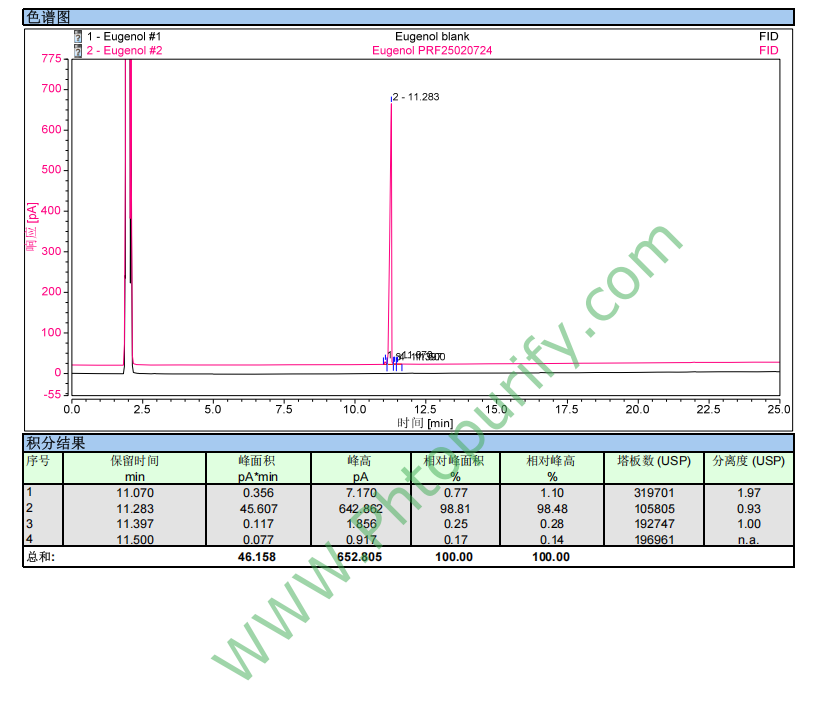
HPLC of Eugenol
Storage conditions:Short-term storage at 2~8℃, long-term storage at -20 ~ -80℃
Eugenol (CAS number: 97-53-0), as an important natural product, mainly exists in the essential oil of Syringa aromatica and is its main active ingredient. Since ancient times, eugenol has been widely used in traditional medicine, especially in the field of dentistry, due to its significant antibacterial, analgesic, and antioxidant properties. In recent years, with the development of natural product pharmacology, the multiple biological activities and molecular mechanisms of eugenol have been extensively studied, demonstrating its potential value in the prevention and treatment of various diseases such as oral infections, inflammation, and tumors. This article aims to provide a systematic review of the chemical structure and physicochemical properties, plant sources and extraction methods, pharmacological activity and mechanism of action, pharmacological evaluation, and clinical application prospects of eugenol. It is expected to provide theoretical basis and research direction for the development of natural product drugs.
Eugenol is a typical phenylpropanoid compound with the chemical formula C10H12O2 and a molecular weight of 164.2040. Its structural feature is that on the skeleton of guaiacol (4-hydroxybenzyl alcohol), the hydroxyl position is replaced by an allyl chain, and the specific structure is 4-allyl-2-methoxyphenol. This structure endows eugenol with unique chemical and biological activity.
In terms of physical and chemical properties, eugenol exhibits moderate lipid solubility with a LogP value of approximately 2.4613, indicating its good cell membrane penetration ability. The polar surface area (TPSA) is 29.46 Å ², indicating that its molecular polarity is low and conducive to the penetration of the blood-brain barrier. Experimental data also shows that it has a high blood-brain barrier penetration ability. Low water solubility (0.8696) limits its solubility in aqueous phase, but its volatility and oil solubility make it suitable for preparing volatile oil-based drugs. In terms of safety, eugenol did not exhibit hERG channel inhibitory activity, and the Ames test result was 0.6, indicating low mutagenicity and good safety basis.
Eugenol mainly exists in the flower buds, leaves and branches of clove plants, and the content of dried clove flower buds is the highest, accounting for 70% -90% of the total amount of clove essential oil. Lilac plants are widely distributed in tropical and subtropical regions, especially in India, Indonesia, and Madagascar where lilac production is abundant.
The traditional methods for extracting eugenol mainly include steam distillation and solvent extraction. Steam distillation is commonly used in industrial scale clove essential oil extraction due to its simple operation and low cost, but it is easy to cause degradation of some heat sensitive components. Solvent extraction methods (such as ethanol, ethyl acetate, and other organic solvents) can effectively preserve the active ingredients of eugenol, but there is a risk of solvent residue. In recent years, supercritical CO2 extraction technology has gradually become a research hotspot for the extraction of eugenol due to its advantages of green environmental protection, strong selectivity, and no solvent residue. In addition, microwave-assisted extraction and ultrasound assisted extraction technologies have also been developed to improve extraction efficiency and purity.
After extraction, eugenol is usually separated, purified, and its content determined by chromatographic techniques such as gas chromatography-mass spectrometry (GC-MS) and high-performance liquid chromatography (HPLC) to ensure its medicinal quality.
The pharmacological activities of eugenol are extensive and diverse, covering multiple aspects such as antibacterial, anti-inflammatory, analgesic, antioxidant, anti-tumor, and deworming.
Eugenol exhibits significant inhibitory effects on various Gram positive and Gram negative bacteria, particularly against oral pathogenic bacteria such as Streptococcus mutans, Staphylococcus aureus, and Porphyromonas gingivalis. Its mechanism of action mainly includes disrupting the integrity of bacterial cell membranes, interfering with cell metabolism and protein synthesis, leading to bacterial death. Eugenol can also inhibit the formation of bacterial biofilms, reduce bacterial resistance and pathogenicity.
Eugenol exerts anti-inflammatory effects by inhibiting the production and release of inflammatory mediators. Research has shown that eugenol can downregulate the expression of cyclooxygenase-2 (COX-2, PTGS2), reduce the synthesis of prostaglandin E2 (PGE2), and alleviate inflammatory reactions. Its analgesic effect is closely related to inhibiting the release of neurotransmitters and blocking pain transmission pathways, and is widely used as an adjuvant therapy for toothache and pulpitis in clinical practice.
Eugenol has strong free radical scavenging ability, which can effectively inhibit lipid peroxidation reaction and protect cells from oxidative damage. Its antioxidant mechanism includes direct capture of reactive oxygen species (ROS), regulation of endogenous antioxidant enzyme activity (such as superoxide dismutase (SOD), glutathione peroxidase (GPx)), and inhibition of oxidative stress-related signaling pathways.
In recent years, eugenol has shown potential in inhibiting tumor cell proliferation, inducing apoptosis, and inhibiting metastasis in various tumor models. Its anti-tumor mechanism involves regulating cell cycle proteins, activating mitochondrial apoptosis pathways, inhibiting NF - κ B signaling pathways, and regulating the inflammatory microenvironment, demonstrating its potential as an adjuvant anticancer drug.
Eugenol also exhibits various biological activities such as deworming, antiviral, and immune regulation, enriching its pharmacological value.
The multi-target mechanism of action of eugenol is the basis for its broad pharmacological activity. For oral infection related diseases, eugenol mainly acts on the following key targets:
In addition, the antioxidant effect of eugenol is also related to its regulation of intracellular redox balance, involving multiple signaling pathways such as Nrf2/ARE.
Eugenol has good medicinal properties. Its molecular weight is moderate, with moderate lipid solubility and polarity, which is beneficial for the absorption and distribution of drugs in the body. The high blood-brain barrier permeability makes it potentially applicable in central nervous system diseases. Low mutagenicity and no hERG inhibitory effect suggest good safety.
Pharmacokinetic studies have shown that eugenol is rapidly absorbed after oral administration, with a rapid peak in plasma concentration and widespread distribution in the body. It is mainly metabolized by the liver, and metabolites are mainly excreted through urine. Its half-life is moderate and suitable for multiple administrations to maintain efficacy. The volatile and lipophilic characteristics make it excellent in local administration (such as oral topical application).
However, the low water solubility of eugenol limits its oral bioavailability, and formulation optimization (such as nanocarriers, liposomes, etc.) is needed to enhance its efficacy and stability.
As a traditional natural medicine ingredient, eugenol has a long history of application in dentistry, especially in the adjuvant treatment of toothache, pulpitis, and oral infections. Modern research further confirms its multiple mechanisms of antibacterial, anti-inflammatory, and analgesic effects, providing scientific basis for its clinical promotion.
In the future, the clinical application of eugenol can be expanded to:
In addition, the safety and multi-target mechanism of action of eugenol make it an important candidate for natural drug development. However, clinical promotion still needs to address technical bottlenecks such as poor water solubility, low bioavailability, and dosage form stability. In the future, it is necessary to strengthen the pharmacokinetic research of eugenol, optimize the administration route, conduct more clinical trials, and verify its efficacy and safety.
As a widely sourced, structurally simple, and biologically active natural product, eugenol exhibits significant pharmacological effects such as antibacterial, anti-inflammatory, analgesic, and antioxidant properties. Its mechanism of action involves multiple molecular targets, which are particularly valuable in the prevention and treatment of oral infections and related diseases. The evaluation of drug properties shows that eugenol has good potential for drug development, but it still needs to overcome limitations such as water solubility and bioavailability. In the future, through modern pharmaceutical formulation technology and systematic clinical research, eugenol is expected to become a model in the development of natural product drugs, providing new ideas and strategies for the treatment of oral diseases and other related diseases.
