Introduction/Overview
Depression is a complex mental disorder characterized by sustained low mood and decreased interest, accompanied by cognitive and physiological impairments, and has become one of the leading causes of disability worldwide. Although traditional antidepressants, represented by selective serotonin reuptake inhibitors, are widely used in clinical practice, they generally suffer from delayed onset, limited efficacy, and significant side effects. Therefore, exploring candidate molecules with novel mechanisms of action and high efficiency and low toxicity from natural products has always been an important direction for the development of antidepressant drugs. Traditional Chinese Medicine Yuanzhi(Polygala tenuifolia Willd., as a traditional sedative and puzzle drug, has been extensively proven to have antidepressant activity by modern research. The saponins in Yuanzhi are considered to be the key material basis for its neuropsychiatric pharmacological effects. In recent years, with the advancement of separation and identification techniques, a series of structurally novel saponins from Polygala tenuifolia have been discovered one after another. Among them, Onjisaponin Z, due to its unique chemical structure and regulatory potential in various depression related targets and pathways, is gradually becoming a new focus of research on natural antidepressant components. This article aims to provide a systematic review of the chemical properties, plant sources, pharmacological activities, mechanisms of action, and medicinal properties of Yuanzhi saponin Z, in order to provide comprehensive scientific references for the in-depth research and development of this compound.
Chemical structure and physicochemical properties
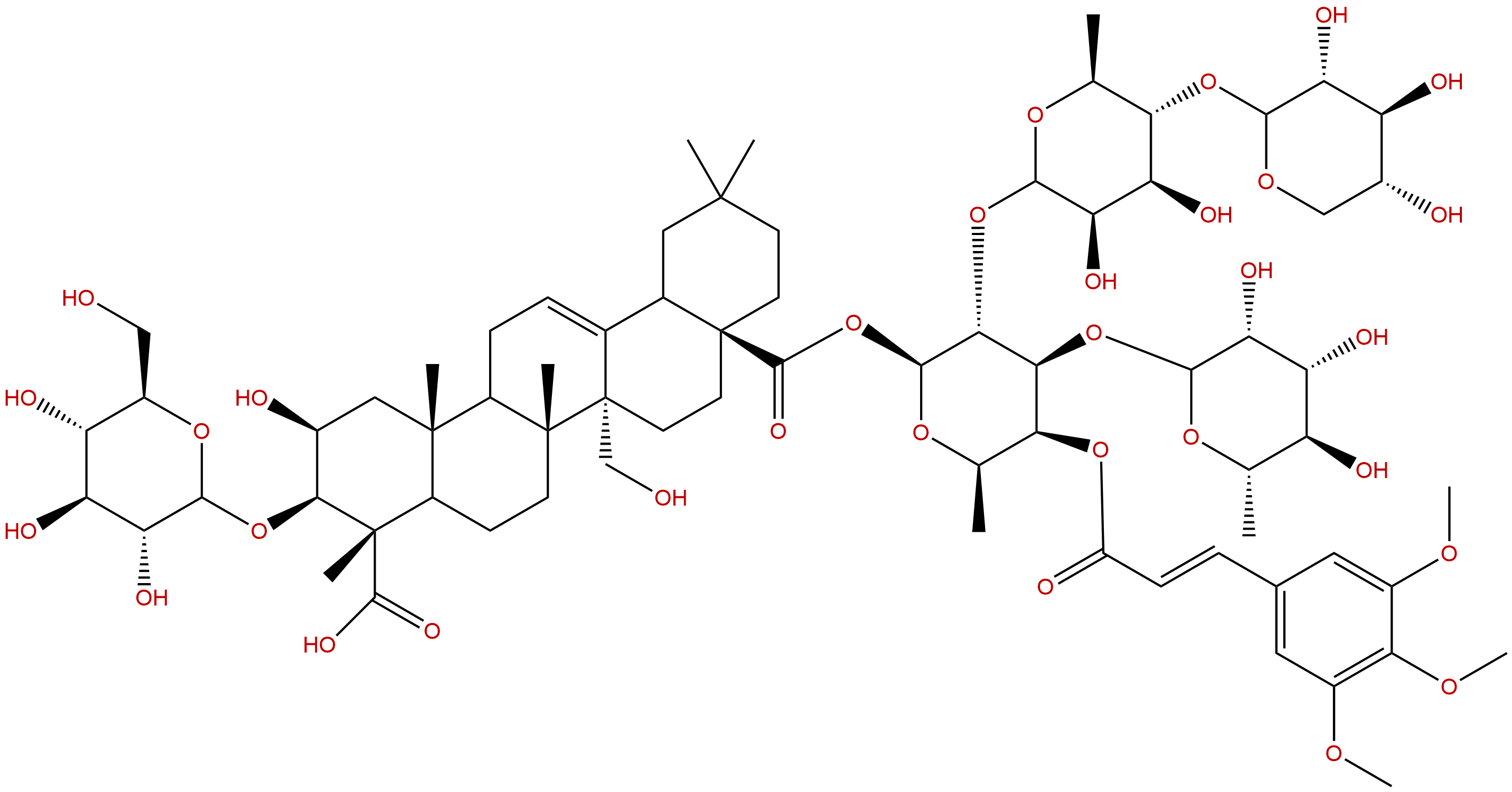
Yuanzhi saponin Z (CAS number: 1078708-72-1) is a triterpenoid saponin compound with a molecular weight of up to 1471.5970 Da. Its basic skeleton is a pentacyclic triterpenoid of the oleanane type, with a complex sugar chain structure that typically connects multiple sugar groups such as glucose, xylose, and xylose. The position and order of these sugar groups determine its unique biological activity and physicochemical properties. The complex glycosylation structure results in a high molecular polarity, with a theoretical topological polarity surface area of up to 483.8800 Å ². However, its calculated LogP value is approximately 2.0351, indicating a certain balance between hydrophilicity and lipophilicity of the molecule. However, its large molecular weight and significant polarity limit its overall water solubility, with a calculated value of approximately 0.2189 mg/mL. This "amphiphilic" characteristic is crucial for its interaction with biofilms and target proteins, but also poses challenges for its absorption and distribution within the organism. Especially, based on its physical and chemical parameters prediction, the ability of Yuanzhi saponin Z to penetrate the blood-brain barrier is relatively low, which may be one of the key bottlenecks that need to be overcome in its development as a central nervous system drug. In terms of preliminary safety evaluation, existing computational models predict that there is no significant risk of hERG potassium channel inhibition (predicted as "no"), and the Ames test predicts a value of 0.0, suggesting that it may not have direct genetic toxicity, which lays a preliminary safety foundation for its further development.
Plant sources and extraction methods
Yuanzhi saponin Z mainly comes from the traditional Chinese medicine Yuanzhi(Polygala tenuifolia Dry roots of Willd. Yuanzhi, as a plant in the Yuanzhi family, is rich in various active ingredients such as saponins, oligosaccharides, ketones, etc. in its roots. Yuanzhi saponin Z is one of the high molecular weight saponins with low content and complex structure, and its separation and identification rely on advanced chromatographic techniques.
The extraction process usually begins with the pretreatment (crushing) of the medicinal material of Yuanzhi root. Conventional extraction methods often use alcohol extraction (such as methanol, ethanol) or alcohol water mixed solvent extraction to fully extract saponins with a wide range of polarities. After obtaining the crude extract, it needs to go through a systematic separation and purification process. Large pore adsorption resin column chromatography is commonly used for initial enrichment to remove a large amount of impurities such as sugars and pigments. Subsequently, a combination of techniques including normal phase silica gel column chromatography, reverse phase silica gel column chromatography (such as ODS), and high-performance liquid chromatography were used for repeated separation. Given the large molecular weight and strong polarity of Yuanzhi saponin Z, semi preparative or preparative high-performance liquid chromatography is the key step in obtaining high-purity monomers, often using acetonitrile water or methanol water systems as mobile phases. In recent years, new separation technologies such as high-speed countercurrent chromatography have also provided more efficient choices for the preparation of such complex saponins. The isolated compounds need to be structurally confirmed through various spectroscopic methods such as nuclear magnetic resonance and mass spectrometry.
Pharmacological activity research
The pharmacological research of saponins Z from Polygala tenuifolia mainly focuses on its antidepressant and neuroprotective activities. Although direct research on this monomer is still in its infancy, the potential value can be revealed by combining its structural analogues and the study of total saponins from Polygala tenuifolia.
1. Antidepressant like activity Significant antidepressant effects have been observed in studies based on total saponins of Polygala tenuifolia or specific saponin components. Yuanzhi saponin Z, as one of its members, is speculated to exert antidepressant effects through multiple pathways such as regulating the monoamine neurotransmitter system, inhibiting neuroinflammation, and promoting the expression of neurotrophic factors. In animal behavior experiments (such as forced swimming experiments and tail suspension experiments), relevant extracts can effectively shorten the immobility time of mice and exhibit antidepressant like effects.
2. Neuroprotective effect The pathological and physiological processes of depression are closely related to neuronal damage and decreased synaptic plasticity. Research has shown that saponins from Polygala tenuifolia can counteract neuronal toxicity induced by β - amyloid and glutamate, and reduce cell apoptosis. Yuanzhi saponin Z may protect neurons from oxidative stress and inflammatory cytokine attacks through its antioxidant and anti-inflammatory properties.
3. Anti inflammatory and antioxidant properties Chronic low-grade inflammation is one of the important mechanisms of depression. Yuanzhi saponin Z has been predicted or preliminarily confirmed to regulate inflammatory core pathways such as NF - κ B, inhibit excessive activation of microglia, and reduce the production of pro-inflammatory cytokines such as interleukin-1 β and tumor necrosis factor - α. Meanwhile, by activating the Nrf2 antioxidant pathway and upregulating the expression of downstream antioxidant enzymes, the antioxidant defense ability of nerve cells is enhanced.
4. Improve cognitive function Yuanzhi is traditionally used for "puzzle solving", and modern research has also found that its saponin components can improve learning and memory disorders in various model animals. Yuanzhi saponin Z may improve cognitive impairment associated with depression by regulating the cholinergic system (such as α 7 nicotinic acetylcholine receptors), promoting neurogenesis and synaptic remodeling in the hippocampus.
Mechanism of action and molecular targets
The antidepressant effect of Yuanzhi saponin Z involves synergistic regulation of multiple targets and pathways, and its predicted and potential target network is as follows:
1. Regulation of monoamine neurotransmitter system Directly or indirectly inhibiting the activity of monoamine oxidase A, reducing the degradation of monoamine neurotransmitters such as serotonin and norepinephrine, thereby increasing the concentration of synaptic neurotransmitters, is one of the pathways of action of classic antidepressants.
2. Neuroendocrine and inflammatory immune axis regulation:
* Inhibition of indoleamine 2,3-dioxygenase 1 IDO1 is a key rate limiting enzyme for tryptophan metabolism along the canine urinary tract pathway, and its activation leads to the accumulation of neurotoxic metabolites and reduces serotonin synthesis. Inhibiting IDO1 can correct the imbalance of tryptophan metabolism, exert antidepressant and neuroprotective effects.
* Regulating the nuclear factor kappa B signaling pathway By inhibiting I κ B kinase or interacting with NF - κ B subunits such as RELA, the excessive activation of NF - κ B is suppressed, thereby downregulating the transcription of downstream pro-inflammatory cytokines and reducing neuroinflammation.
* Inhibit inflammasome activation It is possible to inhibit the activation of CASP1 (cysteine protease-1), block the maturation and release of IL-1 β and IL-18, and suppress the inflammatory response mediated by NLRP3 inflammasome.
3. Activation of oxidative stress defense system As a key regulatory factor of oxidative stress, the activation of Nrf2 is the core of the antioxidant effect of saponins Z from Polygala tenuifolia. Compounds may promote Nrf2 dissociation and nuclear translocation by modifying cysteine residues on Keap1, initiating transcription of antioxidant proteins such as HO-1 and NQO1, and enhancing cell resistance to oxidative damage.
4. Neuronutrition and regulation of cell survival pathways:
* Activate AMPK signal AMPK is a core sensor for cellular energy metabolism. Its activation can promote autophagy, improve mitochondrial function, and may exert neuroprotective and antidepressant effects by regulating downstream pathways such as mTOR.
* Regulating the MAPK/ERK pathway Extracellular signal regulated kinases are important pathways that regulate cell proliferation, differentiation, and survival. Yuanzhi saponin Z may promote the expression of neurotrophic factors such as BDNF by affecting the phosphorylation level of MAPK1, thereby supporting neuronal survival and synaptic plasticity.
5. Ionic channels and neurotransmitter receptor regulation:
* Adjust TRPV1 channel Transient receptor potential vanillic acid subtype 1 channel is involved in pain, depression, and neurogenic inflammation. Regulating its activity may affect glutamate release, neuropeptide metabolism, and participate in emotion regulation.
* Acting on α 7 nAChR The α 7 nicotinic acetylcholine receptor is closely related to cognitive function and anti-inflammatory effects. Exciting this receptor can quickly generate anti-inflammatory signals and improve cognition, which may be one of the mechanisms of its "intelligence enhancing" antidepressant effect.
6. Hormone receptor interaction The potential interaction with estrogen receptors suggests that saponins Z may be involved in regulating neuroendocrine functions related to emotions and cognition, especially in the pathophysiology of female depression.
Evaluation of drug properties and pharmacokinetics
The pharmacological evaluation of Yuanzhi saponin Z presents both opportunities and challenges.
Advantage aspects Although its molecular weight is large, calculating the LogP value suggests that it has a certain degree of lipid solubility, which may be beneficial for transmembrane transport. Most importantly, preliminary computer predictions did not show significant hERG channel inhibition risk and genotoxicity, providing important early positive signals for its safety development.
Main challenges:
1. Oral bioavailability The extremely high molecular weight and large TPSA severely limit its ability to passively diffuse across intestinal epithelial cells, indicating that its oral absorption may be poor. As a saponin component, it may be partially hydrolyzed by acids or enzymes in the gastrointestinal tract, or influenced by gut microbiota metabolism.
2. Blood-brain barrier permeability The prediction of "low" BBB permeability is the most severe challenge for it as a central nervous system drug. How to deliver sufficient amounts of drugs to brain targets is a core issue that must be addressed in the research and development process. The strategy may include developing prodrugs, using nano delivery systems, or exploring the possibility of indirectly exerting central effects by regulating the peripheral inflammation brain axis.
3. Pharmacokinetic properties Currently, there is a lack of detailed pharmacokinetic data for this monomer in vivo. Referring to similar saponins, it is expected that their distribution in the body may be widespread, but the elimination pathway and half-life are not yet clear. Whether it works as a prototype drug or metabolizes into active aglycones in the body, further research is needed.
4. Formulation development Due to its poor water and lipid solubility, developing suitable drug delivery formulations (such as solid dispersions, liposomes, micelles, etc.) to improve its solubility and stability is a necessary step in advancing its preclinical research.
Clinical application prospects and prospects
As a structurally novel natural product, the clinical application prospects of Yuanzhi saponin Z mainly depend on the depth of future research and breakthroughs in key technological bottlenecks.
1. As a novel multi-target antidepressant candidate drug It acts on multiple targets related to new mechanisms of depression, such as AMPK, IDO1, NF - κ B, Nrf2, providing a new chemical entity for the development of "multi-target" antidepressants with faster onset and fewer side effects. Especially suitable for depression subtypes with poor response to traditional monoamine drugs and significant inflammatory or oxidative stress characteristics.
2. Combination therapy and complementary therapy Given its unique mechanism of action, saponins Z or their main extracts from Yuanzhi are expected to be used in combination with existing antidepressants to enhance efficacy, reduce monotherapy dosage and side effects. Under the guidance of traditional Chinese medicine theory, developing it as one of the active ingredients in compound Chinese medicine is also an important direction that is in line with its source background.
3. Expand indications Its anti-inflammatory, antioxidant, and neuroprotective properties suggest that it has potential therapeutic value in neurodegenerative diseases such as Alzheimer's disease, Parkinson's disease, stroke, and neurodegenerative diseases, and is worth exploring.
4. Future research directions:
* In depth in vitro and in vivo pharmacological validation It is necessary to systematically evaluate the behavioral and pharmacological effects of pure Yuanzhi saponin Z on a more comprehensive animal model of depression, and clarify its dose-response relationship.
* Confirmation of the mechanism of action Using techniques such as gene knockout, specific inhibitors, molecular docking, and point mutations, verify their direct interactions and functional consequences with the predicted targets one by one.
* Pharmacokinetic and Metabolic Studies Conduct comprehensive ADME research to clarify its absorption, distribution, metabolism, excretion patterns, and main active metabolites.
* Development of a new delivery system Key research focuses on targeted delivery technology for BBB, such as designing nanocarriers based on receptor-mediated transport, which is the key to promoting its clinical application.
* structural optimization On the basis of clarifying its pharmacophore, reasonable structural modifications are made to improve its pharmacokinetic properties while retaining its activity, such as increasing BBB permeability.
Conclusion
Yuanzhi saponin Z is a high molecular weight triterpenoid saponin isolated from traditional Chinese medicine Yuanzhi. Its complex chemical structure carries great potential for multi-target regulation of depression related pathological networks. Current research predicts and preliminary evidence suggests that it can exert antidepressant and neuroprotective effects through various mechanisms such as regulating monoamine metabolism, inhibiting neuroinflammation, activating antioxidant defense, and regulating neurotrophic pathways. Despite facing significant challenges in terms of poor oral absorption and low blood-brain barrier permeability, its unique multi-target mechanism of action and good preliminary safety prediction make it a highly valuable lead compound for research. Future research needs to focus on confirming its pharmacological mechanism, elucidating its in vivo fate, and overcoming its delivery barriers through modern pharmaceutical and medicinal chemistry methods. With the gradual resolution of these key scientific issues, Yuanzhi Saponin Z is expected to provide new impetus and direction for the development of antidepressant drugs derived from traditional medicine.