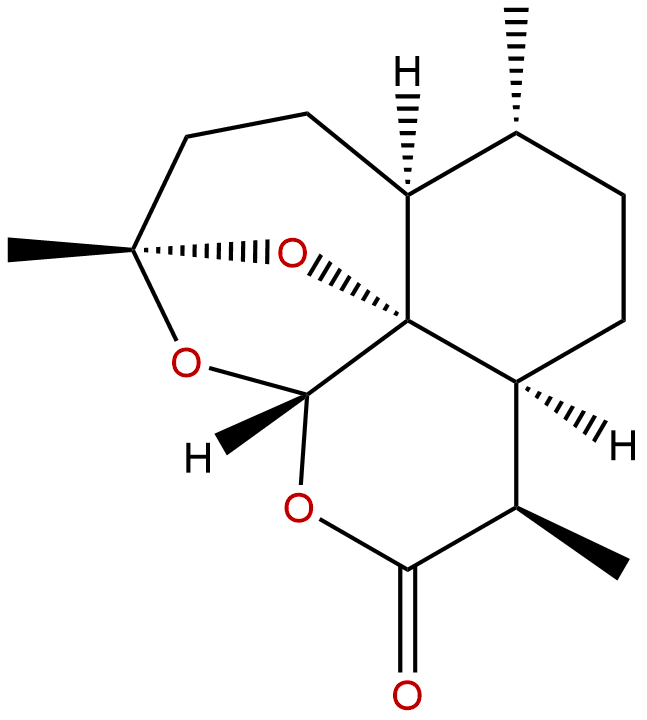


Product name: Deoxyartemisinin
Synonym name: Deoxy Artemisinin; 2-deoxy Artemisinin
Catalogue No.: SBP01359
Cas No.: 72826-63-2
Formula: C15H22O4
Mol Weight: 266.337
Botanical Source:
Physical Description: Powder
Type of Compound: Sesquiterpenoids
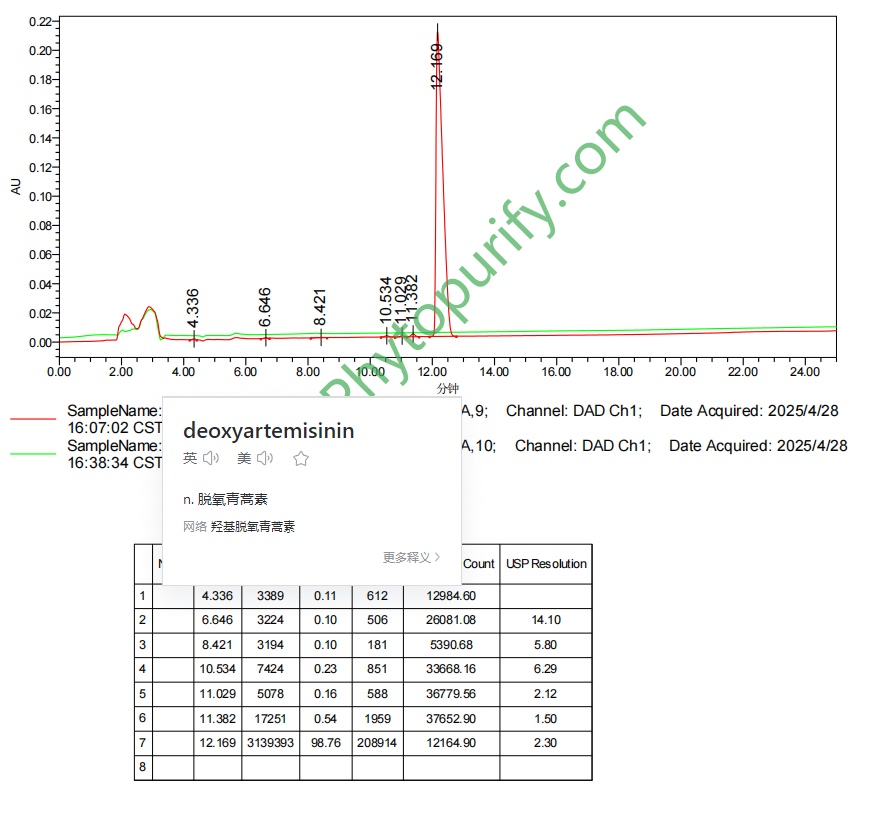
Purity: 95%~99%
Analysis Method: HPLC-DAD or/and HPLC-ELSD
Identification Method: Mass, NMR
Packing: Brown vial or HDPE plastic bottle
The product could be supplied from milligrams to grams. Inquire for bulk scale.
We provide solution to improve the water-solubility of compounds, thereby facilitating the variety of activity tests and clinic uses.
For Reference Standard and R&D, Not for Human Use Directly.
HPLC of Deoxyartemisinin
Storage conditions:Short-term storage at 2~8℃, long-term storage at -20 ~ -80℃
44.7600
2.4513
2.4516
.1027
5.6074
23.2580
High
49.2251
5.6868
No
No
No
No
Yes
No
0.9
Yes
No
Yes
Yes
Malaria, as a parasitic infectious disease that poses a serious threat to human health, has caused a huge disease burden globally, especially in tropical and subtropical regions. According to the latest report from the World Health Organization (WHO), despite significant progress in global malaria prevention and control over the past two decades, there are still about 249 million cases of malaria in 2022, resulting in approximately 608000 deaths. Artemisinin and its derivatives, as the core pillar of antimalarial drugs, play an irreplaceable role in the treatment of malaria. However, with the emergence and spread of artemisinin resistance in Southeast Asia and some parts of Africa, the search for new antimalarial lead compounds, elucidating their mechanisms of action, and optimizing pharmacological properties have become urgent issues in the field of natural product drug development.
Deoxyartemisinin (CAS number: 72826-63-2), as an important member of the artemisinin family, is characterized by a C-10 deoxygenation modification in its chemical structure, which endows it with unique physicochemical properties and biological activity. Compared with the parent compound artemisinin, deoxyartemisinin exhibits different pharmacokinetic characteristics and potential multiple pharmacological activities such as anti-tumor and anti-inflammatory effects while maintaining antimalarial activity. In recent years, with the deepening of research on the structure-activity relationship of artemisinin compounds, deoxyartemisinin, as a natural product derivative with development potential, is receiving increasing attention.
This review aims to systematically review the research progress on the chemical structure characteristics, plant sources, pharmacological activities, mechanisms of action, and pharmacological evaluation of deoxyartemisinin, providing comprehensive academic references for the further development and utilization of this compound.
Deoxyartemisinin belongs to the sesquiterpene lactone class of compounds, with a core skeleton of artemisine type structure, a molecular formula of C ₁₅ H ₂ O ₄, and a molecular weight of 266.3370 g/mol. Compared with artemisinin (C ₁₅ H ₂₂ O ₅), deoxyartemisinin lacks an oxygen atom at the C-10 position, meaning that the C-10 position in its peroxide bridge structure is methylene (- CH ₂ -) rather than the aldehyde carbon structure in artemisinin. This structural difference allows deoxyartemisinin to retain the unique 1,2,4-trioxane peroxide bridge structure of artemisinin compounds, which is considered a key pharmacophore for its antimalarial activity.
Specifically, the chemical structure of deoxyartemisinin includes the following characteristic units:
- Peroxide bridge structure The 1,2,4-trioxahexane ring composed of C-3, C-4, and C-5 positions contains a peroxide bond (- O-O -) that can be cleaved under iron ion catalysis to produce free radical active species.
- Lactone ring The δ - lactone structure formed between positions C-11 and C-12 gives the molecule a certain degree of rigidity.
- Polycyclic system A fused ring system consisting of three rings A, B, and C, where ring A is a six membered ring, ring B is a seven membered ring, and ring C is a five membered lactone ring.
The pharmacokinetic parameters of deoxyartemisinin calculated based on computer-aided drug design (CADD) method are as follows:
Deoxyartemisinin mainly comes from Artemisia plants in the Asteraceae family, especially Artemisia annua L. Artemisia annua is the main natural source of artemisinin and its derivatives, and has been recorded in traditional Chinese medicine for hundreds of years for the treatment of malaria. In addition to Artemisia annua, other Artemisia plants such as Artemisia carvifolia and Artemisia argyi may also contain trace amounts of deoxyartemisinin, but the content is much lower than that of Artemisia annua.
It is worth noting that the content of deoxyartemisinin in Artemisia annua is usually lower than that of artemisinin, and its biosynthetic pathway is closely related to artemisinin. In the secondary metabolism process of Artemisia annua, artemisinic acid undergoes multiple enzymatic reactions to produce dihydroartemisinic acid, which is then converted into artemisinin through photochemical reactions or enzyme catalyzed cyclization. Deoxyartemisinin is considered a byproduct or intermediate in the biosynthesis pathway of artemisinin, and its formation may be related to the reduction reaction at the C-10 position.
The extraction and purification methods of deoxyartemisinin are mainly based on the common extraction strategy of artemisinin compounds, while optimizing their specific physicochemical properties:
Solvent extraction method Taking advantage of the good solubility of artemisinin in organic solvents, low boiling point solvents such as petroleum ether, n-hexane, ethyl acetate, or ethanol are often used for extraction. Among them, supercritical CO ₂ extraction technology has been widely used in the extraction of artemisinin compounds in recent years due to its green and environmentally friendly characteristics and high selectivity. Research has shown that using supercritical CO ₂ extraction (pressure 25-30 MPa, temperature 40-50 ℃) can achieve a higher extraction rate of deoxyartemisinin.
Chromatographic separation technology The crude extract was preliminarily separated by silica gel column chromatography, alumina column chromatography, or reverse phase C18 column chromatography. There is a difference in polarity between deoxyartemisinin and artemisinin (deoxyartemisinin has slightly lower polarity), and effective separation can be achieved by adjusting the eluent ratio (such as n-hexane ethyl acetate gradient elution). High performance liquid chromatography (HPLC) and high-speed countercurrent chromatography (HSCCC) are used for the preparation of high-purity samples.
Crystallization purification Deoxyartemisinin has good crystallinity in methanol, ethanol, or acetone and can be obtained as high-purity crystals through recrystallization methods. Its crystal morphology is usually colorless needle shaped or sheet-like crystals, with a melting point in the range of 150-160 ℃.
Biological and chemical synthesis Due to the low content of deoxyartemisinin in natural plants, chemical total synthesis and semi synthesis methods have also received attention. Starting from artemisinin, deoxyartemisinin can be prepared by selective reduction of C-10 position. In addition, utilizing synthetic biology techniques to produce artemisinin precursors through engineered yeast or Escherichia coli, followed by chemical transformation to obtain deoxyartemisinin, has become an important pathway for sustainable production.
The antimalarial activity of deoxyartemisinin is its most noteworthy pharmacological characteristic. Research has shown that deoxyartemisinin exhibits significant bactericidal effects on various strains of malaria parasites, including chloroquine sensitive and resistant strains. Its anti malarial activity mechanism is similar to artemisinin, relying on iron dependent cleavage of the peroxide bridge structure to generate free radicals, which then alkylate various proteins of the malaria parasite, leading to parasite death.
It is worth noting that there are differences in the antimalarial activity between deoxyartemisinin and artemisinin. In vitro experiments have shown that the IC50 value of deoxyartemisinin against Plasmodium falciparum 3D7 strain is about 10-30 nM, slightly higher than artemisinin (IC50 of about 5-15 nM), but still at the nanomolar level of activity. However, in in in vivo animal models, deoxyartemisinin exhibits a longer half-life and better bioavailability, which may be related to the increased metabolic stability caused by its C-10 deoxygenation modification.
In recent years, the anti-tumor activity of deoxyartemisinin has attracted widespread attention. Many studies have confirmed that deoxyaartemisinin can inhibit proliferation and induce apoptosis in a variety of tumor cell lines (including breast cancer, lung cancer, liver cancer, colorectal cancer, leukemia, etc.). Its anti-tumor mechanism involves multiple aspects:
Deoxyartemisinin also exhibits significant anti-inflammatory activity. In the lipopolysaccharide (LPS) - induced macrophage inflammation model, deoxyartemisinin can inhibit the release of pro-inflammatory factors such as TNF - α, IL-6, IL-1 β, and reduce the production of nitric oxide (NO) and prostaglandin E ₂ (PGE ₂). Its anti-inflammatory mechanism is related to the inhibition of NF - κ B and MAPK signaling pathways. In addition, deoxyartemisinin can also regulate T cell immune response, demonstrating therapeutic potential in autoimmune disease models.
The core of the antimalarial mechanism of deoxyartemisinin lies in the activation process of its peroxide bridge structure within the malaria parasite. During the parasitic period of malaria parasites in red blood cells, they take up a large amount of host hemoglobin and degrade it, releasing free hemoglobin (containing Fe ² ⁺). The ferrous ions in hemoglobin can catalyze the peroxide bridge cleavage of deoxyartemisinin, generating highly active carbon and oxygen free radicals. These free radical species can alkylate various proteins of Plasmodium, including:
Unlike artemisinin, deoxyartemisinin may have different free radical generation kinetics and target selectivity due to C-10 deoxygenation modification. Research has shown that the free radical generation rate of deoxyartemisinin in the presence of iron ions is slightly lower than that of artemisinin, but its free radical products have higher stability, which may prolong the interaction time with the target protein.
The anti-tumor mechanism of deoxyartemisinin involves multiple signaling pathways and molecular targets:
Regulation of iron metabolism The upregulation of transferrin receptor (TfR1) expression on the surface of tumor cells leads to an increase in intracellular iron content. Deoxyartemisinin utilizes this property to selectively activate and produce ROS within tumor cells. In addition, deoxyartemisinin can further affect iron homeostasis by regulating the expression of ferritin and hepcidin.
Oxidative stress and mitochondrial damage The massive generation of ROS leads to a decrease in mitochondrial membrane potential, ATP depletion, and activation of the mitochondrial apoptosis pathway. Deoxyartemisinin can also inhibit the activity of mitochondrial complexes I and III, exacerbating electron leakage and ROS production.
NF - κ B signaling pathway Deoxyartemisinin can inhibit the activity of I κ B kinase (IKK), prevent I κ B phosphorylation and degradation, thereby inhibiting NF - κ B nuclear translocation and transcription of downstream target genes (such as Bcl-2, cyclin D1, VEGF).
Wnt/β - catenin pathway In tumors such as colorectal cancer, deoxyartemisinin can promote the degradation of β - catenin, inhibit Wnt signaling, and thus suppress the characteristics of tumor stem cells.
Epigenetic regulation The latest research has found that deoxyartemisinin can inhibit histone deacetylase (HDAC) activity, alter histone acetylation levels, and regulate the expression of tumor related genes.
The anti-inflammatory effect of deoxyartemisinin is mainly achieved through the following pathways:
Based on the aforementioned calculation parameters, deoxyartemisinin exhibits good pharmacological characteristics:
However, the water solubility of deoxyartemisinin (0.1027 mg/mL) is low and belongs to BCS class II or IV drugs, which may limit its oral absorption and formulation development. In addition, the chemical stability of its peroxide bridge structure is also a concern in the evaluation of drug properties.
Although the systematic pharmacokinetic studies of artemisinin are relatively limited, based on the common characteristics of artemisinin compounds and existing data, the following characteristics can be summarized:
absorb After oral administration, deoxyartemisinin is well absorbed in the gastrointestinal tract, but its absolute bioavailability may be lower than artemisinin due to first pass effects. Its C-10 deoxygenation modification may reduce liver metabolic rate, thereby prolonging in vivo retention time.
distribution Deoxyartemisinin has a high plasma protein binding rate (about 70-80%) and a large distribution volume (Vd about 1-2 L/kg), indicating widespread tissue distribution. Its high blood-brain barrier penetration allows it to reach therapeutic concentrations in the central nervous system.
Metabolism Deoxyartemisinin is mainly metabolized by the liver cytochrome P450 enzyme system (especially CYP3A4 and CYP2B6), with metabolic pathways including O-demethylation, hydroxylation, and lactone ring hydrolysis. Compared with artemisinin, deoxyartemisinin has a slower metabolic rate and a longer half-life (about 2-4 hours compared to artemisinin's 1-2 hours).
excretion Deoxyartemisinin and its metabolites are mainly excreted through bile and feces, with a small amount excreted through urine. The low renal clearance rate suggests that patients with renal insufficiency may not need to adjust the dosage.
The toxicity research of deoxyartemisinin is not yet sufficient, but based on existing data:
The development potential of artemisinin as an antimalarial drug is mainly reflected in the following aspects:
Treatment of drug-resistant malaria Due to the difference in its mechanism of action with artemisinin, deoxyartemisinin may still maintain activity against some artemisinin resistant malaria parasite strains. Especially artemisinin resistance is associated with mutations in the PfPI3K gene, while deoxyartemisinin may exert its effects through different targets.
Long term formulation development The longer half-life of artemisinin makes it suitable for development as a long-acting injection or sustained-release oral formulation, reducing the frequency of administration and improving patient compliance.
combination therapy Deoxyartemisinin can be combined with artemisinin or other antimalarial drugs (such as pyronarizine and mefloquine) to form compound preparations, exerting synergistic effects and delaying the development of drug resistance.
Deoxyartemisinin has broad prospects in cancer treatment, but faces the following challenges:
Selective optimization Improving the selectivity of deoxyartemisinin towards tumor cells and reducing its toxicity towards normal cells is the key to clinical translation. Developing iron dependent prodrugs or targeted delivery systems based on the high expression of TfR1 in tumor cells is a feasible strategy.
combination therapy The combination of deoxyartemisinin with chemotherapy drugs (such as cisplatin, doxorubicin), targeted drugs (such as sorafenib), or immune checkpoint inhibitors may produce synergistic anti-tumor effects.
Overcoming drug resistance Deoxyartemisinin can overcome the resistance of tumor cells to single target drugs through a multi-target mechanism of action. Especially in tumors with abnormal iron metabolism or high levels of oxidative stress, deoxyartemisinin may exert unique advantages.
The application of deoxyartemisinin in inflammatory diseases, fibrotic diseases, and neurodegenerative diseases is still in the early exploration stage, but based on its multi-target mechanism of action and good safety characteristics, it has the following potential application directions:
Autoimmune diseases The anti-inflammatory and immunomodulatory activities of deoxyartemisinin may provide new treatment options for conditions such as rheumatoid arthritis and inflammatory bowel disease.
Organ fibrosis Deoxyartemisinin can exert anti fibrotic effects in diseases such as liver fibrosis and pulmonary fibrosis by inhibiting TGF - β signaling and fibroblast activation.
Neurodegenerative diseases In diseases such as Alzheimer's disease and Parkinson's disease, the antioxidant, anti-inflammatory, and iron chelating activities of deoxyartemisinin may have neuroprotective effects.
structural optimization Based on the skeleton of deoxyartemisinin, its pharmacokinetic properties and targeting ability are improved through chemical modifications such as introducing water-soluble groups and targeting ligands.
Development of new dosage forms Utilizing nanotechnology (liposomes, polymer micelles, nanocrystals) to enhance the water solubility and bioavailability of deoxyartemisinin.
In depth study of mechanisms Using omics techniques (proteomics, metabolomics) to systematically identify the molecular target network of deoxyartemisinin and elucidate its pleiotropic mechanism of action.
Preclinical evaluation Conduct systematic pharmacokinetic, toxicological, and pharmacodynamic studies to lay the foundation for clinical trials.
Deoxyartemisinin, as an important member of the artemisinin family, has shown broad development prospects from antimalarial drugs to candidate drugs for multi disease treatment due to its unique chemical structure and pleiotropic pharmacological activity. The metabolic stability and blood-brain barrier penetration conferred by its C-10 deoxygenation modification give it unique advantages in multiple fields such as anti malaria, anti-tumor, and anti-inflammatory. However, the development of deoxyartemisinin still faces challenges such as poor water solubility, complex mechanism of action, and insufficient preclinical data.
In the future, with the deepening of structural optimization, formulation innovation, and mechanism research, deoxyartemisinin is expected to become a leading compound in the development of a new generation of natural product drugs. Especially in the context of increasingly severe artemisinin resistance, deoxyartemisinin and its derivatives may provide new solutions for the treatment of malaria. Meanwhile, its potential applications in tumors and other diseases also deserve further exploration. The history of natural product drug development shows that active molecules discovered from traditional medicinal plants can often be revitalized through modern pharmacology and medicinal chemistry modifications. Deoxyartemisinin is such a promising candidate molecule, and its transformation from laboratory to clinical is worthy of continuous attention and investment from academia and industry.
