


Synonym name:
Catalogue No.: BP1011
Cas No.: 80418-25-3
Formula: C41H70O13
Mol Weight: 770.998
Botanical Source: Panax notoginseng (San qi)
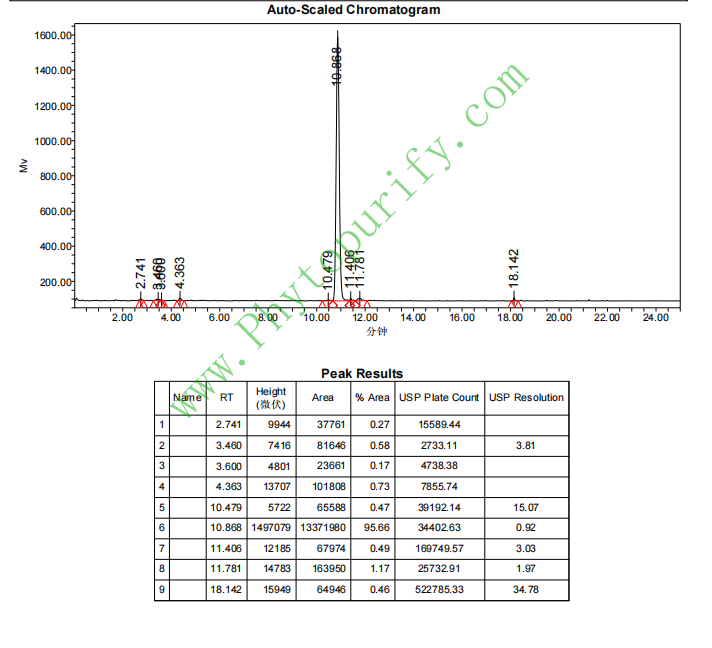
Purity: 95%~99%
Analysis Method: HPLC-DAD or/and HPLC-ELSD
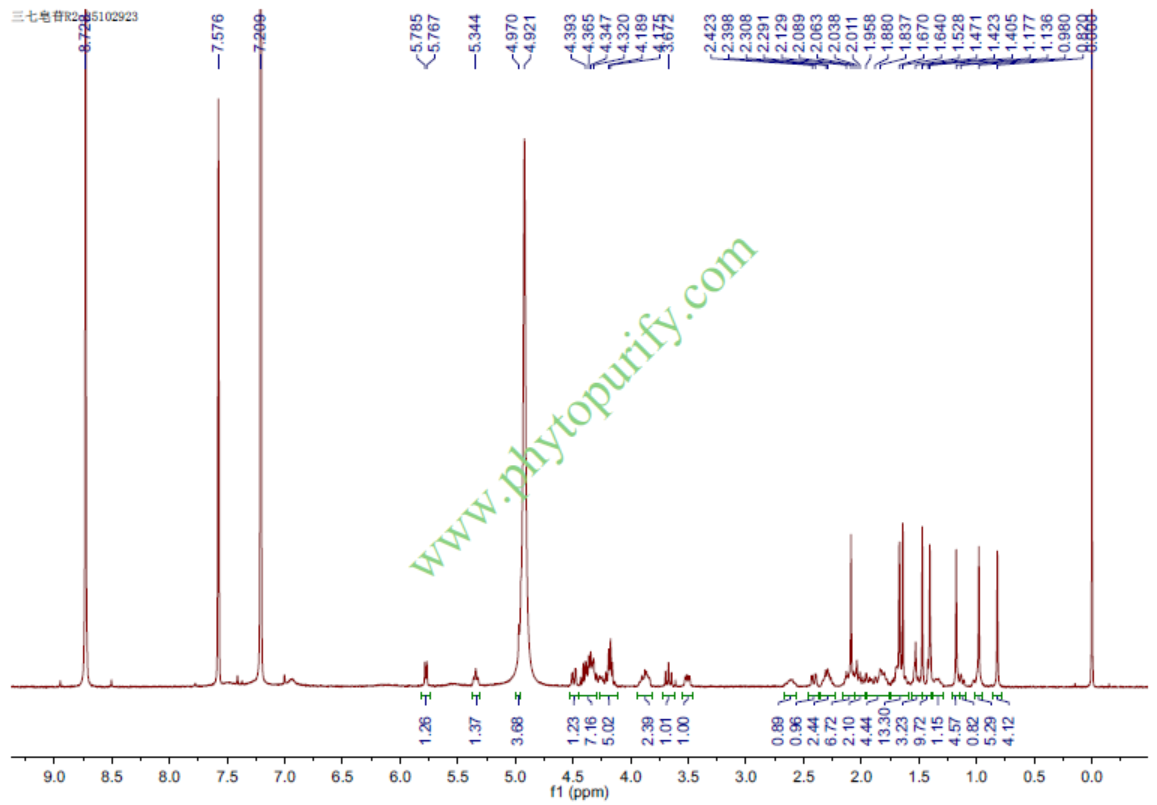
Identification Method: Mass, NMR
Packing: Brown vial or HDPE plastic bottle
Can be supplied from milligrams to grams.
For Reference Standard and R&D, Not for Human Use Directly.
Inquire for bulk scale.
HPLC of Notoginsenoside R2
HNMR of Notoginsenoside R2
Storage conditions:Short-term storage at 2~8℃, long-term storage at -20 ~ -80℃
Panax notoginseng, as a traditional Chinese medicinal herb, is widely used in the prevention and treatment of cardiovascular and cerebrovascular diseases due to its significant effects of promoting blood circulation, removing blood stasis, stopping bleeding, and anti-inflammatory. Sanqi saponins are the main active ingredients in Sanqi, with diverse pharmacological activities and good clinical application value. Notoginsenoside R2 (CAS number 80418-25-3), as one of the triterpenoid saponins, has received widespread attention in recent years due to its potential in cardiovascular protection. This article aims to systematically review the chemical structure, sources, pharmacological activity, mechanism of action, pharmacological evaluation, and clinical application prospects of Panax notoginseng saponin R2, providing theoretical basis for subsequent basic and clinical research.
Sanqi saponin R2 belongs to the natural triterpenoid saponin class, with a molecular formula of C42H70O13 and a molecular weight of 770.9980. Its structural core is the pentacyclic triterpenoid parent nucleus, which connects multiple sugar groups to form a typical saponin structure. In terms of physical and chemical properties, the LogP value of Sanqi saponin R2 is 2.7013, indicating that it has moderate lipid solubility and is beneficial for cell membrane penetration. The polar surface area (TPSA) is 218.99, indicating high molecular polarity and low water solubility (0.0463), which may affect its oral absorption and bioavailability. The low permeability of the blood-brain barrier suggests limited exposure of the central nervous system. The negative result of hERG channel inhibition experiment indicates a low risk of cardiac toxicity. The Ames mutagenicity test showed a value of 0.0, indicating a low risk of genotoxicity and good safety.
Sanqi saponin R2 mainly exists in the roots and rhizomes of Sanqi. Sanqi is a plant of the Panax genus in the Araliaceae family, mainly distributed in Yunnan, Guangxi and other places in China. Traditional extraction methods typically use ethanol or methanol as solvents to obtain crude extracts through reflux extraction or ultrasound assisted extraction. Subsequently, liquid-liquid distribution, silica gel column chromatography, reverse phase high performance liquid chromatography (RP-HPLC) and other techniques were used for separation and purification, ultimately obtaining high-purity Sanqi saponin R2. Modern extraction processes are continuously optimized, such as supercritical CO2 extraction and membrane separation technology, aiming to improve extraction efficiency and purity and reduce production costs.
Sanqi saponin R2 has shown significant cardiovascular protective effects in multiple in vitro and in vivo experiments. Its main pharmacological effects include:
In addition, Sanqi saponin R2 has shown potential in regulating lipid metabolism and improving myocardial energy metabolism, demonstrating its comprehensive therapeutic advantages of multi-target and multi mechanism.
The cardiovascular protective effect of Sanqi saponin R2 involves multiple molecular targets and signaling pathways, mainly including:
The synergistic regulation of these targets constitutes the molecular basis for the multidimensional protection of the cardiovascular system by Sanqi Saponin R2.
The pharmacological evaluation of Sanqi saponin R2 shows that it has good safety and potential medicinal value. Its molecular weight is relatively large, polarity is high, and water solubility is poor, which may limit oral bioavailability. This suggests the need to improve pharmacokinetic properties through formulation optimization or structural modification. The low permeability of the blood-brain barrier reduces the risk of central nervous system side effects. The hERG channel has no inhibitory effect, reducing the drug safety hazards of arrhythmia. The Ames test is negative, indicating no significant mutagenicity.
Pharmacokinetic studies have shown that the absorption of Sanqi saponin R2 is slow after oral administration, and it is widely distributed in the body. It is mainly metabolized through the liver and excreted through bile and urine. Its half-life is moderate and suitable for daily administration. Further research on in vivo metabolic pathways, drug interactions, and long-term toxicology is needed in the future to provide a basis for clinical development.
Based on the multi target and multi mechanism effects of Panax notoginseng saponin R2 in the field of cardiovascular protection, it has broad application prospects in the auxiliary treatment of coronary heart disease, myocardial ischemia, atherosclerosis, hypertension and other diseases. At present, Sanqi Saponin R2 is still in the basic and preclinical research stage, and future research needs to be strengthened in the following directions:
Overall, Sanqi saponin R2, as a natural triterpenoid saponin compound, has significant potential as a new type of cardiovascular drug due to its unique pharmacological activity and good safety.
Sanqi saponin R2, as an important active ingredient in Sanqi, has shown significant application value in the field of cardiovascular protection due to its multi-target regulation and multiple pharmacological effects. Its good safety and pharmacological characteristics lay the foundation for clinical translation. In the future, through in-depth mechanism research, pharmacokinetic optimization, and clinical validation, it is expected to promote the development of Sanqi Saponin R2 as a new natural medicine for the prevention and treatment of cardiovascular diseases. Continuous interdisciplinary collaboration and innovative research will accelerate its transition from the laboratory to clinical practice, benefiting a wide range of patients.
