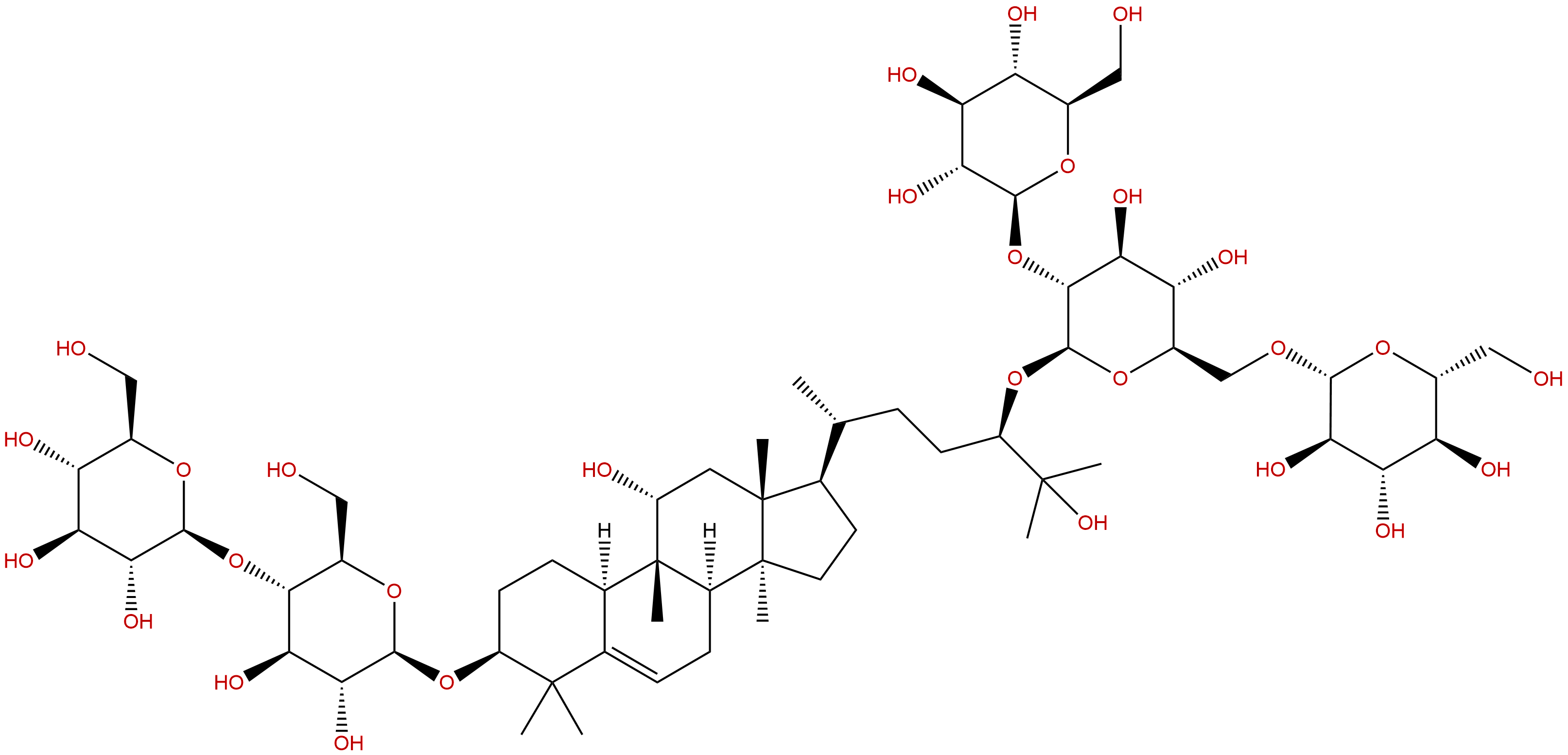


Product name: Isomogroside V
Synonym name:
Catalogue No.: BP3449
Cas No.: 1126032-65-2
Formula: C60H102O29
Mol Weight: 1287.45
Botanical Source: Momordica grosvenorii and Siraitia siamensis; Luohanguo
Physical Description: Powder
Type of Compound: Triterpenoids
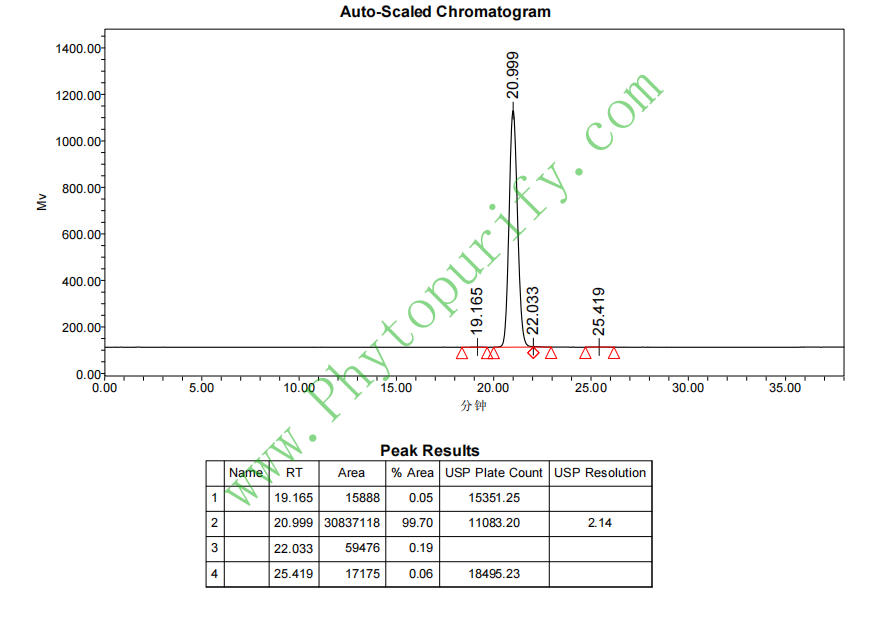
Purity: 95%~99%
Analysis Method: HPLC-DAD or/and HPLC-ELSD
Identification Method: Mass, NMR
Packing: Brown vial or HDPE plastic bottle
The product could be supplied from milligrams to grams. Inquire for bulk scale.
We provide solution to improve the water-solubility of compounds, thereby facilitating the variety of activity tests and clinic uses.
For Reference Standard and R&D, Not for Human Use Directly.
HPLC of Isomogroside V
Storage conditions:Short-term storage at 2~8℃, long-term storage at -20 ~ -80℃
476.6700
.9963
.9958
.8245
.4071
.4215
Low
66.6593
7.5134
No
No
No
No
No
No
0.0
Yes
No
No
Yes
Isomogroside V (CAS No. 1126032-65-2) is a traditional medicinal plant monk fruit(Siraitia grosvenorii)The triterpenoid saponins of cucurbitacin extracted by middle separation. As a member of Siraitia grosvenorii glycoside family, it not only has great potential High sweetness, low calorie natural sweetener Due to its unique chemical structure, it exhibits significant Pharmacological activity Especially in anti-diabetic The field has received widespread attention from researchers. Its English name "Isomogroside V" reveals its structural similarity with the known sweet ingredient mogroside V. The prefix "Iso -" usually indicates that it is an isomer, which may be different in the glycosyl linkage sites or configurations.
From the perspective of research background, as the global prevalence of diabetes continues to rise and consumers' demand for health and natural food additives increases, finding safe and effective natural anti diabetes drugs and sugar substitutes has become a hot spot. As a unique dual-use resource of medicine and food in China, the research on sweet ingredients of Siraitia grosvenorii has gone from the initial application in food industry to the exploration of pharmacological mechanism and pharmaceutical properties. The discovery of isomogroside V marks that the understanding of the active ingredients of Siraitia grosvenorii has entered a more refined level. The existing database describes and classifies it as a momordica grosvenorii glycoside and β - D-glucoside, and defines its Plant metabolites The role. However, target prediction analysis suggests that it has potential interactions with multiple diabetes related targets (such as GCK, PPARG, INS, etc.), pointing to the biological activity beyond the function of simple sweeteners, which provides a scientific basis for the development of "functional sweeteners" or new anti diabetes lead compounds with both flavor and therapeutic functions.
The molecular formula of isorhamoside V is C60H102O29, with a molecular weight of up to 1287.4500 g/mol Such a large molecular weight is among the largest in natural products, mainly due to its complex glycosylation structure. From the SMILES string, its basic skeleton can be parsed:Cucurbitane type triterpenoid mother nucleus Multiple connections have been made Glucose unit This structure is the typical feature of mogrosides, and also the material basis of its high sweetness and water solubility.
The key physicochemical parameters related to drug properties provide a preliminary assessment of its biological activity:
- Lipophilic nature The calculated LogP value is approximately 0.9963, The LogD value is approximately 0.9958 This indicates that isogrosvenoside V presents Moderate lipophilicity Slightly inclined towards hydrophilicity. This is consistent with the structure of the molecule, which contains both hydrophobic triterpenoid parent nuclei and a large number of hydrophilic hydroxyl and sugar groups. Moderate LogP is beneficial for its distribution and transmembrane transport in organisms.
- Polar Surface Area Topological Polarity Surface Area (TPSA) up to 476.67 ŲTPSA is a key parameter for predicting molecular permeability, such as intestinal absorption and blood-brain barrier penetration. Typically, molecules with TPSA>140 Å ² exhibit a significant decrease in membrane permeability. The extremely high TPSA of isorhamoside V clearly indicates that Oral bioavailability may be low And it is difficult to penetrate the blood-brain barrier (BBB).
- solubility The calculated value of its water solubility is approximately 0.8245(The unit may be on the scale of mg/mL or log mol/L, usually indicating a certain degree of solubility), combined with its structure of polyhydroxypolysaccharides, it can be inferred that it is soluble in water Has good solubility This is beneficial for its application as a food additive in aquatic systems.
- Permeability Caco-2 cell permeability simulation value(0.4215)And effective permeability coefficient (Peff, 0.4071)All of them are at a relatively low level, which is consistent with their high TPSA prediction, further confirming their Intestinal absorption may be poor。
These physical and chemical properties collectively depict a typical Natural products with high polarity and multiple glycosides The main challenge in developing it into an oral medication lies in improving its absorption and bioavailability.
The only natural source of isorhamoside V is monk fruit(Monk Fruit), scientific name Siraitia grosvenorii It belongs to the Cucurbitaceae family of plants. Siraitia grosvenorii is an endemic species in China, mainly distributed in the subtropical mountains of Guangxi, Guangdong, Hunan and other places.
Luohanguo has a long medicinal history. In the theory of traditional Chinese medicine, it is cool in nature, sweet in taste, and belongs to the lung and large intestine meridians. Traditionally, it is mainly used for Clearing heat and moistening lungs, promoting throat and opening sounds, smoothing intestines and promoting bowel movements Commonly used to treat symptoms such as lung heat, dry cough, sore throat, loss of voice, intestinal dryness, and constipation. In production areas such as Guangxi, there is also a folk custom of using it to relieve heat and moisten the throat. The core of its great medicinal and edible value lies in the cucurbitane triterpene saponin - mogroside, which is rich in fruits. The sweetness of these glycosides can reach tens to hundreds of times that of sucrose, with extremely low calories and no aftertaste like artificial sweeteners.
The modern extraction process is mainly to obtain a variety of sweet glycosides from dried Momordica grosvenorii fruit, including Arhat grosvenorii IV, V, VI and Isomomordica grosvenorii V. Isomogroside V, as one of the "isomers", its content may be relatively low, but its unique structure endows it with biological activity that may be different from other homologues. From the traditional "moistening the lung and relieving cough" to the "anti diabetes" potential revealed by modern research, it reflects the continuous deepening of the scientific connotation of siraitia grosvenorii, a traditional medicinal material, and is also a model of modern research of traditional Chinese medicine - from the clinical efficacy back, through chemical separation and activity screening, to lock the specific material basis of efficacy.
The database information clearly identified the relationship between isogrosvenoside V and anti-diabetic The activity is correlated and five key targets that it may act on are predicted:GCK, PPARG, IRS1, SLC2A4, and INS These targets cover multiple core processes of glucose metabolism, forming a potential multi-target action network.
1. Target analysis and mechanism speculation:
2. Hypothesis of comprehensive mechanism of action:
Based on the above targets, we can outline the potential multi pathway anti diabetes mechanism of isorhamoside V:
- Improve insulin sensitivity By activating PPARG, the response of peripheral tissues such as adipose tissue to insulin is enhanced; At the same time, by enhancing IRS1 mediated signaling, the role of insulin in muscles and liver is strengthened, jointly combating insulin resistance.
- Promote glucose disposal On the one hand, activating liver GCK accelerates liver glycogen synthesis; On the other hand, the insulin signaling pathway promotes the translocation of GLUT4 on muscle and adipocyte membranes, increasing peripheral tissue uptake and utilization of glucose.
- Regulating insulin secretion It may regulate glucose stimulated insulin secretion by affecting the GCK activity of pancreatic beta cells, making it more precise and timely.
- Potential protective effect Cucurbitacin triterpenoid mother nucleus often has anti-inflammatory and antioxidant activities, which may indirectly protect pancreatic beta cells and improve chronic inflammation under insulin resistance.
This Multi target, multi pathway Compared with the single target effect of traditional hypoglycemic drugs, the characteristics of its action may be more conducive to comprehensively regulating glucose metabolism disorders, and may reduce the side effects caused by excessive stimulation of a single pathway. Of course, these mechanisms are currently mostly based on target prediction and inference from studies of similar compounds, and further cell and animal experiments are needed to confirm them.
Drug efficacy assessment aims to predict the likelihood of an active molecule developing into a successful drug from a medicinal chemistry perspective. We analyzed isorhamoside V in combination with Lipinski's Five (Ro5) rules and other key parameters:
1. Analysis of fat solubility rules:
- Molecular weight (MW):1287.45 Da, much greater than The upper limit of Ro5 is 500 Da.
- Lipid water partition coefficient (LogP):0.996, Comply with The requirement for Ro5 to be less than 5.
- Hydrogen bond donor (HBD)According to its structure (hydroxyl groups on multiple sugar groups), the number of HBDs far exceeds the 5 upper limits of Ro5.
- Hydrogen bond acceptor (HBA)There are numerous oxygen atoms (29 O) in the molecule, and the number of HBAs far exceeds the upper limit of Ro5 by 10.
Obviously, isorhamoside V has seriously violated three of the five rules of Lipinski (MW, HBD, HBA), which strongly suggests that Oral absorption may be very poor Ro5 is mainly suitable for predicting drug like small molecules, while large molecule natural products such as saponins, polysaccharides, peptides, etc. often "violate" these rules, and their absorption and metabolism have their unique pathways (such as possible through intestinal hydrolysis, microbial metabolism, or active transport).
2. In depth interpretation of other key parameters:
- Absorption and penetration As mentioned earlier, the extremely high TPSA (476.67 Å ²) and low Caco-2/Peff values are consistent with the Ro5 analysis conclusion, confirming its Passive transmembrane diffusion ability is extremely weak As a highly polar glycoside, it may mainly remain in the intestine after oral administration, or require hydrolysis of some glycosides by gut microbiota to generate secondary glycosides before it can be absorbed and exert systemic effects.
- distribution BBB permeability prediction is' low ', which is consistent with high TPSA, indicating that it Difficult to enter the central nervous system This is a disadvantage for drugs that require central action, but it can also avoid potential central side effects.
- Metabolism and toxicity:
- Plasma protein binding rate (PPB)66.66%, belonging to the moderate level, means that about one-third of the molecules in the blood are in a free state and can be distributed to tissues.
- Toxicity warning The Ames test (mutagenicity), chromosomal aberration, and hERG inhibition (cardiac toxicity) predictions were all negative Very favorable safety signal However, it is worth noting that the prediction of serological indicators may have implications for Alkaline phosphatase (ALK)and Alanine aminotransferase (ALT)There is an impact, this prompt requires Pay attention to its potential liver effects In subsequent research, liver toxicity assessment should be emphasized.
- Feasibility of synthesis The synthetic accessibility index (SyneAccessibility) is 7.5134 (usually the lower the value, the easier it is to synthesize), indicating that its total synthetic route may be more complex. At present, the more feasible sources are still plant extraction and semi synthetic modification.
Comprehensive evaluation conclusion:
Isomogroside V as a lead compound Its core advantage lies in its clear Pharmacological activity prediction And good ones Preliminary safety signal(No genetic toxicity, no cardiac toxicity warning). The main challenge lies in Extremely poor drug like properties Especially the issue of oral bioavailability. This does not completely negate its development value, but determines its development strategy:
1. As a functional food/health product ingredient Develop health products for blood glucose management by directly utilizing their natural properties, sweetness, and local (intestinal) or metabolic activity.
2. As a lead compound for drugs: A systematic approach is required structural optimization For example, by glycosylation pruning (reducing the number of sugar units), preparing aglycones or small molecule derivatives to reduce MW and TPSA, improve permeability and oral absorption. Alternatively, development New drug delivery system For example, nano formulations, phospholipid complexes, prodrugs, etc. can be used to improve their delivery efficiency.
3. Research on the mechanism of action: The first task is to use the in vitro and in vivo models to verify its multi target anti diabetes activity, and determine whether it really works through the above predicted targets.
At present, there are relatively few public research literatures on isorhamoside V, and its data are more from the database of phytochemical isolation, identification and calculation prediction. This indicates that the compound is under study Early detection stage Full of exploration space. Compared with Siraitin V, which has been studied more deeply, Isosiraitin V, as its isomer, its unique structure-activity relationship, precise sweetness characteristics (sweetness, flavor curve) and differentiated biological activity are all topics worthy of further study.
Research Status:
1. Separation and identification: Isolation and basic structure identification of Siraitia grosvenorii have been completed (CAS No. has been included).
2. Activity prediction Based on computational biology and database comparison, its multi target anti diabetes activity has been predicted, but experimental verification is urgently needed.
3. Safety screening The calculation of toxicology predictions has provided relatively positive preliminary results, laying the foundation for subsequent research.
Future research directions and application prospects:
Deepening basic research:
Application development direction:
In conclusion, isogrosvenoside V is a treasure molecule excavated from the traditional Chinese medicine Siraitia grosvenorii. It builds a bridge connecting "natural sweetness" and "disease treatment". Although its massive glycoside structure poses challenges to the traditional path of oral medicine, this is precisely the field where modern medicinal chemistry and formulation science can shine. With the in-depth disclosure of its active mechanism and the application of new delivery strategies, isorhamoside V is expected to emerge from an ancient fruit and grow into a new star in the field of diabetes prevention and health food in the future.
