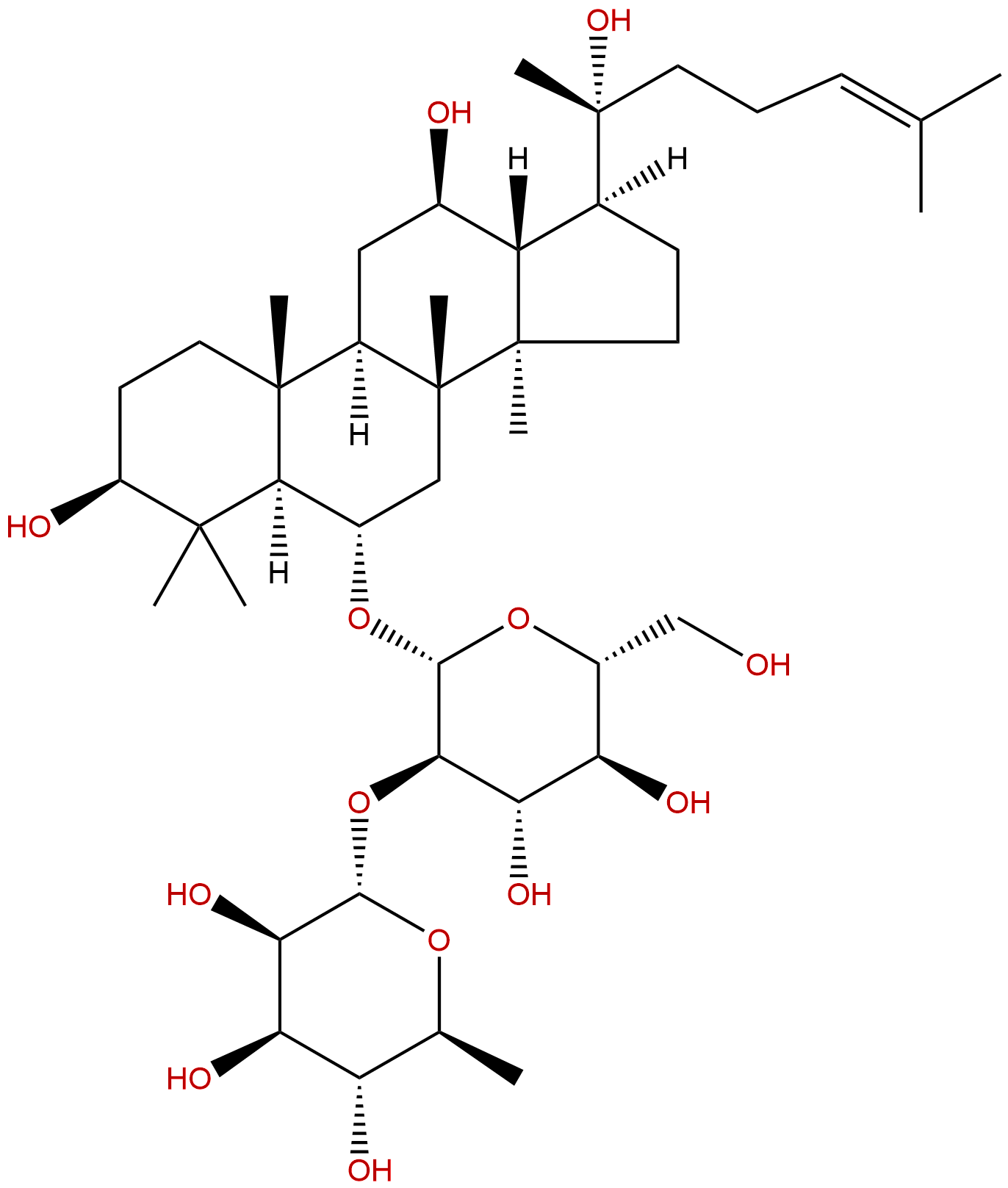


Product name: 20(R)-Ginsenoside Rg2
Synonym name: R-Ginsenoside Rg2
Catalogue No.: BP1554
Cas No.: 80952-72-3
Formula: C42H72O13
Mol Weight: 785.025
Botanical Source: Constit. of Panax ginseng
Physical Description: Powder
Type of Compound: Triterpenoids
Purity: 95%~99%
Analysis Method: HPLC-DAD or/and HPLC-ELSD
Identification Method: Mass, NMR
Packing: Brown vial or HDPE plastic bottle
The product could be supplied from milligrams to grams. Inquire for bulk scale.
We provide solution to improve the water-solubility of compounds, thereby facilitating the variety of activity tests and clinic uses.
For Reference Standard and R&D, Not for Human Use Directly.
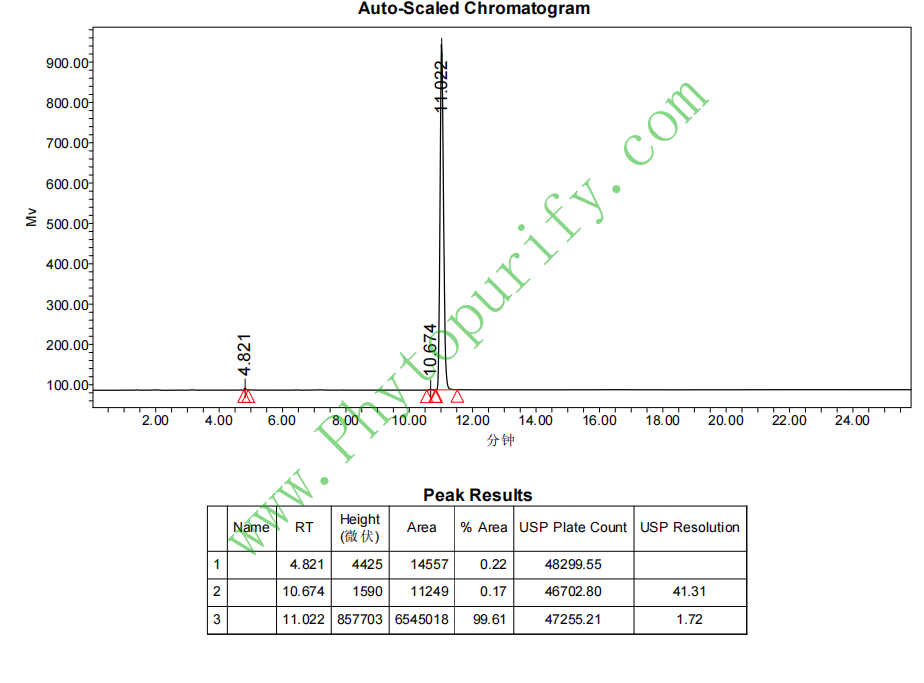
HPLC of 20(R)-Ginsenoside Rg2
Storage conditions:Short-term storage at 2~8℃, long-term storage at -20 ~ -80℃
218.9900
3.0994
3.0993
.0434
.6108
.2027
Low
66.8992
6.0007
No
No
No
No
No
No
0.0
Yes
No
No
No
Natural products, as an important treasure trove for drug discovery, play an irreplaceable role in the history of human disease prevention and treatment. Ginseng(Panax ginseng C. As a traditional precious medicinal herb, the pharmacological value of its core active ingredient ginsenosides, A. Mey., has attracted much attention. Ginsenoside Rg2 is an important member of the protopanaxatriol type saponins, which exists in two isomers, 20 (S) and 20 (R). among which,20 (R) - Ginsenoside Rg2 (CAS: 80952-72-3) Due to its unique three-dimensional configuration, it exhibits a different biological activity spectrum from the 20 (S) - configuration, especially in the field of anti-tumor therapy, showing great potential. In recent years, with the deepening development of modern pharmacology and molecular biology techniques, the multi-target and multi pathway anti-tumor mechanisms of 20 (R) - Rg2 have been gradually revealed. Its multiple effects such as regulating apoptosis, inhibiting metastasis, and reversing drug resistance have aroused widespread interest among researchers. This article aims to systematically review the chemical properties, plant sources, pharmacological activities, molecular mechanisms of action, pharmacological evaluation, and clinical application prospects of 20 (R) - Rg2, in order to provide comprehensive scientific references for the in-depth research and development of this compound.
The molecular formula of 20 (R) - ginsenoside Rg2 is C42H72O13, with a molecular weight of 785.0250. Its chemical structure belongs to the Damane type tetracyclic triterpenoid saponin, which is composed of hydrophobic aglycones (20 (R) - protopanaxatriol) and hydrophilic glycosides (one molecule of glucose and one molecule of rhamnose) connected by glycosidic bonds. Its key feature is that the chiral carbon atom at C-20 is in the R configuration, which forms a diastereomer with the 20 (S) - configuration. The subtle differences in stereochemistry significantly affect their interaction patterns with biomolecules such as receptors and enzymes, leading to differences in their biological activity and strength.
From the analysis of parameters related to drug properties, the lipid water partition coefficient (LogP) of 20 (R) - Rg2 is 3.0994, indicating that it has a certain degree of lipophilicity. Its topological polar surface area (TPSA) is as high as 218.99 Å ², which is mainly attributed to the abundant hydroxyl groups and oxygen atoms on the sugar ring in the molecule, leading to its strong ability to form hydrogen bonds. The calculated water solubility value is relatively low (about 0.0434 mg/mL), indicating that it is a poorly soluble compound, which may be a major limiting factor for its oral bioavailability. In terms of preliminary safety prediction, the compound has no inhibitory risk on hERG potassium channels (hERG inhibition: No), and the Ames test result is 0.0, indicating that it may not be mutagenic and has a relatively good safety starting point. However, its blood-brain barrier permeability is predicted to be 'low', which means it may have difficulty entering the central nervous system to exert its effects.
20 (R) - Ginsenoside Rg2 mainly comes from plants of the Panax genus in the Araliaceae family, such as ginseng(Panax ginseng)Western ginseng(Panax quinquefolius)And Sanqi(Panax notoginseng). It is worth noting that in fresh or unprocessed ginseng, naturally occurring Rg2 is usually mainly in the 20 (S) - configuration, with relatively low levels of 20 (R) - configuration. The generation of 20 (R) - configuration is often closely related to the processing process. For example, in the preparation of red ginseng from ginseng, after steaming and drying, some 20 (S) - configuration saponins undergo differential isomerization or sugar hydrolysis conversion, generating various rare saponins including 20 (R) - Rg2. This makes red ginseng an important source of 20 (R) - Rg2.
At present, the main methods for obtaining 20 (R) - Rg2 include:
1. Plant extraction and separation method Obtained from the roots, stems, and leaves of ginseng, red ginseng, or Panax notoginseng by alcohol (such as methanol, ethanol) reflux or ultrasonic extraction, followed by multi-step separation and purification using macroporous resin, silica gel column chromatography, and reverse phase preparative liquid chromatography. This method has high cost, complicated steps, and low yield.
2. Biotransformation method Selective hydrolysis and transformation of abundant prototype saponins (such as ginsenoside Rb1, Rc, etc.) using microorganisms or enzymes (such as glycosidase) to selectively prepare 20 (R) - Rg2. This method has mild conditions and good selectivity, and is a promising strategy for improving the yield of rare saponins.
3. Chemical synthesis and semi synthesis The fundamental approach to obtaining sufficient standard samples for in-depth research is to construct a damaane skeleton through full chemical synthesis and introduce specific sugar groups and chiral centers, or to modify the structure using readily available saponins as raw materials through semi synthesis. However, it still faces the challenges of complex steps and low overall yield.
Numerous in vitro and in vivo studies have confirmed that 20 (R) - Rg2 has a wide range of pharmacological activities, with its most prominent and extensively studied area being its anti-tumor effects.
1. Antitumor activity
20 (R) - Rg2 showed significant proliferation inhibition and apoptosis promoting effects on a variety of human tumor cell lines, including breast cancer, lung cancer, liver cancer, colon cancer, ovarian cancer and glioma. In animal models, 20 (R) - Rg2 can effectively inhibit tumor growth, reduce tumor volume and weight, and when combined with certain chemotherapy drugs, it can produce synergistic effects and alleviate the toxic side effects of chemotherapy drugs.
2. Other potential pharmacological activities
In addition to anti-tumor effects, research also suggests that 20 (R) - Rg2 may have neuroprotective, anti-inflammatory, anti-aging, and cardiovascular function improving activities. For example, it has been reported in Alzheimer's disease models to alleviate beta amyloid induced neurotoxicity, but its low blood-brain barrier permeability limits in vivo validation of this effect. These activities provide clues for their multi indication development, but more solid research data is needed to support it.
The anti-tumor effect of 20 (R) - Rg2 is not achieved through a single target, but through intervening in multiple key stages of tumor occurrence and development, forming a multi-target network pharmacological effect. The molecular targets of its mechanism of action and regulation mainly include:
1. Inducing apoptosis of tumor cells
This is one of the most core anti-tumor mechanisms of 20 (R) - Rg2. It downregulates anti apoptotic proteins Bcl-2 and Mcl-1 Simultaneously upregulating the expression of pro apoptotic proteins (such as Bax), disrupting mitochondrial membrane potential, promoting cytochrome C release, and activating the Caspase cascade reaction, ultimately leading to cell apoptosis. In addition, it can also inhibit STAT3 Abnormal activation of signaling pathways. STAT3, as an important transcription factor, its sustained activation promotes the expression of various anti apoptotic and proliferation genes. 20 (R) - Rg2 inhibits STAT3 phosphorylation and blocks its downstream oncogenic signals.
2. Inhibit tumor invasion and metastasis
Tumor metastasis is the main cause of treatment failure and death. 20 (R) - Rg2 can significantly inhibit matrix metalloproteinases MMP-2 The expression and activity of MMP-9. MMP-2 is a key enzyme that degrades the extracellular matrix (ECM) and basement membrane. When its activity is inhibited, the invasion and migration ability of tumor cells is weakened. Meanwhile, it can also downregulate hypoxia inducible factors HIF-1αThe expression. HIF-1 α is stably present in the hypoxic microenvironment of tumors and can activate a series of genes that promote angiogenesis (such as VEGF), invasion, metastasis, and metabolic reprogramming.
3. Interference with tumor cell cycle and DNA metabolism
Research has shown that 20 (R) - Rg2 can block tumor cells at specific cell cycle checkpoints (such as G0/G1 phase or G2/M phase) and inhibit their proliferation. Its function may be related to the regulation of cyclins and cyclin dependent kinases (CDKs) in cells. Even more interestingly, research suggests that it may have a direct or indirect impact Topoisomerase I (TOP1)and Topoisomerase II alpha (TOP2A)The activity. Topoisomerase is a key enzyme for DNA replication and transcription, and is also a target of various chemotherapy drugs such as irinotecan and etoposide. The effect of 20 (R) - Rg2 on such targets may be related to its reversal of drug resistance or synergistic chemotherapy.
4. Regulating hormone related signaling pathways
In hormone dependent tumors (such as estrogen receptor positive breast cancer), 20 (R) - Rg2 shows the potential to regulate hormone signaling pathways. It has been reported that it can be lowered Estrogen receptor alpha (ESR1)Expression or activity of and inhibition of aromatase CYP19A1 The activity. CYP19A1 is the rate limiting enzyme for the conversion of androgens to estrogens, and its inhibition can reduce local estrogen levels in tumors, thereby inhibiting tumor growth.
5. Regulating key kinase signaling pathways
MAPK/ERK Signal pathway (involving MAPK1/ERK2)Plays a central role in cell proliferation, differentiation, and survival. 20 (R) - Rg2 can transmit growth inhibition and pro apoptotic signals by inhibiting excessive activation of this pathway.
In summary, 20 (R) - Rg2 forms a synergistic anti-tumor network by simultaneously acting on multiple key targets such as MCL1, BCL2, STAT3, MMP2, TOP1, HIF1A, TOP2A, MAPK1, ESR1, CYP19A1, etc.
Although the pharmacological activity of 20 (R) - Rg2 is clear, its drug likeness faces challenges mainly due to its inherent physicochemical properties.
1. Absorption, distribution, metabolism, and excretion (ADME)
* absorb High TPSA and larger molecular weight result in poor membrane permeability, coupled with low water solubility, making oral absorption difficult and expected low bioavailability.
* distribution The predicted blood-brain barrier permeability is low, which limits its therapeutic application for central nervous system tumors or diseases. The distribution characteristics of its organization still require detailed in vivo radioactive labeling research to clarify.
* Metabolism As a saponin compound, it is easily hydrolyzed and metabolized by gut microbiota and hepatic enzymes (especially CYP450 enzyme system) in the gastrointestinal tract and liver. The prototype drug is rapidly converted into ginsenoside glycoside or other secondary metabolites, which is not only a possible pathway for its activity conversion, but also the main reason for its low in vivo exposure and short half-life.
* excretion Its metabolites are mainly excreted through bile and kidneys.
2. Optimization strategy for drug properties
In order to overcome the above shortcomings and improve the drug resistance of 20 (R) - Rg2, researchers are exploring various strategies:
* Prodrug design By chemically modifying (such as esterification, amidation) the hydroxyl group on its sugar group, a more lipophilic prodrug is prepared to improve membrane permeability and oral absorption, and then hydrolyzed in vivo to release the prototype drug.
* New drug delivery system Using nanotechnology, such as liposomes, polymer micelles, nanoparticles, solid dispersions, etc., to encapsulate 20 (R) - Rg2. These carriers can significantly improve their water solubility and stability, achieve targeted delivery (such as EPR effect targeting tumors), prolong circulation time, and potentially enhance their ability to cross biological barriers.
* Simplification of Structure and Synthesis of Similar Compounds On the basis of clarifying its pharmacophore, synthesizing derivatives or analogues with simpler structures, better physicochemical properties, and more stable metabolism is a classic pathway for pharmaceutical chemistry development.
At present, there is still a relative lack of complete preclinical pharmacokinetic research data on the 20 (R) - Rg2 system, which is a key information gap that must be filled before it can move towards clinical development.
20 (R) - Ginsenoside Rg2 shows broad prospects as a novel anti-tumor drug, but its transformation still has a long way to go.
1. Potential clinical application directions
* Antitumor adjuvant therapy drugs As an adjuvant drug for chemotherapy, radiotherapy, or targeted therapy, utilizing its multi-target properties to enhance efficacy, reverse drug resistance, and reduce adverse reactions.
* Components of anti-tumor compound preparations Formulate a compound with traditional Chinese medicine or other active ingredients to achieve synergistic effects, in line with the concept of holistic treatment in traditional Chinese medicine.
* Exploration of targeted therapy for specific tumors: Targeting at its targets (such as STAT3, HIF-1 α, CYP19A1), develop precise treatment strategies for tumor subtypes with abnormal activation of corresponding signal pathways (such as triple negative breast cancer, hormone resistant breast cancer, etc.).
2. Future research prospects
* In depth mechanism research It is necessary to use techniques such as gene knockout/knock in, proteomics, metabolomics, etc. to further accurately verify its direct target and elucidate the complex signaling network it regulates.
* Systematic evaluation of drug properties Standardized preclinical ADME studies must be conducted to clarify its absolute bioavailability, tissue distribution, major metabolites, and excretion pathways in different species of animals.
* Comprehensive Security Assessment Conduct systematic safety evaluations of acute toxicity, long-term toxicity, reproductive toxicity, etc., to provide a safe dosage range for clinical research.
* Formulation technology research and development The development of a new drug delivery system is the key to its successful application. Need to optimize the formulation process, complete formulation evaluation and in vitro and in vivo correlation research.
* Clinical study design If clinical research is to be conducted in the future, it is necessary to carefully design the trial protocol, starting from dose exploration, gradually verifying its safety, tolerability, and preliminary efficacy in cancer patients.
20 (R) - Ginsenoside Rg2 is a natural product with unique stereochemistry and multi-target anti-tumor activity. It demonstrates the potential to combat various malignant tumors by regulating apoptosis, metastasis, cell cycle, and key proteins in multiple signaling pathways. However, its inherent low solubility and low permeability, which are bottlenecks in drug development, severely restrict its conversion into clinical drugs. Future research should focus on using modern medicinal chemistry and pharmaceutical methods (such as prodrug design, nano delivery) to improve its physicochemical properties and pharmacokinetic behavior, while combining systems biology methods to further elucidate its mechanism of action network. Only through interdisciplinary collaboration and overcoming its application shortcomings can the modern medical value of this rare component in ancient ginseng be fully unleashed, and it is expected to provide a new multi-target candidate drug or adjuvant therapy strategy for tumor treatment.
