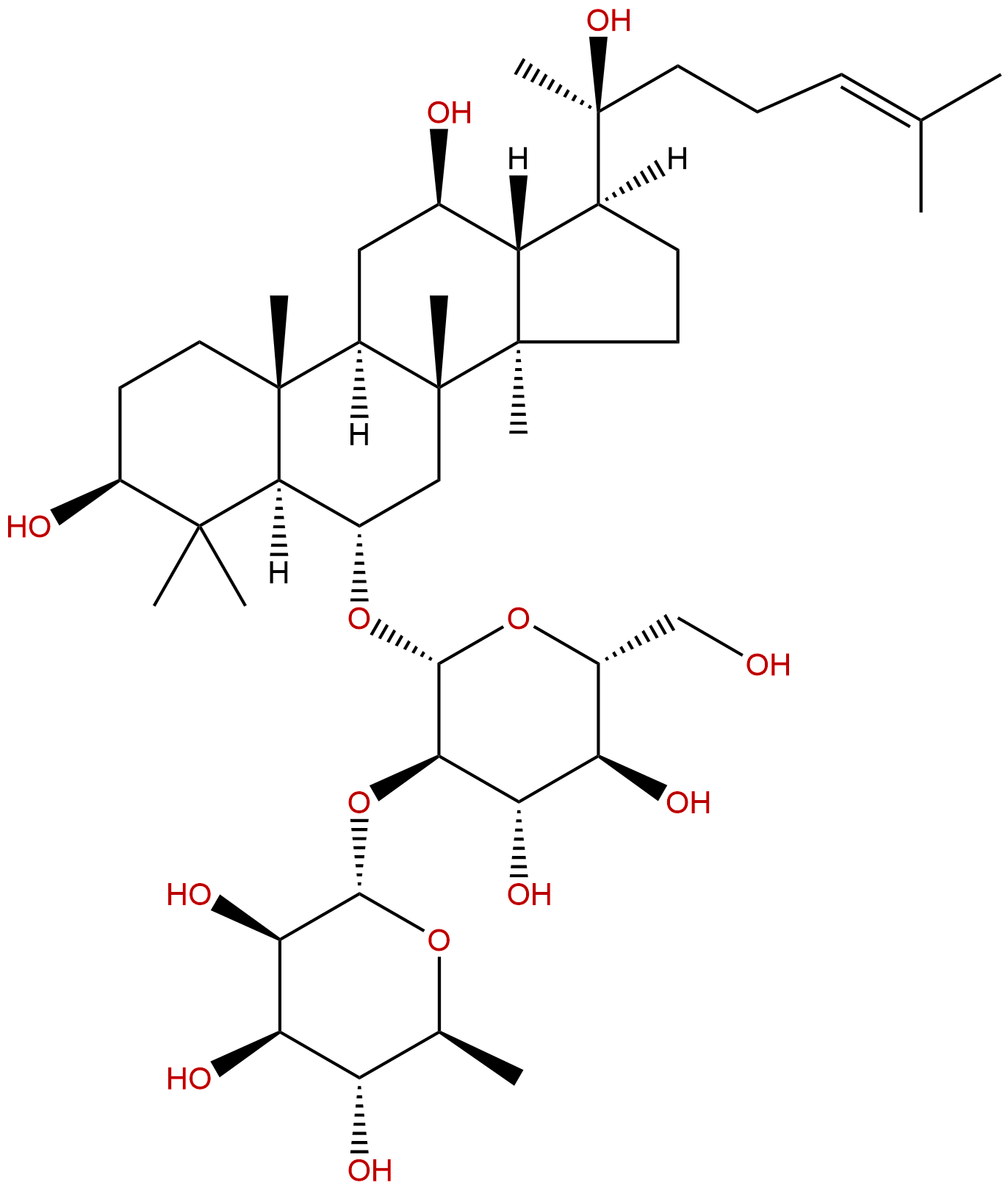


Product name: Ginsenoside Rg2
Synonym name: Chikusetsusaponin I; Ginsenoside C
Catalogue No.: BP0665
Cas No.: 52286-74-5
Formula: C42H72O13
Mol Weight: 785.025
Botanical Source: Panax ginseng (ginseng), Panax quinquefolia and Panax notoginseng
Physical Description: White powder
Type of Compound: Triterpenoids
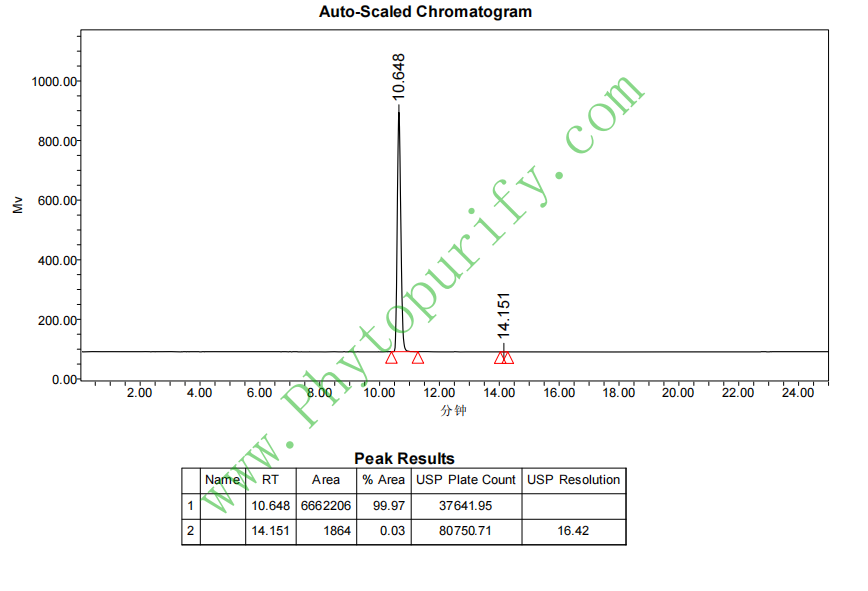
Purity: 95%~99%
Analysis Method: HPLC-DAD or/and HPLC-ELSD
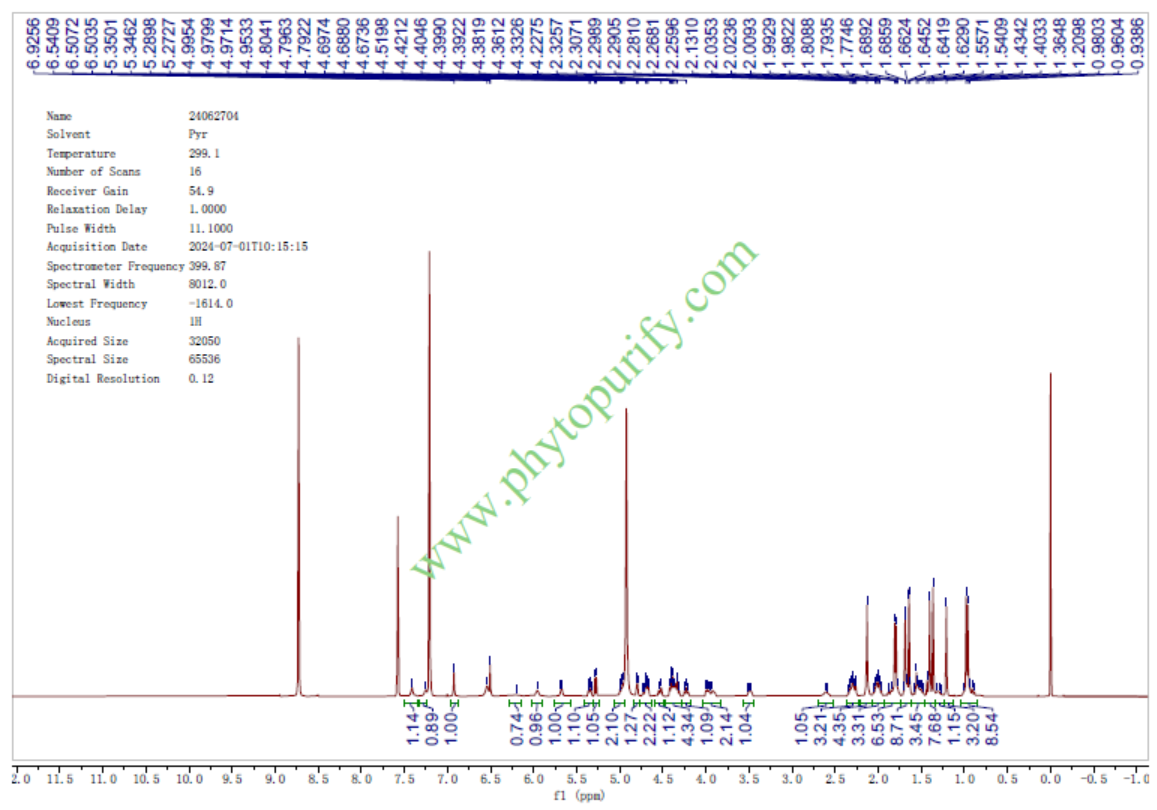
Identification Method: Mass, NMR
Packing: Brown vial or HDPE plastic bottle
Storage: Store in a well closed container, protected from air and light. Put into refrigerate or freeze for long term storage.
Whenever possible, you should prepare and use solutions on the same day. However, if you need to make up stock solutions in advance, we recommend that you store the solution as aliquots in tightly sealed vials at -20℃. Generally, these will be useable for up to two weeks.
The product could be supplied from milligrams to grams, up to kilograms
Inquire for bulk scale.
Descriptions:
Ginsenoside Rg2 suppresses the hepatic glucose production via AMPK-induced phosphorylation of GSK3β and induction of SHP gene expression, suggests that it has therapeutic potential for type 2 diabetic patients.[1]
Ginsenoside Rg2 inhibits nicotinic acetylcholine receptor-mediated Na+ influx and channel activity; it also inhibits the 5-HT-induced inward peak current (I5-HT) in dose dependent and reversible manner, the half-inhibitory concentrations (IC50) of ginsenoside Rg2 is 22.3 +/- 4.6 microM, suggests that it might regulate the 5-HT3A receptors that are expressed in Xenopus oocytes.[2]
Ginsenoside Rg2 can reduce LPS-mediated THP-1 monocyte adhesion to HUVEC, in a concentration-dependent manne, it may provide direct vascular benefits with inhibition of leukocyte adhesion into vascular wall thereby providing protection against vascular inflammatory disease.[3]
Ginsenoside Rg2 protects cells against UVB-induced genotoxicity by increasing DNA repair, in possible association with modulation of protein levels involved in p53 signaling pathway.[4]
Ginsenoside Rg2 improves learning and memory through mechanisms related to anti-apoptosis in MID rats, indicates that it may represent a potential neurorestorative treatment strategy for vascular dementia or other ischemic insults.[5]
Ginsenoside Rg2 has protective effects against H2O2-induced injury and apoptosis in H9c2 cells.[6]
References:
[1] Yuan H D, Kim D Y, Quan H Y, et al. Chem-Bioll Interact, 2012, 195(1):35-42.
[2] Choi S, Lee J H, Oh S, et al. Mol Cells, 2003, 15(1):108-13.
[3] Cho Y S, Chan H K, Ha T S, et al. Korean J Physiol Pham 2013, 17(2):133-7.
[4] Ha S E, Shin D H, Kim H D, et al. N-S Arch Pharmacol, 2010, 382(1):89-101.
[5] Gong Z H, Liu M X, Gong L L, et al. Prog in Modern Biomed, 2010,10(06):1069-75.
[6] Fu W, Sui D, Yu X, et al. Int J Clin Exp Med, 2015, 8(11):19938-47.
[7] Yu M, Mi H, Jiao L. China Pharmacist, 2005, 8(12):1017-9.
HPLC of Ginsenoside Rg2
HNMR of Ginsenoside Rg2
Storage conditions:Short-term storage at 2~8℃, long-term storage at -20 ~ -80℃
218.9900
3.1018
3.1014
.0429
.6108
.2027
Low
67.0258
6.0007
No
No
No
No
No
No
0.0
Yes
No
No
No
Ginseng(Panax ginseng C. A. Mey., as a traditional precious Chinese medicinal herb, has been proven by thousands of years of clinical practice to have the effects of "strengthening the body and strengthening the foundation" and "greatly replenishing vitality". Modern pharmacological research has shown that the extensive biological activity of ginseng is mainly attributed to a class of triterpenoid saponins it is rich in - ginsenosides. Ginsenoside Rg2 (CAS number: 52286-74-5) is one of the important members of protopanaxatriol saponins and the core active ingredient for ginseng to exert pharmacological effects. In recent years, with the deepening of separation and purification technology and molecular biology research, ginsenoside Rg2 has attracted much attention due to its significant activities in cardiovascular protection, neuroprotection, anti-inflammatory, and regulation of glucose metabolism. Especially in the fields of hyperglycemia and its complications, neurodegenerative diseases, etc., Rg2 exhibits unique regulatory potential, and its mechanism of action involves the regulation of multiple key targets such as EHMT2, AMPK, BACE1, etc. This article aims to systematically review the chemical properties, pharmacological activities, molecular mechanisms of action, and pharmacological research progress of ginsenoside Rg2, in order to provide scientific basis for the deep development and clinical application of this natural product.
The molecular formula of ginsenoside Rg2 is C42H72O13, with a molecular weight of 785.0250. Its chemical structure belongs to the Damane type tetracyclic triterpenoid saponin, and its aglycone is Protopanaxatriol. Connect a sugar group at positions C-6 and C-20, specifically 20 (S) - protopanaxatriol-6-O - α - L-rhamnopyranosyl - (1 → 2) - β - D-glucopyranoside. This unique glycosylation pattern is a key structural feature that distinguishes it from other ginsenosides such as Rg1 and Re, and profoundly affects its physicochemical properties and biological activity.
From the analysis of parameters related to drug properties, the lipid water partition coefficient (LogP) of Rg2 is 3.1018, indicating that it has a certain degree of lipophilicity, but not high lipid solubility. Its topological polar surface area (TPSA) is as high as 218.99 Å ², which is mainly attributed to the abundant hydroxyl and sugar structures in the molecule, leading to its high polarity. The water solubility parameter is 0.0429, indicating that its solubility in water is low and it belongs to insoluble compounds, which to some extent limits its bioavailability. The prediction of blood-brain barrier permeability as "low" suggests that entering the central nervous system in the form of prototype drugs may pose challenges, but the possibility of metabolites or indirectly exerting neuroprotective effects by regulating peripheral targets cannot be ignored. In terms of preliminary safety evaluation, hERG inhibition is "no", indicating a low risk of cardiac toxicity; The Ames test result is 0.0, indicating that it has no significant genetic toxicity potential. These physicochemical and preliminary safety properties lay the foundation for its subsequent formulation improvement and safety evaluation.
Ginsenoside Rg2 mainly comes from plants of the Panax genus in the Araliaceae family, including ginseng(Panax ginseng)Western ginseng(Panax quinquefolius)And Sanqi(Panax notoginseng)Wait. There are significant differences in the content of Rg2 among different varieties, origins, growth years, and medicinal parts (such as main roots, fibrous roots, stems and leaves). Usually, the content of Rg2 in red ginseng (processed by steaming ginseng) is higher than that in sun dried ginseng. This is because the steaming process promotes the hydrolysis and transformation of some ginsenosides (such as Rg1) to produce secondary saponins such as Rg2, thereby enhancing certain specific activities.
The extraction of ginsenoside Rg2 from plant materials usually follows the following process: first, polar solvents (such as methanol, ethanol, or water alcohol mixed solutions) are used for reflux extraction or ultrasound assisted extraction to fully obtain total saponins. Subsequently, enrichment and purification were carried out using macroporous adsorption resins (such as D101, AB-8), and the saponin components were preliminarily separated by gradient elution with ethanol water solutions of different concentrations. To obtain high-purity Rg2 monomer, it is necessary to further use preparative high-performance liquid chromatography (Prep HPLC), which often uses a reverse phase C18 chromatographic column with acetonitrile water or methanol water as the mobile phase for fine separation. In recent years, technologies such as high-speed countercurrent chromatography and preparative thin-layer chromatography have also been applied to the separation and purification of Rg2. In addition, directional conversion of high content precursor saponins (such as Rg1) into Rg2 through enzymatic conversion or mild acid hydrolysis is an effective biotransformation strategy to increase the yield of Rg2.
Numerous in vitro and in vivo studies have confirmed that ginsenoside Rg2 has broad and significant pharmacological activities, mainly manifested in the following aspects:
Cardiovascular protective effect Rg2 is one of the key components of ginseng that plays a "heart strengthening" role. Research has shown that Rg2 can enhance myocardial contractility, improve cardiac function, and counteract myocardial ischemia/reperfusion injury induced by various factors. Its mechanism is related to improving myocardial energy metabolism, inhibiting oxidative stress and calcium overload, and reducing inflammatory response. Especially important, as described in the compound information, Rg2 can significantly inhibit the expression of vascular cell adhesion molecule-1 (VCAM-1) and intercellular adhesion molecule-1 (ICAM-1) mediated by inflammatory factors such as lipopolysaccharide (LPS), thus inhibiting the adhesion of leukocytes to vascular endothelial cells and reducing vascular endothelial inflammation, which is of great significance for the early prevention and treatment of atherosclerosis.
Neuroprotective and Anti Alzheimer's Disease Potential Rg2 exhibits clear neuroprotective activity. In Alzheimer's disease (AD) related research, Rg2 can reduce the accumulation of β - amyloid 1-42 (A β 1-42), which is one of the core pathological processes of AD. It may reduce the production of A β by inhibiting the activity of β - secretase 1 (BACE1); Simultaneously promoting the phagocytic clearance of A β by microglia. In addition, Rg2 can improve learning and memory impairment induced by scopolamine or A β, and its mechanism involves regulating the cholinergic system, inhibiting tau protein hyperphosphorylation, enhancing synaptic plasticity, and anti neuronal apoptosis.
Regulating glucose metabolism and combating hyperglycemia Regarding hyperglycemia, Rg2 exhibits multi-target regulatory potential. Research has shown that Rg2 can improve insulin resistance and promote peripheral tissue uptake and utilization of glucose. Its function may be related to activating the adenosine monophosphate activated protein kinase (AMPK) signaling pathway, thereby regulating energy metabolism and insulin sensitivity. Meanwhile, Rg2 may exert a comprehensive hypoglycemic effect by affecting the secretion or degradation of glucagon like peptide-1 (GLP-1) (involving targets such as DPP-4 and CES1), as well as regulating the activity of key enzymes involved in liver glycogen metabolism (such as GCK).
Anti inflammatory and immune regulation In addition to inhibiting the expression of endothelial adhesion molecules, Rg2 can also suppress the excessive production of pro-inflammatory mediators such as nitric oxide (NO), prostaglandin E2 (PGE2), tumor necrosis factor - α (TNF - α), interleukin-6 (IL-6), etc. in immune cells such as macrophages. Its anti-inflammatory effect is closely related to the inhibition of the activation of nuclear factor kappa B (NF - κ B) and mitogen activated protein kinase (MAPKs) signaling pathways.
Other activities The study also reported that Rg2 has potential effects in anti fatigue, anti-aging, anti-tumor adjuvant therapy (enhancing chemotherapy sensitivity, reducing side effects), and protecting organs such as the liver and kidneys from damage.
The pharmacological effects of ginsenoside Rg2 depend on its interactions with multiple molecular targets, forming a complex network regulatory mechanism. For hyperglycemia and related complications, its target network is particularly prominent:
In summary, Rg2 does not act on a single target, but rather restores metabolism and neural homeostasis at the systemic level by synergistically regulating a network composed of AMPK, EHMT2, BACE1, and others.
Although the pharmacological activity of ginsenoside Rg2 is clear, its pharmacological development still faces challenges, mainly due to its poor pharmacokinetic properties.
To improve its medicinal properties, current research strategies include:
1. Structural modification Chemical modification of glycosides or glycosides to enhance their lipid solubility and metabolic stability.
2. New drug delivery system Develop drug delivery systems such as liposomes, nanoparticles, microemulsions, and solid dispersions to significantly improve their solubility and oral bioavailability.
3. Prodrug strategy Preparation of prodrugs that release active ingredients at specific sites.
4. combination therapy: Used in combination with absorption enhancers or drugs with other mechanisms of action to achieve synergistic effects.
The clinical application prospects of ginsenoside Rg2 are broad, but the transformation path still needs solid research.
Potential indications:
Future research directions and challenges:
Ginsenoside Rg2, as a precious active ingredient of ginseng, has shown great potential in the prevention and treatment of metabolic diseases, cardiovascular and cerebrovascular diseases, and neurodegenerative diseases due to its multi-target and multi pathway pharmacological effects. From inhibiting the expression of VCAM-1/ICAM-1 to anti atherosclerosis, reducing the accumulation of A β to anti AD, and then regulating glucose metabolism through AMPK, EHMT2 and other target networks, its scientific connotation is increasingly rich. However, its inherent drug defects such as poor solubility, low bioavailability, and weak blood-brain barrier penetration ability are the main obstacles that restrict its conversion into clinical drugs. Future research should strive to comprehensively apply modern pharmaceutical, medicinal chemistry, and biological technologies based on a deep understanding of its molecular mechanisms, break through delivery bottlenecks, promote the successful transformation of this traditional treasure into modern therapeutic drugs, and contribute unique value to human health.
