


Product name: Siamenoside I
Synonym name:
Catalogue No.: BP1304
Cas No.: 126105-12-2
Formula: C54H92O24
Mol Weight: 1125.31
Botanical Source: Siraitiae fructus
Physical Description:
Type of Compound: Triterpenoids
Purity: 95%~99%
Analysis Method: HPLC-DAD or/and HPLC-ELSD
Identification Method: Mass, NMR
Packing: Brown vial or HDPE plastic bottle
Storage: Store in a well closed container, protected from air and light. Put into refrigerate or freeze for long term storage.
Whenever possible, you should prepare and use solutions on the same day. However, if you need to make up stock solutions in advance, we recommend that you store the solution as aliquots in tightly sealed vials at -20℃. Generally, these will be useable for up to two weeks.
The product could be supplied from milligrams to grams
Inquire for bulk scale.
Description:
Siamenoside I is one of the mogrosides that has several kinds of bioactivities, it exhibits maltase inhibitory effect with the IC50 value of 12 mM.
References:
J Atheroscler Thromb. 2002;9(2):114-20.
Sweet elements of Siraitia grosvenori inhibit oxidative modification of low-density lipoprotein.
This study examined the ability of sweet elements extracted from Siraitia grosvenori (SG) to inhibit the oxidation of LDL.
METHODS AND RESULTS:
We monitored the formation of conjugated diene during copper-mediated LDL oxidation in the presence or absence of sweet elements of whole extract of SG (SG extract) or cucurbitane glycosides (CGs) purified from SG extract as sweet elements. CGs consist of Mogroside IV (Mog.IV), Mogroside V (Mog.V), 11-Oxo-mogroside V (11-Oxo-mog.V), and Siamenoside I (Sia.I). In addition, the effect of these elements on human umbilical vein endothelial cell (HUVEC)- mediated LDL oxidation was tested by measuring production of lipid peroxides. SG extract inhibited copper-mediated LDL oxidation in a dose-dependent fashion, but neither glucose nor erythritol suppressed the oxidation. Among CGs, 11-Oxo-mog.V significantly inhibited LDL oxidation, and prolongation of the lag time during LDL oxidation by 11-Oxo-mog.V was dose-dependent. The lag time (119.7 +/- 8.9 min) in the presence of 200 microM 11-Oxo-mog.V was significantly longer than that (76.8 +/- 5.5 min) of control (p < 0.01). In addition, SG extract and 11-Oxo-mog.V inhibited HUVEC-mediated LDL oxidation in a dose-dependent manner.
CONCLUSIONS:
These results demonstrate that SG extract can inhibit LDL oxidation and that 11-Oxo-mog.V, a sweet element of SG extract, provides the anti-oxidative property of SG which might reduce the atherogenic potential of LDL.
J Agric Food Chem. 2005 Apr 20;53(8):2941-6.
Triterpene glycosides of Siraitia grosvenori inhibit rat intestinal maltase and suppress the rise in blood glucose level after a single oral administration of maltose in rats.
The effect of the crude extract from Siraitia grosvenori Swingle (SG-ex) on the postprandial rise in blood glucose level was investigated.
METHODS AND RESULTS:
The increase in plasma glucose level in response to the oral administration of maltose was significantly suppressed in rats when SG-ex was given orally 3 min before the maltose administration. There was, however, no effect when glucose was administered instead, suggesting that the antihyperglycemic effect of SG-ex is elicited by inhibition of maltase in the small intestinal epithelium. In vitro, SG-ex inhibited rat small intestinal maltase. Similar effects were also observed both in vivo and in vitro when the concentrate of the sweet elements (triterpene glycosides) prepared from SG-ex was used. Furthermore, the main sweet element of SG-ex, mogroside V, and some minor elements such as mogroside IV, Siamenoside I, and mogroside III also exhibited maltase inhibitory effect with IC50 values of 14, 12, 10, and 1.6 mM, respectively.
CONCLUSIONS:
These results suggest that SG-ex exerts anti-hyperglycemic effects in rats by inhibiting maltase activity and that these effects are at least partially exerted by its sweet elements, triterpene glycosides.
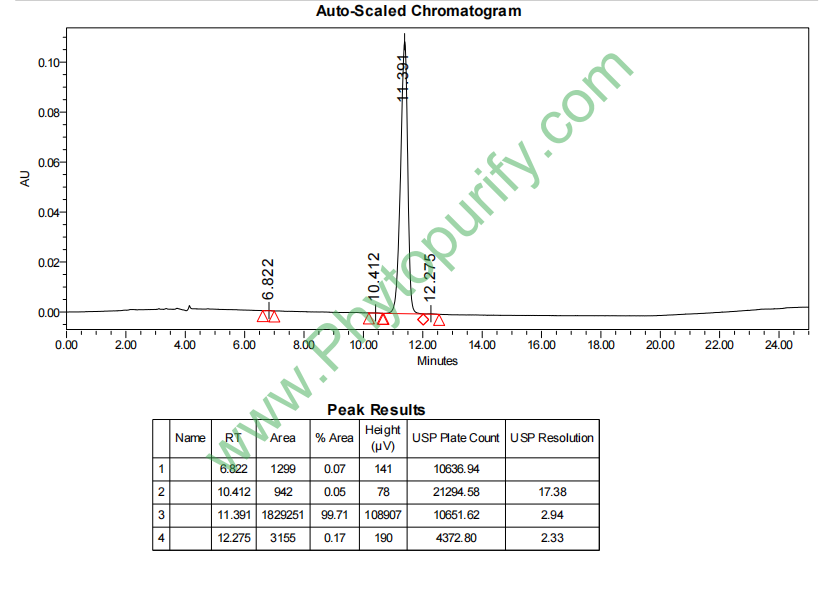
HPLC of Siamenoside I
Storage conditions:Short-term storage at 2~8℃, long-term storage at -20 ~ -80℃
Siamenoside I is a sweet glycoside natural product isolated from Siraitia grosvenorii, belonging to the triterpene sweet glycoside family. As a traditional Chinese medicine and natural sweetener, Momordica grosvenorii has attracted much attention due to its low calorie, high sweetness and various biological activities. In recent years, selenidin I has become a research hotspot in the field of natural product pharmacology due to its unique chemical structure and extensive biological activity, especially its potential therapeutic effect in malignant tumors such as liver cancer. This article will provide a systematic review of the chemical structure and physicochemical properties, plant sources and extraction methods, pharmacological activity and mechanism of action, pharmacological evaluation, and clinical application prospects of selenidin I. The aim is to provide scientific basis for the further development and application of this compound.
The molecular formula of selenidin I is C54H88O28, with a molecular weight of 1125.3060. Its chemical structure belongs to the triterpenoid saponin class, with the core being a pentacyclic triterpenoid skeleton that connects multiple sugar residues to form a typical sweet glycoside structure. This structure gives high polarity to Cynomoside I, manifested by a large topological polar surface area (TPSA) of 397.52 Å ² and a LogP value of 1.4533, indicating moderate lipophilicity and strong hydrophilicity. The water solubility index is 0.3664, indicating that it has a certain solubility in water, but solubility is still influenced by the number and structure of sugar groups. The molecular structure of Cynomoside I is complex, containing multiple hydroxyl and glycosidic bonds, with good stability and no significant hERG channel inhibition. The Ames mutagenicity test result is 0, indicating its high safety.
Saimen glycoside I is mainly isolated from the fruit of Siraitia grosvenorii. Momordica grosvenorii is a cucurbitaceae plant, which is native to southern China. Its fruit contains rich glycosides. Traditional extraction methods usually use water extraction or alcohol extraction, combined with multi-step separation and purification techniques, to obtain high-purity selenidin I.
The specific extraction process includes: first, crush the dried siraitia grosvenorii pulp, use hot water or 70% ethanol for reflux extraction, concentrate the extract, and then use column chromatography (such as silica gel column, reverse C18 column) to separate the sweet glycoside components. Further purification was carried out by high-performance liquid chromatography (HPLC), followed by structural identification using mass spectrometry (MS) and nuclear magnetic resonance (NMR) techniques. In recent years, the application of ultrasound assisted extraction (UAE) and microwave-assisted extraction (MAE) technologies has improved extraction efficiency and purity, which is conducive to industrial production.
Saimeng glycoside I exhibits various biological activities, especially significant effects in anti-tumor, anti-inflammatory, antioxidant, and immune regulation.
Liver cancer is a malignant tumor with high incidence rate and mortality worldwide. Saimeng glycoside I has shown inhibitory effects on tumor cell proliferation, induction of apoptosis, and inhibition of metastasis in various in vitro and in vivo liver cancer models. Its anti liver cancer activity is mainly achieved by regulating tumor related signaling pathways, manifested as cell cycle arrest, regulation of apoptosis related protein expression, and reduced invasion and migration ability.
Saimeng glycoside I can significantly inhibit the production of inflammatory mediators, reduce the expression of pro-inflammatory cytokines such as TNF - α and IL-6, and alleviate inflammatory reactions. At the same time, it has the ability to eliminate free radicals, enhance cellular antioxidant enzyme activity, and protect cells from oxidative stress damage.
Research has shown that seman glycoside I can regulate immune cell function, enhance macrophage phagocytic ability, promote lymphocyte proliferation, regulate cytokine secretion, and improve the body's immune defense ability.
The anti liver cancer effect of Saimon glycoside I involves multiple key molecular targets and signaling pathways, mainly including:
The synergistic regulation of these targets enables saikosaponin I to inhibit the development of liver cancer from multiple angles and pathways, demonstrating its potential as a multi-target anti-tumor drug.
The pharmacological parameters of Saimeng glycoside I indicate that it has certain potential for drug development. The high molecular weight (1125.3060) and TPSA (397.52) suggest that its oral bioavailability may be limited, but a moderate LogP value (1.4533) is beneficial for cell membrane permeability. The water solubility index of 0.3664 indicates that its solubility in aqueous phase is still acceptable, which is beneficial for the development of formulations.
Low blood-brain barrier permeability reduces the risk of central nervous system toxicity. No hERG channel inhibitory effect, reducing the possibility of cardiac toxicity. The Ames test is negative, indicating a low risk of genetic toxicity.
Although there is currently a lack of systematic pharmacokinetic (PK) data, based on its structural characteristics, selenidin I may undergo processes such as glycoside hydrolysis and liver metabolism in vivo. In the future, it is necessary to conduct in vivo absorption, distribution, metabolism, and excretion (ADME) research, optimize administration routes and dosage forms, and improve bioavailability.
As a naturally occurring polysaccharide compound, seman glycoside I has good safety and multi-target anti-tumor activity, especially showing broad application prospects in the field of liver cancer treatment. Its multi-target mechanism of action helps overcome the resistance problem of single target drugs, and combined with modern drug design technology, it is expected to be developed as a new type of anti liver cancer drug.
In addition, the anti-inflammatory, antioxidant, and immunomodulatory effects of seman glycoside I also provide possibilities for its application in chronic inflammatory diseases, metabolic syndrome, and immune related diseases. Future research should focus on:
Through interdisciplinary collaboration, semanidin I is expected to become an important breakthrough in the development of natural anti-tumor drugs.
As an important glycoside component in Siraitia grosvenorii, Saimen glycoside I has become a hot spot in natural product pharmacology research due to its unique chemical structure and significant biological activity, especially its potential in the treatment of liver cancer. Its multi-target and multi mechanism characteristics provide new ideas for the development of anti-tumor drugs. Although there are still challenges in pharmacokinetics and clinical applications at present, with the deepening of research and technological progress, semanidin I is expected to become a star molecule in the field of natural product anti-tumor drugs, promoting the process of natural drug translation into clinical practice. In the future, the basic and applied research of the system will provide solid scientific support for its development and utilization, promoting its widespread application in the treatment of liver cancer and related diseases.
