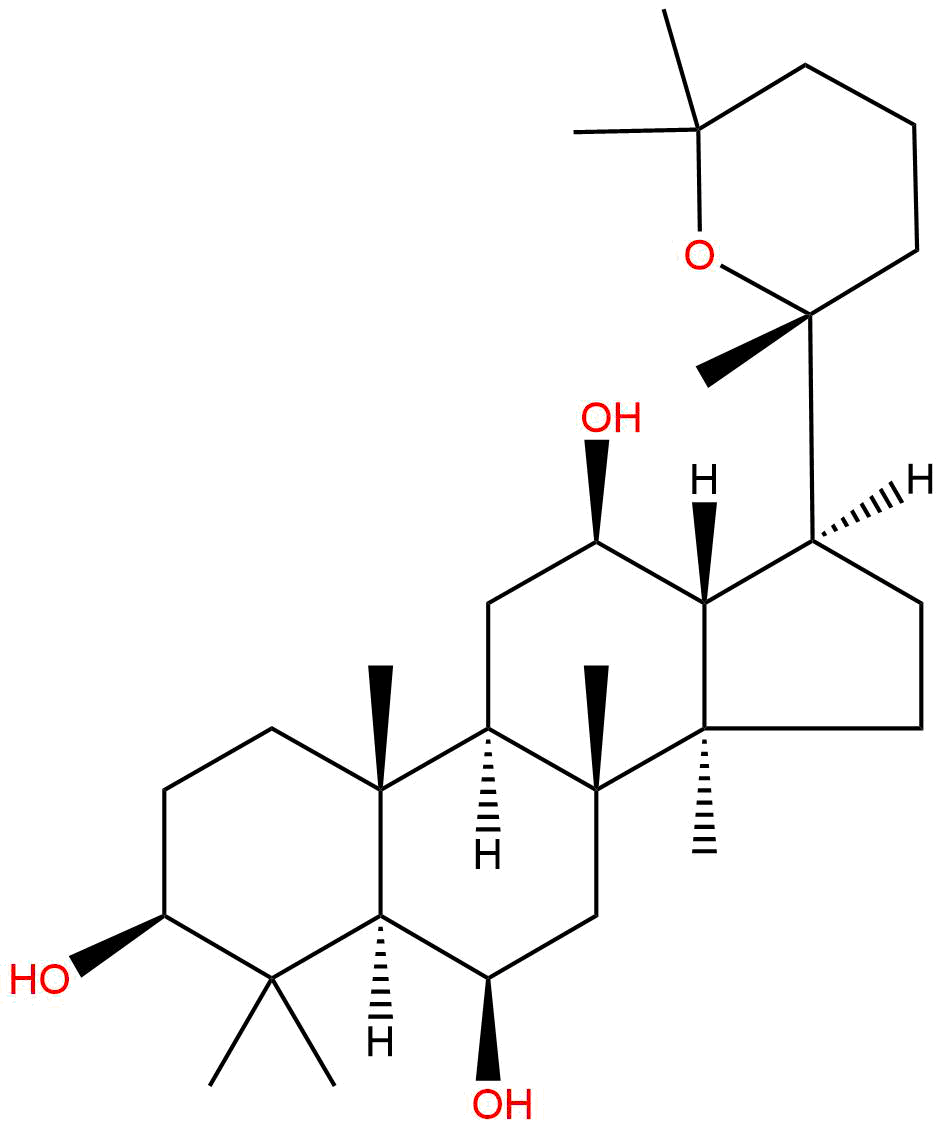


Product name: Panaxatriol
Synonym name: (20R)-Panaxatriol
Catalogue No.: BP1061
Cas No.: 32791-84-7
Formula: C30H52O4
Mol Weight: 476.742
Botanical Source: Ginseng Radix Et Rhizoma
Physical Description:
Type of Compound: Triterpenoids
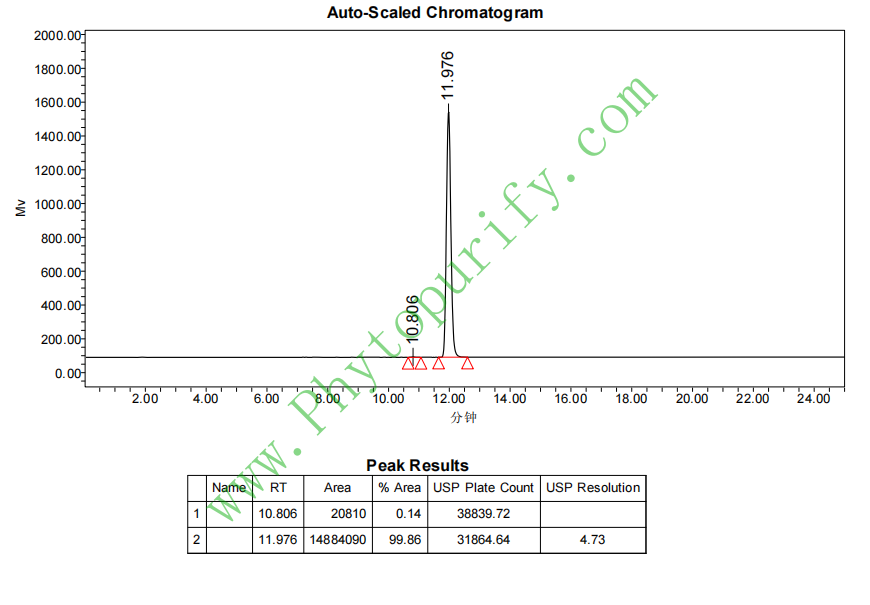
Purity: 95%~99%
Analysis Method: HPLC-DAD or/and HPLC-ELSD
Identification Method: Mass, NMR
Packing: Brown vial or HDPE plastic bottle
Storage: Store in a well closed container, protected from air and light. Put into refrigerate or freeze for long term storage.
Whenever possible, you should prepare and use solutions on the same day. However, if you need to make up stock solutions in advance, we recommend that you store the solution as aliquots in tightly sealed vials at -20℃. Generally, these will be useable for up to two weeks.
The product could be supplied from milligrams to grams
Inquire for bulk scale.
Chengdu Biopurify Phytochemicals Ltd. is a leading company in the research, development, manufacture and marketing of High Quality Phytochemicals and Extracts(especially Active Ingredients from Traditional Chinese Medicine,TCM), Natural Active Pharmaceutical Ingredients worldwide.
The main services:
A. Supply active ingredients and reference standards of TCM, from mgs to kgs scale
B. Custom extraction and purification, target Herb Active Ingredients
C. Custom synthesis and semi-synthesis for Natural Active Ingredients
D. CR(contract research), CM(contract manufacture) and PD(process development) services from lab scale, pilot scale to commercial scale(GMP is also available)
E. TCM compounds library for drug screen,more than 3000 compounds available, many of them are rare and unique.
HPLC of Panaxatriol
Storage conditions:Short-term storage at 2~8℃, long-term storage at -20 ~ -80℃
69.9200
5.5241
5.5241
.0009
5.5718
7.4108
High
85.1198
5.0627
No
No
No
No
No
No
0.0
Yes
No
No
No
Ginseng, as a treasure of traditional Chinese medicine, has been known to the world for thousands of years for its effects of tonifying qi, promoting digestion, and calming the mind. Modern pharmacological research reveals that the excellent efficacy of ginseng stems from its complex and diverse active ingredients, among which ginsenosides are considered the core pharmacological substances. Panaxatriol, as the aglycone of the original ginsenotriol type saponins (such as Rg1, Re, Rf, etc.), is a key secondary metabolite produced by the in vivo metabolism or in vitro acid hydrolysis of these saponins. Compared to its glycosylation precursor, panaxatriol has a smaller molecular weight and different physicochemical properties, which directly affect its bioavailability and biological activity. In recent years, research has not only confirmed the significant effects of panaxatriol in radiation protection, especially in reducing radiation-induced bone marrow suppression, but also expanded its pharmacological effects to the forefront field of anti-tumor. Its anti-tumor activity involves multiple pathways such as inducing apoptosis, inhibiting proliferation, anti angiogenesis, and reversing drug resistance, and its target network is complex and precise. The purpose of this article is to systematically review the chemical properties, plant sources, pharmacological activities, and especially the multi-target mechanism of its anti-tumor effect of panaxatriol, and evaluate its pharmacological properties, in order to provide a solid scientific basis for the deep development and clinical application of this natural product.
Ginseng triol (CAS number: 32791-84-7) is a tetracyclic triterpenoid compound belonging to the Damatane type. Its molecular formula is C30H52O4 and its molecular weight is 476.7420. Its core structure consists of four steroid like rings (A, B, C, D) and one side chain, each with a hydroxyl substituent at positions C-3, C-6, C-12, and C-20. This is the origin of its "triol" name (actually a four hydroxyl group, but traditionally named based on the structure of the original ginsenoside). The C-20 position is in the S configuration and belongs to the original ginseng triol series.
Its physicochemical properties significantly affect its biological activity and metabolism. The lipid water partition coefficient (LogP) of panaxatriol is 5.5241, indicating its high lipophilicity. The topological polar surface area (TPSA) is 69.92 Å ², which is relatively low. These parameters collectively determine its extremely low water solubility (approximately 0.0009 mg/mL), which poses a challenge for its formulation development. High lipophilicity also indicates that it is easy to penetrate cell membranes, but it may also lead to tissue selectivity in its distribution in vivo. It is worth noting that its blood-brain barrier permeability is predicted to be "high", indicating its potential central nervous system activity, which may be related to the traditional effects of ginseng on intelligence and neuroprotection. In the preliminary safety screening, its hERG inhibitory activity was "no", and the Ames test result was 0.0 (no mutagenicity), providing preliminary support for its relatively good safety.
Ginseng triol mainly comes from plants of the Panax genus in the Araliaceae family, such as Panax ginseng C.A. Meyer, Panax quinquefolius L., and Panax notoginseng. In the plant body, ginsenosides such as Rg1, Re, Rf, and Rg2 are not abundant in free form, but are stored in the form of original ginsenosides by binding with glycosides as aglycones.
Therefore, there are two main ways to obtain panaxatriol:
1. Extract and isolate directly from plants Although the content is extremely low, it can be separated from the total saponins extract of ginseng by modern chromatographic techniques such as silica gel column chromatography, high-performance liquid chromatography, etc.
2. Saponin hydrolysis conversion This is currently the more commonly used and economical method for obtaining panaxatriol. Usually, ginseng parts rich in original ginsenosides (such as the main root and whisker root) are used as raw materials. The total saponins are first extracted by alcohol and purified by macroporous resin. Then, the glycosidic bonds in the saponin molecules are cleaved by acid hydrolysis (usually hydrochloric acid or sulfuric acid), alkaline hydrolysis, or enzymatic hydrolysis to release the aglycone ginsenosides. Acid hydrolysis conditions are severe and may produce by-products; Enzymatic hydrolysis (such as using cellulases, pectinases, and specific glycosidases) has mild conditions and high selectivity, making it a more promising green preparation method. The hydrolysis product can be purified through steps such as extraction, crystallization, and recrystallization to obtain high-purity panaxatriol.
Ginseng triol exhibits a wide range of pharmacological activities, and its research has gradually deepened from radiation protection to anti-tumor and other fields.
Radiation protection function One of the most prominent activities of panaxatriol is its ability to reduce radiation damage, particularly in protecting the hematopoietic system. Research has shown that administering panaxatriol before whole-body radiation can significantly improve the survival rate of irradiated animals, alleviate the decrease in peripheral blood leukocyte, platelet, and bone marrow nucleated cell numbers, promote the proliferation and differentiation of hematopoietic stem cells/progenitor cells, and accelerate hematopoietic reconstruction. The mechanism may be related to clearing free radicals generated by radiation, reducing oxidative stress, inhibiting hematopoietic cell apoptosis, and regulating the hematopoietic microenvironment.
Antitumor activity This is currently a hot topic in the research of panaxatriol. A large number of in vitro and in vivo experiments have confirmed that panaxatriol has inhibitory activity on a variety of tumor cells, including lung cancer, liver cancer, breast cancer, colon cancer, leukemia, etc.
Other activities In addition, research also suggests that ginsenosides have potential activities such as neuroprotection, anti-inflammatory, anti fatigue, and immune regulation, which are consistent with their traditional effects, but the specific mechanisms need to be further elucidated.
The anti-tumor effect of panaxatriol involves a complex multi-target regulatory network, and its mechanism of action is not a single pathway, but through the synergistic effect of affecting multiple key signaling molecules and pathways. Based on the provided target information, its mechanism can be summarized as follows:
Regulating apoptosis balance and promoting apoptosis:
Intervention in signal transduction pathways:
Inhibit tumor invasion and angiogenesis:
Interference with DNA metabolism and topological structure:
In summary, panaxatriol forms a multidimensional and multi-target anti-tumor network by simultaneously acting on apoptosis regulatory proteins, key nodes of multiple signaling pathways, invasion related enzymes, and DNA metabolic enzymes, which helps overcome the problem of resistance to single target drugs.
Although ginseng triol has shown good pharmacological activity, its medicinal properties still face challenges, mainly due to its physicochemical properties.
Absorption, distribution, metabolism, excretion (ADME):
Challenges and Strategies in Drug Development:
At present, there are relatively few research reports on the pharmacokinetics of the ginseng triol system, which will be an important gap that must be filled before its clinical application.
Ginseng triol, as a multi-target and multifunctional natural product lead compound, has broad clinical application prospects.
As an adjuvant therapy drug for anti-tumor treatment:
As a radiation protection agent Suitable for occupational radiation exposed personnel (such as radiologists, nuclear industry practitioners), patients undergoing radiation diagnosis or treatment, and emergency situations such as nuclear accidents.
Other fields Its potential in neuroprotection, anti-inflammatory and other aspects also provides possibilities for its application in neurodegenerative and inflammatory diseases of the nervous system.
Future research should focus on:
* In depth mechanism research Using proteomics, metabolomics and other technologies, comprehensively map its target network and elucidate the systemic biology basis of its pleiotropy.
* Pharmacokinetic optimization Strengthen the research on its in vivo ADME process and effectively solve its drug development bottleneck through formulation technology and structural modification strategies.
* Preclinical and clinical research Carry out standardized pharmacological and safety evaluations, promote its transition from laboratory to clinical research, and verify its effectiveness and safety in the human body.
* Exploration of combination therapy Systematically study its synergistic effect with existing standard anti-tumor therapies (chemotherapy, targeted therapy, immunotherapy) and explore the optimal combination regimen.
Ginsenoside triol, a key glycoside in the ginsenoside family, is emerging from the background of traditional Chinese medicine and exhibiting remarkable multiple biological activities under the illumination of modern pharmacological research. From the initial star of radiation protection to the enormous potential of multi-target action in the field of anti-tumor, its research process reflects the value of deep exploration of natural products. Although its inherent physicochemical properties, such as low water solubility, pose challenges for drug development, this is precisely the direction that modern medicinal chemistry and pharmacy can strive to break through. With a clearer understanding of its complex mechanism of action, as well as the development of novel derivatives and advanced delivery systems based on its structure, panaxatriol is expected to transform from a promising lead compound into an innovative drug that can be used clinically. It not only plays a unique role in tumor adjuvant therapy and radiation protection, but may also provide new options for the treatment of other major diseases. Continuous and in-depth research on it will further enrich the treasure trove of natural product pharmacology and contribute to the cause of human health by combining ancient wisdom with modern technology.
