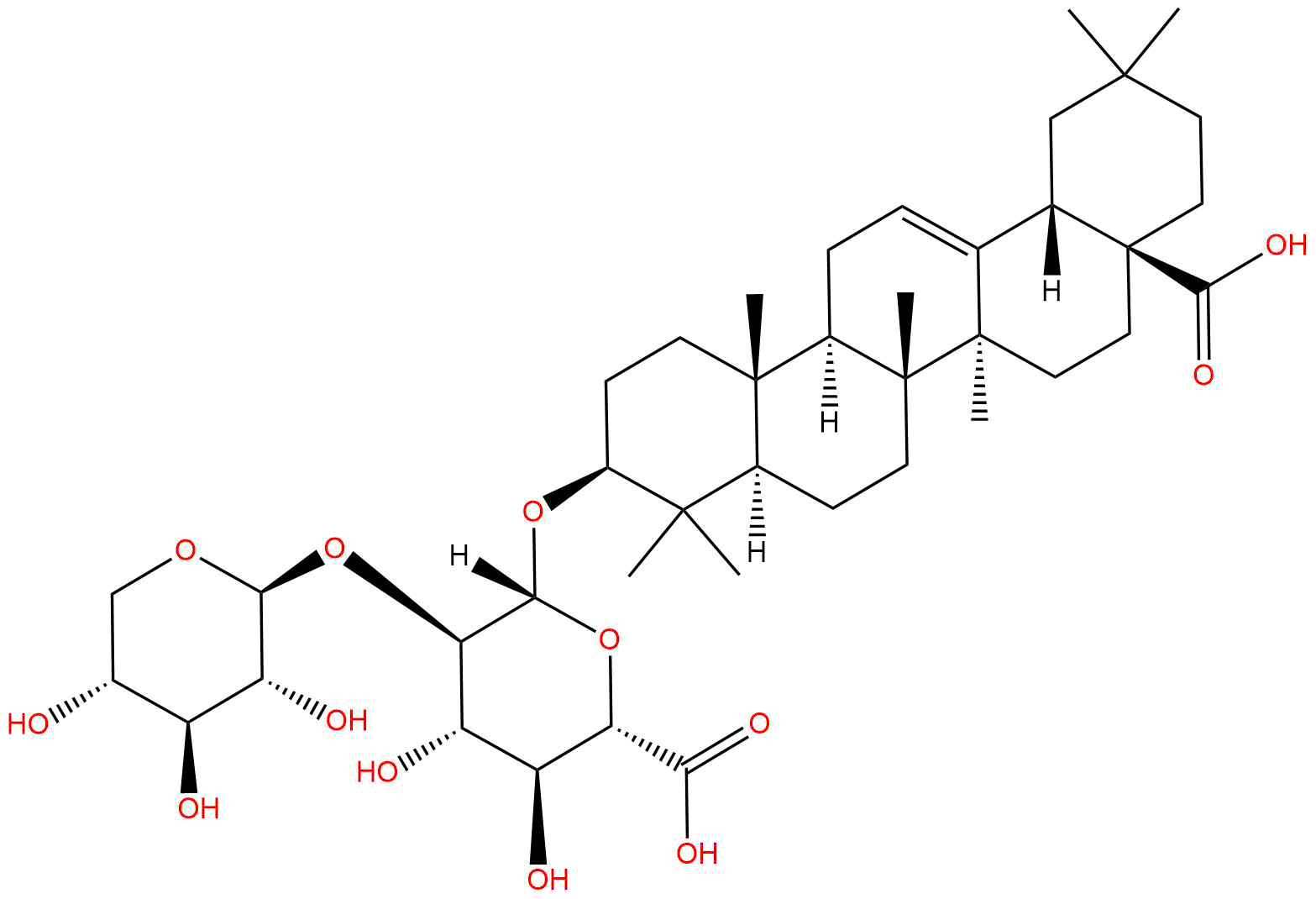


Product name: Pseudoginsenoside RP1
Synonym name:
Catalogue No.: BP2271
Cas No.: 96158-07-5
Formula: C41H64O13
Mol Weight: 764.95
Botanical Source: Aralia chinensis L
Type of Compound: Triterpenoids
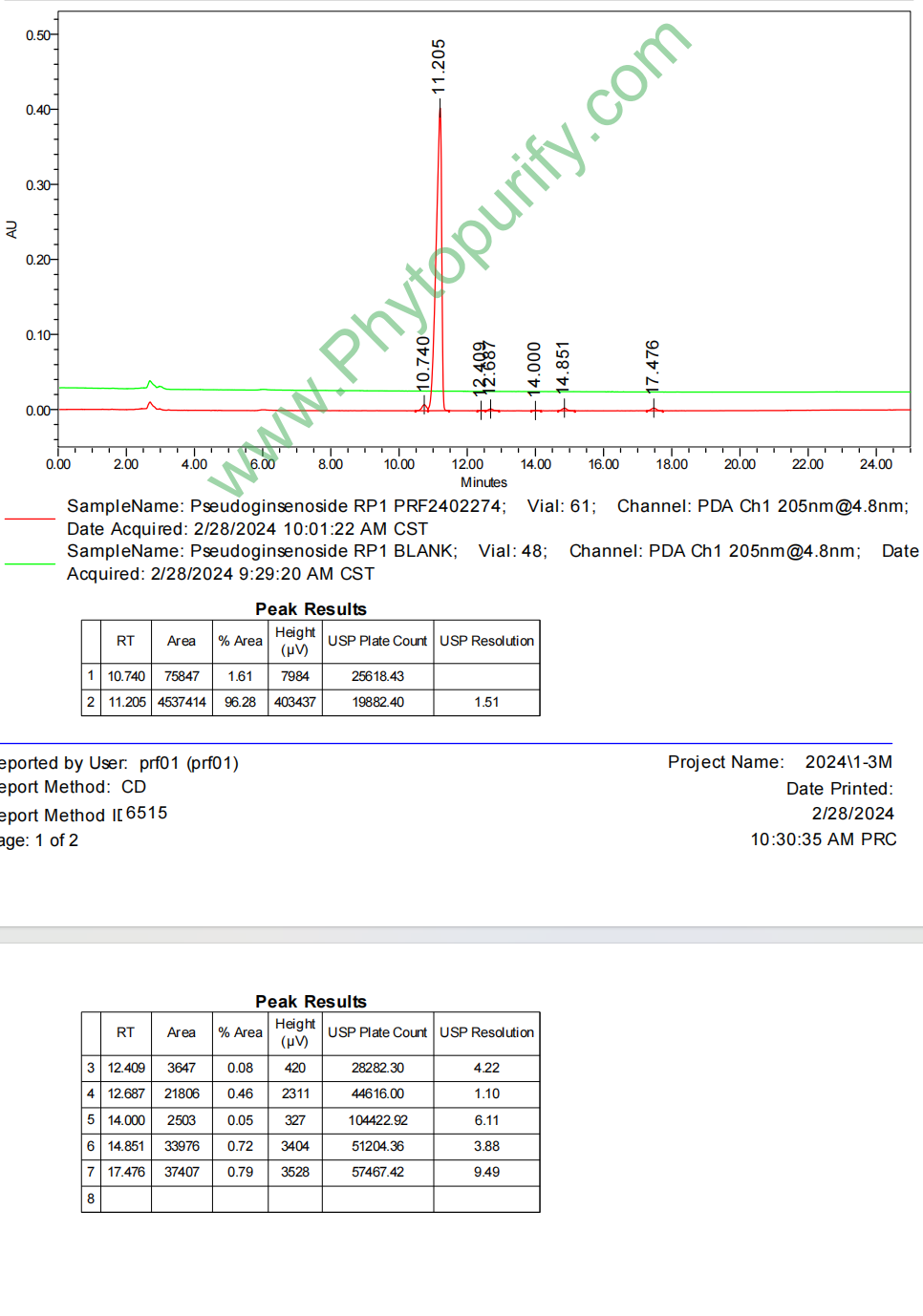
Purity: 95%~99%
Analysis Method: HPLC-DAD or/and HPLC-ELSD
Identification Method: Mass, NMR
Packing: Brown vial or HDPE plastic bottle
Storage: Store in a well closed container, protected from air and light. Put into refrigerate or freeze for long term storage.
Whenever possible, you should prepare and use solutions on the same day. However, if you need to make up stock solutions in advance, we recommend that you store the solution as aliquots in tightly sealed vials at -20℃. Generally, these will be useable for up to two weeks.
The product could be supplied from milligrams to grams
Inquire for bulk scale.
For Reference Standard and R&D, Not for Human Use Directly.
HPLC of Pseudoginsenoside RP1
Storage conditions:Short-term storage at 2~8℃, long-term storage at -20 ~ -80℃
212.6700
3.4058
.2963
.0531
.6221
.2232
Low
88.8252
5.7229
No
No
Yes
No
Yes
No
0.0
Yes
No
No
No
Natural products, as an important source of drug discovery, play an irreplaceable role in the long history of human struggle against diseases. Among them, it originates from plants of the ginseng genus(Panax The saponin compounds of spp have always been a hot topic in natural product chemistry and pharmacology research due to their wide pharmacological activity and unique chemical structure. Ginsenosides, as the main active ingredient of ginseng, have been proven to have various biological activities such as anti-tumor, anti-inflammatory, antioxidant, immune regulation, and improvement of cardiovascular function. However, the complexity of the chemical composition of ginseng plants determines the diversity of their active ingredients. In addition to the classic protopanaxadiol type (PPD) and protopanaxatriol type (PPT) saponins, a series of rare saponins formed by structural modifications are increasingly attracting the attention of researchers due to their unique or enhanced pharmacological activities.
Pseudoginsenoside RP1 (abbreviated as PG-RP1) is one of these rare saponins. Its CAS number is 96158-07-5, and it is a naturally occurring triterpenoid compound. From a chemical structure perspective, PG-RP1 belongs to the Dammarane type tetracyclic triterpenoid saponin, but its glycosyl side chain and aglycone structure differ significantly from common ginsenosides such as Rb1 and Rg1. This structural specificity endows PG-RP1 with unique physicochemical properties and biological activity profiles that distinguish it from other saponins.
In recent years, with the advancement of separation and purification technology and the improvement of pharmacological screening models, research on PG-RP1 has gradually deepened. Preliminary studies have shown that PG-RP1 has potential therapeutic value in various disease models, especially in the field of malignant tumors. Its inhibitory effect on prostate cancer has attracted widespread interest in the academic community. Prostate cancer is one of the most common malignant tumors in the male genitourinary system, with a complex pathogenesis involving multiple links such as androgen receptor (AR) signaling, apoptosis escape, angiogenesis, and metastasis. Although existing treatment methods such as androgen deprivation therapy (ADT) are initially effective, most patients eventually develop castration resistant prostate cancer (CRPC) with a very poor prognosis. Therefore, it is of great clinical significance to search for natural compounds with new mechanisms of action and high efficiency and low toxicity for the prevention and treatment of prostate cancer. The emergence of PG-RP1 provides a new candidate molecule for this field.
This article provides a systematic review of the research progress on ginsenoside RP1, covering its chemical structure and physicochemical properties, plant sources and extraction methods, pharmacological activity, mechanism of action and molecular targets, pharmacological evaluation and pharmacokinetic characteristics. It also looks forward to its clinical application prospects, aiming to provide comprehensive scientific basis for the in-depth development and utilization of this natural product.
The anthropomorphic ginsenoside RP1 belongs to the Dammarane type triterpenoid saponin, and its chemical structure is based on the core skeleton of Dammarane, which consists of 17 carbon atoms forming four fused rings (A, B, C, D) and is connected to an oxygen-containing side chain at position C-20. Compared with typical ginsenosides such as 20 (S) - protopanaxadiol type saponins, the structural characteristics of PG-RP1 are mainly reflected in the possible modifications on its glycosylation and aglycone.
Specifically, the aglycone of PG-RP1 is generally considered a derivative of 20 (S) - protopanaxadiol (PPD), but its C-20 side chain structure or glycosylation connection may differ. According to existing literature, the molecular formula of PG-RP1 is C ₄₂ H ₇₂ O ₁③, with a molecular weight of 764.9500 Da. Its structure typically contains a PPD type glycoside and sugar chains are connected at positions C-3 and C-20, respectively. Common glycan compositions may include glucose (Glc), arabinose (Ara), or xylose (Xyl), among others. The specific linking order and bond type (such as β - D-glucopyranose - (1 → 2) - β - D-glucopyranose) are crucial in determining its chemical properties and biological activity. Compared with the common ginsenoside Rb1 (containing 4 sugar groups), PG-RP1 has a smaller number of sugar groups (usually 2-3), which makes it exhibit stronger lipophilicity.
In terms of physicochemical properties, the lipid water partition coefficient (LogP) of PG-RP1 is 3.4058, indicating its lipophilicity, which facilitates its penetration of the cell membrane and interaction with intracellular targets. Its topological polar surface area (TPSA) is 212.6700 Å ², which is a relatively high value mainly attributed to the presence of multiple hydroxyl and glycosidic bonds in its molecule. A higher TPSA typically indicates poorer membrane permeability and lower bioavailability, but also suggests that it may not easily penetrate the blood-brain barrier (BBB). The pharmacological parameters clearly indicate that the blood-brain barrier penetration ability of PG-RP1 is "low", which to some extent limits its application in central nervous system diseases. However, for the treatment of peripheral tissue diseases (such as prostate), it may be a favorable factor that can reduce central nervous system side effects.
The water solubility of PG-RP1 is 0.0531 mg/mL, which belongs to the category of slight solubility. This limited water solubility is a common feature of many saponin compounds and is also one of the main bottlenecks restricting their formulation development and in vivo application. In terms of stability, PG-RP1 is relatively stable under acidic conditions, but under strong alkaline environments or the action of specific enzymes (such as β - glucosidase), its glycosidic bonds may undergo hydrolysis, generating secondary glycosides or aglycones. In addition, its molecular structure contains multiple chiral centers and exhibits optical rotation. Overall, the chemical structure of PG-RP1 determines its amphiphilic characteristics, which include both hydrophilic (sugar moiety) and lipophilic (glycoside moiety) properties. This amphiphilicity is the structural basis for saponin compounds to interact with biomolecules such as biofilms, proteins, and nucleic acids.
Anthropomorphic ginsenoside RP1 is not the main component of ginseng plants (such as ginseng, American ginseng, and Panax notoginseng), but a rare saponin with extremely low content. Its plant sources are relatively limited, mainly isolated from certain specific ginseng plants or their processed products. The currently known sources of PG-RP1 include:
Given the extremely low content of PG-RP1 in natural plants, direct extraction efficiency is not high and the cost is expensive. Therefore, its acquisition mainly relies on the following methods:
In recent years, significant progress has been made in the pharmacological activity research of anthropomorphic ginsenoside RP1, revealing its potential application value in multiple aspects such as anti-tumor, anti-inflammatory, antioxidant, and cardiovascular protection. Among them, the anti-tumor activity, especially the effect on prostate cancer, has been studied in depth.
prostate cancer Multiple in vitro and in vivo studies have shown that PG-RP1 has a significant inhibitory effect on the proliferation of prostate cancer cells such as LNCaP, PC-3, DU145, etc. Its functional characteristics are manifested as:
- Inducing cell apoptosis PG-RP1 can induce apoptosis in prostate cancer cells by activating endogenous (mitochondrial) and exogenous (death receptor) apoptotic pathways. Specifically, it is manifested as upregulating the expression of pro apoptotic proteins Bax and Bad, downregulating the expression of anti apoptotic protein Bcl-2, leading to a decrease in mitochondrial membrane potential (Δ PSI m), release of cytochrome c, and activation of Caspase-9 and Caspase-3, ultimately triggering cell apoptosis. Meanwhile, it can also upregulate the expression of death receptors (such as Fas) and their ligands (FasL), activating Caspase-8.
- Inhibition of cell proliferation and cycle arrest PG-RP1 can arrest the prostate cancer cell cycle in G0/G1 or G2/M phases, which is associated with downregulation of the expression of cyclin D1, cyclin B1, and cyclin dependent kinases (CDK4, CDK2, CDC2), as well as upregulation of cyclin dependent kinase inhibitors (such as p21, p27).
- Inhibit migration and invasion PG-RP1 can significantly inhibit the migration and invasion ability of prostate cancer cells, which is related to the downregulation of the expression and activity of matrix metalloproteinases (MMP-2, MMP-9), as well as the inhibition of epithelial mesenchymal transition (EMT) process.
Other tumors: In addition to prostate cancer, preliminary studies also found that PG-RP1 also showed certain growth inhibition on lung cancer, liver cancer, breast cancer, colorectal cancer and other tumor cell lines, but its sensitivity and mechanism of action may vary depending on the cell type.
Chronic inflammation and oxidative stress are important driving factors for the occurrence and development of various diseases, including cancer. Research has shown that PG-RP1 has significant anti-inflammatory and antioxidant activities:
- anti-inflammatory effect In a macrophage model stimulated by lipopolysaccharide (LPS), PG-RP1 can significantly inhibit the production of pro-inflammatory factors such as tumor necrosis factor - α (TNF - α), interleukin-6 (IL-6), and interleukin-1 β (IL-1 β). The mechanism may be related to the inhibition of the activation of the nuclear factor kappa B (NF - κ B) signaling pathway, by inhibiting the phosphorylation and degradation of I κ B α, preventing the nuclear translocation of NF - κ B p65 subunit, and thereby reducing the transcription of downstream inflammatory genes.
- Antioxidant effect PG-RP1 can directly scavenge free radicals such as DPPH free radicals and ABTS free radicals, and enhance the activity of endogenous antioxidant enzymes in cells such as superoxide dismutase (SOD), catalase (CAT), and glutathione peroxidase (GPx). More importantly, it can activate the nuclear factor E2 related factor 2 (NFE2L2, also known as NRF2) signaling pathway, promoting the expression of downstream antioxidant response element (ARE) driven genes (such as HO-1, NQO1), thereby enhancing the cell's defense against oxidative stress.
The pharmacological activity of anthropomorphic ginsenoside RP1 is the result of multi-target and multi pathway synergistic effects. Based on existing research, especially in-depth exploration of prostate cancer, its core mechanism of action can be summarized as follows, involving multiple key molecular targets.
This is the core mechanism of PG-RP1's anti-tumor effect. It breaks the survival advantage of tumor cells by finely regulating the balance between pro apoptotic and anti apoptotic proteins.
- Target: BCL2 family PG-RP1 can directly or indirectly downregulate the expression of anti apoptotic protein BCL2, while upregulating the expression of pro apoptotic protein BAX. The increase in BAX/BCL2 ratio is a key switch that initiates the mitochondrial apoptosis pathway. In addition, it may also affect other members of the BCL2 family, such as BID, BIM, etc.
- Target: CASP1 Caspase-1 (CASP1) is a key effector molecule for inflammasome activation and is involved in pyroptosis. Although traditionally believed to primarily mediate inflammatory cell death, recent studies have found that CASP1 also participates in the regulation of classical apoptosis in certain situations. The effect of PG-RP1 on CASP1 may be related to its dual anti-inflammatory and pro apoptotic activities.
- Target: STAT3 Signal transducer and activator of transcription factor 3 (STAT3) is a key oncogenic transcription factor that is continuously activated in various tumors, including prostate cancer, promoting cell proliferation, survival, angiogenesis, and immune escape. PG-RP1 can inhibit the phosphorylation (Tyr705 site) and nuclear translocation of STAT3, thereby blocking the transcription of downstream target genes (such as Cyclin D1, Bcl xL, Survivor, VEGF) and exerting anti-tumor effects.
PG-RP1 prevents unlimited proliferation of tumor cells by affecting cell cycle checkpoints.
- Target: PRKCA Protein kinase C alpha (PRKCA) is a member of the PKC family, involved in regulating cell proliferation, differentiation, and apoptosis. In some cases, activation of PRKCA can promote cell cycle progression. PG-RP1 may inhibit the activity of PRKCA, interfere with its downstream signals (such as the MAPK/ERK pathway), and lead to cell cycle arrest.
- Target: MAPT The microtubule associated protein Tau (MAPT) plays a crucial role in stabilizing microtubule structures, and its abnormal expression or phosphorylation is associated with mitosis and migration of tumor cells. The effect of PG-RP1 on MAPT may indirectly interfere with microtubule dynamics and affect cell division.
PG-RP1 blocks tumor invasion and metastasis by inhibiting extracellular matrix (ECM) degradation and EMT processes.
- Target: MMP2 Matrix metalloproteinase-2 (MMP2) is a key enzyme that degrades type IV collagen (the main component of the basement membrane) and plays a central role in tumor invasion and metastasis. PG-RP1 can significantly inhibit the expression and enzyme activity of MMP2 at the transcriptional and protein levels, thereby weakening the invasive ability of tumor cells.
- Target: ESR2 Estrogen receptor beta (ESR2/ER β) plays a complex role in prostate cancer and is generally considered to have anti-cancer properties. PG-RP1 may suppress tumor progression by upregulating the expression of ESR2 or enhancing its transcriptional activity, inhibiting AR signaling or promoting cell differentiation.
In addition, PG-RP1 may exert its comprehensive pharmacological effects by regulating other signaling pathways such as PI3K/Akt/mTOR, MAPK, Wnt/β - catenin, etc. Its multi-target characteristics give it unique advantages in dealing with complex diseases such as cancer, but also increase the difficulty of elucidating its precise molecular mechanisms.
The evaluation of drug properties and pharmacokinetic studies are crucial steps in promoting natural products from the laboratory to clinical applications. Based on the provided parameters and existing literature, conduct a preliminary evaluation of the pharmacological properties of PG-RP1.
Summary From the above parameters, PG-RP1 has good target binding potential (moderate LogP) and low risks of cardiac and genetic toxicity. However, its high molecular weight, high TPSA, and low water solubility are the main shortcomings in its drug development, especially its extremely low oral bioavailability, which is the biggest challenge facing its clinical translation.
At present, there are relatively limited research reports on the pharmacokinetics (PK) of PG-RP1 in vivo, but it can be inferred based on its structural characteristics and PK behavior of similar saponins:
- absorb Oral absorption is extremely poor. Saponins are easily degraded or metabolized in the gastrointestinal tract by the action of gastric acid, bile, and gut microbiota. The sugar chain of PG-RP1 may be gradually hydrolyzed by β - glucosidase produced by gut microbiota, producing secondary glycosides or aglycones (such as PPD), which may be absorbed into the bloodstream. Therefore, after oral administration of PG-RP1, its prototype drug concentration in plasma is usually extremely low, and its main active form may be its metabolite.
- distribution After intravenous administration, PG-RP1 may be widely distributed in blood rich tissues such as the liver, kidneys, and lungs. Due to its lipophilicity, it may highly bind to plasma proteins such as albumin. Low BBB penetration limits its distribution in the central nervous system.
- Metabolism The liver is the main site for saponin metabolism. PG-RP1 may undergo phase I metabolism (such as oxidation, reduction, hydrolysis) and phase II metabolism (such as glucuronidation, sulfation). The gradual hydrolysis of its sugar chains is the main metabolic pathway. The cytochrome P450 enzyme system (such as CYP3A4) may also be involved in the oxidative metabolism of its glycoside moiety.
- excretion Saponins and their metabolites are mainly excreted into the intestine through bile and excreted with feces. Only a small amount may be excreted through the kidneys in the form of urine. Its half-life (t1/2) may vary depending on the route of administration and animal species. After intravenous administration, it may be shorter (several hours), while after oral administration, it may exhibit a longer apparent half-life due to slow absorption and enterohepatic circulation.
As a natural product with unique structure and multi-target activity, anthropomorphic ginsenoside RP1 has shown broad clinical application prospects, but also faces many challenges.
As a rare and structurally unique saponin in the Panax genus, the anthropomorphic ginsenoside RP1 exhibits significant biological activity in various pharmacological fields such as anti-tumor (especially prostate cancer), anti-inflammatory, and antioxidant effects due to its multi-target and multi pathway action characteristics. It intervenes in malignant phenotypes such as apoptosis, proliferation, metastasis, and drug resistance of tumor cells by regulating a series of key molecular targets including BCL2, STAT3, MMP2, NFE2L2, ABCB1, etc. The mechanism of action network is clear and distinctive.
However, the pharmacological properties of PG-RP1 face severe challenges, with high molecular weight, high polarity, and low water solubility resulting in extremely low oral bioavailability, which has become the biggest obstacle for its transition from laboratory to clinical application. Future research should focus on: firstly, breaking through its bioavailability bottleneck through structural modification, prodrug design, or advanced nano drug delivery systems; The second is to use modern molecular biology and chemical biology techniques to thoroughly elucidate their precise molecular targets and mechanisms of action; The third is to develop efficient and green biotransformation preparation processes to solve their source problems.
Despite the numerous challenges ahead, the unique chemical space and excellent in vitro/in vivo activity of PG-RP1 make it a highly promising lead compound for development. With the continuous deepening of related research and the gradual breakthrough of technological bottlenecks, anthropomorphic ginsenoside RP1 is expected to become a new drug candidate molecule for the treatment of major diseases such as prostate cancer in the future, contributing to the cause of human health. The research on it not only enriches the treasure trove of natural product chemistry, but also provides valuable examples for discovering innovative drugs from traditional Chinese medicine.
