Introduction/Overview
Saikogenin A (CAS number: 5092-09-1) is an important active ingredient extracted from the traditional Chinese medicine Bupleurum spp. and belongs to the saponin class of natural products. Chaihu, as a commonly used medicinal herb in traditional Chinese medicine, has been widely used in the treatment of various diseases such as liver and gallbladder diseases, fever, inflammation, and immune regulation. With the development of modern pharmacology and molecular biology, saikosaponin A has received increasing attention due to its significant biological activity, especially its potential therapeutic effect in liver diseases. Recent studies have shown that saikosaponin A not only has significant anti-inflammatory and anti fibrotic effects, but also exhibits inhibitory activity against dipeptidyl peptidase IV (DPP-IV), providing a new target and mechanism basis for its treatment in diseases such as hepatitis and liver fibrosis.
This review aims to systematically summarize the chemical structure and physicochemical properties, plant sources and extraction methods, pharmacological activity and mechanism of action of saikosaponin A, with a focus on exploring its molecular targets and pharmacological evaluation in liver diseases, and finally looking forward to its clinical application prospects. By integrating existing basic and applied research, provide theoretical basis and research direction for the drug development of this natural product.
Chemical structure and physicochemical properties
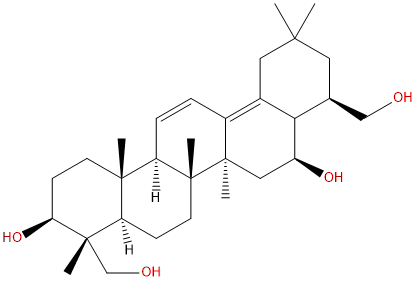
Chaihu saponin A is a typical triterpenoid saponin compound with a molecular formula of C30H48O5 and a molecular weight of 472.71. Its chemical structure contains a steroid skeleton with multiple hydroxyl and carboxyl functional groups, endowing it with certain polarity and biological activity. The LogP value of saikosaponin A is 4.655, indicating that it has high lipid solubility and is beneficial for penetrating cell membranes, but its water solubility is low (0.0021 mg/mL), suggesting limited solubility in aqueous media.
The molecular polar surface area (TPSA) is 80.92 Å ², indicating its moderate polarity, which may affect its drug absorption and distribution characteristics. The high penetration ability of the blood-brain barrier suggests that saikosaponin A may have certain effects or influences on the central nervous system. The negative result of hERG channel inhibition experiment indicates a low risk of cardiac toxicity; The Ames test result is 0.0, indicating no significant genotoxicity risk.
Overall, saikosaponin A has certain potential for drug development in terms of physicochemical properties, but its low water solubility and high lipid solubility may pose challenges to formulation design and in vivo bioavailability.
Plant sources and extraction methods
Bupleurum saponin A is mainly derived from Bupleurum spp., among which Bupleurum chinense DC. and Bupleurum scorzonerifolium Willd. are the main medicinal sources. Chaihu is a plant in the Umbelliferae family, and its roots are commonly used medicinal herbs in traditional Chinese medicine, containing abundant saponin compounds.
The common methods for extracting saikosaponin A from Bupleurum chinense include:
-
Solvent extraction
Ethanol or methanol are usually used as extraction solvents to obtain crude extracts through reflux or ultrasound assisted extraction. The ethanol concentration is generally controlled between 70% and 95% to balance the extraction efficiency of polar and non-polar components.
-
Separation and purification
The crude extract was separated and purified through multiple steps such as liquid-liquid distribution, silica gel column chromatography, and reverse phase high performance liquid chromatography (RP-HPLC) to obtain high-purity saikosaponin A. In recent years, supercritical CO ₂ extraction and molecular imprinting techniques have also been attempted to improve extraction efficiency and selectivity.
-
Structural Identification
The purified saikosaponin A was structurally confirmed using modern analytical techniques such as mass spectrometry (MS), nuclear magnetic resonance (NMR), and infrared spectroscopy (IR).
The optimization of extraction process not only affects the yield and purity of saikosaponin A, but also directly relates to its pharmacological activity and subsequent drug development and application.
Pharmacological activity research
The pharmacological activity research of saikosaponin A mainly focuses on its anti-inflammatory, anti liver fibrosis, and DPP-IV inhibitory effects, reflecting its potential in the treatment of liver diseases.
anti-inflammatory effect
Chaihu saponin A significantly reduces inflammatory response by inhibiting the nuclear factor kappa B (NF - κ B) signaling pathway, reducing the expression of pro-inflammatory cytokines such as TNF - α, IL-6, etc. Both in vitro cell models and in vivo animal models of inflammation have confirmed its good anti-inflammatory effect.
Anti hepatic fibrosis effect
Liver fibrosis is a common pathological process in the progression of various chronic liver diseases. Chaihu saponin A inhibits hepatic stellate cell activation and collagen (COL1A1) deposition by regulating transforming growth factor beta 1 (TGF - β 1) and its downstream signaling pathways, thereby reducing liver tissue fibrosis. In addition, its regulation of the expression of matrix metalloproteinase 9 (MMP9) and tissue inhibitory factor 1 (TIMP1) helps maintain the dynamic balance of the liver matrix.
DPP-IV inhibitory activity
As a DPP-IV inhibitor, saikosaponin A can prolong the half-life of incretin (GLP-1) and regulate blood glucose metabolism, suggesting its potential application in diabetes and related metabolic diseases. This activity may also indirectly affect liver metabolism and inflammatory status.
Mechanism of action and molecular targets
The mechanism of action of saikosaponin A in hepatitis and liver fibrosis involves multiple key molecular targets and signaling pathways:
-
NF - κ B signaling pathway
NF - κ B is a core transcription factor that regulates inflammatory responses. Chaihu saponin A inhibits the phosphorylation and degradation of I κ B α, prevents NF - κ B from entering the nucleus, reduces the transcription of inflammatory genes, and alleviates liver inflammation damage.
-
TGF - β 1/Smad signaling pathway
TGF - β 1 is a key pro fibrotic factor in liver fibrosis. Chaihu saponin A can inhibit the expression of TGF - β 1 and the phosphorylation of downstream Smad2/3, block the activation of hepatic stellate cells and collagen synthesis, and slow down the fibrosis process.
-
Matrix metalloproteinase-9 (MMP9) and tissue inhibitory factor 1 (TIMP1)
MMP9 is involved in the degradation of extracellular matrix (ECM), and TIMP1 is its inhibitory factor. Chaihu saponin A regulates the expression ratio of MMP9 and TIMP1, promotes normal metabolism of ECM, and prevents excessive fibrosis.
-
DPP-IV inhibition
By inhibiting DPP-IV activity, saikosaponin A prolongs the action time of GLP-1, improves insulin secretion and blood glucose control, and indirectly alleviates liver metabolic burden.
The synergistic regulation of these molecular targets enables saikosaponin A to exert a comprehensive therapeutic effect in multiple pathological processes.
Evaluation of drug properties and pharmacokinetics
The pharmacological evaluation of saikosaponin A involves its physicochemical properties, toxicological safety, and in vivo pharmacokinetic characteristics.
Physical and chemical properties and drug compatibility
The high lipid solubility and low water solubility of saikosaponin A suggest that its oral bioavailability may be limited. Its moderate TPSA and high blood-brain barrier penetration ability may bring potential effects or side effects to the central nervous system. In the development of formulations, it is necessary to use techniques such as nanocarriers, liposomes, or solid dispersions to improve their solubility and stability.
Toxicological safety
The hERG channel inhibition experiment was negative, indicating a low risk of cardiac toxicity; The Ames test results showed no significant genotoxicity. In addition, no significant toxic side effects were observed in animal acute toxicity experiments, supporting its safety.
Pharmacokinetic characteristics
At present, there is limited systematic pharmacokinetic data on saikosaponin A. Preliminary studies have shown that its oral absorption is slow, the plasma half-life is moderate, and it is mainly excreted through liver metabolism. Its high lipid solubility is beneficial for cell membrane penetration, but may lead to significant first pass effects in the liver. Further pharmacokinetic and metabolic studies are needed in the future to clarify their in vivo distribution, metabolic pathways, and excretion patterns.
Clinical application prospects and prospects
As a key active ingredient in Bupleurum chinense, saikosaponin A has multi-target and multi mechanism pharmacological properties, especially with significant potential in the treatment of hepatitis and liver fibrosis. Its DPP-IV inhibitory activity also provides new ideas for the combination therapy of metabolic diseases.
The future clinical application prospects are mainly reflected in the following aspects:
-
Liver disease treatment
Based on its anti-inflammatory and anti fibrotic effects, saikosaponin A is expected to become an adjuvant or alternative treatment for chronic hepatitis, liver fibrosis, and cirrhosis, especially suitable for early intervention and disease relief.
-
Metabolic disease management
Through DPP-IV inhibition, saikosaponin A may improve diabetes and its liver complications, and promote metabolic balance.
-
Multi target combination therapy strategy
Combining modern drug design concepts, saikosaponin A can be used in combination with other anti-inflammatory, antioxidant, or anti fibrotic drugs to achieve synergistic effects.
-
Development of new formulations
Developing new drug carriers such as nano formulations and sustained-release formulations to address the issue of poor water solubility will greatly enhance their clinical application value.
However, the clinical translation of saikosaponin A still faces challenges such as unclear pharmacokinetics, insufficient formulation development, and lack of clinical trial data. In the future, it is necessary to strengthen systematic pharmacological, toxicological, and clinical research to promote its transition from laboratory to clinical use.
Conclusion
Chaihu saponin A, as an important active saponin in Chaihu, has shown broad application prospects in the treatment of diseases such as hepatitis and liver fibrosis due to its unique chemical structure and diverse biological activities. It exerts anti-inflammatory and anti fibrotic effects by regulating key molecular targets such as NF - κ B, TGF - β 1, MMP9/TIMP1, while also possessing DPP-IV inhibitory activity and metabolic regulatory functions.
Although there is a preliminary understanding of the pharmacological mechanism of saikosaponin A, its pharmacological properties and clinical applications still require further research. In the future, by optimizing extraction and purification processes, improving drug formulations, and conducting systematic pharmacokinetic and clinical trials, saikosaponin A is expected to become a model in the field of natural product drug development, providing new treatment methods and scientific basis for liver diseases and related metabolic diseases.
In summary, saikosaponin A is not only an important object of modernization research in traditional Chinese medicine, but also a valuable resource for innovative development of natural medicines, which deserves continuous investment and exploration in basic and clinical research.