


Product name: Curcumol
Synonym name: 5,8-Epoxy-10(14)-guaien-8-ol
Catalogue No.: BP0422
Cas No.: 4871-97-0
Formula: C15H24O2
Mol Weight: 236.355
Botanical Source: Curcumae Rhizoma
Physical Description:
Type of Compound: Sesquiterpenoids
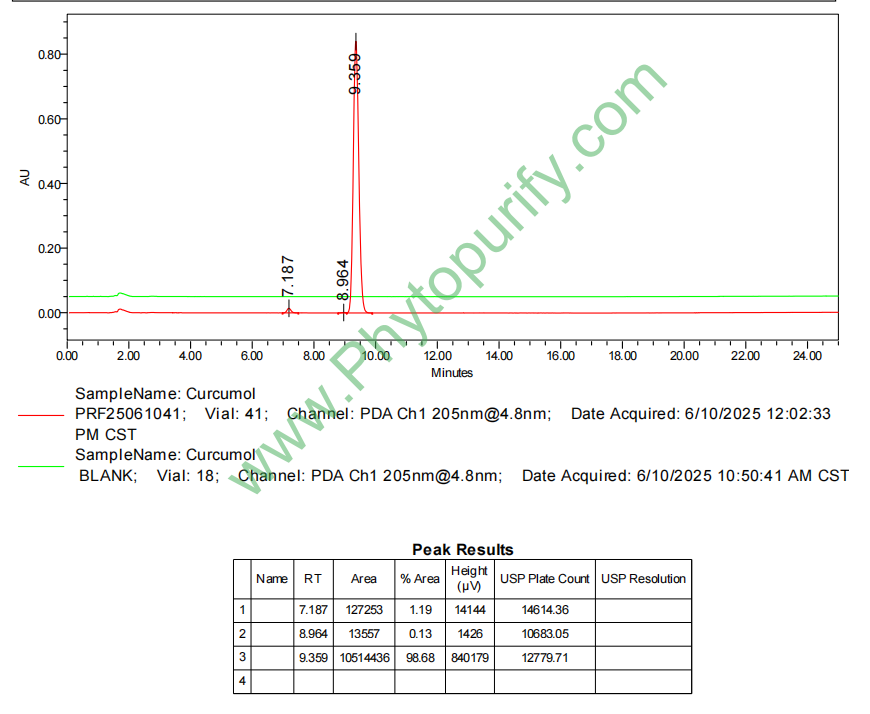
Purity: 95%~99%
Analysis Method: HPLC-DAD or/and HPLC-ELSD
Identification Method: Mass, NMR
Packing: Brown vial or HDPE plastic bottle
Storage: Store in a well closed container, protected from air and light. Put into refrigerate or freeze for long term storage.
Whenever possible, you should prepare and use solutions on the same day. However, if you need to make up stock solutions in advance, we recommend that you store the solution as aliquots in tightly sealed vials at -20℃. Generally, these will be useable for up to two weeks.
The product could be supplied from milligrams to grams
Inquire for bulk scale.
Chengdu Biopurify Phytochemicals Ltd. is a leading company in the research, development, manufacture and marketing of High Quality Phytochemicals and Extracts(especially Active Ingredients from Traditional Chinese Medicine,TCM), Natural Active Pharmaceutical Ingredients worldwide.
The main services:
A. Supply active ingredients and reference standards of TCM, from mgs to kgs scale
B. Custom extraction and purification, target Herb Active Ingredients
C. Custom synthesis and semi-synthesis for Natural Active Ingredients
D. CR(contract research), CM(contract manufacture) and PD(process development) services from lab scale, pilot scale to commercial scale(GMP is also available)
E. TCM compounds library for drug screen,more than 3000 compounds available, many of them are rare and unique.
HPLC of Curcumol
Storage conditions:Short-term storage at 2~8℃, long-term storage at -20 ~ -80℃
Curcumol, CAS number 4871-97-0, is a naturally occurring sesquiterpene compound mainly distributed in the ginger family plant Curcuma wenyujin Y.H. Chen et C. Ling. As a natural product with multiple biological activities, curcumin has shown significant pharmacological potential in the fields of anti-cancer, antimicrobial, antifungal, antiviral, and anti-inflammatory effects. In recent years, with the advancement of natural product pharmacology and molecular biology techniques, the mechanism of action and molecular targets of curcumin have gradually been revealed, especially in inducing cell apoptosis by regulating key cell signaling pathways in various tumor cells, becoming an important candidate molecule for the development of anti-tumor drugs.
This review aims to systematically summarize the chemical structure and physicochemical properties, plant sources and extraction methods, pharmacological activity research progress, mechanism of action and molecular targets, pharmacological evaluation and pharmacokinetic characteristics of curcumin, and explore its clinical application prospects and future research directions, providing theoretical support and research references for researchers in related fields.
Curcumol is a sesquiterpene compound with a molecular formula of C15H24O2 and a molecular weight of 236.35. Its chemical structure contains a typical sesquiterpene skeleton with two hydroxyl groups, endowing it with certain polarity and biological activity. The LogP value of curcumin is 2.8, indicating that it has moderate lipid solubility, which is beneficial for membrane penetration and in vivo distribution. The topological polar surface area (TPSA) is 40.46 Å ² and the number of hydrogen bond acceptors is 2, indicating its ability to form hydrogen bonds in drug target protein binding.
Curcumol has high blood-brain barrier permeability, indicating that it may act on central nervous system related diseases. In addition, curcumin has shown good safety in vivo, with no hepatotoxicity, cardiotoxicity, or hERG channel inhibition, and a negative Ames mutagenicity test, indicating a low risk of genotoxicity.
Curcuma wenyujin is mainly found in the ginger plant Curcuma wenyujin, which is widely used in traditional Chinese medicine for promoting blood circulation, removing blood stasis, reducing swelling, and relieving pain. As an important component of the volatile oil and lipid soluble components of Curcuma zedoaria, its content and quality are significantly affected by planting environment, harvesting period, and processing methods.
Traditional extraction methods often use solvent extraction combined with fractionation technology. Common extraction solvents include ethanol, methanol, ethyl acetate, etc. After extraction, purification is carried out through column chromatography, preparative liquid chromatography, and other methods. In recent years, green and efficient technologies such as ultrasound assisted extraction and microwave-assisted extraction have been introduced into the extraction process of curcumin, significantly improving extraction efficiency and purity while reducing the use of organic solvents, in line with modern green chemistry concepts.
The pharmacological activity research of curcumin covers multiple aspects such as anti-tumor, antimicrobial, antifungal, antiviral, and anti-inflammatory effects.
Curcumol has significant inhibitory effect in many tumor cell lines, especially in solid tumors such as breast cancer, lung cancer, liver cancer and colorectal cancer. Its anti-cancer mechanism is mainly achieved through multiple pathways such as inducing cell apoptosis, inhibiting cell proliferation, blocking cell cycle, and inhibiting tumor cell migration and invasion.
In breast cancer, curcumol can regulate a variety of key molecular targets, such as AMPK (PRKAA1), BCL2, STAT3, ESR2, ABCB1, ABCG2, PRKCA, MAPT, NFE2L2 and TOP1, and significantly inhibit the growth and drug resistance of tumor cells. It activates the AMPK signaling pathway, inhibits the BCL2 mediated anti apoptotic mechanism, reduces the pro cancer transcriptional activity of STAT3, and enhances cell apoptosis signaling.
Curcumol exhibits inhibitory effects on various pathogenic bacteria and fungi, particularly strong bactericidal activity against Gram positive bacteria and certain fungal strains. Its mechanism of action may involve disrupting cell membrane structure, inhibiting key enzyme activity, and interfering with microbial metabolic processes.
Curcumol exhibits inhibitory effects on various viruses, including influenza virus, hepatitis B virus, etc. Research has shown that curcumin can exert antiviral effects by regulating the immune response of host cells and directly inhibiting virus replication.
Curcumol significantly alleviates inflammation by inhibiting the NF - κ B signaling pathway, reducing the expression of pro-inflammatory factors such as TNF - α, IL-6, and IL-1 β. Its anti-inflammatory effect has been validated in various inflammatory models, demonstrating potential application value in treating inflammatory diseases.
The multi-target mechanism of action of curcumin is the basis for its broad pharmacological activity. It mainly regulates cell proliferation, apoptosis, and inflammatory response by modulating key signaling pathways within cells, including MAPK/ERK, PI3K/Akt, and NF - κ B.
In cancer treatment, curcumin promotes energy metabolism regulation and inhibits tumor cell growth by activating the AMPK (PRKAA1) pathway. Its regulation of BCL2 family proteins reduces anti apoptotic signals and promotes mitochondrial mediated cell apoptosis. After the STAT3 signaling pathway is inhibited, the proliferation and immune escape ability of tumor cells are weakened. Curcumol also affects the expression of drug efflux pumps ABCB1 and ABCG2, overcoming multidrug resistance in tumor cells.
In addition, curcumin regulates the estrogen receptor ESR2 and affects the growth of hormone dependent tumors. PRKCA and MAPT, as key proteins in cell signal transduction and microtubule stability, are also regulated by curcumin, further affecting cell cycle and migration ability. As a regulatory factor of oxidative stress response, NFE2L2's activity regulation helps cells resist oxidative damage. TOP1, as a DNA topoisomerase, its inhibition helps block DNA replication and transcription in tumor cells.
Curcumol has good medicinal properties. Its molecular weight is 236.35, moderate lipid solubility (LogP 2.8), and low polarity (TPSA 40.46) are beneficial for oral absorption and cell membrane penetration. The number of hydrogen bond receptors is 2, which conforms to Lipinski's rule and is conducive to binding with target proteins.
The high permeability of the blood-brain barrier suggests that curcumin has potential advantages in the treatment of central nervous system diseases. Toxicological evaluation shows that curcumin has no significant hepatotoxicity, cardiotoxicity, or hERG channel inhibitory effect, and is relatively safe. A negative Ames test indicates a low risk of genotoxicity and is suitable for further drug development.
Pharmacokinetic studies have shown that curcumin has good bioavailability and distribution characteristics in vivo. Its metabolic pathway mainly involves the liver enzyme system, and its excretion pathway is mainly through bile and urine. Its half-life is moderate and can maintain effective blood drug concentration, supporting the design of clinical dosing regimens.
As a multifunctional natural product, curcumin has a wide range of pharmacological activities and good safety, demonstrating strong clinical application potential. Especially in the adjuvant treatment of solid tumors such as breast cancer, curcumol regulates the proliferation and apoptosis of tumor cells through multiple targets and pathways, which is expected to overcome the drug resistance and side effects of traditional chemotherapy drugs.
Future research should focus on preclinical efficacy evaluation, dosage form optimization, and combination therapy strategies of curcumin, further clarifying its pharmacokinetic characteristics and safety evaluation. At the same time, based on modern molecular pharmacology techniques, we will deeply analyze the interaction mechanism between curcumin and target proteins, and promote its clinical translation.
In addition, the potential applications of curcumin in anti-inflammatory, antiviral, and neuroprotective fields are also worth paying attention to. By combining nanotechnology and targeted delivery systems, it is expected to improve its bioavailability and targeting, and expand its clinical application scope.
Curcumol, as a natural sesquiterpene with multiple pharmacological activities, has shown broad clinical application prospects due to its unique chemical structure and good medicinal properties. Its significant activities in anti-cancer, antimicrobial, antiviral, and anti-inflammatory aspects provide valuable resources and ideas for the development of natural product drugs. In the future, through systematic pharmacological mechanism research and preclinical evaluation, curcumin is expected to become an important representative of new natural medicines, promoting the application and development of natural products in modern medicine.
