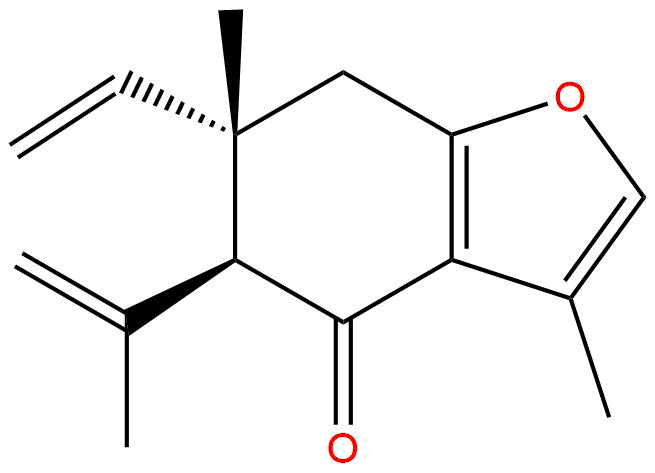


Product name: Curzerenone
Synonym name:
Catalogue No.: SBP03073
Cas No.: 20493-56-5
Formula: C15H18O2
Mol Weight: 230.307
Botanical Source: Curcumae Rhizoma
Physical Description:
Type of Compound: Sesquiterpenoids
Purity: 95%~99%
Analysis Method: HPLC-DAD or/and HPLC-ELSD
Identification Method: Mass, NMR
Packing: Brown vial or HDPE plastic bottle
Storage: Store in a well closed container, protected from air and light. Put into refrigerate or freeze for long term storage.
Whenever possible, you should prepare and use solutions on the same day. However, if you need to make up stock solutions in advance, we recommend that you store the solution as aliquots in tightly sealed vials at -20℃. Generally, these will be useable for up to two weeks.
The product could be supplied from milligrams to grams
Inquire for bulk scale.
For Reference Standard and R&D, Not for Human Use Directly.
Storage conditions:Short-term storage at 2~8℃, long-term storage at -20 ~ -80℃
35.5300
2.8100
Unknown
Unknown
Unknown
Unknown
Unknown
Unknown
Unknown
Curzerenone (CAS No. 20493-56-5) is a natural product isolated from the essential oil of Xizang's Curcuma zedoaria, which belongs to a sesquiterpene compound. In recent years, with the increasing importance of natural products in drug development, curcumin has gradually become a research hotspot in the fields of pharmacology and natural medicinal chemistry due to its unique chemical structure and potential multi-target pharmacological activity. Previous studies have shown that curcumin has inhibitory effects on various pathogenic microorganisms, especially exhibiting slight inhibitory activity against Escherichia coli. In addition, curcumin may exert potential therapeutic effects in various pathological states such as tumors, inflammation, and metabolic diseases by regulating key molecular targets. This article aims to systematically review the chemical structure, sources, pharmacological activity, and mechanism of action of curcumin, evaluate its pharmacological properties and clinical application prospects, and provide theoretical basis for subsequent research and development.
The molecular formula of curcumin is C15H22O2, with a molecular weight of 230.30. Its chemical structure belongs to sesquiterpene ketones, with typical terpenoid skeletons and ketone functional groups. Its LogP value is 2.81, indicating moderate lipid solubility and facilitating cell membrane penetration. Its topological polar surface area (TPSA) is 35.53 Å ², and the number of hydrogen bond acceptors is 2, indicating that it has certain bioavailability and good membrane permeability in vivo. The structure of curcumin contains a cyclic terpene skeleton and a ketone group, which endows it with certain chemical stability and reactivity. Although its safety indicators such as blood-brain barrier penetration, hepatotoxicity, cardiotoxicity, hERG inhibition, and mutagenicity (Ames test) are not yet clear, its physicochemical properties lay the foundation for its potential as a drug molecule.
Zedoary turmeric ketone mainly exists in the essential oil of Xizang Camphor tree leaves. Curcuma zedoaria, a plant of the ginger family, is widely distributed in tropical and subtropical regions of Asia. It is traditionally used in traditional Chinese medicine and folk herbs, and has the effects of promoting blood circulation, removing blood stasis, reducing swelling, and relieving pain. Curcumone, as one of its volatile components, is usually extracted from essential oils by distillation and purified using chromatographic techniques such as column chromatography and gas chromatography-mass spectrometry (GC-MS). In recent years, modern green extraction methods such as supercritical CO2 extraction and microwave-assisted extraction have also been applied to improve the extraction efficiency and purity of curcumin. The temperature, time, and solvent selection during the extraction process have a significant impact on the yield and stability of curcumin.
The pharmacological activity research of curcumin mainly focuses on antibacterial, anti-tumor, anti-inflammatory, and metabolic regulation aspects.
Curcumone exhibits a slight inhibitory effect on Escherichia coli, indicating its potential for antibacterial activity. Although its activity against other bacteria has not been systematically reported, as a natural volatile oil component, curcumin may exert antibacterial effects by disrupting bacterial cell membranes, interfering with bacterial metabolic pathways, and other mechanisms. In addition, the regulatory effect of curcumin on bacterial lipopolysaccharide receptor TLR4 needs further research, which may provide a molecular basis for its antibacterial and anti-inflammatory activities.
Curcumone exhibits potential regulatory ability on targets related to lung cancer and colon cancer. Lung cancer related targets include BCL2, MAPT, PIK3CA, EGFR, TP53, CDKN2A, ATP1A1, KRAS, MET, and BAX. Curcumone may affect tumor cell proliferation, apoptosis, and migration by regulating these signaling pathways. The targets related to colon cancer include EGFR, KRAS, VEGFA, TP53, and CTNNB1. Curcumone may exert anti-tumor effects by inhibiting epidermal growth factor receptor signaling, angiogenesis, and cell cycle regulation. The existing in vitro cell experiments and molecular docking studies support the inhibitory potential of curcumin on tumor cells, but lack systematic in vivo validation and mechanism analysis.
Curcumone may exert anti-inflammatory effects in inflammatory diseases such as rheumatoid arthritis by regulating inflammatory factors such as TNF, IL6, NFKB1, IL1B, and MMP3. Its inhibitory effect on the nuclear factor kappa B signaling pathway may be a key mechanism for reducing inflammation and tissue damage. In addition, the regulation of bacterial enteritis related targets such as TLR4 by curcumin suggests its potential application value in intestinal immunity and inflammation.
In the related research of diabetes nephropathy, curcumone may play an anti fibrotic, antioxidant and anti-inflammatory role and slow down the process of kidney damage by regulating transforming growth factor beta 1 (TGFB1), angiotensin II receptor type 1 (AGTR1), nuclear factor E2 related factor 2 (NFE2L2), vascular endothelial growth factor (VEGFA), IL1B and other molecules. Although relevant research is still in its early stages, the potential of curcumin in metabolic diseases deserves further exploration.
The multi-target mechanism of action of curcumin is an important basis for its pharmacological activity. Its regulation of tumor related targets involves apoptosis regulatory proteins (such as BCL2, BAX), signal transduction molecules (EGFR, PIK3CA, KRAS, MET), tumor suppressor factors (TP53, CDKN2A), etc. It may exert anti-cancer effects by inducing tumor cell apoptosis, inhibiting proliferation and migration. The effect of curcumin on colon cancer targets, especially the inhibition of epidermal growth factor receptors and angiogenic factors, suggests that it may inhibit tumor angiogenesis and signal transduction.
In terms of inflammation and immune regulation, curcumin reduces the expression of pro-inflammatory cytokines such as TNF, IL6, and IL1B by inhibiting the nuclear factor kappa B signaling pathway, thereby alleviating the inflammatory response. Meanwhile, its regulation of matrix metalloproteinase-3 (MMP3) helps prevent tissue damage and joint injury.
The regulation of zedoary turmeric ketone on targets related to diabetes nephropathy mainly involves anti fibrosis and antioxidant signaling pathways, such as TGFB1 and NFE2L2, which may protect renal function by reducing glomerulosclerosis and oxidative stress.
In addition, the effects of curcumin on key bacterial enzymes such as DNA polymerase and β - lactase are not yet clear, but its regulation of bacterial lipopolysaccharide receptor TLR4 suggests that it may indirectly inhibit bacterial infection by regulating host immune response.
The molecular weight of curcumin is 230.3, which conforms to the Lipinski rule for drug molecular weight range. The LogP is 2.81, indicating that it has good lipid solubility and is beneficial for cell membrane penetration and oral absorption. Its TPSA is 35.53 Å ² and the number of hydrogen bond receptors is 2, both of which support its good bioavailability and in vivo distribution potential.
At present, the blood-brain barrier permeability of curcumin is not yet clear, but its moderate lipid solubility suggests that it may have some central nervous system permeability. There is no systematic data on safety indicators such as hepatotoxicity, cardiotoxicity, and hERG channel inhibition, and further evaluation is needed through in vivo toxicology and pharmacokinetic studies.
In terms of pharmacokinetics, as a natural volatile oil component, curcumin may have rapid absorption and metabolic characteristics, but its specific absorption, distribution, metabolism, and excretion (ADME) parameters have not been systematically reported. In the future, in combination with internal and external experiments, modern analytical techniques such as LC-MS/MS should be used to clarify its biological half-life, metabolic pathways, and main metabolites, providing a basis for clinical development.
As a natural sesquiterpene ketone compound, curcumin has shown potential application value in anti-tumor, anti-inflammatory, antibacterial, and metabolic disease treatment due to its multi-target and multi pathway pharmacological activities. Especially in the adjuvant therapy of malignant tumors such as lung cancer and colon cancer, curcumin may enhance the efficacy of existing treatment plans and reduce side effects by regulating key tumor signaling pathways.
In inflammatory diseases such as rheumatoid arthritis and bacterial enteritis, curcumin is expected to become a new candidate for natural anti-inflammatory drugs by inhibiting inflammatory factors and regulating immune responses. In addition, its anti fibrosis and antioxidant effects in diabetes nephropathy provide new ideas for the treatment of chronic metabolic diseases.
However, the clinical application of curcumin still faces many challenges. Firstly, its safety and toxicological characteristics have not been systematically evaluated, and comprehensive in vivo toxicological studies are needed. Secondly, the pharmacokinetic properties of curcumin are unclear, which limits the optimization of its dosage form design and administration regimen. Again, the lack of large-scale preclinical and clinical trial data makes it difficult to establish its exact therapeutic efficacy and indications.
Future research should focus on exploring the mechanism of action of curcumin, combining modern molecular biology and medicinal chemistry methods to optimize its structure and improve its activity and safety. At the same time, conduct systematic pharmacokinetic and toxicological research to promote its clinical translation. The development of multi-target combination therapy strategies and nanocarrier delivery systems will also provide new opportunities for the clinical application of curcumin.
As an important active component in the essential oil of Xizang Camphor Leaf, zedoary ketone shows broad potential for drug development by virtue of its unique chemical structure and multi-target pharmacological activity. Its multiple roles in antibacterial, anti-tumor, anti-inflammatory, and metabolic diseases provide valuable examples for the pharmacological research of natural products. Although the pharmacological properties and clinical applications of curcumin are still in their infancy, with further research, it is expected to become an important candidate molecule for new natural medicines. In the future, it is necessary to strengthen the systematic pharmacological research and preclinical evaluation of curcumin, promote its clinical application, and provide new natural drug options for the treatment of related diseases.
