Introduction/Overview
Natural products have long been an important source of innovative drug discovery, among which terpenoids have attracted much attention due to their structural diversity and wide range of biological activities. Furanodienon, as a unique furan type sesquiterpene compound, has emerged in the field of anti-tumor pharmacology in recent years, particularly demonstrating significant inhibitory potential against malignant tumors such as liver cancer. Liver cancer is a malignant tumor with the highest incidence rate and mortality in the world. Its occurrence and development involve complex molecular network regulation. It is an urgent need to find new therapeutic drugs with high efficiency and low toxicity. Curcuma phaeocaulis Val., a traditional Chinese medicine for promoting blood circulation and removing blood stasis, is mainly derived from plants of the Curcuma genus. These plants are commonly used in traditional Chinese medicine for the treatment of diseases such as disease accumulation, providing traditional medical evidence for their anti-tumor activity. Preliminary modern pharmacological research has revealed that this compound can act on multiple molecular targets closely related to liver cancer, such as BCL2, STAT3, TP53, by intervening in multiple key biological processes such as cell apoptosis, proliferation, invasion, and metastasis, exhibiting a multi pathway and multi target characteristic of action. This article aims to provide a systematic review of the chemical properties, plant sources, pharmacological activities, molecular mechanisms of action, medicinal properties, and clinical application prospects of curcumin, in order to provide comprehensive scientific references for the deep development and transformation research of this natural product.
Chemical structure and physicochemical properties
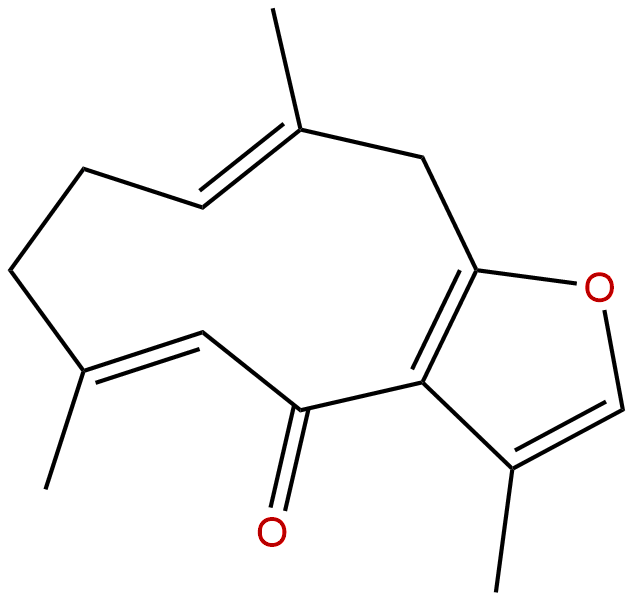
The chemical name of zedoary furan ketone is (3aS, 5R, 9aS, 9bR) -3a, 4,5,7,8,9,9a, 9b-octahydro-5-methyl-3-methyl-naphtho [1,2-c] furan-1 (3H) - one, and its CAS registration number is 24268-41-5. Structurally, it is a typical guaiaceae sesquiterpene, with a core skeleton composed of a decahydronaphthalene ring system fused with a furan ring, and containing an alpha, beta unsaturated ketone (enone) structural unit. This unique furan enone conjugated system is the key pharmacophore for its biological activity, making it easy to undergo Michael addition reactions with biomolecules such as nucleophilic amino acid residues in proteins, thereby regulating target function.
Its molecular formula is C15H18O2 and its molecular weight is 230.3070. The calculated lipid water partition coefficient (LogP) is 3.4531, indicating that the compound has moderate lipophilicity, which is beneficial for its penetration of cell membranes, but may also affect its water solubility and in vivo distribution. Its topological polar surface area (TPSA) is 30.2100 Å ², which is a relatively small value, further confirming its good membrane permeability. The predicted value of water solubility is relatively low, about 0.0236 mg/mL, indicating that it may be necessary to improve its solubility and bioavailability in formulation development through structural modification or the use of appropriate delivery systems (such as nano formulations, cyclodextrin inclusion, etc.). Preliminary drug risk assessment shows a high tendency for it to cross the blood-brain barrier (BBB), providing clues for potential therapeutic research on central nervous system related diseases such as glioma. Importantly, preliminary toxicity warnings indicate that it has no significant inhibitory effect on hERG potassium channels (hERG inhibition: No), reducing the risk of causing QT interval prolongation in the heart; The Ames test predicted a value of 0.3, indicating a low risk of mutagenicity, laying the foundation for further safety evaluation.
Plant sources and extraction methods
Curcuma curcuma is mainly found in the rhizomes of various plants in the Curcuma genus of the ginger family, especially in the traditional Chinese medicine Curcuma curcuma. As a commercial medicinal herb, Curcuma zedoaria mainly includes Curcuma phaeocaulis Val., Curcuma kwangsiensis S. G. Lee et C. F. Liang, and Curcuma wenyujin Y. H. Chen et C. Ling. This compound is one of the important active ingredients in the volatile oil of Curcuma zedoaria, often coexisting with other sesquiterpene compounds such as curcumin, gemcitabine, and β - elemene.
Its extraction and separation usually follow the conventional process of natural product chemistry. Firstly, the volatile oil fraction rich in sesquiterpenes was obtained from the dried rhizomes of Curcuma zedoaria using steam distillation or supercritical CO2 fluid extraction. Due to the relatively stable thermal properties of curcumin, both methods are applicable. Among them, supercritical extraction has the advantages of high efficiency, low solvent residue, and good protection of thermosensitive components. After obtaining the volatile oil, further separation and purification are required. Silica gel column chromatography is commonly used for preliminary separation, using solvent systems of different polarities (such as petroleum ether ethyl acetate gradient elution). Subsequently, a combination of preparative thin layer chromatography (PTLC) or high-performance liquid chromatography (HPLC, often using a reverse phase C18 column with methanol water as the mobile phase) was used for fine purification to obtain high-purity curcumin furadienone monomer. Modern analytical techniques such as gas chromatography-mass spectrometry (GC-MS) and liquid chromatography-mass spectrometry (LC-MS) are commonly used for qualitative and quantitative analysis of the compound during the extraction process. It is worth noting that there may be structural rearrangement or degradation of curcumin during storage, so the storage conditions of the extract and pure product (such as low temperature, light avoidance, and inert gas protection) need to be controlled.
Pharmacological activity research
Numerous in vitro and in vivo pharmacological studies have confirmed that curcumin has a wide range of biological activities, with the most prominent and extensively studied being its anti-tumor activity, particularly evident in liver cancer models.
1. Antitumor activity:
* liver cancer: Multiple studies have confirmed that curcumin can effectively inhibit the proliferation of various liver cancer cell lines (such as HepG2, Hep3B, SMMC-7721), and its effect is concentration - and time-dependent. It can induce cell cycle arrest (such as G2/M phase arrest) in liver cancer cells and significantly trigger cell apoptosis. In the nude mouse transplant tumor model, the administration of curcumin can significantly inhibit tumor growth, and the toxic reactions such as weight loss are relatively mild, showing a certain therapeutic window.
* Other cancers: In addition to liver cancer, this compound also shows birth growth inhibitory activity on breast cancer, lung cancer, colon cancer, gastric cancer and other cancer cells, indicating that its anti-tumor spectrum is broad.
2. Anti inflammatory and analgesic activity:
As one of the components of the volatile oil from Curcuma zedoaria, Curcuma zedofuran ketone also contributes to the anti-inflammatory and analgesic effects of the parent drug. In classic inflammation and pain models such as carrageenan induced paw swelling in rats and acetic acid induced twisting in mice, this compound exhibits significant inhibitory effects. Its anti-inflammatory effect is related to the inhibition of the production of inflammatory mediators such as prostaglandin E2 (PGE2).
3. Antibacterial and antiviral activity:
Preliminary studies have shown that curcumin has inhibitory effects on some bacteria such as Staphylococcus aureus, Escherichia coli, and certain fungi. In addition, there are reports that it has certain antiviral potential.
4. Other activities:
It also includes antioxidant and anti fibrotic effects. These multifaceted pharmacological activities together form the potential basis for the use of curcumin as a candidate drug, with its anti liver cancer activity being the absolute focus of current research.
Mechanism of action and molecular targets
The anti-tumor effect of curcumin, especially its anti liver cancer effect, is not achieved through a single pathway, but involves a complex multi-target regulatory network. According to the provided target information, its mechanism of action can be summarized into the following key aspects:
1. Inducing cell apoptosis: This is one of its most core mechanisms. Curcuma curcuma can upregulate pro apoptotic proteins (such as BAX) and downregulate anti apoptotic proteins BCL2 The expression of BCL2/BAX is reduced, leading to a decrease in the BCL2/BAX ratio and inducing apoptosis through the mitochondrial pathway. In addition, it can inhibit transcription factors STAT3 Phosphorylation and activation. STAT3 is an important oncogene, and its sustained activation promotes cell survival (by upregulating MCL-1, BCL2, etc.) and proliferation. Inhibiting the STAT3 pathway is an important step in inducing apoptosis and inhibiting growth.
2. Inhibit cell proliferation and telomerase activity: This compound can interfere with the cell cycle process, and its mechanism may be related to affecting the expression of cyclins and cyclin dependent kinases. Meanwhile, it has been reported to inhibit telomerase reverse transcriptase TERT The activity. Telomerase activity is abnormally activated in most cancer cells to maintain telomere length, and inhibition of TERT can lead to replicative aging and death of cancer cells.
3. Inhibit invasion and metastasis: The metastasis of liver cancer is the main reason for treatment failure. Curcuma furodenone can significantly reduce matrix metalloproteinases MMP9 Expression and secretion. MMP9 can degrade extracellular matrix and is a key enzyme for tumor cell invasion and angiogenesis. Inhibiting MMP9 activity can effectively weaken the invasion and metastasis ability of liver cancer cells.
4. Regulating key signaling pathways:
* PI3K/Akt pathway: PIK3CA The catalytic subunit p110 α encoding PI3K, which is overactivated and closely related to cell growth, survival, and metabolism. Curcuma zedofuran ketone may promote apoptosis and inhibit growth by inhibiting PI3K/Akt signaling.
* MAPK/ERK pathway: MAPK1 ERK2 is a key kinase in the MAPK pathway, involved in cell proliferation and differentiation. This compound may regulate the phosphorylation level of ERK and affect its downstream signaling.
* EGFR pathway: epidermal growth factor receptor EGFR Overexpression is associated with the progression of liver cancer. Curcuma furadienone may interfere with EGFR and its downstream signaling.
* COX-2/PGE2 pathway: Inhibition of cyclooxygenase PTGS2 The expression of COX-2 reduces the production of inflammatory mediator PGE2, which not only contributes to its anti-inflammatory activity, but also cuts off an important pathway in the tumor microenvironment that promotes growth and immune escape.
5. Impact on DNA topology and p53 function: It may act on TOP1 Topoisomerase I interferes with DNA replication and transcription. Meanwhile, studies have shown that it can stabilize or activate tumor suppressor factors TP53 The function of p53. P53 is the guardian of the genome, and its activation can lead to cell cycle arrest, apoptosis, or aging. TP53 often undergoes mutations or functional inactivation in liver cancer, and restoring the function of the p53 pathway is an important therapeutic strategy.
In summary, curcumin forms a synergistic network by simultaneously acting on key targets in apoptosis regulation (BCL2, STAT3, TP53), proliferation and immortalization (TERT, MAPK1), survival signaling (PIK3CA, EGFR), invasion and metastasis (MMP9), and inflammatory microenvironment (PTGS2), thereby exerting a strong anti liver cancer effect.
Evaluation of drug properties and pharmacokinetics
Based on computational chemistry and preliminary experimental data, a comprehensive evaluation of the pharmacological properties of Curcuma zedoary furan ketone is conducted
Advantage:
1. Moderate molecular weight(230.3) meets the basic requirements of the "Five Rules" for drug properties.
2. Good membrane permeability A moderate LogP value (~3.45) and low TPSA (~30.2 Å ²) predict good cell membrane permeability and oral absorption potential. High blood-brain barrier penetration suggests its potential use in brain tumors.
3. Preliminary safety warning is better There is no significant risk of hERG channel inhibition and low prediction of Ames mutagenicity risk, which reduces early warning signals for subsequent development.
Challenge:
1. Poor water solubility This is the main physical and chemical challenge it faces. The extremely low water solubility (0.0236 mg/mL) may seriously affect its oral bioavailability and the difficulty of formulation for intravenous administration.
2. Metabolism and stability As an olefin compound containing alpha, beta unsaturated ketones, it may be a substrate for glutathione (GSH), which is prone to II binding reactions (such as binding with GSH), and may also be metabolized by cytochrome P450 enzymes (CYP). The furan ring may also exhibit metabolic instability. These factors may lead to faster clearance and shorter half-life in the body.
3. Potential toxicity Although Ames prediction is negative, the α, β - unsaturated ketone structure has the potential for irreversible binding with protein nucleophilic groups, which may pose a risk of off target toxicity that needs to be evaluated in detail through experiments.
Prospects for pharmacokinetic research:
At present, there are insufficient reports on the pharmacokinetic (PK) studies of the curcumin furadienone system. Future research needs to clarify its absorption, distribution, metabolism, and excretion (ADME) characteristics in animal bodies: to what extent is its oral absorption? Is the distribution in the liver (target organ) selective? What are the main metabolites? Which CYP enzymes dominate? How is the excretion pathway? The acquisition of these PK data is crucial for determining dosing regimens, predicting drug interactions, and conducting rational structural optimization. To address the issues of water solubility and metabolic stability, prodrug strategies (such as preparing phosphate or amino acid ester prodrugs), structural fine-tuning (reducing reactivity without affecting activity), and advanced drug delivery systems (such as liposomes, polymer micelles, nanocrystals, etc.) are directions worth exploring.
Clinical application prospects and prospects
The development of curcumin from an active ingredient in traditional Chinese medicine to a candidate compound with clear molecular targets for anti liver cancer has shown promising prospects in translational medicine.
1. As a new candidate drug for anti liver cancer: Its multi-target mechanism of action is particularly suitable for intervening in highly heterogeneous and drug-resistant malignant tumors such as liver cancer. It may be used for:
* Single therapy For early-stage liver cancer or as an alternative option for patients who cannot tolerate standard chemotherapy.
* Combination therapy Combining with existing chemotherapy drugs (such as sorafenib, oxaliplatin, etc.) or immune checkpoint inhibitors may produce synergistic effects, overcome drug resistance, and improve efficacy. For example, its inhibition of STAT3 and COX-2 can help improve the immunosuppressive tumor microenvironment, which may be synergistic with immunotherapy.
2. Expansion of other tumor indications: Based on its broad-spectrum anti-tumor activity, we can further explore its therapeutic value for other cancers with abnormal activation of STAT3 or COX-2 signals (such as breast cancer, colorectal cancer, multiple myeloma, etc.).
3. Structure based drug optimization: A systematic structure-activity relationship (SAR) study and structural modification were conducted using curcumin as the lead compound, with the aim of:
*Improve water solubility and metabolic stability.
*Enhance selectivity and efficacy towards specific key targets such as STAT3 and p53.
*Reduce potential non-specific protein binding toxicity.
Thus developing derivatives or analogues with better drug properties.
4. Application of new formulation technology: The development of targeted delivery systems using nanotechnology, such as nanoparticles that actively target liver cancer cells, can increase drug accumulation at the tumor site, improve efficacy, and reduce side effects caused by systemic exposure. This is an important technological pathway for promoting its clinical application.
Challenges faced: Most current research is in the preclinical stage, and in order to move towards clinical practice, it is necessary to complete a systematic preclinical safety evaluation (acute toxicity, long-term toxicity, reproductive toxicity, etc.), pharmacokinetic studies that comply with Good Clinical Practice (GLP), and standardized Phase III clinical trials. The source and synthetic economy of its natural products are also issues that need to be considered for industrialization.
Conclusion
As a furan sesquiterpene derived from the traditional Chinese medicine Curcuma zedoaria, curcumin has become a highlight in the research of natural anti liver cancer drugs due to its unique chemical structure and multi-target anti-tumor pharmacological activity. Research has shown that it can synergistically induce apoptosis, inhibit proliferation and invasion, and regulate the tumor microenvironment in liver cancer cells by regulating multiple key targets such as BCL2, STAT3, TP53, MMP9, and PIK3CA, demonstrating great potential for development. Despite facing challenges such as poor water solubility and metabolic stability in drug development, these obstacles are expected to be overcome through a comprehensive strategy of modern medicinal chemistry, pharmacy, and nanotechnology. In the future, in-depth analysis of the mechanism of action, systematic pharmacokinetic and safety evaluation, and rational optimization based on structure will jointly promote the transition of curcumin from laboratory to clinical use, providing a new potential treatment option for liver cancer patients and a successful example for exploring multi-target natural anti-cancer drugs from the traditional medical treasure trove.