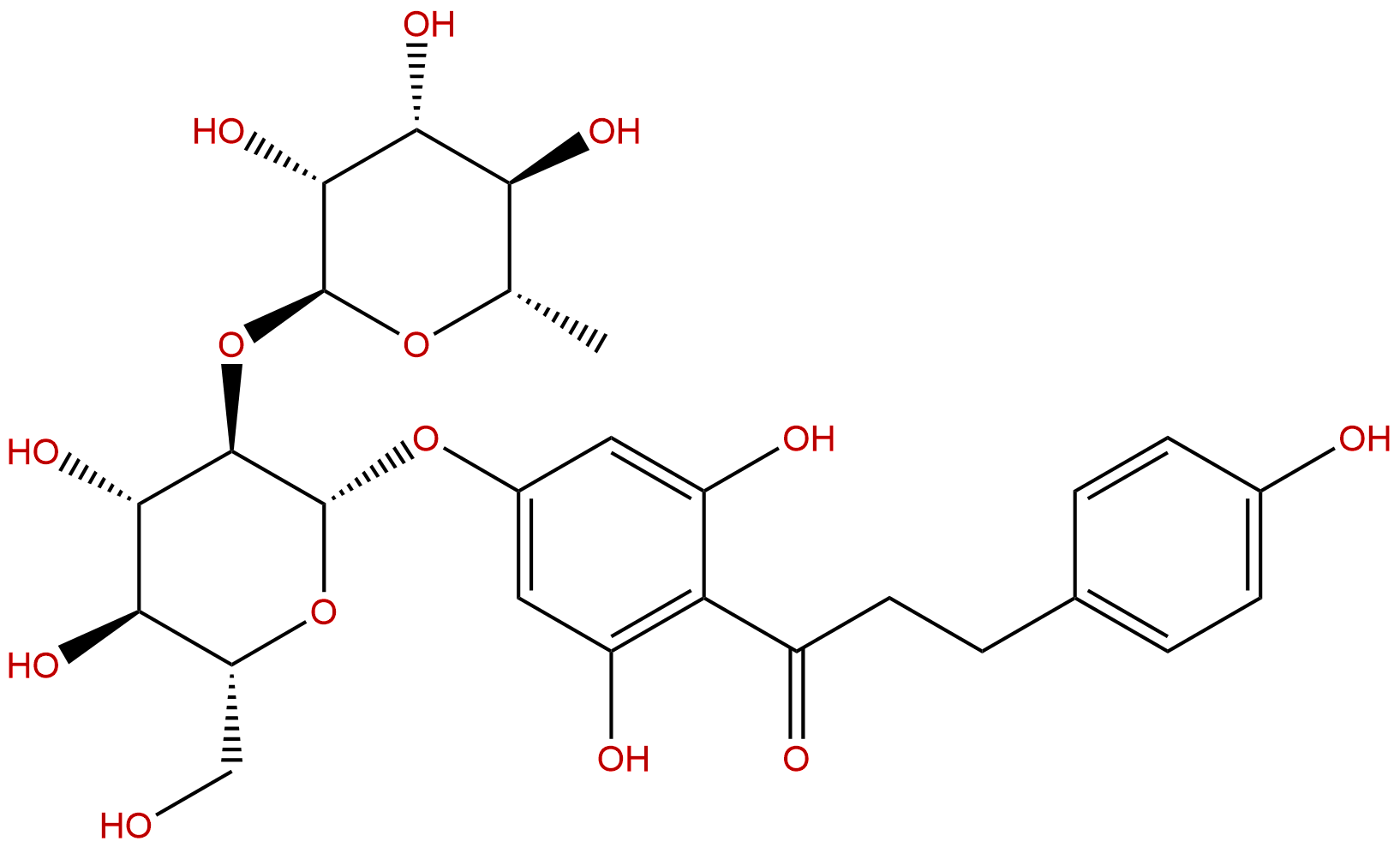


Synonym name: Naringin DC
Catalogue No.: BP0984
Cas No.: 18916-17-1
Formula: C27H34O14
Mol Weight: 582.555
Botanical Source: Synth. from HBH63 by base-induced cleavage, followed by catalytic hydrogenation
Purity: 95%~99%
Analysis Method: HPLC-DAD or/and HPLC-ELSD
Identification Method: Mass, NMR
Packing: Brown vial or HDPE plastic bottle
Can be supplied from milligrams to grams.
For Reference Standard and R&D, Not for Human Use Directly.
Inquire for bulk scale.
Description:
Naringin Dihydrochalcone is an artificial sweetener derived from naringin. Naringin is a major flavanone glycoside obtained from tomatoes, grapefruits, and many other citrus fruits. Naringin exhibits biological properties such as antioxidant, anti-inflammatory, and antiapoptotic activities. Naringin suppresses NF-κB signaling pathway.
References:
《Fine Chemical Intermediates》 2011-04
Study on Preparation of Naringin Dihydrochalcone
The process for preparation of Naringin dihydrochalcone from naringin was investigated.The product was obtained in 90% yield under optimum conditions of pH 13,temperature 45℃,H2 pressure 0.5 MPa,raney nickel loading 5%,and reaction time 4 h.
Food Research International Volume 54, Issue 1, November 2013, Pages 691–696
Preparation and physicochemical characterization of the supramolecular inclusion complex of naringin dihydrochalcone and hydroxypropyl-β-cyclodextrin
Naringin dihydrochalcone (naringin DC) is an intense sweetener and a strong antioxidant with potential applications in many food and pharmaceutical products. However, its low water solubility impedes the realization of these applications.
METHODS AND RESULTS:
This study investigated the feasibility of using hydroxypropyl-β-cyclodextrin (HP-β-CD) to form a supramolecular inclusion complex with Naringin dihydrochalcone to improve its solubility. The inclusion complex was prepared by stirring an equal molar solution of Naringin dihydrochalcone and HP-β-CD at 30°C for 24 h, followed by freeze-drying.Results showed clearly the formation of a supramolecular complex in which the guest molecule, Naringin dihydrochalcone, was entrapped inside the cavity of the host, HP-β-CD. The close association between naringin DC and HP-β-CD resulted in changes in some of the characteristic spectral, phase transitional and morphological properties of Naringin dihydrochalcone. Furthermore, 1H-NMR analyses demonstrated that it was the B ring of Naringin dihydrochalcone that was inserted into the HP-β-CD cavity to form the supramolecular complex.
Storage conditions:Short-term storage at 2~8℃, long-term storage at -20 ~ -80℃
Naringin dihydrochalcone (NDC) is an artificial sweetener derived from naringin, which has attracted widespread attention due to its unique sweetness and potential biological activity. Naringin, as a flavonoid glycoside mainly found in grapefruit (Citrus paradisi), tomato (Solanum lycopersicum), and various citrus fruits, has been proven to have significant pharmacological activities such as antioxidant, anti-inflammatory, and anti apoptotic effects. NDC, as a derivative of naringin, not only inherits some of the biological functions of its parent molecule, but also exhibits superior stability and sweetness characteristics due to structural modifications, making it a research hotspot in the food industry and drug development fields.
In recent years, with the prevalence of metabolic syndrome and obesity related diseases, the potential of natural products and their derivatives in anti obesity treatment has gradually been explored. NDC has shown promising anti obesity potential due to its regulatory effects on various targets related to lipid metabolism and energy balance. This article provides a systematic review of the chemical structure and physicochemical properties of NDC, plant sources and extraction methods, pharmacological activity and mechanism of action, drug evaluation and pharmacokinetics, as well as its clinical application prospects. The aim is to provide comprehensive reference and guidance for research in related fields.
The chemical structure of naringin dihydrochalcone is based on the flavanone skeleton of naringin, which introduces the dihydro group in the chalcone structure through reduction reaction, forming dihydrochalcone derivatives with chalcone characteristics. Its molecular formula is C27H32O14, molecular weight is 582.5550, and CAS number is 18916-17-1. The structural characteristics of NDC include two aromatic rings connected by a saturated acetone bridge, and the glycosidic moiety endowing it with good water solubility and biocompatibility.
In terms of physical and chemical properties, the LogP value of NDC is -0.0147, indicating strong hydrophilicity and a water solubility index of 4.8917, making it suitable for applications in aqueous environments. Its topological polar surface area (TPSA) is 236.0600, indicating that the molecule has a large number of polar groups, which may affect its cell membrane permeability and bioavailability. The low permeability of the blood-brain barrier suggests its limited distribution in the central nervous system. The negative result of hERG channel inhibition experiment indicates a low risk of cardiac toxicity. The Ames mutagenicity test showed a value of 0.0, indicating a low risk of genetic toxicity and a good safety basis.
Naringin, as the parent molecule of NDC, mainly exists in the peel and flesh of grapefruit, pomelo, and other citrus fruits. Its content is greatly affected by variety, maturity, and harvest season. Traditional extraction methods include hot water extraction, ethanol extraction, and ultrasound assisted extraction. In recent years, the application of supercritical CO2 extraction and microwave-assisted extraction technologies has improved extraction efficiency and purity.
NDC, as an artificially synthesized derivative, is usually prepared through a chemical reduction reaction of naringin. The commonly used synthetic route includes using palladium catalyzed hydrogenation reaction to reduce the chalcone structure of naringin to dihydrochalcone. This method has mild conditions, high yield, and is easy to scale up production. In addition, enzymatic catalysis has also been explored to improve selectivity and environmental friendliness.
During the extraction and purification process, techniques such as column chromatography and counter current chromatography are often used to obtain high-purity naringin and its derivatives. The improvement of purity is crucial for subsequent pharmacological activity research and clinical applications.
The pharmacological activity research of NDC mainly focuses on its anti obesity and metabolic regulatory effects. Numerous in vitro and in vivo experiments have shown that NDC can exert anti obesity effects by regulating lipid metabolism, energy expenditure, and inflammatory response through multiple targets.
NDC inhibits the expression of adipogenic genes such as PPARG (peroxisome proliferator activated receptor gamma), SREBF1 (steroid regulatory element binding protein 1), and FASN (fatty acid synthase) by regulating adipocyte differentiation and lipid accumulation. In addition, NDC promotes fat breakdown and energy metabolism, activates ADRB3 (β 3 adrenergic receptor) and UCP1 (uncoupling protein 1), and enhances calorie expenditure in adipose tissue.
NDC inherits the antioxidant and anti-inflammatory properties of naringin, which can inhibit the NF - κ B signaling pathway, reduce the release of pro-inflammatory cytokines, and alleviate chronic low-grade inflammation. This is of great significance for the prevention and treatment of obesity and related metabolic diseases.
NDC regulates such metabolic regulators as LEPR (leptin receptor), LEP (leptin), ADIPOQ (adiponectin), improves insulin sensitivity and energy homeostasis, showing potential value in treating type 2 diabetes and fatty liver.
The mechanism of action of NDC involves multiple signaling pathways and molecular targets, mainly including:
In summary, NDC regulates lipid metabolism, energy balance, and inflammatory response through multi-target and multi pathway synergistic effects, exerting its potential for anti obesity and prevention and treatment of metabolic diseases.
The pharmacological evaluation of NDC shows that it has good safety and drug compatibility. It has good water solubility, which is beneficial for the development of oral preparations. The low permeability of the blood-brain barrier reduces the risk of central nervous system side effects. The hERG channel has no inhibitory effect and reduces the risk of cardiac toxicity. The Ames test is negative, indicating a low risk of genetic toxicity.
In terms of pharmacokinetics, the high polarity and large TPSA of NDC may limit its oral bioavailability, and absorption needs to be improved through formulation optimization or drug carrier technology. The metabolism in the body mainly involves glycoside hydrolysis and corresponding phenolic metabolism, and the metabolites may retain some biological activity. Further systematic research is needed on half-life and distribution characteristics.
With the increasing number of obesity and metabolic syndrome patients, the development of safe and effective natural product based drugs has become an urgent problem to be solved. NDC, as a natural product derivative with clear sources and good safety, has shown broad clinical application prospects.
Future research should focus on:
In addition, the potential of NDC in anti-inflammatory, antioxidant, and neuroprotective fields is also worth further exploration, which may expand its scope of application.
As a derivative of naringin, naringin dihydrochalcone combines the biological activity of natural products with the structural advantages of artificial synthesis, exhibiting good anti obesity and metabolic regulation potential. Its multi-target and multi mechanism mode of action provides a theoretical basis and practical direction for the development of new metabolic disease treatment drugs. Although research on its pharmacokinetics and clinical applications is still in its early stages, as research deepens, NDC is expected to become an important candidate molecule in the field of natural product pharmacology, contributing new solutions to the prevention and treatment of obesity and related metabolic diseases. Future systematic research and clinical validation will be key to driving its translational applications.
