


Synonym name:
Catalogue No.: BP0885
Cas No.: 119425-90-0
Formula: C18H20O5
Mol Weight: 316.353
Botanical Source: Dracaena loureiri
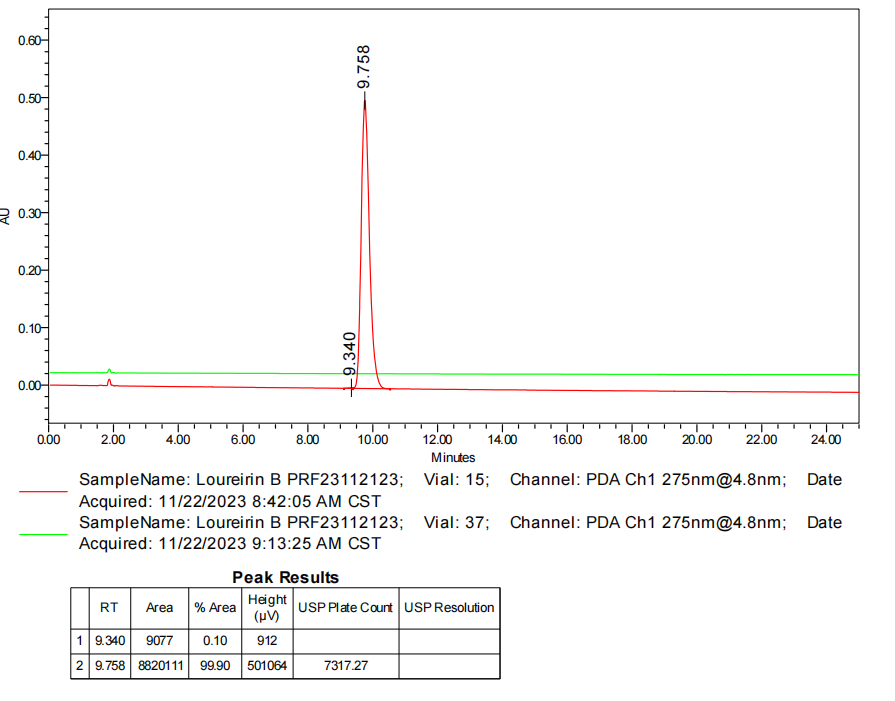
Purity: 95%~99%
Analysis Method: HPLC-DAD or/and HPLC-ELSD
Identification Method: Mass, NMR
Packing: Brown vial or HDPE plastic bottle
Can be supplied from milligrams to grams.
For Reference Standard and R&D, Not for Human Use Directly.
Inquire for bulk scale.
Description:
Loureirin B, a flavonoid extracted from Dracaena cochinchinensis, is an inhibitor of plasminogen activator inhibitor-1 (PAI-1), with an IC50 of 26.10 μM; Loureirin B also inhibits KATP, the phosphorylation of ERK and JNK, and has anti-diabetic activity.Loureirin B inhibits fibroblast proliferation and extracellular matrix deposition in hypertrophic scar via TGF-β/Smad pathway, loureirin B can suppress tetrodotoxin-sensitive (TTX-S) voltage-gated sodium currents in a dose-dependent way.
References:
Exp Dermatol. 2015 May;24(5):355-60.
Loureirin B inhibits fibroblast proliferation and extracellular matrix deposition in hypertrophic scar via TGF-β/Smad pathway.
The ethanolic extract of Resina Draconis (RDEE) has been reported beneficial to normal wound healing yielding more regularly arranged collagen fibres. Loureirin B, a major component in RDEE, has been supposed to be effective on the prevention and treatment of pathological scars.
METHODS AND RESULTS:
To investigate the therapeutic effects of Loureirin B on hypertrophic scar (HS), fibroblasts from human HS and normal skin (NS) were isolated. Results showed that Loureirin B dose-dependently downregulated both mRNA and protein levels of type I collagen (ColI), type III collagen (ColIII) and α-smooth muscle actin (α-SMA) in HS fibroblasts. Loureirin B also suppressed fibroblast proliferative activity and redistributed cell cycle, but did not affect cell apoptosis. In vivo rabbit ear scar model, Loureirin B significantly improved the arrangement and deposition of collagen fibres, decreased protein levels of ColI, ColIII and α-SMA and suppressed myofibroblast differentiation and scar proliferative activity. In NS fibroblasts, Loureirin B effectively inhibited TGF-β1-induced upregulation of ColI, ColIII and α-SMA levels, myofibroblast differentiation and the activation of Smad2 and Smad3. Loureirin B also affected mRNA levels of major MMPs and TIMPs in TGF-β1-stimulated fibroblasts.
CONCLUSIONS:
Taken together, this study demonstrates that Loureirin B could downregulate the expression of fibrosis-related molecules by regulating MMPs and TIMPs levels, inhibit scar fibroblast proliferation and suppress TGF-β1-induced fibrosis, during which TGF-β1/Smad2/3 pathway is likely involved. These findings suggest that Loureirin B is a potential therapeutic compound for HS treatment.
Sci China C Life Sci. 2004 Aug;47(4):340-8.
Effects of dragon's blood resin and its component loureirin B on tetrodotoxin-sensitive voltage-gated sodium currents in rat dorsal root ganglion neurons.
Using whole-cell patch clamp technique on the membrane of freshly isolated dorsal root ganglion (DRG) neurons, the effects of dragon's blood resin and its important component Loureirin B on tetrodotoxin-sensitive (TTX-S) voltage-gated sodium currents were observed.
METHODS AND RESULTS:
The results show that both blood resin and Loureirin B could suppress TTX-S voltage-gated sodium currents in a dose-dependent way. The peak current amplitudes and the steady-state activation and inactivation curves are also made to shift by 0.05% blood resin and 0.2 mmol/L Loureirin B.
CONCLUSIONS:
These results demonstrate that the effects of blood resin on TTX-S sodium current may contribute to Loureirin B in blood resin. Perhaps the analgesic effect of blood resin is caused partly by Loureirin B directly interfering with the nociceptive transmission of primary sensory neurons.
HPLC of Loureirin B
Storage conditions:Short-term storage at 2~8℃, long-term storage at -20 ~ -80℃
64.9900
2.8701
2.8232
.1870
4.3012
17.9701
High
87.9188
1.9879
Yes
No
Yes
No
Yes
No
0.0
No
Yes
Yes
No
Loureirin B (CAS number: 119425-90-0) is a natural flavonoid product isolated from Dracaena cochinchinensis. As one of the main active ingredients in the traditional Chinese medicine "Dragon's Blood", Dragon's Blood B has attracted much attention due to its diverse biological activities. In recent years, with the in-depth study of its molecular mechanism and pharmacological effects, dracaena B has shown broad application potential in the fields of anti-inflammatory, anti diabetes and blood system diseases. Especially as an effective inhibitor of plasma plasminogen activator inhibitor-1 (PAI-1), a key inhibitor of the fibrinolytic system, and its regulatory effects on multiple signaling pathways, it provides a theoretical basis for its development as a novel therapeutic drug.
This article will provide a systematic review of the chemical structure and physicochemical properties, plant sources and extraction methods, pharmacological activity and mechanism of action, pharmacological evaluation and pharmacokinetic characteristics of Longxuesu B. Combined with current research progress, it will explore its clinical application prospects and future development directions.
Longxuesu B is a flavonoid compound with a molecular formula of C18H16O6 and a molecular weight of 316.3530. Its structural characteristics include a typical flavonoid skeleton containing multiple hydroxyl and methoxy substituents, endowing it with certain polarity and biological activity. According to calculations, its LogP value is 2.8701, indicating that it has moderate lipid solubility, which is beneficial for membrane penetration. The topological polar surface area (TPSA) is 64.99 Å ², indicating its good permeability in vivo, especially its high ability to penetrate the blood-brain barrier.
The water solubility is 0.1870 mg/mL, which belongs to the low to medium solubility range, indicating the need to consider improving solubility in drug formulation design. The hERG channel inhibition experiment showed a negative result, indicating a low risk of cardiac toxicity associated with Longxuesu B. The Ames mutagenicity test result is 0.0, indicating that its genotoxicity risk is relatively low and has a good safety basis.
The chemical structure of Longxuesu B is shown in Figure 1 (there should be a structural formula diagram here), and its flavonoid core structure endows it with various biological activities, especially exhibiting unique advantages in regulating inflammatory responses and metabolic diseases.
Longxuesu B mainly comes from Dracaena cochinchinensis, a evergreen tree in the Liliaceae family, which is distributed in southern China and some parts of Southeast Asia. The red resin secreted when its trunk is injured is the traditional Chinese medicine "Dragon's Blood", which contains various active ingredients, among which Dragon's Blood B has a higher content.
The extraction method usually uses organic solvent extraction combined with chromatographic separation technology. The specific process includes:
In recent years, the application of new technologies such as ultrasound assisted extraction and microwave-assisted extraction has improved extraction efficiency and purity, providing technical support for the large-scale preparation of dragon blood extract B.
The pharmacological activities of Dracaena B mainly focus on anti-inflammatory, anti diabetes and blood system regulation. The specific research results are as follows:
Inflammatory response is a common pathological basis for various diseases. Longxuesu B exhibits significant anti-inflammatory activity by regulating inflammation related signaling pathways through multiple targets. Both in vitro cell models and animal experiments have confirmed that it can inhibit the expression of pro-inflammatory factors such as IL-6 and TNF - α, and reduce the release of inflammatory mediators.
Research has shown that Longxue B can inhibit the activation of the nuclear factor kappa B (NF - κ B) signaling pathway, reduce the transcriptional activity of NFKB1, and thereby downregulate the expression of key inflammatory enzymes such as PTGS2 (COX-2) and NOS2 (iNOS). In addition, Longxuesu B has a regulatory effect on inflammation related ion channels TRPV1 and TRPA1, reducing inflammatory pain responses.
Longxuesu B improves pancreatic beta cell function, promotes insulin secretion, and lowers blood glucose levels by inhibiting ATP sensitive potassium channels (KATP) and regulating ERK and JNK phosphorylation in the MAPK signaling pathway. Its inhibitory effect on PAI-1 (IC50=26.10 μ M) is helpful to improve the common hypercoagulable state of blood in patients with diabetes and prevent complications of diabetes.
In vivo experiments showed that Longxuetin B could significantly improve the blood glucose metabolism indicators of diabetes rats, reduce the inflammation and oxidative stress injury of pancreatic tissue, suggesting its potential as an adjunctive treatment drug for diabetes.
PAI-1, as a key inhibitory factor of the fibrinolytic system, is overexpressed and associated with various thrombotic diseases. Longxuesu B effectively inhibits PAI-1 activity, promotes the activation of plasminogen, helps prevent thrombosis, and improves blood rheology.
In addition, there have been preliminary reports on the protective effects of Longxuesu B on platelet function and vascular endothelial cells, indicating its potential application in the prevention and treatment of cardiovascular diseases.
The multi-target mechanism of action of Longxuesu B is the basis of its broad pharmacological activity, mainly involving the following aspects:
PAI-1 is the main inhibitory factor in the fibrinolytic system, involved in regulating blood fibrinolysis balance. Longxuesu B binds to PAI-1, inhibits its activity, promotes the conversion of plasminogen to plasmin, thereby enhancing blood fibrinolysis function and reducing the risk of thrombosis. The IC50 of this effect is 26.10 μ M, indicating moderate inhibitory activity.
Longxuesu B can significantly inhibit the phosphorylation of ERK and JNK in cells, and block the overactivation of the MAPK signaling pathway. This pathway plays a critical role in inflammatory response and cellular stress, regulating cell proliferation, differentiation, and apoptosis. By inhibiting ERK/JNK, Longxuesu B reduces inflammatory damage and protects cellular function.
ATP sensitive potassium channels (KATP) play an important role in the regulation of insulin secretion in pancreatic beta cells. Longxuesu B inhibits KATP channel activity, promotes cell membrane depolarization, enhances insulin release, and helps improve glucose metabolism disorders.
Longxuesu B has regulatory effects on various inflammation related targets, including:
To sum up, dracaena B regulates the intracellular signal network through multi target synergy to achieve multiple pharmacological effects such as anti-inflammatory, anti diabetes and antithrombotic.
The pharmacological evaluation of Longxuesu B shows that it has good potential for drug development:
In terms of pharmacokinetics, existing research is relatively limited. Preliminary in vivo experiments have shown that the bioavailability of Longxuesu B is moderate after oral administration, with a plasma half-life of several hours, mainly metabolized through the liver. Its high blood-brain barrier permeability makes it potentially applicable in neurological diseases. In the future, it is necessary to conduct systematic research on absorption, distribution, metabolism, and excretion (ADME) to clarify their in vivo behavioral characteristics.
Based on the significant activity of Dracaena B in anti inflammation, anti diabetes and blood system regulation, its clinical application prospects are broad:
However, the clinical translation of Longxuesu B still faces many challenges, including drug stability, unclear metabolic pathways in vivo, insufficient formulation development and safety systematic evaluation. Future research should focus on:
As an important flavonoid active ingredient in Dracaena tenuifolia, dracaena B shows multiple biological activities such as anti-inflammatory, anti diabetes and antithrombotic by virtue of its multi-target and multi-channel pharmacological effects. Its excellent pharmacokinetic parameters and safety foundation have laid a solid foundation for the development of new drugs. In the future, through in-depth mechanism research, systematic pharmacokinetic evaluation, and preclinical studies, Longxuesu B is expected to become a new natural drug for the treatment of inflammatory and metabolic diseases, providing new strategies and choices for the clinical treatment of related diseases.
