


Product name: Tenuifolin
Synonym name:
Catalogue No.: BP1374
Cas No.: 20183-47-5
Formula: C36H56O12
Mol Weight: 680.832
Botanical Source: Polygala tenuifolia, Polygala senega, Strophanthus sp. and Pygeum africanum (preferred genus name Prunus)
Physical Description: White powder
Type of Compound: Triterpenoids
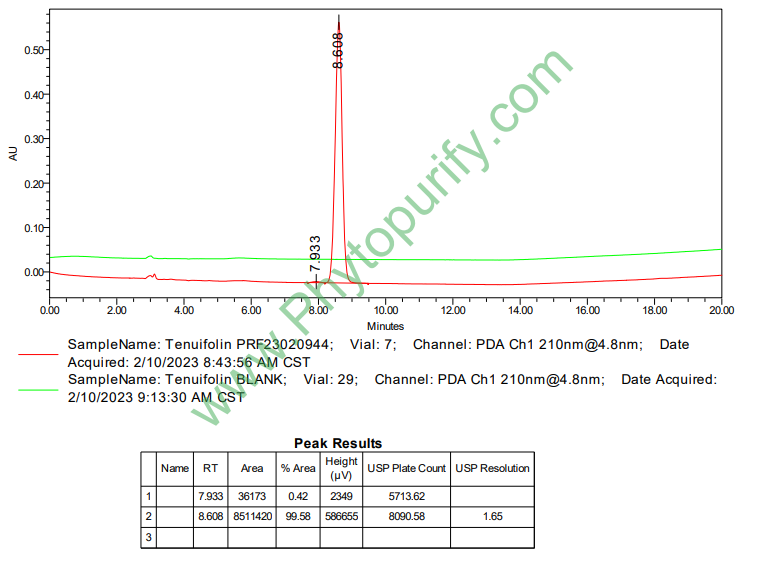
Purity: 95%~99%
Analysis Method: HPLC-DAD or/and HPLC-ELSD
Identification Method: Mass, NMR
Packing: Brown vial or HDPE plastic bottle
Storage: Store in a well closed container, protected from air and light. Put into refrigerate or freeze for long term storage.
Whenever possible, you should prepare and use solutions on the same day. However, if you need to make up stock solutions in advance, we recommend that you store the solution as aliquots in tightly sealed vials at -20℃. Generally, these will be useable for up to two weeks.
The product could be supplied from milligrams to grams, up to kilograms
Inquire for bulk scale.
Descriptions:
Tenuifolin is an effective compound from tenuigenin, is commonly used in traditional Chinese herbal medicine for memory loss, has no inherent toxicity to either the transfected or wild type cells at the effective concentrations, it inhibits amyloid-β secretion in vitro.[1]
Tenuifolin is one of the active constituents of HPS against the neurotoxicity induced by Aβ25-35 peptides in vitro and in vivo, it possesses neuroprotective effects against Aβ25-35-induced apoptosis in PC12 cells and significantly improves the cognitive deficits induced by the intrahippocampal injection of Aβ25-35 in mice. [2]
References:
[1] Lv J, Jia H, Jiang Y, et al. Acta Physiol, 2009, 196(4):419-25.
[2] Liu Y M, Li Z Y, Hu H, et al. Pharmacol Biochem Be, 2015, 128:14-22.
[3] Dong X B, Jun L I, Jiang Y, et al. China journal of Chinese materia medica, 2007, 32(16):1647-9.
HPLC of Tenuifolin
Storage conditions:Short-term storage at 2~8℃, long-term storage at -20 ~ -80℃
Tenuifolin, a triterpenoid saponin isolated from the traditional Chinese medicine Polygala tenuifolia Willd., has received widespread attention in recent years due to its significant neuroprotective effects and potential therapeutic value for neurodegenerative diseases. As a classic medicinal herb in traditional Chinese medicine used to enhance memory, alleviate anxiety, and calm the body, one of the main active ingredients of Yuanzhi is saponins from the slender leaves of Yuanzhi. A large number of in vitro and in vivo studies have shown that saponins from Ganoderma lucidum not only have good oral activity, but also can regulate nervous system function through multiple targets and pathways, especially showing unique advantages in the prevention and treatment of neurodegenerative diseases such as Alzheimer's disease (AD).
This article will provide a systematic review of the chemical structure and physicochemical properties, plant sources and extraction methods, pharmacological activity and mechanism of action, pharmacological evaluation, pharmacokinetic characteristics, as well as the potential and future development direction of saponins in the field of fine leaf remote sensing. The aim is to provide theoretical basis and practical guidance for related research.
The molecular formula of Zhizhi saponins is C36H-58O12, with a molecular weight of 680.8320, belonging to the triterpenoid saponin class. Its structural core is a typical triterpenoid skeleton, connected by multiple sugar residues, giving it high polarity. In terms of physical and chemical properties, the LogP value of Zhizhi saponins is about 2.13, indicating that they have moderate lipid solubility and are beneficial for membrane penetration. Its topological polar surface area (TPSA) is relatively large, at 214.44 Å ², reflecting its strong polarity and water solubility. The water solubility is 0.15, indicating limited solubility in water, but sufficient to support oral administration.
The low penetration ability of the blood-brain barrier suggests limited efficiency in directly entering the central nervous system, but this does not prevent it from exerting neuroprotective effects through indirect mechanisms. The hERG channel inhibition test was negative, indicating a low risk of cardiac toxicity associated with saponins from Polygala tenuifolia. The Ames mutagenicity test result is 0, indicating low genetic toxicity risk and good safety.
The saponins of Polygala tenuifolia Willd. mainly come from the roots of Polygala tenuifolia Willd. Yuanzhi is a plant of the Yuanzhi family, widely distributed in northern China, as well as in Korea, Japan, and other places. In traditional Chinese medicine, Yuanzhi root is used as a medicinal herb for calming the mind, enhancing intelligence, and eliminating phlegm.
The common methods for extracting saponins from slender leaves of Polygala tenuifolia include:
The extraction process requires temperature and pH control to prevent degradation of saponin structures. The purified saponins from Polygala tenuifolia are commonly subjected to structural identification using mass spectrometry (MS), nuclear magnetic resonance (NMR), and other methods.
The pharmacological activity of saponins from Ganoderma lucidum mainly focuses on neuroprotection and cognitive function improvement, involving various neurodegenerative disease models.
Through multi-target regulation, saponins from the slender leaves of Polygala tenuifolia significantly inhibit the activity of β - secretase 1 (BACE1), reduce the generation and deposition of amyloid beta protein (A β), especially A β 2.5-35 fragments, and alleviate A β - induced neurotoxicity. In vitro experiments have shown that saponins from Ganoderma lucidum can inhibit neuronal apoptosis induced by A β 25-35, reduce the activation of caspase-3 and caspase-9, and block the apoptotic signaling pathway.
Saponins from Ganoderma lucidum can activate the NFE2L2 (nuclear factor E2 related factor 2) signaling pathway, enhance cellular antioxidant capacity, and reduce oxidative stress damage. In addition, it regulates the TLR4 (Toll like receptor 4) signaling pathway, inhibits neuroinflammatory responses, and reduces inflammatory damage to nerve cells.
Xiyeyuanzhi saponins can effectively reduce acetylcholinesterase (AChE) activity, increase acetylcholine content in the brain, and improve cholinergic nerve conduction. At the same time, it can also increase the levels of neurotransmitters such as norepinephrine and dopamine, promote neuronal function recovery, and improve learning and memory abilities.
In an aging mouse model, oral administration of Ganoderma lucidum saponins significantly improved spatial learning and memory abilities, manifested as shortened latency and enhanced spatial memory abilities in the water maze experiment, suggesting its potential therapeutic value for cognitive impairment.
Xiyeyuanzhi saponins have also been reported to have antidepressant, anti anxiety, and nerve regeneration promoting effects, which may be achieved by regulating signaling pathways such as PRKCA (protein kinase C alpha) and MAPK1 (mitogen activated protein kinase 1).
The mechanism of action of saponins from Ganoderma lucidum is complex, involving multiple molecular targets and signaling pathways, reflecting its multi-target pharmacological properties.
BACE1 is a key enzyme in the generation of A β, and saponins from Ganoderma lucidum directly or indirectly inhibit BACE1 activity, reduce the cleavage of A β precursor protein (APP), decrease the production of toxic A β, and slow down the formation of amyloid plaques.
Xiyeyuanzhi saponins inhibit the activation of caspase-3 and caspase-9, blocking mitochondrial mediated cell apoptosis. Its regulation of BCL2 protein enhances cell anti apoptotic ability and protects neuronal survival.
By inhibiting the activity of AChE, saponins from Ganoderma lucidum increase the content of acetylcholine and improve the efficiency of nerve transmission. Simultaneously increasing levels of norepinephrine and dopamine, regulating central nervous system function.
Saponins from Ganoderma lucidum activate the NFE2L2 pathway, promote the expression of antioxidant enzymes, and alleviate oxidative stress. By inhibiting TLR4 signaling, reducing the release of pro-inflammatory cytokines, and alleviating neuroinflammation.
Saponins from Ganoderma lucidum may regulate signaling molecules such as PRKCA and MAPK1, affecting the proliferation, differentiation, and survival of nerve cells, promoting nerve repair and functional recovery.
The high molecular weight (680.8 Da) and high TPSA (214.44 Å ²) of the saponins from the slender leaved plant indicate their strong polarity, which may limit their ability to pass through cell membranes and the blood-brain barrier. A LogP value of 2.13 indicates moderate lipid solubility, which is beneficial for oral absorption.
The water solubility is 0.15, which belongs to low solubility drugs and may affect their bioavailability. The low penetration ability of the blood-brain barrier suggests that its efficiency in directly entering the central nervous system is limited, but it can still play a role by regulating the peripheral nervous system or indirect mechanisms.
The hERG channel inhibition test was negative, indicating a low risk of cardiac toxicity. The Ames test result is 0, indicating low genetic toxicity risk and good safety.
At present, there is relatively little systematic pharmacokinetic research on saponins from Ganoderma lucidum. Existing studies have shown that saponins from Ganoderma lucidum are absorbed quickly after oral administration, and the peak plasma concentration occurs at a moderate time. Its metabolism in the body is mainly through the liver enzyme system, and the metabolites need further identification.
Due to the low permeability of the blood-brain barrier, the distribution of saponins in the central nervous system is limited, and it may be necessary to increase their concentration in the brain through structural modification or formulation optimization.
The saponins from Ganoderma lucidum have shown great potential for application in the treatment of neurodegenerative diseases, especially Alzheimer's disease. Its multi-target and multi mechanism pharmacological effects are expected to overcome the limitations of single target drugs and provide more comprehensive neuroprotection and cognitive function improvement.
The key to future clinical applications lies in:
In addition, the potential of saponins from Ganoderma lucidum in anti depression, anti anxiety, and nerve repair is also worth exploring, providing new ideas for the comprehensive treatment of neurological diseases.
As an important triterpenoid saponin in Polygala tenuifolia, its multi-target neuroprotective effects and good safety have made it a hot natural product in the research of neurodegenerative diseases, especially Alzheimer's disease. It significantly improves cognitive function through multiple mechanisms such as inhibiting β - secretase activity, anti apoptosis, antioxidant, and regulating neurotransmitters, demonstrating broad clinical application prospects.
In the future, we should strengthen in-depth research on its pharmacokinetic characteristics and mechanism of action, optimize formulation technology, and promote clinical translation. Xiyeyuanzhi saponins are expected to become important neuroprotective agents in the field of natural product pharmacology, providing new drug candidates and treatment strategies for the treatment of neurodegenerative diseases.
