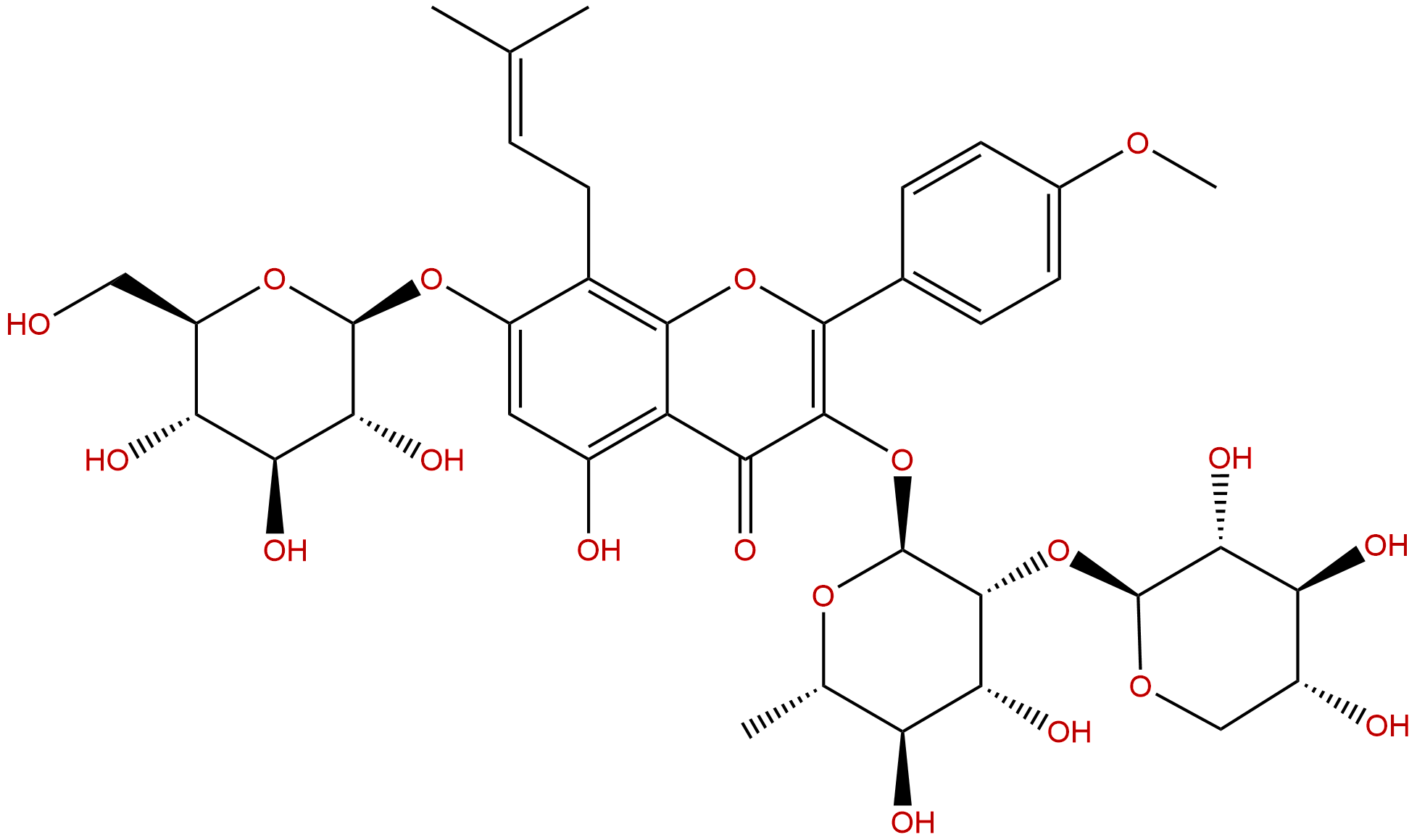


Synonym name:
Catalogue No.: BP0546
Cas No.: 110623-73-9
Formula: C38H48O19
Mol Weight: 808.783
Botanical Source: Epimedium spp. and Vancouveria hexandra
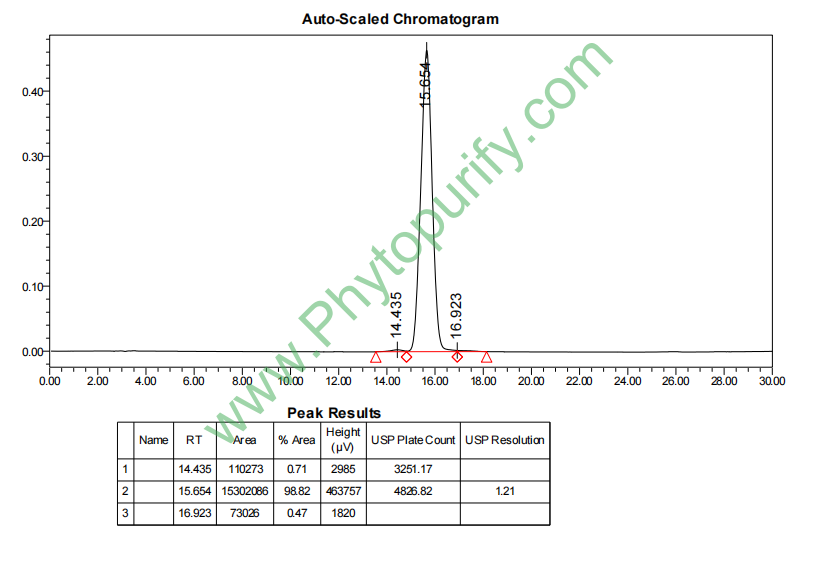
Purity: 95%~99%
Analysis Method: HPLC-DAD or/and HPLC-ELSD
Identification Method: Mass, NMR
Packing: Brown vial or HDPE plastic bottle
Can be supplied from milligrams to grams.
For Reference Standard and R&D, Not for Human Use Directly.
Inquire for bulk scale.
Description:
Epimedin A,epimendin B, epimendin C, icariin and baohuoside are flavonoids, main active ingredient in Epimedium, have clear anti-osteoporosis effect, the accumulation of epimedins A, B, C, and icariin in a traditional medicinal plant could be suppressed by light stress.
References:
Acta Physiol Plant, 2013, 35(11):3271-5.
Light stress suppresses the accumulation of epimedins A, B, C, and icariin in Epimedium, a traditional medicinal plant.
Epimedium is well-known in China and East Asia due to high content of flavonoid derivatives, including icariin, epimedin A, Epimedin B, and epimedin C, hereafter designated as bioactive components, which have been extensively utilized to cure many diseases. So far, the molecular mechanism of the bioactive components biosynthesis remains unclear.
METHODS AND RESULTS:
In the present study, the effect of light stress (24 h illumination) on the accumulation of bioactive components and the expression of flavonoid genes in Epimedium was investigated. Under light stress, the structural genes CHS1, CHI1, F3H, FLS, DFR1, DFR2, and ANS were remarkably up-regulated while CHS2 and F3′H were significantly down-regulated. For transcription factors, the expression of Epimedium MYB7 and TT8 were increased while Epimedium GL3, MYBF, and TTG1 expression were depressed. Additionally, the content of bioactive components was significantly decreased under light stress.
CONCLUSIONS:
Our results suggested that the decrease of bioactive compounds may be attributed to transcripts of late genes (DFRs and ANS) increased to a higher level than that of early genes (FLS and CHS1).
HPLC of Epimedin B
Storage conditions:Short-term storage at 2~8℃, long-term storage at -20 ~ -80℃
297.1200
.6327
.6277
2.9155
.4201
.3123
Low
80.0815
5.4951
Yes
No
Yes
No
No
No
0.0
Yes
Yes
Yes
Yes
Osteoporosis is a systemic bone disease characterized by reduced bone mass, destruction of bone microstructure, and increased bone fragility. It is a major public health challenge facing an aging society. At present, although first-line clinical drugs can effectively inhibit bone resorption, there are still limitations in promoting bone formation, and long-term use may be accompanied by adverse reactions. Therefore, searching for lead compounds with dual activities of bone resorption inhibition and bone formation promotion from natural products has become an important direction for drug development. Epimedium spp., as a traditional Chinese medicine for tonifying the kidneys and strengthening bones, has been widely recognized for its anti osteoporosis effects. Epimidin B is a flavonol glycoside compound isolated from Epimedium, and is one of the key active ingredients in the pharmacological effects of total flavonoids in Epimedium. In recent years, a large number of studies have revealed the significant potential of Chaohuoding B in regulating bone metabolism balance and improving bone microstructure, and its multi-target mechanism of action has gradually been elucidated. This article aims to systematically review the chemical characteristics, plant sources, pharmacological activities, molecular mechanisms, and medicinal properties of Chaohuoding B, in order to provide comprehensive scientific references for the in-depth research and development of this natural product.
Chaohuoding B (CAS number: 110623-73-9) is a flavonol glycoside substituted with isopentenyl group, and its chemical name is icariin B. Its molecular formula is C ∝₉ H ₅₀ O ₁₉, and its molecular weight is 808.7830. Its core structure is the Kaempferol nucleus, which is connected to a rhamnose group at C-3, a glucose group at C-7, and an isopentenyl group at C-8. This unique isopentenyl modification is considered one of the key structural features of its strong biological activity.
From the analysis of parameters related to drug properties, the lipid water partition coefficient (LogP) of Chaohuoding B is 0.6327, indicating its relatively balanced lipophilic and hydrophilic properties. Its topological polar surface area (TPSA) is as high as 297.1200 Å ², which is mainly attributed to the abundant hydroxyl and sugar structures in the molecule, resulting in strong polarity. The water solubility parameter is 2.9155, indicating that it has a certain degree of solubility in water, but may still belong to the category of slightly soluble or poorly soluble, which poses a challenge for its formulation development. Pharmacokinetic prediction shows that it has low blood-brain barrier permeability and mainly acts on the peripheral system. In terms of preliminary safety prediction, hERG inhibition is "no", indicating a low potential risk of cardiac toxicity; The Ames test result is 0.0, indicating that it has no mutagenicity in this model and has a good genetic toxicity safety window. These physicochemical and preliminary safety parameters laid the foundation for its subsequent development.
Chaohuoding B mainly comes from various plants in the Epimedium genus of the Berberidaceae family, such as Epimedium koreanum, Epimedium sagittatum, Epimedium pubescens, and Epimedium wushanense. The content of Chaohuoding B varies among different species and regions, and usually coexists with components such as icariin, Chaohuoding A, and C.
The extraction and separation method follows the conventional process of natural product chemistry. Firstly, dried Epimedium medicinal materials are usually subjected to reflux extraction or ultrasound assisted extraction using alcohol (such as ethanol, methanol) or a mixture of alcohol and water solvents to fully obtain flavonoid components. Subsequently, preliminary enrichment and purification were carried out using macroporous adsorption resin (such as AB-8, D101) column chromatography, and gradient elution was performed using ethanol water solutions of different concentrations. Chaohuoding B is usually obtained at the sites of medium to high concentration alcohol elution. In order to further obtain high-purity monomers, it is often necessary to combine silica gel column chromatography, polyamide column chromatography, Sephadex LH-20 column chromatography, high performance liquid chromatography (HPLC) or preparative liquid chromatography for repeated separation and purification. Modern technologies such as high-speed countercurrent chromatography (HSCCC) have also been applied to the preparation of Chaohuoding B due to their high efficiency and no loss of solid adsorbents. The optimization of extraction processes (such as solvent selection, temperature, time) and standardization are crucial for ensuring the quality of raw materials and consistency in subsequent research.
Numerous in vitro and in vivo studies have confirmed that Chaohuoding B has clear anti osteoporosis activity, characterized by its bidirectional regulation of bone formation mediated by osteoblasts and bone resorption mediated by osteoclasts.
In terms of promoting bone formation, Chaohuoding B can significantly stimulate the proliferation, differentiation, and mineralization of pre osteoblasts (such as MC3T3-E1 and UMR-106 cells). Research has shown that it can upregulate the expression of key markers of osteogenic differentiation, enhance alkaline phosphatase (ALP) activity, and promote the formation of calcium nodules. In a rat or mouse model of osteoporosis induced by ovariectomy (OVX), oral administration of Chaohuoding B can effectively increase bone density (BMD), improve bone biomechanical properties (such as maximum load and elastic modulus), and micro computed tomography (micro CT) analysis shows that it can significantly improve bone trabecular structural parameters, such as increasing the number (Tb. N) and thickness (Tb. Th) of bone trabeculae and reducing the degree of trabecular separation (Tb. Sp).
In terms of inhibiting bone resorption, Chaohuoding B can suppress osteoclast differentiation induced by receptor activator of nuclear factor kappa B ligand (RANKL). In the osteoclastogenesis system of RAW 264.7 cells or bone marrow-derived macrophages (BMMs), treatment with Chaohuoding B can reduce the number of multinucleated tartrate resistant acid phosphatase (TRAP) positive osteoclasts and decrease the expression of osteoclast specific genes and the area of bone resorption pits. In animal models, it can also reduce the levels of bone resorption markers such as TRAP-5b and CTX-I in serum.
In addition, the study suggests that Chaohuoding B may have auxiliary effects such as anti-inflammatory, antioxidant, and improving lipid metabolism, which may indirectly benefit the stability of the bone microenvironment and overall bone health.
The anti osteoporosis effect of Chaohuoding B involves a complex multi-target regulatory network, whose core lies in coordinating the balance between osteogenesis and osteoclastogenesis processes. Existing research has focused on multiple key molecular targets and signaling pathways.
1. Regulating osteogenic differentiation and bone formation:
* RUNX2 and SP7 (Osterix): RUNX2 is the main regulator of osteogenic differentiation, and SP7 is its downstream key transcription factor. Chaohuoding B can significantly upregulate the mRNA and protein expression of RUNX2 and SP7 in osteoblasts, thereby initiating the osteogenic differentiation program.
* Wnt/β - catenin pathway: This pathway is a key positive signal that promotes bone formation. Chaohuoding B may promote the expression of osteogenic related genes such as COL1A1 and BGLAP by inhibiting the expression of sclerosing protein (SOST), a Wnt pathway antagonist, to release its inhibition on the Wnt pathway, activate β - catenin signaling, and promote the expression of osteogenic related genes. BGLAP (osteocalcin) and COL1A1 (type I collagen alpha 1 chain) are important biomarkers for bone matrix formation and maturation, and Chaohuoding B upregulates their expression.
* Nuclear receptors VDR and ESR1: Vitamin D receptor (VDR) and estrogen receptor alpha (ESR1) play important roles in maintaining bone metabolism balance. The chemical structure of Chaohuoding B may allow it to interact with these receptors, simulating or enhancing the effects of endogenous ligands, thereby exerting estrogen like or vitamin D-like bone synthesis metabolism promoting effects.
2. Inhibit osteoclast differentiation and bone resorption:
* NF - κ B and MAPK pathway: RANKL/RANK signaling is the core of osteoclast differentiation. Chaohuoding B can inhibit the activation of the NF - κ B and MAPK (such as p38 and JNK) signaling pathways activated by RANKL, thereby downregulating the expression of the transcription factor NFATc1 necessary for osteoclast differentiation.
* Genes related to osteoclast function: Chaohuoding B can downregulate the expression of tissue protease K (CTSK, responsible for degrading bone matrix collagen) and matrix metalloproteinase 9 (MMP9, involved in osteoclast migration and bone matrix degradation), directly weakening the bone resorption function of osteoclasts.
* OPG/RANKL/RANK axis: Chaohuoding B may negatively regulate osteoclastogenesis by upregulating osteoprotegerin (OPG, encoded by TNFRSF11B gene) secreted by osteoblasts, competitively binding to RANKL, and blocking its binding to RANK on osteoclast precursor cells.
In summary, Chaohuoding B promotes osteogenesis by acting on targets such as ESR1, VDR, RUNX2, SP7, SOST, COL1A1, BGLAP, while inhibiting osteoclast by regulating targets such as CTSK, MMP9, TNFRSF11B (OPG), forming a synergistic network that jointly maintains bone homeostasis.
Although Chaohuoding B exhibits excellent pharmacological activity, its pharmacological properties, especially pharmacokinetic properties, are obstacles that must be overcome for its clinical application.
Existing research shows that Chaohuoding B, as a flavonoid glycoside compound, generally has low oral bioavailability. This is mainly attributed to: ① its larger molecular weight and higher polarity (high TPSA), resulting in poor transmembrane permeability; ② Easily hydrolyzed by microbial communities or enzymes in the gastrointestinal tract, converted into aglycones or other metabolites; ③ May experience significant first pass effects. Animal pharmacokinetic studies typically detect that the prototype drug has a low concentration in plasma, a fast peak time, and a short elimination half-life.
The metabolic processes in its body are complex, mainly involving hydrolysis, deglycosylation, oxidation, and binding reactions. In the intestine and liver, Chaohuoding B may gradually remove its sugar group and generate secondary glycosides (such as icariin II) or final aglycones (kaempferol). These metabolites themselves may also have biological activity, forming the characteristic of its "prodrug" or multi-component synergistic effect. Subsequently, these aglycones and their metabolites further bind with glucuronic acid or sulfuric acid to form more water-soluble complexes, which are excreted through bile or urine.
To improve its bioavailability, researchers are exploring various strategies: ① Structural modification: by preparing prodrugs (such as esterification, preparation of phospholipid complexes) or by incorporating nanocrystals, cyclodextrins, etc., to improve its solubility and membrane permeability. ② New drug delivery systems: Develop delivery systems such as liposomes, nanoemulsions, solid dispersions, and self microemulsions to promote their absorption and targeted delivery. ③ Combination therapy: Used in combination with absorption enhancers or other natural ingredients to utilize synergistic effects.
In terms of safety, in addition to the negative predictions of hERG and Ames mentioned above, existing animal subacute or chronic toxicity experiments have reported good tolerability within a certain dose range, but more systematic preclinical toxicology research is still needed.
Chaohuoding B, as a candidate natural drug molecule for anti osteoporosis, has unique advantages such as multi-target, bidirectional regulation, originating from traditional Chinese medicine, and long-term application indicating high safety. The clinical application prospects are mainly reflected in the following aspects:
However, there are still many challenges to clinical practice: ① Pharmacokinetic optimization The primary challenge is to significantly improve its bioavailability through formulation or structural modification methods. ② The mechanism of action needs to be more accurately explained In particular, further research is needed to investigate the direct interactions between it and various targets in complex in vivo environments, as well as the upstream and downstream relationships of signaling pathways. ③ Conduct systematic preclinical and clinical research This includes pharmacological confirmation that complies with regulations, safety evaluations of long-term toxicity, reproductive toxicity, and final human pharmacokinetics and efficacy clinical trials. ④ Intellectual Property Protection and Industrialization It involves the construction of the entire industry chain from raw material cultivation, standardized extraction to formulation production.
Chaohuoding B, as an important active flavonoid glycoside in Epimedium, has shown great potential as a new type of anti osteoporosis drug due to its clear dual pharmacological activity of promoting osteogenesis and inhibiting osteoclastogenesis, as well as its molecular mechanism of acting on multiple key bone metabolism pathways such as RUNX2, Wnt/β - catenin, OPG/RANKL/RANK. Although there are challenges in drug formulation, especially in oral absorption, modern pharmacy and medicinal chemistry techniques provide possible solutions for this. Future research should focus on improving its pharmacokinetic properties through formulation innovation, using chemical biology methods to deeply reveal its direct targets and signaling networks, and gradually promote standardized preclinical and clinical evaluations. The continuous in-depth research on Chaohuoding B not only helps to transform the wisdom of traditional Chinese medicine into a modern medically recognized therapy, but also provides a model for discovering multi-target bone disease treatment drugs from natural products.
