Introduction/Overview
Osteoporosis, as a systemic bone disease characterized by reduced bone mass, destruction of bone microstructure, and increased bone fragility, has become a global public health challenge. With the acceleration of the aging process of the population, its incidence rate continues to rise, bringing a heavy burden to the social medical system. At present, first-line clinical treatment drugs such as bisphosphonates, selective estrogen receptor modulators, and RANKL inhibitors can effectively inhibit bone resorption, but their effect in promoting bone formation is limited, and long-term use may be accompanied by risks such as mandibular necrosis and atypical femoral fractures. Therefore, exploring lead compounds with dual activities of bone resorption inhibition and bone formation promotion from natural products has become an important direction for new drug development.
Herba Epimedii, as a traditional Chinese medicinal herb for tonifying the kidneys, strengthening yang, strengthening tendons and bones, has been widely proven to have anti osteoporosis activity by modern pharmacology. The main active ingredients are flavonoids, among which Icariin has been extensively studied. However, icariin is rapidly metabolized in the body, and its aglycones and secondary metabolites are considered key entities for exerting pharmacological effects. Baohuoside VII, as one of the main active metabolites of icariin in the body, has attracted much attention in recent years due to its significant anti osteoporosis activity. Research has shown that Baohuo glycoside VII not only retains the bone formation potential of the parent compound, but also exhibits potential advantages in terms of bioavailability and targeting. Particularly remarkable is that the latest research reveals that Baohuoside VII also shows a multi target protective effect in metabolic complications such as diabetes nephropathy, suggesting that its mechanism of action may be far beyond the simple "tonifying the kidney and strengthening the bone", involving a broader network of energy metabolism, oxidative stress and inflammation regulation. This article aims to provide a systematic review of the chemical properties, plant sources, pharmacological activities, molecular mechanisms, and pharmacological properties of Baohuo glycoside VII, and to explore its clinical application prospects as a multi-target therapeutic drug.
Chemical structure and physicochemical properties
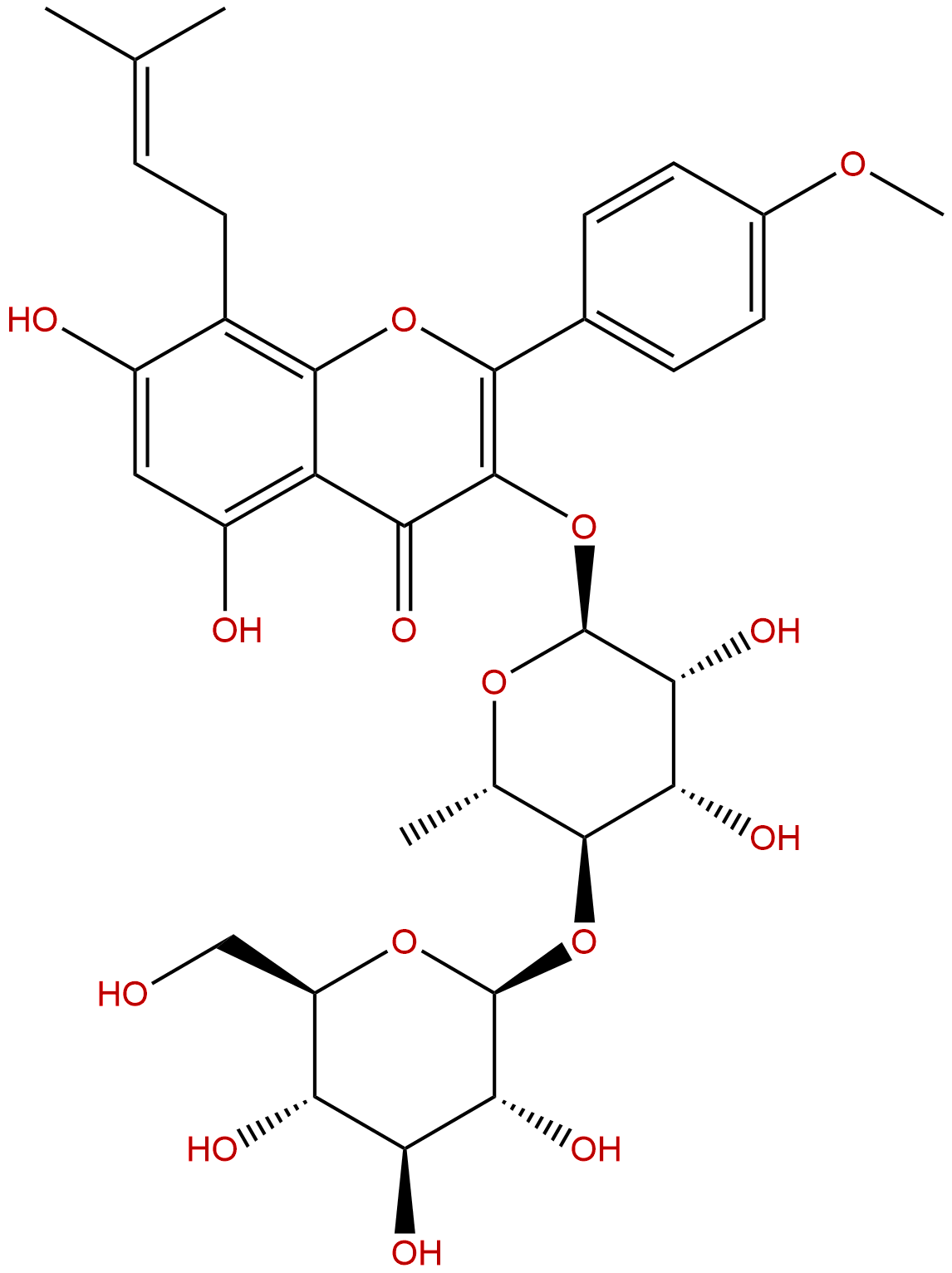
Baohuo glycoside VII (CAS number: 119730-89-1), also known as 3,5,7-trihydroxy-4 '- methoxy-8-isoprenyl flavone-3-O - α - L-rhamnoside - (1 → 2) - β - D-glucoside, is a typical isoprenyl flavonoid glycoside. Its molecular formula is C33H40O15 and its molecular weight is 676.6680 Da.
Structurally, Baohuo glycoside VII is based on flavonoids as its basic skeleton (A, C rings), with methoxy substitution at the 4 'position of its B ring, which is one of its key features distinguishing it from icariin (4' - hydroxyl). More importantly, there is an isopentenyl group (- C5H9) attached to the 8th position of its A ring, and the introduction of this hydrophobic group significantly affects the lipid solubility and membrane permeability of the compound. The sugar chain is partially connected to the hydroxyl group at position 3, consisting of a xylose (α - L-configuration) linked to a glucose (β - D-configuration) via a 1 → 2 glycosidic bond, forming a disaccharide chain. This specific glycosylation pattern has a decisive impact on its water solubility, recognition of target proteins, and in vivo metabolic stability.
Based on its chemical structure, Baohuo glycoside VII exhibits unique physicochemical properties. The calculated lipid water partition coefficient (LogP) is 1.2621, indicating that it has moderate lipophilicity and is conducive to transmembrane transport. The topologically polar surface area (TPSA) is as high as 238.2000 Å ², which is mainly attributed to the numerous hydroxyl groups and oxygen atoms on the sugar chain in the molecule, indicating that it has more hydrogen bond donor and acceptor sites. Its water solubility value is 1.5512 (usually referring to - logSw or similar scales, the lower the value, the higher the solubility), indicating that it belongs to a slightly soluble to poorly soluble compound, which may be a limiting factor for its oral absorption. Based on these parameters, it is predicted that the blood-brain barrier permeability is low and mainly distributed in peripheral tissues. In the preliminary safety evaluation, the risk of hERG inhibition is "no", and the Ames test result is 0.0 (negative), indicating that the risk of cardiac toxicity and genetic toxicity is low, and it has a good basis for drug development.
Plant sources and extraction methods
Baohuo glycoside VII mainly comes from various plants in the Epimedium L. genus of the Berberidaceae family, such as Epimedium koreanum Nakai, Epimedium sagittatum (Sieb. et Zucc.) Maxim., Epimedium pubescens Maxim., etc. In the dry aboveground parts of these plants (i.e. traditional Chinese medicine "Epimedium"), Baohuo glycoside VII often coexists with other flavonoid glycosides such as icariin and Baohuo glycoside I, but its content is usually lower than that of icariin. It is worth noting that Baohuo glycoside VII can also be produced as the main deglycosylation metabolite of icariin in the gut microbiota and liver metabolic enzymes (such as β - glucosidase) in animals and humans, which may be an important source of its in vivo activity.
Extracting baohuo glycoside VII from plant materials using conventional methods similar to other flavonoid glycosides.Solvent extraction method It is the most commonly used preliminary enrichment method, often using ethanol water or methanol water systems for heating reflux or ultrasound assisted extraction. Ethanol concentration (such as 50% -70%), solid-liquid ratio, extraction temperature, and time are key parameters that affect yield.Macroporous adsorption resin chromatography This is the core step of subsequent purification, which utilizes resin (such as AB-8, D101, HP-20, etc.) for selective adsorption of flavonoids and gradient elution with different concentrations of ethanol solution to effectively remove impurities such as polysaccharides and proteins, and preliminarily enrich Baohuo glycoside VII. In order to obtain high-purity monomers, it is necessary to combine Preparation type high-performance liquid chromatography Usually, a reverse phase C18 chromatography column is used, with methanol water or acetonitrile water (often containing a small amount of formic acid or acetic acid to adjust the pH) as the mobile phase for isocratic or gradient elution. The target peak fraction is collected by monitoring with a UV detector (usually around 270 nm wavelength), and after concentration and freeze-drying, the pure product of Baohuo glycoside VII can be obtained. In addition, liquid-liquid distribution chromatography techniques such as high-speed countercurrent chromatography have also been applied for the separation and purification of this compound due to their advantages of irreversible adsorption and high recovery rate.
With the increasing demand for Baohuo glycoside VII, utilizing biotransformation The technology of using abundant icariin as a substrate and conducting targeted hydrolysis through specific glycosidases such as cellulase and β - glucosidase has become a potential strategy for efficient and green preparation of baohuo glycoside VII.
Pharmacological activity research
The pharmacological activity study of cablin VII initially focused on its anti osteoporosis effect, and has expanded to the protection of metabolic related diseases such as diabetes and nephropathy.
1. Anti osteoporosis activity
This is the core pharmacological activity of Baohuo glycoside VII. Numerous in vitro and in vivo experiments have confirmed that Baohuo glycoside VII can effectively combat bone loss caused by various factors.
* Promote osteoblast differentiation and mineralization: In bone marrow mesenchymal stem cells (BMSCs) and pre osteoblast cell lines (such as MC3T3-E1), baohuo glycoside VII can significantly upregulate the expression of key osteogenic transcription factors Runx2 and Osterix, enhance alkaline phosphatase (ALP) activity, promote collagen synthesis (such as COL1A1) and calcium nodule formation, thereby accelerating osteogenic differentiation process.
* Inhibition of osteoclastogenesis and function: In the osteoclast differentiation model induced by receptor activator of nuclear factor kappa B ligand (RANKL), baohuo glycoside VII can inhibit the fusion of osteoclast precursor cells to form multinucleated osteoclasts and reduce their ability to form bone resorption cavities. The mechanism involves interfering with the NF - κ B and MAPK signaling pathways downstream of RANKL.
* Improving Osteoporosis Induced by Ovarian Resection (OVX): In castrated rat or mouse models, oral administration of Baohuo glycoside VII can dose dependently increase bone density (BMD), improve bone trabecular microstructure (increase bone volume fraction, number of bone trabeculae, reduce separation), and enhance bone biomechanical properties (such as maximum load and stiffness). The effect is comparable to or better than estrogen or bisphosphonates, and there are no significant estrogen like side effects such as uterine weight gain.
2. Protective effect on diabetes nephropathy
Recent studies have found that Baohuoside VII has multiple protective effects on diabetes nephropathy (DN), which shares part of the signal pathway with its anti osteoporosis effect.
* Reduce renal fibrosis: In high glucose stimulated renal tubular epithelial cells or diabetes animal model kidneys, Baohuoside VII can down regulate the expression of fibrosis markers (such as α - SMA, fibronectin) and pro fibrosis factors (such as TGF - β 1, CTGF), inhibit the excessive deposition of extracellular matrix (ECM), and delay the process of glomerulosclerosis and tubulointerstitial fibrosis.
* Improving metabolic disorders and oxidative stress: Baohuoside VII can improve glucose and lipid metabolism in diabetes model and reduce insulin resistance. More importantly, it can activate the cellular defense system, upregulate the expression of antioxidant enzymes such as HO-1 and NQO1, reduce the generation of reactive oxygen species (ROS), inhibit lipid peroxidation, and protect kidney cells from high glucose induced oxidative damage.
* Anti inflammatory effect: Baohuoside VII can inhibit the excessive production of inflammatory factors (such as TNF - α, IL-1 β, IL-6) in the kidney of diabetes, block the abnormal activation of the inflammatory core pathway NF - κ B, and reduce the inflammatory infiltration of the kidney.
In addition, sporadic reports suggest that Baohuo glycoside VII may have potential activities such as anti-tumor and neuroprotective effects, but further in-depth and systematic research is needed.
Mechanism of action and molecular targets
The multiple pharmacological activities of Baohuo glycoside VII stem from its regulation of complex cellular signaling networks. Its mechanism of action is not on a single target, but through the synergistic action of multiple targets and pathways. Several key molecular targets and pathways have been identified for its anti osteoporosis and renal protective activity:
1. Mechanisms related to bone metabolism
* BMP/Smad signaling pathway: Baohuo glycoside VII can upregulate the expression of bone morphogenetic proteins (BMPs), especially BMP-2/4/7, promote the phosphorylation of Smad1/5/8 and its binding to Smad4, and thereby transcribe and activate osteogenic related genes, which is one of its core mechanisms for promoting bone formation.
* Wnt/β - catenin signaling pathway: This pathway is crucial for determining the lineage of osteoblasts. Baohuo glycoside VII may inhibit the activity of glycogen synthase kinase-3 β (GSK-3 β), prevent the phosphorylation degradation of β - catenin, promote its accumulation in the nucleus, and activate TCF/LEF mediated osteogenic gene transcription.
* OPG/RANKL/RANK system: Baohuo glycoside VII can promote the secretion of osteoprotegerin (OPG) by osteoblasts, competitively bind to RANKL, thereby blocking the binding of RANKL to its receptor RANK, and inhibiting the differentiation and activation of osteoclasts.
2. Related mechanisms and targets of diabetes nephropathy
Based on the provided target information, the protective effect of Baohuo glycoside VII on DN involves a precise regulatory network:
* Energy metabolism and stress sensing core: AMPK and SIRT1. AMP activated protein kinase (AMPK, encoded by PRKAA1, etc.) and deacetylase SIRT1 are core regulatory factors for cellular energy metabolism and stress adaptation. Baohuo glycoside VII has been proven to be an effective activator of AMPK and SIRT1. Activated AMPK and SIRT1 can promote fatty acid oxidation, improve insulin sensitivity, inhibit inflammation and fibrosis, and upregulate antioxidant defense.
* Antioxidant defense main control switch: Nrf2. Nuclear factor E2 related factor 2 (Nrf2, encoded by NFE2L2) is the master switch for cell protective genes driven by antioxidant response elements (ARE). Baohuo glycoside VII can promote the dissociation and translocation of Nrf2 from Keap1 into the nucleus, activate downstream genes such as HO-1 and NQO1, which is the key to its resistance to high glucose oxidative damage.
* The key mediators of inflammation and fibrosis: NF - κ B and SERPINE1. Baohuo glycoside VII inhibits the degradation of I κ B α or the phosphorylation/acetylation of p65 (RELA) subunits, blocking the abnormal activation of the NF - κ B pathway and downregulating inflammatory factors such as TNF - α and IL-6. At the same time, it can inhibit the expression of plasminogen activator inhibitor-1 (PAI-1, encoded by SERPINE1), and overexpression of PAI-1 can inhibit extracellular matrix degradation and promote fibrosis.
* Specific damage pathway regulation:
* Protein kinase C (PKC) pathway: High glucose activation of PKC (especially PRKCA, PRKCB) is an important link in the pathogenesis of diabetic nephropathy. Baohuo glycoside VII may indirectly inhibit abnormal activation of PKC through upstream mechanisms such as improving metabolism.
* Aldehyde reductase (AKR1B1): Inhibition of AKR1B1 can reduce the accumulation of sorbitol and oxidative stress, and Baohuo glycoside VII may have an inhibitory effect on it.
* Matrix metalloproteinase-2 (MMP2): Regulating MMP2 activity helps maintain the normal structure and function of the glomerular basement membrane.
* Transient receptor potential vanillic acid subtype 1 (TRPV1): TRPV1 is involved in renal nociceptive and inflammatory responses, and its regulation may be related to the analgesic and anti-inflammatory effects of Baohuo glycoside VII.
To sum up, Baohuoside VII forms a multi-dimensional defense network by synergistically activating protective pathways such as AMPK/SIRT1/Nrf2 and inhibiting injurious pathways such as NF - κ B/PKC, thus achieving multi-target protection of diabetes nephropathy.
Evaluation of drug properties and pharmacokinetics
Although Baohuo glycoside VII has significant pharmacological activity, its successful development as a drug highly depends on its drugability and pharmacokinetic (PK) characteristics.
Drug Evaluation:
As mentioned earlier, the molecular weight of Baohuo glycoside VII (676.67) is slightly higher than the conventional upper limit of Ro5 (500), but its LogP is moderate, and the number of hydrogen bond donors and acceptors is higher due to the presence of sugar groups. The characteristic of its slight solubility is the main challenge in the development of oral formulations, which may require the use of formulation technologies such as phospholipid complexes, cyclodextrin inclusion complexes, nanocrystals, or solid dispersions to improve its dissolution and bioavailability. A good preliminary safety prediction (no hERG inhibition, Ames negative) laid the foundation for its subsequent development.
Pharmacokinetic studies:
The existing pharmacokinetic studies (mainly conducted in animal models such as rats) have revealed several characteristics of the in vivo process of Baohuo glycoside VII:
* Absorption: After oral administration, the absorption of Baohuo glycoside VII in the gastrointestinal tract is slow and incomplete, and its absolute bioavailability is low. This is related to its larger polar surface area and glycosidic structure, which may involve the efflux of intestinal transporters such as P-glycoprotein. Food may affect its absorption.
* Distribution: After entering the systemic circulation, Baohuo glycoside VII can quickly distribute to various tissues and organs. Due to its low blood-brain barrier permeability, it is mainly distributed in peripheral tissues such as the liver, kidneys, and bones. This distribution characteristic precisely matches the target organs for treating osteoporosis and kidney disease, and may be an advantage. The binding rate data with plasma proteins is not yet clear.
* Metabolism: As a glycoside compound, the main metabolic pathway of Baohuo glycoside VII in the body is hydrolysis. It can gradually remove glycosides under the action of β - glucosidase in the gut microbiota and liver/kidney, producing secondary glycosides (such as paeoniflorin I) or final aglycones (icariin). These metabolites may have similar or stronger activity than the prototype drug, contributing together to the overall efficacy. In addition, phase II metabolic reactions such as hydroxyl methylation and glucuronic acid binding may also occur.
* Excretion: Baohuo glycoside VII and its metabolites are mainly excreted through the kidneys with urine, and some are excreted through bile and feces. Its elimination half-life is moderate and requires reasonable dosing intervals to maintain effective blood drug concentration.
Overall, the pharmacokinetic properties of Baohuo glycoside VII suggest that its oral utilization needs to be improved, but its target tissue distribution characteristics and active metabolites provide compensation for its pharmacological effects. Future research needs to further elucidate its PK behavior in the human body and explore optimized drug delivery strategies.
Clinical application prospects and prospects
Baohuo glycoside VII, as a natural active molecule derived from traditional Chinese medicine, has shown broad clinical application prospects, but also faces many challenges.
Prospect:
1. New candidate drugs for anti osteoporosis: Compared with existing anti bone resorption drugs, Baohuo glycoside VII has dual regulatory potential of "promoting bone formation" and "inhibiting bone resorption", and has good preliminary safety without typical estrogenic side effects. It is expected to be developed as a first-line or adjuvant therapy for the treatment of postmenopausal osteoporosis, age-related osteoporosis, and even glucocorticoid induced osteoporosis.
2. Multi target therapeutic agents for metabolic complications such as diabetes nephropathy: Through AMPK/SIRT1/Nrf2 and other core pathways, it plays a role in improving metabolism, anti-oxidation, anti-inflammatory and anti fibrosis, providing a new multi-target intervention strategy for the treatment of diabetes nephropathy. It may be suitable for early prevention and mid-term treatment of diabetes nephropathy, and delay its progression to end-stage nephropathy.
3. Partners for enhancing efficacy and reducing toxicity through combination therapy: Given its unique mechanism of action, the combination of Baohuo glycoside VII with existing drugs (such as bisphosphonates, SGLT2 inhibitors, RAS inhibitors, etc.) may produce synergistic effects, reduce their respective dosages and side effects, and improve treatment efficacy.
4. Development of dietary supplements or functional foods: Under the premise of obtaining sufficient safety data, Baohuo glycoside VII or its rich Epimedium extract can be developed into health products for bone health maintenance and metabolic regulation in middle-aged and elderly people.
Challenges and Prospects:
1. Improved bioavailability: This is the biggest bottleneck for its clinical progress. Future research needs to focus on the development of novel drug delivery systems, such as nanodelivery, prodrug design, transdermal delivery, etc., to improve their solubility, permeability, and stability.
2. In depth study of the mechanism of action: Although multiple targets have been identified, the direct interaction mode between Baohuo glycoside VII and these target proteins, as well as the existence of unknown high affinity receptors, still require precise analysis through chemical biology, structural biology, and other methods.
3. Systematic human clinical trials: At present, most research is still in the preclinical stage. There is an urgent need to design a rigorous phase I-III clinical trial to systematically evaluate its safety, tolerance, pharmacokinetics in humans and the exact efficacy for osteoporosis, diabetes nephropathy and other indications.
4. Large scale production with controllable quality: It is necessary to establish a comprehensive quality control system from raw material cultivation (ensuring stable content of Baohuo glycoside VII in medicinal materials), green extraction to high-purity preparation, and explore efficient enzymatic or synthetic biology preparation processes to meet the needs of future large-scale production.
Conclusion
Baohuoside VII, as a representative active flavonoid glycoside in Epimedium, has become a highlight in the research of natural product drugs by virtue of its clear anti osteoporosis activity and the emerging protective effect of diabetes nephropathy. The specificity of its chemical structure (isopentenyl, methoxy, disaccharide chain) lays the foundation for its unique physicochemical properties and biological activity. Research has shown that it exerts multi-target and multi pathway pharmacological effects by precisely regulating key signaling networks such as AMPK/SIRT1/Nrf2 and NF - κ B, demonstrating the advantages of natural product systems in intervening in complex diseases. Although facing challenges in the aspect of drug performance, especially oral bioavailability, with the progress of pharmaceutical technology and the deep excavation of its mechanism of action, Baohuoside VII is expected to successfully transform from a potential lead compound to an innovative drug for treating major chronic diseases such as osteoporosis and diabetes nephropathy, realize the transformation from the wisdom of traditional Chinese medicine to modern medical achievements, and contribute unique value to the cause of human health through reasonable dosage form transformation and drug delivery scheme design. Future research should adhere to clinical demand orientation, deepen basic research, break through the bottleneck of transformation, and accelerate the process of its clinical application.