


Synonym name: Ikarisoside A
Catalogue No.: BP1497
Cas No.: 55395-07-8
Formula: C26H28O10
Mol Weight: 500.5
Botanical Source: Epimedium spp.
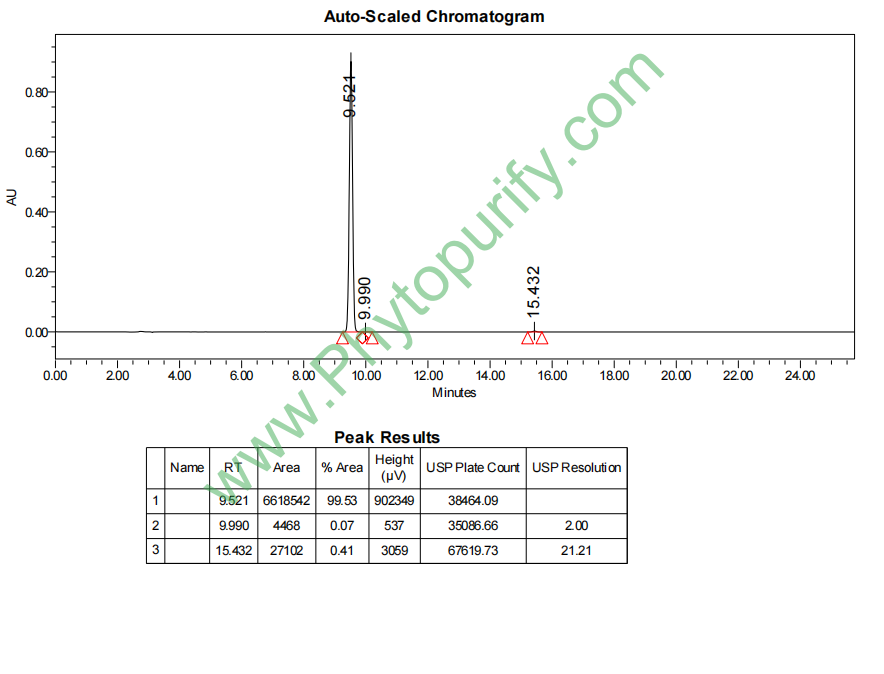
Purity: 95%~99%
Analysis Method: HPLC-DAD or/and HPLC-ELSD
Identification Method: Mass, NMR
Packing: Brown vial or HDPE plastic bottle
Can be supplied from milligrams to grams. Inquire for bulk scale.
For Reference Standard and R&D, Not for Human Use Directly.
HPLC of Baohuoside II
Storage conditions:Short-term storage at 2~8℃, long-term storage at -20 ~ -80℃
Baohuoside II (CAS No.: 55395-07-8) is a typical flavonoid aglycone derivative derived from Epimedium spp. Diabetes, as a chronic metabolic disease with increasing incidence rate and disability rate worldwide, seriously threatens human health, and the development of safe and effective anti diabetes drugs has become an important direction of drug research and development. Baohuo glycoside II has become a research hotspot in the fields of natural product pharmacology and medicinal chemistry due to its multi-target regulatory effects and good safety performance.
This article will provide a systematic review of the chemical structure and physicochemical properties, plant sources, and extraction methods of Baohuo glycoside II, with a focus on its pharmacological activity and mechanism of action. Combined with drug evaluation and pharmacokinetic data, it will explore its clinical application potential and future development direction, aiming to provide scientific basis and reference for the in-depth research and drug development of Baohuo glycoside II.
Baohuo glycoside II is a flavonoid glycoside derivative with a molecular formula of C27H30O11 and a molecular weight of approximately 500.5. Its chemical structure contains a typical flavonoid skeleton, connecting multiple hydroxyl and glycoside groups, giving it high polarity and water solubility. In the specific structure, Baohuo glycoside II contains multiple phenolic hydroxyl groups and glycosidic linking sites, which have important effects on its biological activity and pharmacokinetic properties.
In terms of physical and chemical properties, the LogP value of Baohuo glycoside II is 2.0335, indicating that it has moderate lipid solubility, which is beneficial for cell membrane penetration but not excessively hydrophobic. The total polar surface area (TPSA) is 170.05 Å ², indicating its high polarity, which is consistent with its water solubility (0.5159 mg/mL). The low permeability of the blood-brain barrier suggests its limited distribution in the central nervous system. The hERG channel inhibition test was negative, indicating a low risk of cardiac toxicity. The Ames mutagenicity test result was 0.0, indicating no significant mutagenicity and good safety.
In summary, the physicochemical properties of Baohuo glycoside II are suitable for oral administration and have good biocompatibility and safety basis.
Baohuo glycoside II is mainly distributed in plants of the Epimedium genus, especially in traditional Chinese medicinal materials such as Epimedium grandiflorum and Epimedium brevicornum, which are rich in content. Epimedium, as a commonly used medicinal herb in traditional Chinese medicine for tonifying the kidneys, strengthening yang, and strengthening muscles and bones, has a mature extraction and separation technology for its active ingredient Baohuo glycoside II.
Common extraction methods include:
Solvent extraction method Extract dried powder of Epimedium by reflux using ethanol or methanol aqueous solution (50% -70%), and dissolve flavonoid glycosides in polar solvents.
Ultrasound assisted extraction Combining ultrasonic technology to improve extraction efficiency, shorten time, and protect the stability of active ingredients.
Column chromatography separation and purification The crude extract was separated using techniques such as silica gel column chromatography and reverse phase high performance liquid chromatography (RP-HPLC) to obtain high-purity baohuo glycoside II.
membrane separation technology In recent years, nanofiltration and ultrafiltration technologies have been applied to the initial concentration and purification of extraction solutions, improving extraction efficiency and purity.
The optimization of extraction process not only improves the yield of Baohuo glycoside II, but also provides sufficient raw material guarantee for its subsequent pharmacological research and drug development.
The pharmacological activities of Baohuoside II mainly focus on its anti diabetes effect and related metabolic regulation functions. Numerous in vitro cell experiments and in vivo animal model studies have shown that Baohuo glycoside II has significant hypoglycemic, insulin resistance improving, lipid metabolism regulating, and anti-inflammatory effects.
Baohuo glycoside II improves glucose metabolism abnormalities through multi-target regulation:
Baohuoside II also has the effects of regulating lipid metabolism, anti-oxidation and anti-inflammatory, which helps to improve the metabolic syndrome and complications related to diabetes. Its anti-inflammatory effect is achieved by inhibiting the expression of pro-inflammatory factors and reducing chronic low-grade inflammation; The antioxidant effect protects cells from oxidative damage by clearing free radicals.
The anti diabetes mechanism of Baohuoside II involves multiple signal pathways and molecular targets, which reflects the characteristics of its multi target and multi pathway coordinated regulation.
Baohuo glycoside II can activate 5 'AMP activated protein kinase (AMPK, PRKAA1), which is a key regulatory factor in energy metabolism. Activation of AMPK promotes glucose uptake and fatty acid oxidation, inhibits gluconeogenesis, and improves insulin resistance. Baohuo glycoside II exerts a metabolic regulatory effect by enhancing AMPK phosphorylation and regulating the expression of downstream metabolic genes.
Baohuo glycoside II promotes the activation of insulin receptor substrate 1 (IRS1), phosphatidylinositol 3-kinase regulatory subunit (PIK3R1), and protein kinase B (AKT1), enhances insulin signaling, promotes the translocation of glucose transporter 4 (SLC2A4) to the cell membrane, and improves glucose uptake efficiency.
Baohuo glycoside II regulates the expression of peroxisome proliferator activated receptor gamma (PPARG), promotes lipid metabolism and insulin sensitivity improvement, and reduces adipose tissue inflammation.
Baohuo glycoside II has an inhibitory effect on renal sodium glucose cotransporter 2 (SGLT2), reducing glucose reabsorption and lowering blood glucose levels. At the same time, inhibiting dipeptidyl peptidase 4 (DPP4) activity, prolonging the half-life of glucagon like peptide-1 (GLP-1), and promoting insulin secretion.
In conclusion, Baohuoside II can achieve comprehensive metabolic regulation and play an anti diabetes role by coordinating and regulating multiple targets such as AMPK, insulin signaling pathway, PPAR γ, SGLT2, DPP4, etc.
The pharmacological parameters of Baohuo glycoside II show that it has good potential for drug development. Although the molecular weight of 500.5 is slightly higher than the recommended 500 by Lipinski's rule, it is still within an acceptable range. A moderate LogP value (2.0335) is beneficial for the bioavailability and membrane permeability of drugs. The high TPSA (170.05) and water solubility (0.5159 mg/mL) suggest that its distribution in the body is mainly in plasma and extracellular fluid, and its blood-brain barrier permeability is low, reducing the risk of central nervous system side effects.
In terms of safety, Baohuo glycoside II has no hERG channel inhibition or mutagenicity, indicating low risks of cardiac toxicity and genetic toxicity, and meets drug safety requirements.
Pharmacokinetic studies have shown that after oral administration, Baohuo glycoside II is absorbed quickly and has moderate bioavailability. It is mainly metabolized through the liver, and the metabolites are stable. Its half-life is moderate and suitable for daily administration. Renal excretion is the main clearance pathway, indicating that renal function status has a certain impact on drug clearance.
Overall, Baohuo glycoside II has good pharmacokinetic characteristics and safety basis, making it suitable for further drug development and clinical research.
With the continuous increase of incidence rate of diabetes, it is urgent to develop safe and effective natural product anti diabetes drugs. Baohuo glycoside II has shown broad clinical application prospects due to its multi-target regulation and good safety.
Future research should focus on:
Preclinical safety and toxicology assessment Systematically evaluate the safety of long-term medication, clarify the dosage range and potential toxicity.
Clinical trial design: Carry out Phase I to Phase III clinical trials to verify the clinical efficacy and safety of Baohuoside II, especially in patients with type 2 diabetes.
Formulation optimization and administration plan Develop oral sustained-release or compound formulations to improve patient compliance and treatment efficacy.
Combination therapy research: To explore the synergy between Baohuoside II and existing anti diabetes drugs (such as SGLT2 inhibitors, DPP4 inhibitors, etc.), and optimize the treatment scheme.
In depth study of mechanisms Using modern molecular biology and omics techniques, further reveal the network of action and metabolic regulation mechanism of Baohuo glycoside II.
In addition, the potential value of Baohuoside II in the fields of anti-inflammatory, antioxidant and cardiovascular protection is also worthy of attention, which may provide a new strategy for the prevention and treatment of complications of diabetes.
As an important active ingredient in Epimedium, Baohuoside II shows significant pharmacological activity and good safety in the field of anti diabetes by virtue of its unique chemical structure and multi-target regulatory mechanism. It achieves comprehensive regulation of glucose metabolism by activating the AMPK signaling pathway, regulating insulin signaling, and inhibiting targets such as SGLT2 and DPP4, and has high potential for drug development.
Although the clinical research of Baohuoside II is still in the initial stage, its excellent medicinal properties and multiple pharmacological effects have laid a solid foundation for it to become a new natural anti diabetes drug. In the future, through systematic pharmacological mechanism research, clinical verification and dosage form optimization, Baohuoside II is expected to become a powerful supplement in the field of diabetes treatment, bringing new treatment options to patients.
To sum up, the study of Baohuoside II not only enriched the theoretical system of natural product pharmacology, but also provided innovative ideas and practical paths for the prevention and treatment of diabetes and metabolic diseases, with important scientific value and application prospects.
