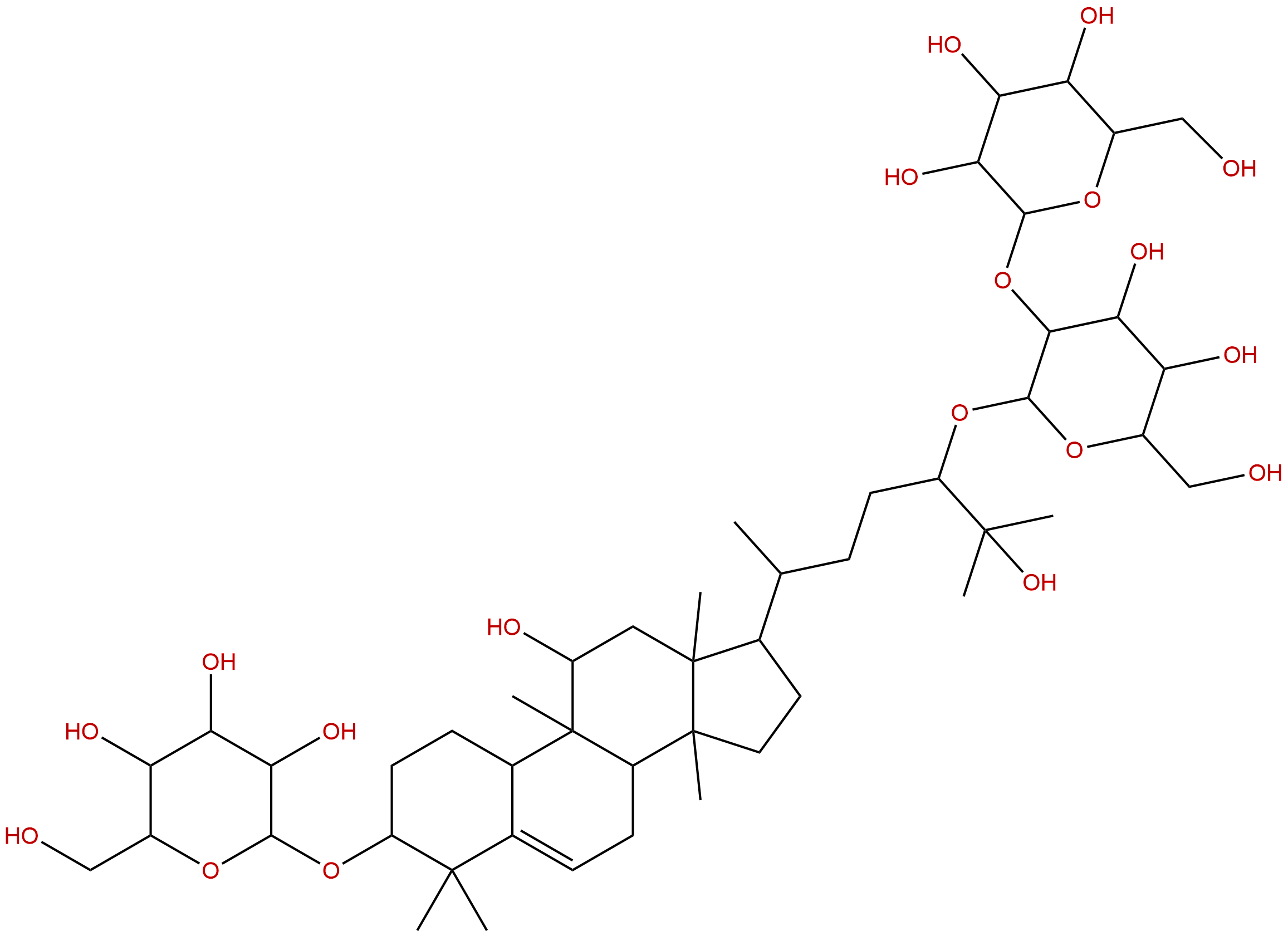


Product name: Mogroside IIIe
Synonym name:
Catalogue No.: BP1555
Cas No.: 88901-37-5
Formula: C48H82O19
Mol Weight: 963.165
Botanical Source: Momordica grosvenorii and Siraitia siamensis; Luohanguo
Physical Description:
Type of Compound: Triterpenoids
Purity: 95%~99%
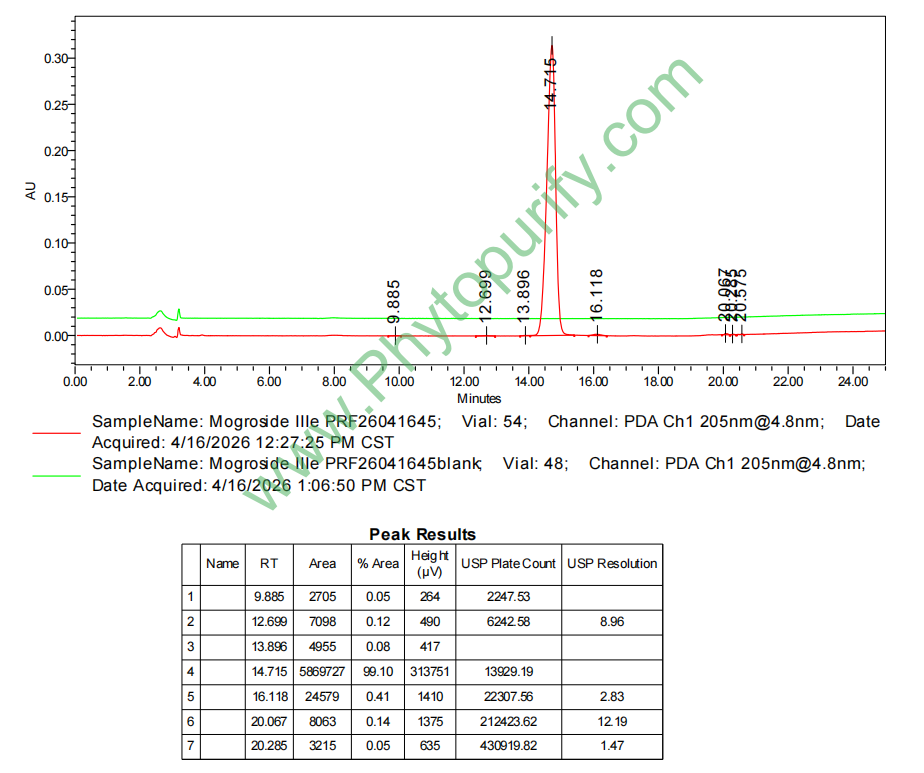
Analysis Method: HPLC-DAD or/and HPLC-ELSD
Identification Method: Mass, NMR
Packing: Brown vial or HDPE plastic bottle
The product could be supplied from milligrams to grams. Inquire for bulk scale.
We provide solution to improve the water-solubility of compounds, thereby facilitating the variety of activity tests and clinic uses.
For Reference Standard and R&D, Not for Human Use Directly.
HPLC of Mogroside IIIe
Storage conditions:Short-term storage at 2~8℃, long-term storage at -20 ~ -80℃
318.3700
1.8986
1.8987
.1785
.4362
.5364
Low
70.3597
6.5779
No
No
No
No
No
No
0.0
Yes
No
No
No
Diabetes is a global chronic metabolic disease, its incidence rate continues to rise, has become a serious public health challenge. At present, although first-line hypoglycemic drugs can effectively control blood sugar, long-term use often accompanies side effects such as weight gain, low blood sugar risk, and cardiovascular events, prompting researchers to continuously explore safer and multi-target treatment strategies from natural products. Siraitia grosvenorii(Siraitia grosvenorii)As a traditional medicinal and edible plant in China, its sweetness mainly comes from a kind of cucurbitane type triterpene saponin - Arhat. Among them, Arhat III e (CAS: 88901-37-5), as an important member of Arhat derivatives, has attracted much attention in recent years because of its remarkable pharmacological activities in anti diabetes, anti-inflammatory and anti fibrosis. Compared with mogroside V with higher sweetness, Arhat IIIe has unique research value in content, biological activity and potential mechanism of action. The purpose of this paper is to systematically review the chemical characteristics, plant origin, pharmacological activity, molecular mechanism of action and pharmaceutical properties of Arhat fruit glycoside IIIe, in order to provide scientific basis for the in-depth development and clinical application of this natural product.
Arhat fruit glycoside IIIe is a cucurbitane type tetracyclic triterpene saponin, its molecular formula is C48H82O20, and its molecular weight is 963.1650. Its basic skeleton is cucurbitan-5-en-3 β, 24R-diol (mogrol), with sugar chains connected by glycosidic bonds at the C3 and C24 positions, respectively. Specifically, the C3 position of Arhat fruit glycoside IIIe connects a disaccharide chain (Glc (β 1-2) Rha) composed of glucose (Glc) and rhamnose (Rha), while the C24 position connects a single glucose group. This specific glycosylation mode is the key structural feature that distinguishes it from Arhat fruit glycoside IE (mogroside IE, C3 position is single glucoside) and other homologues (such as Arhat fruit glycoside IIe, IVe, V).
From the analysis of physical and chemical properties, the calculated lipid water partition coefficient (LogP) is 1.8986, indicating that the compound has a certain lipophilicity but is not highly lipophilic. Its topological polar surface area (TPSA) is as high as 318.3700 Å ², mainly attributed to the abundant hydroxyl and sugar ring structures in the molecule, indicating its good hydrophilicity. This inference is consistent with the water solubility data (0.1785 mg/mL), indicating that Arhat IIIe is slightly soluble to soluble in water. The high TPSA and polarity make it difficult for it to efficiently penetrate the blood-brain barrier (predicted as low permeability), which to some extent limits its direct effects on central nervous system related diseases, but may also reduce the potential risk of neurotoxicity. In addition, preliminary pharmacological predictions indicate that the hERG inhibition risk is negative, and the Ames mutagenicity test predicts a value of 0.0, suggesting that it may have a good cardiac safety and genotoxic safety profile.
Arhat IIIe is mainly derived from the cucurbitaceae plant Siraitia grosvenorii(Siraitia grosvenorii The dried fruit of Swingle. In momordica grosvenorii, the glycosides of Arhat grosvenorii exist in the form of a series of mogrol glycosides with different sweetness. Arhat grosvenorii IIIe is one of the more abundant components, and its content is generally lower than momordica grosvenorii V, but higher than Arhat grosvenorii IV and VI.
Its extraction and separation usually follow the conventional process of natural product chemistry. First, the dried Siraitia grosvenorii fruit is extracted or refluxed with water, alcohol solution (such as methanol, ethanol) or hot water to obtain the crude extract. Subsequently, macroporous adsorption resins (such as AB-8, D101, HPD series) were used for enrichment and purification, and gradient elution was carried out through ethanol aqueous solution of different concentrations. Arhat glycosides were usually enriched at the high concentration ethanol elution site. After obtaining the total extract of siraitin, further separation and purification depend on a variety of chromatographic techniques. Silica gel column chromatography, reverse phase silica gel column chromatography (such as ODS-C18), and high-performance liquid chromatography (HPLC) or preparative liquid chromatography (pre HPLC) are commonly used. Since Arhat fruit glycoside IIIe is similar to other Arhat fruit glycosides in structure and polarity, and it is difficult to separate, it is often necessary to combine multiple chromatographic methods or use high-performance chromatographic columns for repeated separation. Modern separation and analysis technologies, such as high-speed countercurrent chromatography (HSCCC) and separation strategies guided by liquid chromatography-mass spectrometry (LC-MS), have also been applied to rapidly and efficiently obtain high-purity monomer compounds of Arhat fruit glycoside IIIe.
A large number of pharmacological studies in vitro and in vivo have confirmed that Arhat IIIe has various biological activities, among which the anti diabetes effect is the most prominent.
1. Anti diabetes activity: Many studies have confirmed that Arhat fruit glycoside IIIe can significantly improve the disorder of glucose and lipid metabolism in diabetes model animals. In the model of streptozotocin (STZ) - induced or high-fat diet combined with STZ induced diabetes mice/rats, intragastric administration of Arhat fruit glycoside IIIe can reduce the levels of fasting blood glucose, postprandial blood glucose and glycosylated hemoglobin (HbA1c) in a dose-dependent manner. At the same time, it can improve insulin resistance and enhance insulin sensitivity, manifested by significant improvements in oral glucose tolerance test (OGTT) and insulin tolerance test (ITT) results. In addition, Arhat fruit glycoside IIIe can also regulate lipid metabolism, reduce serum triglyceride (TG), total cholesterol (TC) and low-density lipoprotein cholesterol (LDL-C) levels, and increase high-density lipoprotein cholesterol (HDL-C), which has an improvement effect on diabetes complications such as non-alcoholic fatty liver disease (NAFLD).
2. Anti inflammatory and antioxidant activity: Chronic low-grade inflammation is the core of the occurrence and development of insulin resistance and type 2 diabetes. Studies have shown that Arhat fructoside IIIe can inhibit the excessive production of proinflammatory factors such as tumor necrosis factor - α (TNF - α), interleukin-6 (IL-6) and nitric oxide (NO) in macrophages stimulated by lipopolysaccharide (LPS) or palmitic acid. Its anti-inflammatory effect is related to the inhibition of the activation of nuclear factor kappa B (NF - κ B) and mitogen activated protein kinase (MAPK) signaling pathways. At the same time, Arhat fruit glycoside IIIe shows the ability to eliminate free radicals (such as DPPH, ABTS free radicals), and can improve the activities of superoxide dismutase (SOD), glutathione peroxidase (GSH Px) and other antioxidant enzymes in cells or tissues, reduce the level of malondialdehyde (MDA), thereby reducing oxidative stress damage.
3. Anti fibrotic activity: As one of its known pharmacological effects, Arhat fruit glycoside IIIe shows protective effects in liver fibrosis and renal fibrosis models. For example, in the model of liver fibrosis induced by carbon tetrachloride (CCl4) or bile duct ligation, the intervention of Arhat fruit glycoside IIIe can significantly reduce the deposition of collagen in liver tissue, and reduce the level of serum markers of liver fibrosis (such as hyaluronic acid, laminin, type III procollagen, type IV collagen). Its anti fibrotic mechanism involves inhibiting the activation and proliferation of hepatic stellate cells (HSCs), downregulating transforming growth factor - β 1 (TGF - β 1) and its downstream Smad signaling pathway, thereby reducing the excessive synthesis and deposition of extracellular matrix (ECM). This activity is of great significance for the prevention and treatment of diabetes related liver and kidney complications.
The anti diabetes and other pharmacological effects of Arhat fruit glycoside IIIe are not achieved through a single target, but involve a complex multi target regulatory network. Its core mechanism is closely related to improving insulin signaling pathway, regulating energy metabolism and reducing inflammatory oxidative stress.
1. Activate the AMPK signaling pathway: AMP activated protein kinase (AMPK) is a core regulatory factor in cellular energy metabolism. Studies have shown that Arhat fruit glycoside IIIe can directly or indirectly activate AMPK (composed of PRKAA1 and other subunits). The activation of AMPK produces a series of downstream effects: a) promoting the translocation of glucose transporter 4 (GLUT4, encoded by the SLC2A4 gene) from skeletal muscle and adipocytes to the cell membrane, increasing the uptake and utilization of glucose by peripheral tissues; b) Inhibit the expression of key enzymes involved in hepatic gluconeogenesis and reduce hepatic glucose output; c) Promote fatty acid oxidation, inhibit fat synthesis, and thus improve lipid metabolism. This is one of the core mechanisms by which it exerts its hypoglycemic and lipid-lowering effects.
2. Regulating the insulin-PI3K/Akt signaling pathway: Arhat fruit glycoside IIIe can enhance the tyrosine phosphorylation of insulin receptor substrate 1 (IRS1), activate phosphatidylinositol 3-kinase (PI3K, whose regulatory subunit is PIK3R1) and its downstream key kinase Akt (AKT1). Activated Akt further promotes membrane translocation of GLUT4 and regulates metabolic processes such as glycogen synthesis and protein synthesis. The activation of this pathway directly improves the efficiency of insulin signaling and alleviates insulin resistance.
3. Acting on other key metabolic targets:
* PPARγ: Arhat fruit glycoside IIIe may act as a regulator of peroxisome proliferator activated receptor γ (PPARG). PPAR γ is a target of insulin sensitizer thiazolidinedione drugs, and its activation can promote adipocyte differentiation, increase adiponectin secretion, and improve systemic insulin sensitivity.
* GCK and SGLT2: The study suggests that Arhat fructoside IIIe may have a positive regulation effect on glucokinase (GCK, the rate limiting enzyme of glucose metabolism) and promote the utilization of glucose by the liver. Meanwhile, there is evidence to suggest that it may inhibit renal sodium glucose cotransporter 2 (SGLT2), reduce tubular reabsorption of glucose, and increase urinary glucose excretion, a mechanism similar to the novel hypoglycemic drug SGLT2 inhibitors.
* DPP-4: Lohanoside IIIe showed inhibitory activity against dipeptidyl peptidase-4 (DPP4) in vitro. DPP4 inhibitors promote insulin secretion and inhibit glucagon release by prolonging the activity of endogenous glucagon like peptide-1 (GLP-1).
4. Anti inflammatory and antioxidant related pathways: In addition to the above metabolic targets, Arhat fruit glycoside IIIe reduces the production of inflammatory factors by inhibiting NF - κ B, MAPK (p38, JNK, ERK) and other inflammatory signaling pathways. Its antioxidant effect is related to the activation of the nuclear factor E2 related factor 2 (Nrf2) pathway, which upregulates the expression of downstream antioxidant enzymes.
To sum up, Arhat fruit glycoside IIIe forms its multi-dimensional and multi-channel action network to improve glucose and lipid metabolism and insulin resistance through synergistic action on multiple key targets such as AMPK, PI3K/Akt, PPAR γ, and supplemented by anti-inflammatory and antioxidant effects.
Although the pharmacological activity of Arhat fruit glycoside IIIe is clear, its drug potency and pharmacokinetic (PK) characteristics are the key to determine whether it can be successfully developed as a drug.
Analysis of pharmacological parameters: According to the provided calculation data, its molecular weight (963.1650) far exceeds the upper limit of the traditional "Rule of Five" (MW<500), which is common in large molecule natural saponins and may affect their oral absorption and transmembrane transport. A higher TPSA (318.37) and relatively lower LogP (1.90) indicate strong hydrophilicity, which is consistent with the characteristics of most glycoside compounds. The predicted water solubility is acceptable, but the actual bioavailability may be limited by its larger molecular size and polarity. The blood-brain barrier has low permeability, which limits central function, but may be beneficial in reducing central side effects. The negative inhibition of hERG and the negative prediction of Ames test are positive signals for its safety.
Current status of pharmacokinetic research: At present, the pharmacokinetic study of Arhat fruit glycoside IIIe system is relatively limited, but based on the study of similar Arhat fruit glycosides, its possible characteristics can be inferred. After oral administration, Arhat fruit glycosides may be partially hydrolyzed by intestinal flora in the gastrointestinal tract, and partial glycosides may be removed and converted into secondary glycosides or aglycones (such as mogrol). These metabolites may be the real active forms. The absorption of prototype compounds and their metabolites may be moderate to weak, and the absolute bioavailability needs to be accurately determined. Its distribution may mainly be concentrated in organs with abundant blood and active metabolism, such as the liver and kidneys, while the amount entering the brain is extremely small. The metabolic pathway may involve phase I (such as oxidation) and phase II (such as glucuronidation, sulfation) reactions in the liver. The main excretion pathways may be through the kidneys (prototype or metabolites) and bile (feces). Future research needs to clarify its detailed PK parameters in rats, dogs, and even humans, including absorption rate and degree, distribution volume, plasma protein binding rate, major metabolic enzymes, and excretion pathways, which are essential for preclinical development.
Structural modification and formulation optimization: In order to improve its pharmaceutical performance, it may be necessary to modify the structure of Arhat fruit glycoside IIIe, such as preparing its prodrug (such as esterification to improve fat solubility), or exploring its active metabolite as a lead compound. In terms of dosage forms, developing nano formulations (such as liposomes, polymer nanoparticles), self microemulsion delivery systems, or cyclodextrin inclusion complexes may be effective strategies to improve oral absorption and enhance bioavailability.
As a multi target and multi effect natural active ingredient, Arhat fruit glycoside III shows broad clinical application prospects in the prevention and treatment of diabetes and its complications.
Potential application directions:
1. First line or adjuvant treatment of type 2 diabetes: Its multi-target mechanism of action (AMPK activation, insulin sensitization, potential SGLT2/DPP4 inhibition) makes it possible to develop it as a novel oral hypoglycemic agent, particularly suitable for patients with insulin resistance, obesity, or mild dyslipidemia. It can be used as a monotherapy or in combination with existing drugs (such as metformin) to achieve synergistic effects and reduce side effects.
2. Prevention and treatment of complications of diabetes: Its anti-inflammatory, antioxidant and anti fibrosis activities make it unique in the prevention and treatment of diabetes nephropathy, diabetes non-alcoholic fatty liver/liver fibrosis, diabetes cardiovascular disease and other aspects. Consider developing specialized formulations for complications.
3. Comprehensive management of metabolic syndrome: In addition to lowering blood sugar, its role in regulating lipids and improving insulin sensitivity is in line with the comprehensive management concept of metabolic syndrome.
4. Functional and health foods: Relying on the background of "homology of medicine and food" of Arhat grosvenorii, the extracts or concentrates with high content of Siraitia grosvenorii glycoside IIIe can be developed as health food or formula food for special medical purposes with functions of auxiliary hypoglycemic and blood lipid regulation.
Challenges and future research directions:
1. In depth mechanism research: It is necessary to use techniques such as gene knockout and chemical probes to more accurately verify its direct molecular targets and interaction modes, and clarify the primary secondary relationships and collaborative logic in its "multi-target" network.
2. Systematic pharmacokinetic and toxicological evaluation: A complete set of preclinical pharmacokinetic (ADME) and long-term toxicology studies that meet the requirements for new drug registration must be completed to clarify their safety window.
3. Clinical research validation: Conducting rigorous clinical trials from Phase I to Phase III is the final step in verifying its human efficacy and safety. It is necessary to design a reasonable clinical trial plan, select appropriate patient populations and observation endpoints.
4. Intellectual Property and Industrialization: Strengthen the full chain patent layout from extraction and purification processes, structural modifications, formulation technology to medical applications. Addressing the technical challenges of large-scale, high-purity, and low-cost industrial production.
Arhat IIIe is an active natural product derived from the traditional medicinal plant Siraitia grosvenorii. With its unique chemical structure and multi-target pharmacological mechanism, it shows significant potential in anti diabetes, anti-inflammatory, antioxidant and anti fibrosis. It comprehensively improves glucose and lipid metabolism and insulin resistance by synergistically regulating key signaling pathways such as AMPK, PI3K/Akt, and PPAR γ, demonstrating the advantages of multi-component and multi-target synergistic effects of natural products. Although it faces the challenges of high molecular weight and low oral bioavailability in terms of pharmaceutical properties, through optimization by modern pharmaceutical chemistry and pharmaceutics, combined with systematic preclinical and clinical research, Arhat fruit glycoside III is expected to be developed into a new drug or functional product for the prevention and treatment of type 2 diabetes and its complications. The in-depth study of Arhat fruit glycoside IIIe not only helps to tap the modern scientific value of traditional Chinese medicine, but also provides new candidate molecules and ideas for drug research and development of metabolic diseases.
