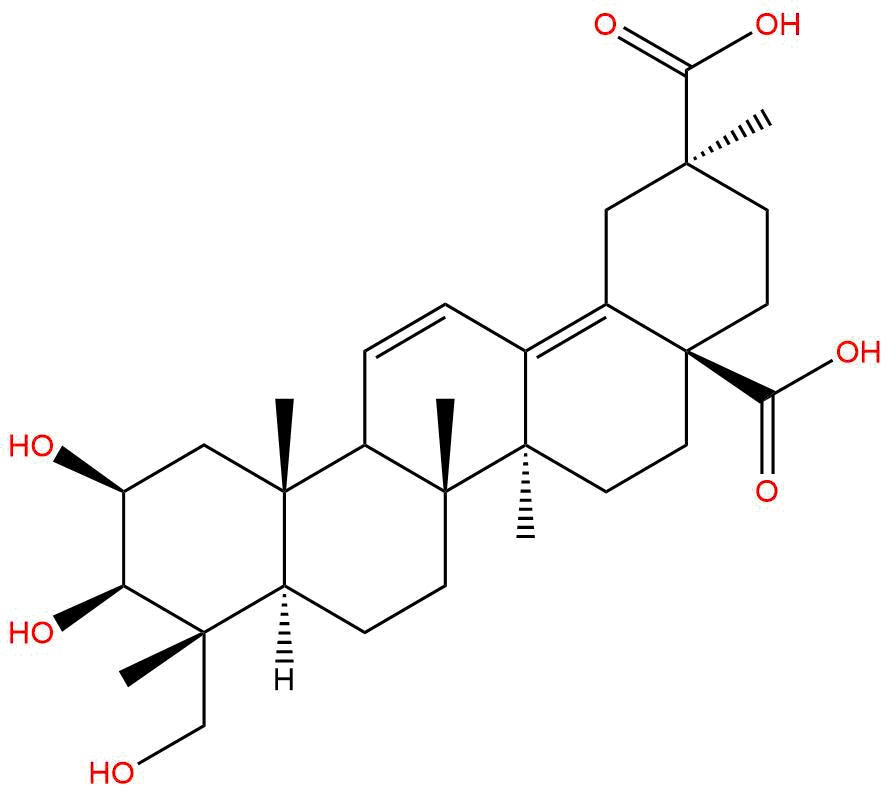


Product name: Jaligonic acid B
Synonym name:
Catalogue No.: BP2291
Cas No.: 2375176-78-4
Formula: C30H44O7
Mol Weight: 516.675
Botanical Source: Phytolaccae radix
Type of Compound: Triterpenoids
Purity: 95%~99%
Analysis Method: HPLC-DAD or/and HPLC-ELSD
Identification Method: Mass, NMR
Packing: Brown vial or HDPE plastic bottle
Storage: Store in a well closed container, protected from air and light. Put into refrigerate or freeze for long term storage.
Whenever possible, you should prepare and use solutions on the same day. However, if you need to make up stock solutions in advance, we recommend that you store the solution as aliquots in tightly sealed vials at -20℃. Generally, these will be useable for up to two weeks.
The product could be supplied from milligrams to grams
Inquire for bulk scale.
For Reference Standard and R&D, Not for Human Use Directly.
Storage conditions:Short-term storage at 2~8℃, long-term storage at -20 ~ -80℃
Jaligonic acid B is an emerging natural product that has received widespread attention for its potential value in the field of anti-tumor therapy, particularly in the treatment of colorectal cancer (CRC). Colorectal cancer is one of the malignant tumors with high incidence rate and mortality in the world. Its complex pathogenesis and multi-target characteristics make the research and development of new anti-cancer drugs particularly urgent. Gallic acid B, with its unique chemical structure and multi-target regulatory ability, provides new ideas and possibilities for the treatment of colorectal cancer.
This article aims to systematically review the chemical structure, plant origin, pharmacological activity, mechanism of action, and pharmacological evaluation of gallic acid B. Combined with its regulatory effects on colorectal cancer related targets, it explores its clinical application prospects and development directions, providing reference for the field of natural product pharmacology.
The molecular formula of gallic acid B is C30H44O8, with a molecular weight of 516.6750, and it belongs to the triterpenoid class. Its molecular structure contains multiple hydroxyl and carboxyl functional groups, endowing it with high polarity and biological activity. The LogP value is 3.1510, indicating that it has moderate lipid solubility, which is beneficial for membrane penetration. The topological polar surface area (TPSA) is 135.2900, indicating its strong ability to interact with polar molecules.
The water solubility is 0.0544, indicating that the solubility of gallic acid B in water is relatively low, suggesting that improvement strategies for solubility need to be considered in drug formulation design. The low permeability of the blood-brain barrier indicates limited distribution in the central nervous system, which may reduce central nervous system side effects. The hERG channel inhibition experiment showed a negative result, indicating a low risk of cardiac toxicity associated with gallic acid B. The Ames test result is 0.0, indicating no significant mutagenicity and high safety.
Gallic acid B is mainly isolated from plants of the Gallium genus, which is widely distributed in tropical and subtropical regions and traditionally used in folk herbal medicine to treat various diseases. Specific plant species include Jaligo, which contains abundant amounts of gallic acid B in its roots, stems, and leaves.
The extraction method usually uses organic solvent extraction combined with column chromatography separation technology. Firstly, ethanol or methanol is used for reflux extraction of plant dried powder, followed by removal of impurities through liquid-liquid distribution. The crude extract was further purified by silica gel column chromatography and reverse phase high-performance liquid chromatography (RP-HPLC) to obtain high-purity gallic acid B. In recent years, the application of supercritical CO2 extraction and microwave-assisted extraction technology has improved extraction efficiency and purity, reduced solvent usage, and is in line with the concept of green chemistry.
Numerous in vitro and in vivo experiments have shown that gallic acid B has significant anti colorectal cancer activity. It mainly manifests as inhibiting tumor cell proliferation, inducing cell apoptosis, blocking cell cycle, and inhibiting tumor metastasis and invasion ability.
In colorectal cancer cell lines, gallic acid B can effectively inhibit cell proliferation, with IC50 values in the low micromolar concentration range. The induced cell apoptosis is related to the mitochondrial pathway, manifested by the regulation of BCL2 family protein expression and the upregulation of apoptosis related enzymes such as activated CASP9. In addition, gallic acid B can also inhibit key cell cycle proteins, block the cell cycle in G0/G1 or G2/M phases, and inhibit the proliferation process of tumor cells.
In animal model studies, gallic acid B significantly delayed the growth of colorectal cancer tumors, reduced tumor volume and weight, and did not show significant toxic side effects. Its anti-tumor effect is closely related to multi-target regulation, reflecting the advantage of natural product multi-target synergistic effect.
The anti colorectal cancer effect of gallic acid B involves multiple key molecular targets, including cell apoptosis, proliferation, inflammatory response, and tumor microenvironment regulation.
BCL2 (B-cell lymphoma 2)
BCL2 is a member of the anti apoptotic protein family. Gallic acid B downregulates BCL2 expression, relieves its inhibition of apoptosis, and promotes tumor cell apoptosis.
NFE2L2 (Nuclear Factor Red Blood Cell 2-Associated Factor 2)
NFE2L2 regulates cellular antioxidant stress response, while gallic acid B regulates its activity, reducing the protective effect of oxidative stress on tumor cells and enhancing cell sensitivity to treatment.
TOP1 and TOP2A (Topoisomerase I and II α)
These two enzymes play a crucial role in DNA replication and transcription. Gallic acid B inhibits the activity of TOP1 and TOP2A, blocks DNA replication, and induces tumor cell death.
MAPK1 (mitogen activated protein kinase 1)
The MAPK signaling pathway is involved in cell proliferation and differentiation, and gallic acid B regulates MAPK1 activity, inhibiting tumor cell proliferation and migration.
CASP9 (Caspase 9)
CASP9 is a key initiating enzyme in the mitochondrial pathway, and glycolic acid B activates CASP9, initiating the cascade of cell apoptosis.
NOS2 (nitric oxide synthase 2)
NOS2 mediates inflammatory response and regulation of tumor microenvironment. Gallic acid B inhibits NOS2 expression, reducing inflammation induced tumor progression.
PIK3CA (Phosphatidylinositol 3-kinase catalytic subunit alpha)
PIK3CA activates the PI3K/Akt signaling pathway, promoting cell survival and proliferation. Gallic acid B inhibits PIK3CA, blocks this signaling pathway, and suppresses tumor growth.
MMP9 (Matrix Metalloproteinase 9)
MMP9 participates in the degradation of tumor extracellular matrix, promoting invasion and metastasis. Gallic acid B inhibits MMP9 expression and blocks tumor metastasis.
EGFR (epidermal growth factor receptor)
The EGFR signaling pathway is a key pathway for the proliferation of various tumor cells. Gallic acid B inhibits tumor cell proliferation and survival by regulating EGFR activity.
In summary, gallic acid B exerts significant therapeutic effects against colorectal cancer through multi-target and multi pathway synergistic effects, reflecting the advantages of the natural product complex mechanism.
The pharmacological indicators of gallic acid B show that it has good development potential. Although the molecular weight of 516.6750 is slightly higher than the ideal range of traditional small molecule drugs, it is still within an acceptable range. The LogP value of 3.1510 indicates moderate lipid solubility, which is beneficial for cell membrane penetration, but low water solubility (0.0544), suggesting the need for drug formulation optimization to improve bioavailability.
The low permeability of the blood-brain barrier reduces the risk of central nervous system toxicity, but limits its application in central nervous system tumors. HERG channel inhibition was negative and Ames test showed no mutagenicity, indicating good drug safety.
In terms of pharmacokinetics, existing research is relatively limited. Preliminary pharmacokinetic data in vivo show that oral absorption of gallic acid B is slow, with a moderate plasma half-life. It is mainly metabolized through the liver, and the activity of its metabolites needs further research. In the future, systematic pharmacokinetic and toxicological studies need to be conducted to clarify its in vivo pharmacokinetic characteristics and safe dose range.
Gallic acid B, as a multi-target natural product for the treatment of colorectal cancer, has significant anti-tumor activity and good safety, and is a potential new drug candidate molecule in the field of colorectal cancer treatment. Its multi-channel collaborative regulation mechanism is expected to overcome the problem of single target drug resistance and improve treatment efficacy.
The future clinical application prospects are mainly reflected in the following aspects:
Single drug therapy potential
By further optimizing the drug formulation and administration regimen, gallic acid B is expected to enter the clinical trial stage as a single anti-tumor drug.
Combination therapy strategy
Gallic acid B can be used in combination with existing chemotherapy drugs, targeted drugs, or immunotherapy drugs to exert synergistic effects, reduce toxic side effects, and improve efficacy.
Drug delivery system development
The development of new delivery systems such as nanocarriers and liposomes to address the issue of low water solubility will effectively enhance their bioavailability and targeting.
Biomarker guided therapy
By combining its target of action, screening corresponding biomarkers, achieving precision medicine, and improving individualized treatment outcomes for patients.
However, the clinical translation of gallic acid B still faces many challenges, including insufficient systematic pharmacokinetic and toxicological evaluation, lack of preclinical safety data, standardization of production processes, and quality control difficulties. In the future, it is necessary to strengthen interdisciplinary cooperation and promote its transformation from laboratory research to clinical applications.
Gallic acid B, as a natural triterpenoid compound with unique structure and multi-target mechanism of action, has shown broad application prospects in the field of colorectal cancer treatment. Its significant anti-tumor activity, good safety, and multi-target regulatory ability provide valuable examples for the development of natural anti-cancer drugs.
In the future, through in-depth pharmacological mechanism research, pharmacokinetic optimization, and preclinical safety evaluation, gallic acid B is expected to become a new candidate drug for the treatment of colorectal cancer. By combining modern drug research and development technology with precision medicine concepts, it will further promote its clinical translation process and benefit more patients.
In summary, the study of gallic acid B not only enriches the theoretical system of natural product pharmacology, but also provides new strategies and hope for the treatment of colorectal cancer, which deserves continuous attention and investment from the scientific research and pharmaceutical industries.
