


Synonym name: Phytolaccasaponin E; Phytolaccoside E
Catalogue No.: BP0560
Cas No.: 65497-07-6
Formula: C42H66O16
Mol Weight: 826.974
Botanical Source: Phytolacca americana (pokeberry), Phytolacca esculenta, Phytolacca thrysiflora and root cultures of Phytolacca acinosa
Purity: 95%~99%
Analysis Method: HPLC-DAD or/and HPLC-ELSD
Identification Method: Mass, NMR
Packing: Brown vial or HDPE plastic bottle
Can be supplied from milligrams to grams.
For Reference Standard and R&D, Not for Human Use Directly.
Inquire for bulk scale.
HPLC of Esculentoside A
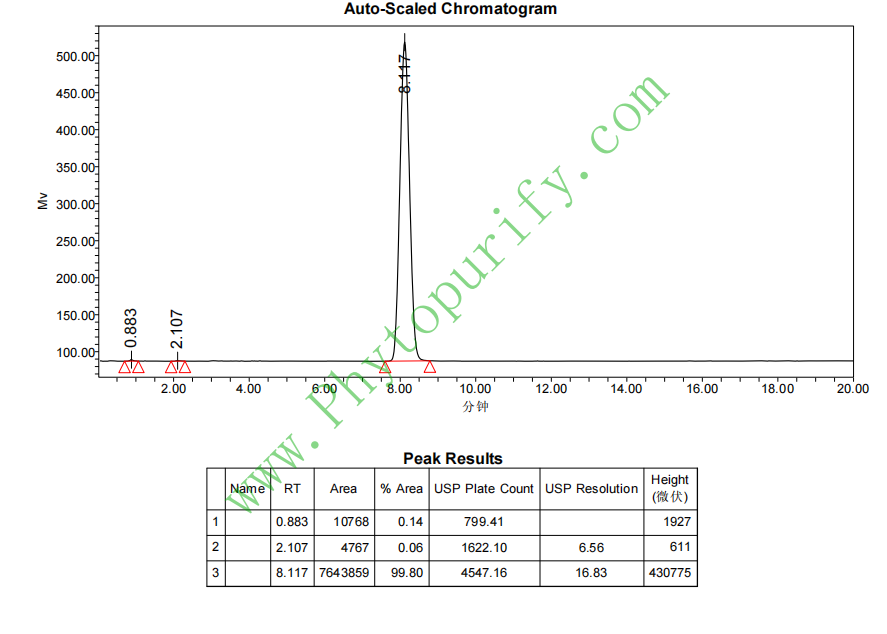
Storage conditions:Short-term storage at 2~8℃, long-term storage at -20 ~ -80℃
Esculentoside A (EsA) is a natural triterpenoid saponin extracted from the roots of Phytolacca esculenta. As one of the important active ingredients in traditional Chinese medicinal herb Shanglu, EsA has attracted much attention due to its significant anti-inflammatory and immunomodulatory activities. In recent years, with the development of natural product pharmacology, the potential therapeutic value of EsA in inflammatory diseases, especially in immune related pathological states such as acute lung injury (ALI), has gradually been revealed. It has become a hot topic in the study of natural anti-inflammatory drugs and immune modulators through its multi-target and multi pathway regulatory effects.
This article will systematically review the chemical structure and physicochemical properties, plant sources and extraction methods, pharmacological activity and mechanism of action, pharmacological parameters and pharmacokinetic characteristics of Shanglu saponin A, and explore its potential for clinical application and future research directions, aiming to provide theoretical basis and research reference for the drug development of this natural product.
The molecular formula of Shanglu Saponin A (EsA) is C42H66O16, with a molecular weight of 826.9740, and it belongs to the triterpenoid saponin class. Its basic skeleton is a pentacyclic triterpenoid structure, connecting multiple sugar residues to form a typical saponin molecular structure. The LogP value of EsA is 1.4032, indicating that it has moderate lipid solubility and is conducive to cell membrane permeation. The polar surface area (TPSA) is as high as 262.36 Å ², indicating strong molecular polarity and low water solubility (0.1468), which may affect its bioavailability and in vivo distribution.
Structurally, the triterpenoid core ring system of EsA is stable, and the glycoside moiety endows it with strong hydrophilicity and specific biological activity. Its molecule contains multiple hydroxyl and glycosidic bonds, making it easy to form hydrogen bonds and van der Waals forces with target proteins, enhancing binding affinity. The low blood-brain barrier penetration suggests that it mainly acts on peripheral tissues, reducing the risk of central nervous system side effects. The hERG channel inhibition experiment showed a negative result, indicating a low risk of cardiac toxicity. The Ames mutagenicity test result is 0, indicating that EsA has no significant genotoxicity.
Phytolacca esculenta, the root active ingredient of the plant Phytolacca esculenta in the family Phytolaciaceae, is the main source of saponin A. Shanglu is widely used in traditional Chinese medicine and has the effects of clearing heat and detoxifying, reducing swelling and dispersing nodules. EsA, as one of its main saponin components, is abundant in content and has significant biological activity.
Traditional extraction methods often use alcohol solvents (such as ethanol and methanol) for reflux extraction of dried roots, followed by purification and separation through liquid-liquid distribution, silica gel column chromatography, and high-performance liquid chromatography (HPLC) techniques. In recent years, in order to improve extraction efficiency and purity, ultrasound assisted extraction, microwave-assisted extraction, and membrane separation technologies have gradually been applied in the extraction process of EsA.
The extraction process usually includes:
1. Drying and crushing of raw materials;
2. Ethanol reflux extraction;
3. Concentrated extraction solution;
4. Use ether or chloroform to remove lipophilic impurities;
5. Separation by silica gel column chromatography;
6. HPLC purification and structural identification.
This method can obtain high-purity EsA, laying the foundation for subsequent pharmacological research and formulation development.
EsA exhibits significant anti-inflammatory effects, especially in acute inflammation models. In vitro experiments have shown that EsA can inhibit lipopolysaccharide (LPS) - induced macrophage inflammatory response and significantly reduce the secretion of pro-inflammatory factors such as TNF - α, IL-6, and IL-1 β. In vivo studies have shown that EsA has a protective effect on LPS induced acute lung injury (ALI) models, reducing inflammation infiltration and tissue damage in lung tissue.
EsA exerts immune regulatory functions by regulating immune related signaling pathways. Its target involves multiple immune regulatory factors, including TLR4, STAT3, IL2, NFKB1, TGFB1, CTLA4, STAT4, IL10, FOXP3, and IFNG. EsA can regulate the functional status of immune cells, promote immune balance, and alleviate tissue damage caused by immune overactivation.
Some studies have shown that EsA has antioxidant activity, which can clear excess reactive oxygen species (ROS) and alleviate cellular damage caused by oxidative stress. In addition, EsA has a protective effect on cell apoptosis and necrosis processes, helping to maintain tissue homeostasis.
The anti-inflammatory and immunomodulatory effects of EsA are mainly achieved by inhibiting the nuclear factor kappa B (NF - κ B) and mitogen activated protein kinase (MAPK) signaling pathways. In LPS induced inflammatory response, EsA can block TLR4 mediated signaling, inhibit downstream NF - κ B activation, and reduce transcription and release of pro-inflammatory cytokines.
The specific mechanism includes:
-Inhibit the phosphorylation and degradation of I κ B α, and prevent NF - κ B from entering the nucleus;
-Inhibit the phosphorylation of MAPK family members (such as p38, ERK, JNK) and weaken the amplification of inflammatory signals;
-Regulating the STAT3 and STAT4 signaling pathways to affect immune cell proliferation and differentiation;
-Promote the expression of anti-inflammatory factor IL-10 and regulatory T cell marker FOXP3, and enhance immune tolerance;
-Inhibit the overexpression of pro-inflammatory cytokines IFN - γ and IL-2, and alleviate immune-mediated inflammatory responses.
In addition, EsA may also participate in the regulation of the immune microenvironment by regulating immunosuppressive molecules such as TGFB1 and CTLA4, promoting the transition of inflammation to the repair stage.
The high molecular weight of EsA (826.9740) and TPSA (262.36 Å ²) indicate its strong polarity, which may affect oral absorption and cell membrane penetration. The LogP is 1.4032, indicating that it has moderate lipid solubility and is beneficial for in vivo distribution. Low water solubility (0.1468) may limit its bioavailability.
The low penetration of the blood-brain barrier suggests that EsA mainly acts on peripheral tissues, reducing the risk of central nervous system side effects. The hERG channel inhibition experiment was negative, indicating a low risk of cardiac toxicity. The Ames test is non mutagenic and has good safety.
Currently, there is limited systematic pharmacokinetic research on EsA. Preliminary data suggests that EsA has slow absorption and limited bioavailability after oral administration, which may be related to its high polarity and molecular weight. The distribution in the body is mainly concentrated in tissues rich in immune cells such as the liver and lungs. The metabolic pathway has not been fully elucidated, and it is speculated that glycoside hydrolysis and oxidative metabolism are mainly carried out through the liver enzyme system. The main excretion pathways may be bile and urine.
In the future, it is necessary to conduct systematic pharmacokinetic and pharmacodynamic studies, optimize dosing regimens and formulation designs, and enhance their clinical application potential.
EsA, as a natural triterpenoid saponin, has shown broad application prospects in the treatment of inflammatory diseases due to its significant anti-inflammatory and immune regulatory activities. Especially in areas such as acute lung injury, chronic inflammatory diseases, autoimmune diseases, and immune function regulation, EsA has potential drug development value.
The key to future clinical applications lies in:
-Optimize the extraction and purification process to ensure stable drug quality;
-Improve its oral bioavailability and in vivo stability through structural modification or formulation innovation;
-Thoroughly investigate its mechanism of action, clarify key molecular targets and signaling pathways;
-Conduct systematic safety evaluation and preclinical pharmacokinetic studies;
-Design reasonable clinical trials to verify their efficacy and safety.
In addition, the combination application of EsA with existing anti-inflammatory drugs and its multi-target effects in the field of immune regulation also provide possibilities for the development of new indications. With the advancement of natural product pharmacology and modern drug development technology, EsA is expected to become an important candidate for novel anti-inflammatory and immunomodulatory drugs.
Esculentoside A, as the main triterpenoid saponin in the roots of the plant, has significant anti-inflammatory and immunomodulatory activities. It inhibits key inflammatory signaling pathways such as NF - κ B and MAPK, regulates multiple immune related targets, reduces inflammatory responses, and protects tissue function. Although there are certain challenges in its drug development, its good safety and multi-target mechanism of action provide a solid foundation for its drug development.
In the future, it is necessary to strengthen in-depth research on the pharmacokinetics and clinical efficacy of EsA, combined with modern drug design techniques, to promote its translation into clinical applications. As an important object of pharmacological research on natural products, EsA not only enriches the resource library of natural anti-inflammatory drugs, but also provides valuable examples for exploring new immune regulation strategies.
