Introduction/Overview
In the treasure trove of traditional medicine, ginseng(Panax ginseng C. A. Mey.'s position as the "King of Herbs" has lasted for thousands of years without decline. The core pharmacological active ingredient, ginsenosides, has always been a hot topic in modern pharmacological research. With the advancement of separation and identification technology, more and more rare or minor saponins with unique structures and significant activities have been discovered, opening up new paths for the modern application of ginseng. Ginsenoside Rh7 (CAS: 343780-68-7) is one of the rising stars. As a minor saponin isolated from ginseng leaves, Rh7, although not dominant in terms of content, is attracting widespread attention from researchers due to its unique and multi-target pharmacological activity in anti-aging and related fields. Aging is a core risk factor for the occurrence and development of various chronic diseases, such as neurodegenerative diseases, cardiovascular diseases, metabolic syndrome, and cancer. Its molecular mechanism is complex, involving multiple levels such as energy metabolism imbalance, increased oxidative stress, telomere shortening, genomic instability, and cellular aging. Therefore, the search for natural compounds that can intervene in the aging process through multiple pathways has significant scientific significance and clinical application value. This article aims to systematically review the chemical characteristics, plant sources, pharmacological activities of ginsenoside Rh7, especially focusing on its anti-aging effect. It deeply analyzes its molecular targets and mechanisms of action, and looks forward to its medicinal properties and future application prospects, in order to provide comprehensive academic references for the in-depth research and development of this compound.
Chemical structure and physicochemical properties
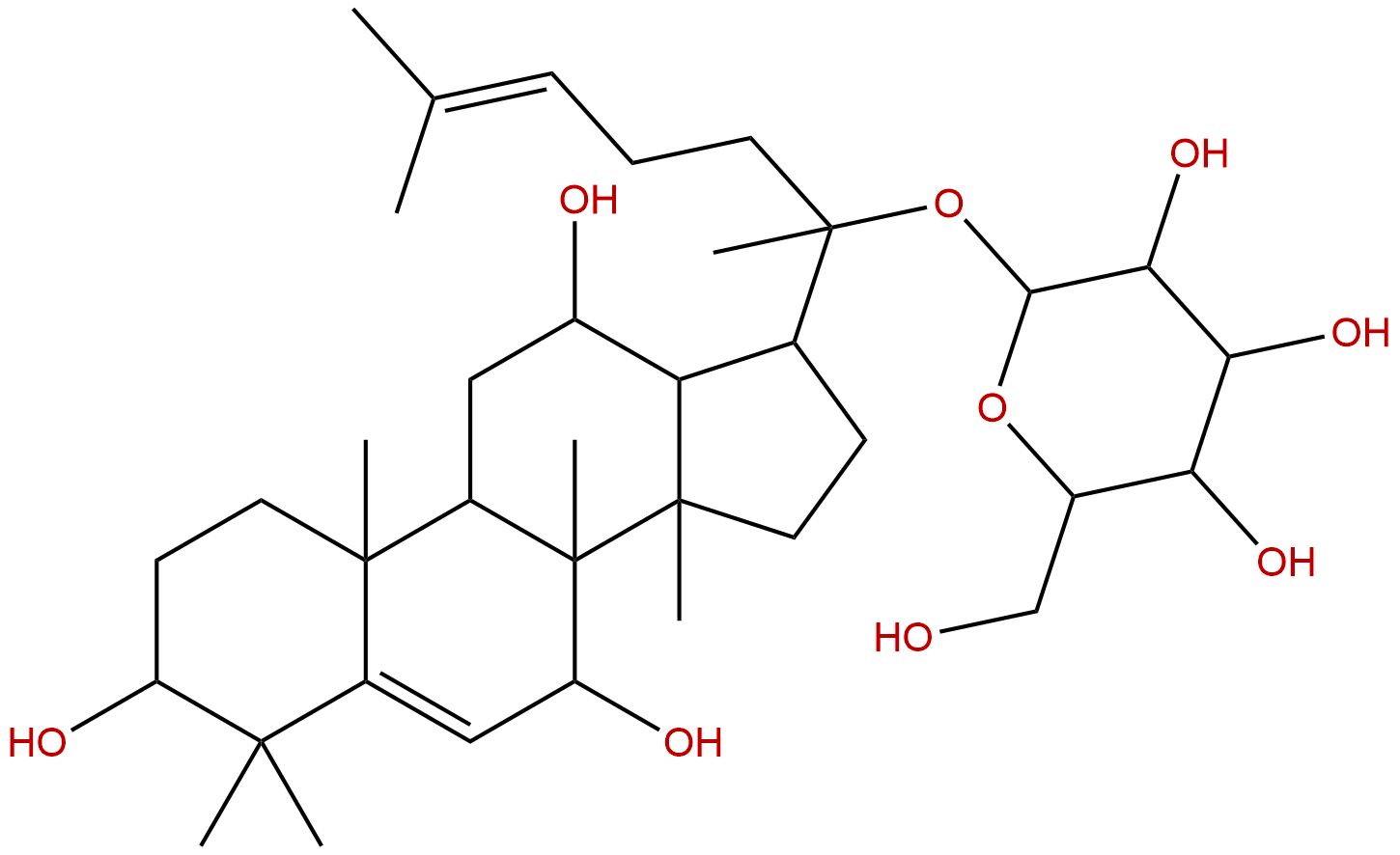
Ginsenoside Rh7 belongs to the dammarane type tetracyclic triterpenoid saponin and is a derivative of the original ginsenediol type saponin. Its molecular formula is C36H60O8 and its molecular weight is 636.8670. The core of its structure is a steroid like Damatane skeleton, with sugar groups connected at positions C-3 and C-20, respectively. Compared with common ginsenosides such as Rb1 and Rg1, the sugar composition of Rh7 is relatively simple, which may be a key factor affecting its physicochemical properties and biological activity.
From the analysis of parameters related to drug formation, the lipid water partition coefficient (LogP) of Rh7 is 3.5582, indicating that it has a certain lipophilicity, which is beneficial for its penetration of cell membranes, but may also affect its dispersion in the aqueous phase. Its topological polar surface area (TPSA) is 160.0700 Å ², which is a relatively high value, mainly attributed to the oxygen atoms on multiple hydroxyl and sugar groups in the molecule, suggesting that it may form a strong hydrogen bonding network. The water solubility parameter is 0.0265, which confirms that it belongs to a poorly soluble compound, which will be the primary challenge to be solved in its formulation development. In terms of preliminary safety prediction, the lack of inhibition of hERG channel by Rh7 suggests a low potential risk of cardiac toxicity, while the Ames test result of 0.0 indicates no mutagenicity, providing positive signals for further safety evaluation. However, its blood-brain barrier permeability prediction is "low", which means that it may be difficult for it to enter the central nervous system in the form of a prototype drug. If it is intended to treat neurodegenerative diseases, structural modifications or special drug delivery systems may be needed to improve its brain distribution.
Plant sources and extraction methods
Ginsenoside Rh7 is mainly isolated from plants of the Panax genus in the Araliaceae family. The initial research reported that it originated from ginseng(Panax ginseng)The leaves. Unlike classical saponins mainly stored in the roots (such as Rb1, Rg1), leaves, as active parts of ginseng growth and metabolism, contain their unique saponin spectrum, and Rh7 is one of the characteristic secondary saponins. In addition, in some other ginseng plants such as Panax notoginseng(Panax notoginseng)It may also be detected in the middle, but the content is usually low.
Due to the low content of Rh7 in plants, its extraction and purification are challenging tasks. Conventional extraction methods often use alcohol extraction, such as reflux extraction or ultrasound assisted extraction of dried and crushed ginseng leaves using methanol, ethanol, or n-butanol. After vacuum concentration, the crude extract needs to undergo a series of complex chromatographic separation steps for purification. Macroporous adsorption resins (such as D101, AB-8) are often used for initial enrichment to remove impurities such as polysaccharides and proteins. Subsequently, repeated separation and purification were performed using silica gel column chromatography, reverse phase silica gel column chromatography (such as ODS), and high-performance liquid chromatography (HPLC) or preparative high-performance liquid chromatography (pre HPLC). In recent years, liquid-liquid distribution chromatography techniques such as high-speed countercurrent chromatography (HSCCC) have also been applied in the separation of rare saponins such as Rh7 due to their high recovery rate and avoidance of irreversible adsorption of active ingredients by solid adsorbents. Finally, the structure was identified through techniques such as nuclear magnetic resonance (NMR) and mass spectrometry (MS). With the development of synthetic biology, the biosynthesis of specific ginsenosides using microbial or plant cell culture systems has become a potential alternative strategy for obtaining rare components such as Rh7.
Pharmacological activity research
The pharmacological activity research of ginsenoside Rh7 is currently in its early stages, but it has shown multiple biological effects, especially in anti-aging and related protective effects.
1. Anti aging activity: This is the most widely studied area in Rh7 research. In cell models, Rh7 can significantly delay various stress-induced cellular senescence. For example, in premature aging cell models induced by hydrogen peroxide (H ₂ O ₂) or D-galactose, Rh7 treatment can reduce the activity of aging associated β - galactosidase (SA - β - gal), decrease cell cycle arrest, and improve cell proliferation ability. In animal models, preliminary studies have shown that Rh7 can improve cognitive function, exercise endurance, and prolong healthy lifespan in naturally aging or rapidly aging model mice.
2. Antioxidant stress: Rh7 exhibits strong free radical scavenging ability and enhanced cellular antioxidant defense. It can directly neutralize reactive oxygen species (ROS) and upregulate the activity of endogenous antioxidant enzyme systems in cells, thereby protecting cells from oxidative damage. This is very important for delaying aging, preventing atherosclerosis, neurodegenerative diseases, etc.
3. Anti inflammatory effect: Chronic low-grade inflammation is another sign of aging. Research has shown that Rh7 can inhibit the excessive production of pro-inflammatory mediators (such as TNF - α, IL-6, IL-1 β, NO) in macrophages induced by stimuli such as lipopolysaccharide (LPS), and its mechanism may be related to the inhibition of the activation of classical inflammatory signaling pathways such as NF - κ B.
4. Neuroprotective effect: Although its BBB permeability is limited, some studies suggest that Rh7 or its metabolites may have neuroprotective potential. In the Alzheimer's disease cell model, Rh7 showed a trend towards reducing beta amyloid (A β) - induced neuronal toxicity and tau protein hyperphosphorylation.
5. Other potential activities: Limited reports also suggest that Rh7 may have certain effects in regulating glucose and lipid metabolism, protecting cardiovascular health, and anti-tumor effects, but these activities still require more systematic and in-depth research to confirm.
Mechanism of action and molecular targets
The anti-aging and multiple pharmacological activities of ginsenoside Rh7 are not achieved through a single target, but through a complex network, whose core mechanism involves multiple aspects such as energy metabolism regulation, maintenance of redox homeostasis, telomere maintenance, and cell cycle regulation. The following are key molecular targets closely related to anti-aging:
1. AMPK/SIRT1 signal axis: AMPK (AMP dependent protein kinase) is the core sensor of cellular energy metabolism, while SIRT1 (silencing information regulatory factor 1) is a NAD+- dependent deacetylase. Together, they form the "metabolic control center" that regulates aging. Research has shown that Rh7 can activate AMPK, thereby upregulating the activity of SIRT1. The activated AMPK/SIRT1 pathway can: (a) promote mitochondrial biosynthesis and function, improve energy metabolism; (b) By deacetylating and activating transcription factor FOXO1, the expression of antioxidant genes (such as SOD1, CAT, HMOX1) is induced to enhance cellular antioxidant defense ability; (c) Inhibiting the mTOR signaling pathway, promoting autophagy, and clearing damaged organelles and protein aggregates.
2. NRF2/ARE antioxidant pathway: NRF2 (nuclear factor E2 related factor 2) is the main regulatory factor of antioxidant stress response. In the resting state, NRF2 is bound to the cytoplasm by Keap1 and undergoes ubiquitination degradation. Rh7 may promote NRF2 dissociation, nuclear entry, and binding to antioxidant response elements (ARE) by modifying the cysteine residues of Keap1 or affecting related kinases, thereby initiating the transcription of a series of phase II detoxifying and antioxidant enzyme genes such as SOD1 (superoxide dismutase), CAT (catalase), HMOX1 (heme oxygenase-1), and systematically enhancing the cell's oxidative stress resistance.
3. Telomeres and cellular aging related targets: Telomere shortening is an important mechanism of cellular replicative aging. Rh7 may indirectly affect telomere stability. On the one hand, its antioxidant effect can reduce ROS damage to telomere DNA; On the other hand, studies suggest that it may affect the activity or expression of telomerase reverse transcriptase (TERT) through upstream signals such as SIRT1, but the specific mechanism is not yet clear. In addition, Rh7 can upregulate the cyclin dependent kinase inhibitor p21 (encoded by the CDKN1A gene). Although this can induce cell cycle checkpoint arrest to repair damage in certain situations, sustained high expression of p21 may lead to cellular aging in the context of aging. Rh7 seems to have a bidirectional regulatory ability, inducing p21 moderately under stress to protect the genome, while also alleviating excessive aging phenotype through other pathways such as activating AMPK. It can also regulate the activity of tumor suppressor protein p53 (TP53), which is the core of cellular stress response. Moderate activation of p53 helps to clear damaged cells, but sustained activation drives aging.
4. FOXO transcription factor family: FOXO1 (forkhead box protein O1) is a key bridge connecting longevity signals with downstream gene expression. As mentioned earlier, Rh7 activates AMPK and SIRT1 to promote deacetylation and transfer of FOXO1 to the nucleus, thereby regulating a series of target genes related to stress resistance, metabolism, and apoptosis, including promoting the expression of antioxidant (SOD2, CAT) and autophagy related genes.
In summary, ginsenoside Rh7 synergistically activates the two core pathways AMPK/SIRT1 and NRF2, and finely regulates cell cycle and aging related nodes such as TP53/p21, forming a multi-target and multi-level anti-aging network, thereby delaying the aging process from multiple dimensions such as energy metabolism, redox balance, and cell homeostasis.
Evaluation of drug properties and pharmacokinetics
Although ginsenoside Rh7 has shown encouraging biological activity in vitro and preliminary animal models, its drug like and pharmacokinetic (PK) properties are obstacles that must be overcome for its clinical application.
Drug analysis: Based on its physical and chemical parameters, the challenges faced by Rh7 mainly lie in Low water solubility and low oral bioavailability High LogP value and low water solubility mean that it is prone to precipitation in the gastrointestinal tract, with limited solubility and dissolution rate, thereby affecting absorption. The larger molecular weight and higher TPSA are also unfavorable for its passive diffusion transmembrane absorption. These characteristics are common challenges for most ginsenoside compounds. The strategies to improve its bioavailability include: ① Formulation technology Preparation of nanocrystals, liposomes, micelles, solid dispersions, or cyclodextrin inclusion complexes to increase their solubility and stability; ② Prodrug modification Chemical modification of the hydroxyl groups on its glycosides or glycosides to prepare precursor drugs with better water solubility or membrane permeability, and release the original drug through enzymatic interpretation in vivo; ③ Combined administration Used in combination with absorption enhancers (such as certain surfactants) or P-glycoprotein inhibitors to reduce intestinal efflux.
Pharmacodynamics: At present, there are very limited reports on pharmacokinetic studies of the Rh7 system, but it can be inferred by referring to the patterns of other ginsenosides. After oral administration, Rh7 is likely to undergo deglycosylation and other transformations under the action of gut microbiota, generating secondary aglycones (such as protopanaxadiol, PPD), which may be the true active forms in vivo. After the prototype drug and its metabolites are absorbed into the liver through the portal vein, they undergo extensive phase I (such as hydroxylation) and phase II (such as glucuronidation and sulfation) metabolism. The drug time curve may exhibit characteristics of late peak time and short half-life. Due to its low prediction of blood-brain barrier permeability, its distribution in brain tissue may be limited, but pathological conditions such as inflammation may alter BBB permeability. The main pathways of excretion may be through bile and urine. In the future, there is an urgent need to conduct systematic in vivo pharmacokinetic studies to clarify the entire process of absorption, distribution, metabolism, and excretion (ADME), providing a basis for dosage form design and dosing regimen formulation.
Clinical application prospects and prospects
Ginsenoside Rh7, as a natural small molecule with multi-target anti-aging activity, has broad clinical application prospects, but the road ahead is long.
Potential application directions:
1. Anti aging health products and drugs: As a functional ingredient or prescription drug, it is used to delay overall aging of the body, prevent or improve age-related functional decline, such as muscle atrophy, skin aging, immune function decline, etc.
2. Prevention and treatment of age-related diseases: Focus on chronic diseases driven by oxidative stress and metabolic disorders.
* Neurodegenerative diseases Such as Alzheimer's disease and Parkinson's disease. Need to solve its brain delivery problem.
* Metabolic diseases By regulating the AMPK pathway, it has the potential to improve insulin resistance, non-alcoholic fatty liver disease, and other conditions.
* cardiovascular disease: Prevent atherosclerosis through antioxidant, anti-inflammatory and endothelial protection.
* Osteoarthritis Relieve degenerative changes and inflammation of articular cartilage.
3. Adjuvant radiotherapy and chemotherapy and organ protection: By utilizing its antioxidant and anti-inflammatory properties, it can alleviate normal tissue damage (such as myocardial toxicity and neurotoxicity) caused by radiotherapy and chemotherapy in cancer patients, or be used for ischemia-reperfusion injury protection in organ transplantation.
Challenges and Future Prospects:
1. Deepening basic research: Current research mostly remains at the cellular and preliminary animal model stage. More long-term efficacy and safety evaluations are needed in rigorous animal models related to human aging, such as naturally aging mice and SAMP8 rapidly aging mice. Further research is needed on the mechanism of action, such as clarifying its specific effects on telomerase and epigenetic modifications.
2. Pharmacokinetic and Formulation Breakthrough: The ADME research of the system is an urgent task. The development of efficient, stable, and highly bioavailable new formulations is the core technological bottleneck driving their transformation. The nano targeted delivery system may be able to simultaneously address the issues of solubility, stability, and tissue targeting (such as brain targeting).
3. Preclinical and clinical studies: After completing a comprehensive preclinical safety evaluation (GLP toxicology), it is necessary to carefully design clinical trials, starting from dose exploration, gradually verifying their effectiveness and safety in specific indications (such as mild cognitive impairment, age-related fatigue syndrome).
4. Multi component collaborative research: As a complex system, ginseng's efficacy is often the result of the synergistic action of multiple saponins. Studying the compatibility effects of Rh7 with other ginsenosides (such as Rg1, Rb1) or other active ingredients may lead to the discovery of better compound formulations.
Conclusion
Ginsenoside Rh7, a secondary saponin derived from ginseng leaves, stands out among numerous natural products due to its unique pharmacological properties of multi-target and multi pathway intervention in the aging process. It precisely regulates the AMPK/SIRT1 energy metabolism center and NRF2 antioxidant defense system, and affects aging related signaling nodes such as TP53/p21, fundamentally combating multiple hallmark features of aging. Although it faces classic challenges such as poor water solubility and low bioavailability in terms of its medicinal properties, this does not conceal its enormous potential as a leading anti-aging compound. With the rapid development of modern pharmacy, medicinal chemistry, and molecular biology technologies, these technological bottlenecks are expected to be overcome one by one. Future research should aim to further elucidate its metabolic fate and precise mechanism of action in vivo, accelerate the development of efficient delivery systems, and promote rigorous clinical validation. The study of ginsenoside Rh7 is not only an exploration of a single active ingredient, but also a vivid practice of exploring modern anti-aging solutions from traditional herbs, which is expected to provide new natural drug candidates for addressing the global aging challenge.