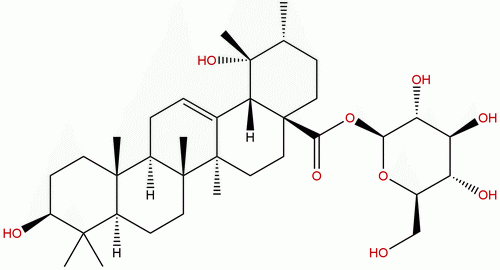
Pomodoric acid-28-O-glucose ester: a natural anti-inflammatory treasure in Poria cocos
1. Overview
Pomolic acid-28-O-glucosyl ester (CAS number: 83725-24-0) is a natural triterpenoid compound with significant biological activity. It belongs to the derivatives of triterpenoids of the Ursuline type, and is a sugar ester compound formed by connecting a glucose group through an ester bond on the C-28 hydroxyl group of Pomolic acid. The molecular formula of this compound is C36H58O9, with a molecular weight of 634.8510 g/mol. Its unique structure has attracted much attention in the fields of natural product chemistry and drug discovery.
This compound is mainly derived from traditional medicinal fungi Poria Separated from Wolfiporia extensa. Poria cocos is the dried mycelium of Poria cocos, a fungus in the family Poriferae. It has a long history of medicinal use in East Asian countries such as China, Japan, and South Korea, and is commonly used to promote diuresis, invigorate the spleen, and calm the heart. As one of the important active ingredients in Poria cocos, the modern pharmacological research on pomofol-28-O-glucose ester has revealed its significant effects anti-inflammatory Activity, which is consistent with its experience in treating inflammatory diseases related to "dampness heat" in traditional medicine.
In recent years, with the deepening understanding of the core role of chronic inflammation in various diseases such as arthritis, metabolic syndrome, and neurodegenerative diseases, the search for efficient and low toxicity natural anti-inflammatory lead compounds has become a research hotspot. Due to its clear multi-target anti-inflammatory mechanism and relatively good pharmacological characteristics, pomofol-28-O-glucose ester is gradually emerging from numerous natural products as a potential candidate molecule for anti-inflammatory drugs, with important research value and development prospects.
2. Chemical structure and physicochemical properties
The chemical structure of pomofol-28-O-glucose ester is the material basis for its biological activity. Its SMILES string (C [C @ @ H] 1CC [C @] 2 (C (=O) O [C @ @ H] 3O)C@HC@@HC@H[C@H]3O)CC[C@]3(C)C(=CC[C@@H]4[C@@]5(C)CCC@H C (C) (C) [C @ @ H] 5CC [C @] 43C) [C @ @ H] 2 [C @] 1 (C) O) accurately describes its atomic connection sequence and stereochemical configuration. This molecule consists of two parts:
1. Glycoside component Pomodoric acid, a pentacyclic triterpenoid skeleton with multiple methyl, hydroxyl, and carboxyl substituents, is a major contributor to hydrophobicity and a key pharmacophore for binding to target proteins.
2. Glycosyl portion A β - D-glucopyranose group is connected to the carboxyl group at position C-28 of the aglycone through an ester bond. The introduction of sugar groups significantly changes the polarity, water solubility, and bioavailability of the parent compound.
Analyze its physicochemical properties based on the provided pharmacological parameters:
- Molecular weight (MW):634.85 g/mol, Slightly higher than the upper limit of conventional small molecule drugs (usually<500 Da), mainly due to the introduction of glucose groups.
- Lipid water partition coefficient (LogP/LogD)Approximately 3.36. This value indicates that the compound has moderate lipophilicity, which can penetrate the lipid bilayer of cells while retaining some water solubility, which is beneficial for its distribution and absorption in vivo. The presence of glucose partially neutralizes the high LogP tendency of hydrophobic triterpenoid skeletons.
- Topological Polarity Surface Area (TPSA): 156.91 Å ². The higher TPSA value mainly comes from multiple hydrogen bond donors and acceptors such as hydroxyl (- OH) and ester bonds (- COO -) in the molecule, which can affect its membrane permeability.
- Water solubility:0.0151 mg/mL, Belonging to the category of slight solubility. Although the glucose group increases polarity, the large triterpenoid skeleton still limits its free dissolution in water.
- Permeability Caco-2 cells have a permeability of 1.44 × 10 ⁻⁶ cm/s and a predicted effective permeability (Peff) of 0.665 cm/s × 10 ⁻⁴, indicating moderate intestinal absorption potential. The blood-brain barrier (BBB) penetration prediction is "low", which is consistent with the characteristics of high TPSA and high molecular weight, suggesting that it may not easily enter the central nervous system. For anti-inflammatory drugs that mainly act on the peripheral system, this may be an advantage in reducing central side effects.
3. Plant sources and traditional applications
The main reported plant sources of pomolic acid-28-O-glucose ester are Poria Poria cocos is a fungal fungus that parasitizes on the roots of pine trees, and its name implies' the spirit that lies beneath the soil '. In traditional Chinese medicine theory, Poria cocos has a flat nature, a sweet and mild taste, and is associated with the heart, lungs, spleen, and kidney meridians Promote diuresis and dampness, invigorate the spleen and stomach, calm the heart and mind The efficacy. In traditional Chinese medicine classics such as "Treatise on Cold Damage" and "Synopsis of the Golden Chamber", Poria cocos is one of the most frequently used medicinal herbs, commonly used to treat conditions such as edema, difficulty urinating, spleen deficiency, diarrhea, palpitations, and insomnia.
Modern plant chemistry research has confirmed that Poria cocos is rich in various active ingredients, including polysaccharides (such as Poria cocos polysaccharides), triterpenoids (such as Poria cocos acid, Turmeric acid, Dehydrated Turmeric acid, Poria cocos acid C, and the derivatives of Pomodoric acid mentioned in this article). Among them, triterpenoids are considered to be the active ingredients in Poria cocos Diuretics, anti-inflammatory, immune regulation, and anti-tumor effects The important material basis of its function. As a member of the triterpenoid family of Poria cocos, the isolation and identification of Pomodoric acid-28-O-gluconate combines traditional medicinal experience with modern molecular pharmacology. The efficacy of Poria cocos, traditionally used to treat "damp heat" syndrome (manifested as inflammation, edema, etc.), may be partially attributed to the regulation of inflammatory pathways by triterpenoid glycosides such as p-phenylpropanoid acid-28-O-glucose ester.
In addition to Poria cocos, the triterpenoid compound Pomodoric acid and its derivatives are also widely present in plants of the Rosaceae family (such as loquat leaves and whitegrass) and the Rhamnaceae family. However, research on Poria cocos as a source of glucose esters with clear anti-inflammatory targets is currently the most systematic and in-depth.
4. Pharmacological activity and mechanism of action
The core pharmacological activity of pomofol-28-O-glucose ester is anti-inflammatory Its function is not through a single target, but through multi-target and multi pathway intervention of complex inflammatory networks, which reflects the typical characteristics of the mechanism of action of natural products. According to the provided target information, its anti-inflammatory mechanism mainly revolves around the following key targets:
1. Inhibit pro-inflammatory cytokines (TNF, IL6, IL1B)
- Tumor necrosis factor alpha (TNF - α) and Interleukin-6 (IL-6)、Interleukin-1 β (IL-1 β) It is the most important pro-inflammatory cytokine in the inflammatory response. They are produced by activated macrophages, T cells, etc., forming a "cytokine storm" that leads to vasodilation, leukocyte infiltration, tissue damage, and fever.
-Pomodoracid-28-O-glucose ester can downregulate the expression and secretion of these cytokines. Research has shown that triterpenoids can block gene transcription and translation of TNF - α, IL-6, and IL-1B by inhibiting upstream signaling pathways such as NF - κ B and MAPK, thereby suppressing excessive inflammatory responses at the source.
2. Inhibit the synthesis of inflammatory mediators synthase (PTGS2/COX-2)
- Prostaglandin endoperoxide synthase 2 (PTGS2), also known as cyclooxygenase-2 (COX-2)It is a key enzyme that catalyzes the production of prostaglandins (PGs) from arachidonic acid, especially strongly induced in inflammatory sites. Prostaglandins (such as PGE2) are strong mediators of pain, heat, and vasodilation.
-This compound can selectively inhibit the activity of COX-2 without significantly affecting the structural COX-1, which is important for maintaining normal gastrointestinal and renal function. This selective inhibition helps to reduce the excessive production of prostaglandins at the site of inflammation, thereby exerting anti-inflammatory, analgesic, and antipyretic effects, and may also reduce the risk of gastrointestinal side effects caused by traditional nonsteroidal anti-inflammatory drugs (NSAIDs) inhibiting COX-1.
3. Regulating core inflammatory transcription factor 1 (NFKB1)
- Nuclear factor kappa B1 (NF - κ B) It is the "master switch" that regulates the expression of numerous inflammation related genes, including TNF - α, IL-6, IL-1 β, COX-2, etc. In the resting state, NF - κ B binds to its inhibitory protein I κ B and exists in the cytoplasm. When stimulated by inflammation (such as LPS, TNF - α), I κ B is phosphorylated and degraded, allowing NF - κ B (usually referred to as p50/p65 dimer) to enter the nucleus and initiate target gene transcription.
-One of the core mechanisms of action of pomofol-28-O-glucose ester is likely to intervene in the activation of the NF - κ B signaling pathway. It may inhibit the activity of I κ B kinase (IKK), prevent the phosphorylation and degradation of I κ B, and thus "lock" NF - κ B in the cytoplasm, preventing it from initiating the expression of downstream pro-inflammatory genes. This is the fundamental reason why it can widely inhibit various inflammatory factors.
Integration of mechanisms of action and related diseases
In summary, pomofoxy-28-O-glucose ester Inhibition of NF - κ B signaling pathway This key upstream node, and subsequently Synergistic downregulation of pro-inflammatory cytokines such as TNF - α, IL-6, IL-1 β, etc, and Inhibition of COX-2 mediated prostaglandin synthesis Form a multi-level anti-inflammatory network. This multi-target mode of action has potential therapeutic value for complex chronic inflammatory diseases.
- Rheumatoid arthritis The above cytokines and mediators play a central role in joint synovitis and bone destruction.
- Inflammatory bowel disease The abnormal immune response of intestinal mucosa is closely related to the overactivation of NF - κ B and TNF - α.
- Atherosclerosis Considered as a chronic vascular inflammation involving the activation of NF - κ B and inflammatory factors in endothelial cells and macrophages.
- Metabolic inflammation Insulin resistance in obesity and diabetes is associated with low-grade chronic inflammation of adipose tissue and liver.
Therefore, the use of pomofol-28-O-glucose ester as a lead compound provides new ideas and candidate molecules for the development of innovative drugs for the treatment of these diseases.
5. Evaluation of drug properties
Comparing the physical and chemical parameters of pomofol-28-O-glucose ester with classical methods Lipinski's Five Rules By comparing the "Five Principles of Similar Drugs", the potential for oral drug development can be preliminarily evaluated
1. Number of hydrogen bond donors (HBDs)Multiple hydroxyl groups on the sugar and glycoside groups in the molecule result in an HBD>5 (rule requirement ≤ 5).violate。
2. Number of hydrogen bond acceptors (HBAs)Multiple hydroxyl and ester bond oxygen atoms in the molecule make its HBA>10 (rule requirement ≤ 10).violate。
3. Molecular weight (MW)634.85>500 Da (rule requirement<500 Da).violate。
4. Lipid water partition coefficient (LogP)3.36<5 (rule requirement<5).Comply with。
5. Number of rotatable keys The molecular structure is complex, with many rotatable bonds, possibly exceeding 10 (usually recommended ≤ 10).Possible violation。
This compound Violating three of Lipinski's rules(HBD, HBA, MW), This is mainly attributed to its glycosylation structure. However, the Lipinski rule mainly applies to small molecule drugs that are passively absorbed. For natural products and their derivatives, especially glycosides, their absorption may involve active transport (such as the glucose transporter SGLT1 mediating the absorption of its glycosyl portion), so relying solely on the "five rules" to determine their pharmacological properties has limitations. Many successful drugs, such as antibiotics and anti-tumor drugs, also exceed these rules.
Combining other pharmacological parameters for a more comprehensive evaluation:
- Absorption and penetration Moderate Caco-2 permeability and LogP value suggest that it may be absorbed in the intestine through passive diffusion and/or active transport. But high TPSA and molecular weight are the main factors limiting its high permeability.
- distribution The predicted plasma protein binding rate (PPB) is 78.66%, which is moderately high, indicating that most of it binds to proteins in the blood and may affect its free drug concentration and tissue distribution. BBB has low penetration and is suitable for peripheral effects.
- Metabolism and toxicity:
- Ames test, chromosomal aberration, hERG inhibition, skin/respiratory sensitization, phototoxicity, and other predictions are all negative or absent This is a very positive signal, indicating that its genetic toxicity and cardiotoxicity risks are low, and its safety potential is good.
- Ser_LK, Ser_ST, Ser_LT predicted as' Yes', indicating that the compound may have an impact on Liver function It has a certain impact and may cause an increase in liver enzyme indicators such as alkaline phosphatase (ALP), aspartate aminotransferase (AST), and alanine aminotransferase (ALT). This needs to be carefully examined and validated through animal experiments in subsequent preclinical studies, which is a risk point that needs to be closely monitored during the development process.
- Feasibility of synthesis The SyneAccess score is 5.4066, indicating moderate difficulty in synthesis or semi synthesis. Natural extraction combined with structural modification may be a feasible development path.
Summary Pomonoacid-28-O-glucose ester is a natural lead compound with clear multi-target anti-inflammatory activity. The main pharmaceutical challenge lies in Insufficient membrane permeability due to high molecular weight and polarity, and Potential risk of liver enzyme impact The advantage lies in Clear mechanism of action, multi-target synergy, low risk of predicted genetic toxicity and cardiac toxicity If it is developed into a drug in the future, it may be necessary to optimize its structure, such as modifying the sugar group (such as preparing prodrugs, finding smaller polar groups to replace), simplifying the triterpenoid skeleton to improve its drug like properties while maintaining activity, and conducting in-depth toxicological research.
6. Research Status and Application Prospects
At present, research on pomofol-28-O-glucose ester is still in progress Preclinical research stage Mainly focused on the following aspects:
1. Separation identification and content analysis A method for extracting, isolating, and purifying the compound from Poria cocos has been established, and qualitative and quantitative analysis has been conducted using techniques such as HPLC, NMR, and MS, laying the foundation for quality control.
2. In vitro pharmacological activity verification A large number of studies have confirmed its ability to inhibit the release of inflammatory mediators such as NO, PGE2, TNF - α, IL-6 in cell models (such as LPS stimulated macrophages RAW264.7, THP-1), and preliminarily revealed its mechanism of action by inhibiting the NF - κ B and MAPK pathways.
3. Preliminary in vivo pharmacological exploration A few studies have observed its anti-inflammatory effect in acute inflammation models in mice (such as carrageenan induced foot swelling and acetic acid induced increased intra-abdominal capillary permeability) or chronic inflammation models (such as adjuvant arthritis), providing preliminary evidence for its in vivo activity.
4. Study on Structure Activity Relationship By comparing the activity of pomolic acid and its sugar esters, as well as other position modified derivatives, we have preliminarily recognized the importance of C-28 glucose esterification in enhancing its water solubility and potentially affecting its biological activity/metabolism.
Future research and application prospects:
- In depth study on the mechanism of action Using techniques such as molecular docking, surface plasmon resonance (SPR), and cellular thermal shift analysis (CETSA), identify the direct interaction sites and patterns with key proteins such as IKK and p65 in the NF - κ B pathway.
- Preclinical development of the system This is currently the most critical step. Standardized pharmacokinetic studies (ADME: absorption, distribution, metabolism, excretion) need to be completed to clarify its oral bioavailability, tissue distribution, metabolites, and excretion pathways. At the same time, comprehensive toxicological evaluations must be conducted, especially in-depth assessments of predicted liver toxicity, to determine the safe dose range.
- Structural optimization and derivative design Based on the shortcomings of drug efficacy evaluation, carry out reasonable drug chemical modifications. For example, exploring the preservation of essential functional groups while simplifying molecules, replacing sugar groups to reduce molecular weight and polarity, or preparing ester prodrugs to improve lipid solubility and absorption.
- Expanding disease model research Validate in more disease models related to chronic inflammation, such as ulcerative colitis, non-alcoholic steatohepatitis (NASH), neuroinflammation models, etc., to explore their broader application potential.
- Explore combination therapy As a multi-target natural product, the combination application with existing anti-inflammatory drugs can be explored to reduce their dosage, minimize side effects, or overcome drug resistance.
In summary, pomofol-28-O-glucose ester is a highly promising anti-inflammatory lead compound discovered from the traditional Chinese medicine Poria cocos. It provides new candidate structures and ideas for the development of innovative anti-inflammatory drugs based on its clear anti-inflammatory mechanism with multiple targets and pathways, as well as relatively acceptable safety predictions. Despite facing challenges in terms of drug efficacy, through rational optimization using modern medicinal chemistry and pharmacy methods, it is expected to be transformed into innovative drugs with clinical application value, or developed into natural product raw materials or health products with specific health functions, achieving the transformation from traditional intelligence to modern medicine.