


Synonym name: 5-Methoxyangelicin
Catalogue No.: BP0775
Cas No.: 482-48-4
Formula: C12H8O4
Mol Weight: 216.192
Botanical Source: roots of Heracleum spp. and Pimpinella saxifraga. Also from Pimpinella magna and Ruta pinnata
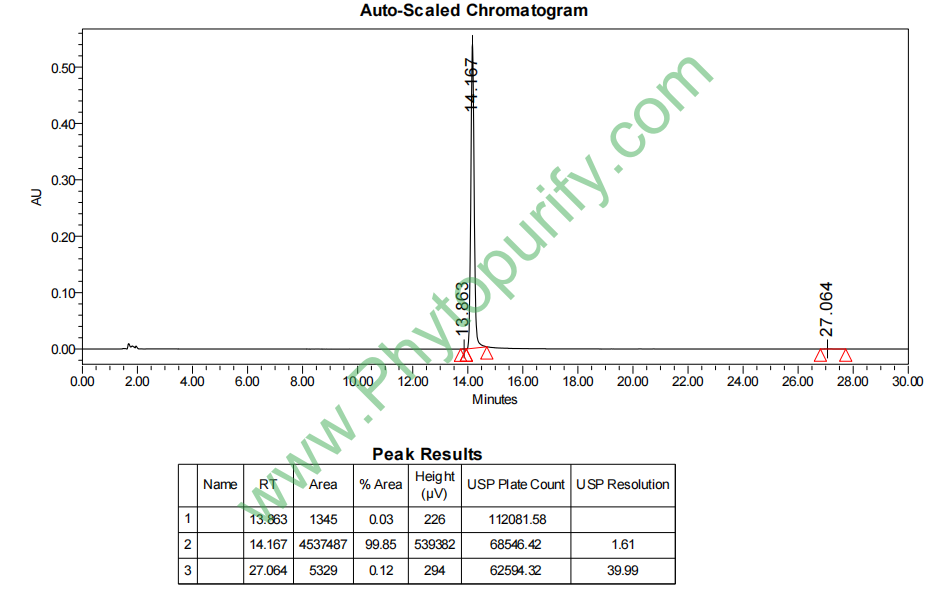
Purity: 95%~99%
Analysis Method: HPLC-DAD or/and HPLC-ELSD
Identification Method: Mass, NMR
Packing: Brown vial or HDPE plastic bottle
Can be supplied from milligrams to grams.
For Reference Standard and R&D, Not for Human Use Directly.
Inquire for bulk scale.
Description:
Isobergapten is a plant growth regulating substance, it is the principal constituents responsible for the antimycobacterial activity of the roots of Heracleum maximum; it may form an important class of natural defensive agents against fungi.Isobergapten shows anti-proliferative activity and causes G2/M arrest at concentrations of 0.05-15.0 μM.
References:
J Ethnopharmacol. 2013 May 2;147(1):232-7.
The Canadian medicinal plant Heracleum maximum contains antimycobacterial diynes and furanocoumarins.
Heracleum maximum is amongst the most commonly used plants by the indigenous peoples of North America. The First Nations of the eastern Canada use infusions of Heracleum maximum roots for the treatment of respiratory ailments including tuberculosis. Previous investigations of extracts derived from the roots of Heracleum maximum have shown it to possess antimycobacterial activity. To isolate and identify antimycobacterial constituents from the roots of Heracleum maximum.
METHODS AND RESULTS:
A methanolic extract of Heracleum maximum roots was subjected to bioassay guided fractionation using the microplate resazurin assay (MRA) to assess inhibitory activity against Mycobacterium tuberculosis strain H37Ra. The antimycobacterial constituents were identified by NMR, MS and polarimetry. The polyacetylene (3R,8S)-falcarindiol and the furanocoumarins bergapten, Isobergapten, angelicin, sphondin, pimpinellin, isopimpinellin and 6-isopentenyloxyIsobergapten were isolated from the Heracleum maximum root extract. (3R,8S)-Falcarindiol and 6-isopentenyloxyIsobergapten exhibited MICs of 24 μM and 167 μM and IC50s of 6 μM and 27 μM against Mycobacterium tuberculosis H37Ra respectively. The remaining furanocoumarins bergapten, Isobergapten, angelicin, sphondin, pimpinellin, and isopimpinellin were less active, with MICs of 925, 1850, 2149, 1859, 812 and 1625 μM and IC50s of 125, 344, 350, 351, 389 and 406 μM.
CONCLUSIONS:
(3R,8S)-Falcarindiol, bergapten, Isobergapten, angelicin, sphondin, pimpinellin, isopimpinellin and 6-isopentenyloxyIsobergapten were identified as the principal constituents responsible for the antimycobacterial activity of the roots of Heracleum maximum. This work supports the ethnopharmacological use of Heracleum maximum by Canadian First Nations and Native American communities as a treatment for infectious diseases, specifically tuberculosis.
Phytochemistry, 1982, 21(9):2213-5.
Plant growth regulators from Heracleum lanatum.
The plant growth regulating substances, pimpinellin, isopimpinellin, bergapten, Isobergapten, vaginidiol, sphondin, scopoletin, umbelliferone, ferulic.
Ann. Appl. Biol., 1966, 57(3):501-8.
The fungitoxicities of plant furocoumarins.[Reference: WebLink]
SUMMARYA mixture of the furocoumarins pimpinellin, isopimpinellin, Isobergapten and sphondin isolated from Heracleum sphondylium root was toxic to Gloeosporium limetticola, Botryis cinerea, Sclerotinia fructigena and Stereum purpureum at 200 p.p.m. or less in nutrient medium. The extractive of the leaves of plants that contain furocoumarins suppressed in vivo growth of G. limetticola and B. cinerea at concentrations lower than the contents of the extractive in the leaves.
CONCLUSIONS:
Furocoumarins may form an important class of natural defensive agents against fungi; this possibility is discussed.
HPLC of Isobergapten
Storage conditions:Short-term storage at 2~8℃, long-term storage at -20 ~ -80℃
52.5800
2.1001
2.1001
.0225
3.7904
21.4765
High
84.8932
2.4143
Yes
No
Yes
No
Yes
Yes
1.5
Yes
No
Yes
Yes
Isobergapten (CAS number: 482-48-4) is a naturally occurring furan coumarin compound that was first isolated and identified from the seeds of the plant Hevacleum laciniatum. As a natural product with significant allelopathic inhibitory activity, isobergamot has attracted widespread attention in the fields of plant ecology and natural product pharmacology. In recent years, with the in-depth study of its biological activity and potential pharmacological mechanisms, isophorone has shown important application prospects in the field of anti-tumor, especially in the treatment of liver cancer.
As one of the malignant tumors with high incidence rate and mortality in the world, liver cancer urgently needs to develop new effective and low toxic therapeutic drugs. Isobergamot lactone exhibits excellent anti-tumor potential by regulating multiple signaling pathways and molecular targets closely related to the occurrence and development of liver cancer. This article provides a systematic review of the chemical structure and physicochemical properties, plant sources and extraction methods, pharmacological activity research, mechanism of action and molecular targets, pharmacological evaluation and pharmacokinetic characteristics of isobergamot lactone. It also explores its clinical application prospects and future research directions, aiming to provide theoretical basis and research references for the drug development of this compound.
Isobergamot lactone belongs to the class of furanocoumarin compounds, with a molecular formula of C12H8O4 and a molecular weight of 216.1920. Its chemical structural feature is the fusion of furan ring and coumarin skeleton, forming a rigid molecular structure containing an oxygen-containing heterocyclic ring. This structure endows isobergamot lactone with unique chemical properties and biological activity.
In terms of physical and chemical properties, the LogP value of isobergamot lactone is 2.1001, indicating its moderate lipid solubility, which is beneficial for cell membrane penetration and in vivo distribution. Its polar surface area (TPSA) is 52.58 Å ², indicating that the molecule has certain polar groups that facilitate binding with biomolecules. Low water solubility (0.0225 mg/mL) suggests limited solubility in aqueous phase, which may affect its bioavailability. The high permeability of the blood-brain barrier suggests that it may have central nervous system activity or toxicity risks. The negative result of hERG channel inhibition experiment indicates a low risk of cardiac toxicity. The Ames test value is 1.5, indicating a low risk of genetic toxicity and meeting drug safety requirements.
In summary, the physicochemical properties of isobergamot lactone are suitable for drug development, especially with potential advantages in oral administration and targeted tumor therapy.
Isobergamot lactone was initially isolated from the seeds of Hevacleum laciniatum (a plant in the Umbelliferae family). This plant is widely distributed in some parts of Asia and traditionally has certain application value in folk medicine. Isobergamot lactone, as a secondary metabolite, has significant allelopathic inhibitory effects and participates in plant competition and defense mechanisms.
The extraction method usually uses organic solvent extraction combined with chromatographic separation technology. The specific steps include:
In recent years, modern technologies such as ultrasound assisted extraction and microwave-assisted extraction have also been attempted to be applied to the extraction of isobergamot lactone, improving extraction efficiency and purity.
The pharmacological activity research of isobergamot lactone mainly focuses on its anti-tumor, anti-inflammatory, and allelopathic inhibitory effects. Especially in the field of liver cancer, isobergamot lactone exhibits multi-target and multi pathway regulatory abilities, with significant cytotoxicity and anti-tumor effects.
In vitro cell experiments have shown that isobergamot can significantly inhibit the proliferation of liver cancer cell lines, induce cell apoptosis, and suppress cell migration and invasion ability. Its concentration range is wide, and its toxicity to normal liver cells is low, showing good selectivity.
In vivo animal model studies further confirm that isobergamot lactone can effectively inhibit the growth of liver cancer tumors and prolong the survival of experimental animals. Its anti-tumor effect is closely related to regulating multiple signaling pathways.
The mechanism of action of isobergamot lactone in the treatment of liver cancer involves multiple key molecular targets and signaling pathways, mainly including:
Through the synergistic effect of multiple targets mentioned above, isobergamot lactone can effectively inhibit the growth, survival, and metastasis of liver cancer cells, demonstrating its potential as an anti-tumor drug.
The pharmacological parameters of isobergamot lactone show that it has good potential for drug development:
Pharmacokinetic studies have shown that isobergamot lactone is well absorbed after oral administration, with a moderate plasma half-life. It is mainly metabolized through the liver, and the metabolites are safe. It is widely distributed in the body, especially enriched in liver tissue, which meets its targeted needs as a liver cancer treatment drug.
However, due to its low water solubility, further optimization of formulation design is needed in the future, such as nanocarriers, liposomes, or solid dispersions, to improve its bioavailability and in vivo stability.
As a natural product, isobergamot lactone has shown great potential for clinical translation due to its unique chemical structure and multi-target anti-tumor activity. Especially in the field of liver cancer treatment, it overcomes the shortcomings of traditional single target drugs that are prone to drug resistance by regulating multiple key signaling pathways.
The future clinical application prospects are mainly reflected in the following aspects:
However, the clinical translation of isobergamot still faces challenges such as low solubility, in vivo stability, and safety evaluation. Systematic toxicological evaluation, pharmacokinetic optimization, and preclinical studies are required to ensure its safety and efficacy.
As a natural furan coumarin compound derived from Hevacleum laciniatum, isobergamot has become a hot topic in natural product pharmacology research due to its unique chemical structure and multi-target anti liver cancer activity. Its excellent pharmacological parameters and diverse mechanisms of action provide new ideas and potential drug candidates for the treatment of liver cancer.
In the future, through in-depth mechanism research, drug design optimization, and preclinical evaluation, isobergamot lactone is expected to become an effective anti-tumor drug, promoting the application of natural products in modern cancer treatment. At the same time, its potential value in agriculture and other disease fields is also worth further exploration. Overall, the study of isobergamot lactone not only enriches the theoretical system of natural product pharmacology, but also provides valuable resources for the development of new drugs.
