


Product name: 7-Hydroxycoumarin
Synonym name: Umbelliferone; Dichrin A; Hydrangin; Skimmetin
Catalogue No.: BP0101
Cas No.: 93-35-6
Formula: C9H6O3
Mol Weight: 162.144
Botanical Source: Occurs widely in plants including Angelica, Artemisia, Ferula and Ruta spp., Hieracium pilosella, Coronilla varia, Picea abies, Peddiea fischeri, Lepidophyllum cupressiforme, Cymbopogon parkeri, Wikstroemia elliptica, Euphorbia humifusa,
Physical Description: Powder
Type of Compound: Coumarins
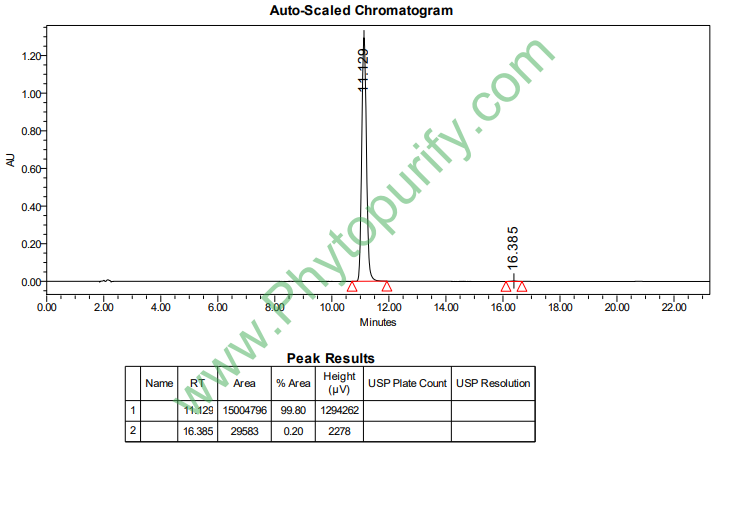
Purity: 95%~99%
Analysis Method: HPLC-DAD or/and HPLC-ELSD
Identification Method: Mass, NMR
Packing: Brown vial or HDPE plastic bottle
Storage: Store in a well closed container, protected from air and light. Put into refrigerate or freeze for long term storage.
Whenever possible, you should prepare and use solutions on the same day. However, if you need to make up stock solutions in advance, we recommend that you store the solution as aliquots in tightly sealed vials at -20℃. Generally, these will be useable for up to two weeks.
The product could be supplied from milligrams to grams, up to kilograms
Inquire for bulk scale.
Descriptions:
Umbelliferone (UMB), a natural antioxidant, is benzopyrone in nature, and it is present in the fruits of golden apple and bitter orange, UMB has a protective effect on membrane fatty acid composition of liver and kidney as supported by antioxidant and antihyperlipidemic effects of UMB reported earlier as evidenced by improved histopathological changes, hepatic and nephritic markers, indicating recovery from the risk of diabetic complications; UMB has antihyperglycemic effect, UMB at 30 mg/kg of body weight possesses a promising antihyperglycemic effect that is comparable with glibenclamide.[1,2]
Umbelliferone analogues and their potential to be antimutagenic/anticarcinogenic against mutations induced by benzo(a)pyrene, a potent mutagen/carcinogen, and hydrogen peroxide, and for their ability to function as free radical scavengers. [3]
Umbelliferone has antioxidative effect, the antioxidative effect is dose-dependent up to 100 ug/ml and then levelled off with no further increase in activity. [4]
Umbelliferone, ferulic acid and eugenol are competitive and limonene is a competitive–non-competitive inhibitor of alkaline phosphatase, ferulic acid and umbelliferone are competitive, whereas eugenol and limonene are competitive–non-competitive and uncompetitive inhibitors of acetylcholinesterase, respectively. [5]
Umbelliferone derivatives is a novel class of inhibitors for steroid 5α-reductase.[6]
Umbelliferone attenuates the alteration characteristics of allergic airway inflammation,
the mechanisms of action of this molecule may contribute for the development of new drugs for the treatment of asthma.[7]
Umbelliferone is an intracellular pH-sensitive fluorescent indicator and blood-brain barrier probe.[8]
Umbelliferone derivatives have antimicrobial properties, and has anti-mutagenic effects induced by 4-nitroquinoline 1-oxide or UV irradiation in E. Coli.[9,10]
References:
[1] Ramesh B, Viswanathan P, Pugalendi K V. Eur J Pharmacol, 2007, 566(1-3):231–9.
[2] Ramesh B, Pugalendi K V. J Med Food, 2006, 9(4):562-6.
[3] Pillai S P, Menon S R, Mitscher L A, et al. J Nat Prod, 1999, 62(10):1358-62.
[4] Rajbir Singh, Bikram Singh, Sukhpreet Singh,et al. Food Chem, 2010, 120(3):825-30.
[5] Kumar P, Singh V K, Singh D K. Phytother Res, 2009, 23(2):172–7.
[6] Fan G J, Mar W, Man K P, et al. Bioorg Med Chem Lett, 2001, 11(17):2361-3.
[7] Vasconcelos J F, Teixeira M M, Barbosa-Filho J M, et al. Eur J Pharm, 2009, 609:126-31.
[8] Jr S T, Anderson R E. J Neurophysiol, 1980, 44(1):60-75.
[9] Jurd L, King A D, Mihara K. Phytochemistry, 1971, 10(12):2965-70.
[10] Ohta T, Watanabe K, Moriya M, et al. Mutation Research/fundamental & Molecular Mechanisms of Mutagenesis, 1983, 117(1-2):135-8.
[11] Liu L X, Zhao T, Sun L X. Journal of Shenyang Pharmaceutical University, 2010, 27(7):563-6.
HPLC of 7-Hydroxycoumarin
Storage conditions:Short-term storage at 2~8℃, long-term storage at -20 ~ -80℃
46.5300
1.7600
1.7600
High
No
No
No
No
No
Negative
7-Hydroxycoumarin (CAS number: 93-35-6), as an important derivative of coumarin natural products, has received widespread attention in pharmacology and natural product research in recent years due to its unique chemical structure and diverse biological activities. 7-hydroxycoumarin is a product of coumarin molecules substituted with hydroxyl groups at position 7, which has significant fluorescence properties and is widely used in the development of biological fluorescent probes. At the same time, as a secondary metabolite in plants, it participates in various plant physiological processes. In addition, 7-hydroxycoumarin is also distributed in food ingredients, demonstrating good biocompatibility and safety. In recent years, with the deepening of molecular mechanism research on complex diseases such as obstructive sleep apnea (OSA), the potential role of 7-hydroxycoumarin in target regulation has gradually been revealed, demonstrating its potential as a novel therapeutic candidate molecule.
This article will provide a systematic review of the chemical structure and physicochemical properties of 7-hydroxycoumarin, plant sources and extraction methods, pharmacological activity research, mechanism of action and molecular targets, pharmacological evaluation and pharmacokinetics, clinical application prospects and prospects, aiming to provide theoretical basis and research direction for subsequent basic research and clinical translation.
The molecular formula of 7-Hydroxycoumarin is C9H6O3, with a molecular weight of 162.14. Its structure is based on the coumarin (2H-1-benzopyran-2-one) skeleton, with the 7th hydroxyl group substituted to form a significantly polar phenolic hydroxyl group. This structure endows 7-hydroxycoumarin with unique physicochemical properties:
In addition, 7-hydroxycoumarin exhibits significant fluorescence properties with an excitation wavelength of approximately 325 nm and an emission wavelength of approximately 450 nm, making it of significant application value in the fields of biological imaging and fluorescent probes.
7-hydroxycoumarin is widely present in various plants, especially in the secondary metabolites of Umbelliferae, Leguminosae, and Lamiaceae plants. Common plants containing 7-hydroxycoumarin include:
7-hydroxycoumarins in these plants mostly exist in free or bound form, participating in plant defense mechanisms and signal transduction.
The extraction of 7-hydroxycoumarin usually involves the following steps:
In recent years, green extraction techniques such as supercritical CO2 extraction and enzyme assisted extraction have gradually been applied to the extraction of 7-hydroxycoumarin, significantly improving extraction efficiency and environmental friendliness.
7-hydroxycoumarin exhibits various pharmacological activities, including antioxidant, anti-inflammatory, anti-tumor, neuroprotective, and metabolic regulation.
7-hydroxycoumarin can effectively scavenge free radicals, inhibit lipid peroxidation, and protect cells from oxidative stress damage. Its phenolic hydroxyl structure endows it with excellent electron donor ability, which can neutralize reactive oxygen species (ROS) and nitrogen free radicals (RNS), and alleviate the progression of oxidative related diseases.
Multiple in vitro and in vivo studies have shown that 7-hydroxycoumarin reduces the production of prostaglandins and leukotrienes and alleviates inflammatory responses by inhibiting the cyclooxygenase (COX) and lipoxygenase (LOX) pathways. In addition, it can also inhibit the expression of pro-inflammatory cytokines such as TNF - α, IL-1 β, and IL-6, exerting anti-inflammatory effects.
Given its excellent blood-brain barrier permeability, 7-hydroxycoumarin exhibits neuroprotective effects in neurodegenerative disease models. Research has found that it can slow down the pathological progression of diseases such as Alzheimer's disease and Parkinson's disease by regulating neurotransmitter metabolism, inhibiting neuroinflammation and oxidative stress.
7-hydroxycoumarin exhibits growth inhibitory effects on various tumor cell lines, with mechanisms involving inducing cell apoptosis, blocking the cell cycle, and inhibiting tumor related signaling pathways such as NF - κ B and PI3K/Akt. In addition, its low toxicity and selectivity make it a potential anti-tumor adjuvant drug.
7-hydroxycoumarin has also shown positive effects in regulating lipid metabolism and cholesterol synthesis, possibly by modulating HMGCR (3-hydroxy-3-methylglutaryl-CoA reductase) activity, affecting cholesterol biosynthesis, and has the potential to prevent cardiovascular disease.
The multi-target mechanism of action of 7-hydroxycoumarin is the basis of its multiple pharmacological effects. Research on molecular targets related to obstructive sleep apnea (OSA) has revealed its potential therapeutic mechanisms.
7-hydroxycoumarin exerts comprehensive effects such as antioxidant, anti-inflammatory, neuroprotective, and metabolic regulation through multi-target and multi pathway synergistic effects. Especially in the pathological mechanism of OSA, it may play a potential therapeutic role by regulating neurotransmitter metabolism, reducing inflammation and oxidative stress, and improving local hypoxic environment.
The pharmacological evaluation of 7-hydroxycoumarin shows that it has good potential for drug development:
Although there is currently limited systematic pharmacokinetic research on 7-hydroxycoumarin, existing studies have shown that:
Further in vivo pharmacokinetic and toxicological studies are needed in the future to clarify its metabolic pathways, drug interactions, and long-term safety.
7-Hydroxycoumarin, as a multifunctional natural product, has a wide range of clinical application potential, especially outstanding in the following aspects:
OSA is a common sleep disorder with complex pathological mechanisms involving neural regulation, inflammatory response, and metabolic abnormalities. 7-hydroxycoumarin may improve neurological function and respiratory regulation in OSA patients, alleviate symptoms and complications by regulating multiple targets such as APP, MAOA, ESR1/2, PTGS1, and carbonic anhydrase.
Due to its neuroprotective and antioxidant effects, 7-hydroxycoumarin has potential value in the adjuvant therapy of neurodegenerative diseases such as Alzheimer's disease and Parkinson's disease.
The anti-inflammatory and lipid metabolism regulating functions of 7-hydroxycoumarin are expected to be used for the prevention and treatment of chronic inflammatory diseases and cardiovascular diseases.
Future research should focus on:
With the advancement of molecular biology and medicinal chemistry technology, 7-hydroxycoumarin is expected to become an important candidate for multi-target natural drug development.
7-hydroxycoumarin, as a structurally simple but functionally diverse natural product, has demonstrated unique research value in the field of natural product pharmacology due to its excellent physicochemical properties and extensive pharmacological activities. Its multi-target regulatory role in obstructive sleep apnea and related diseases reveals its potential clinical application prospects. In the future, through in-depth mechanism research, systematic pharmacokinetic evaluation, and clinical validation, 7-hydroxycoumarin is expected to become an important representative of new natural medicines, providing new ideas and strategies for the treatment of related diseases.
