


Synonym name: Biacangelicol;61046-59-1
Catalogue No.: BP0299
Cas No.: 26091-79-2
Formula: C17H16O6
Mol Weight: 316.309
Botanical Source:
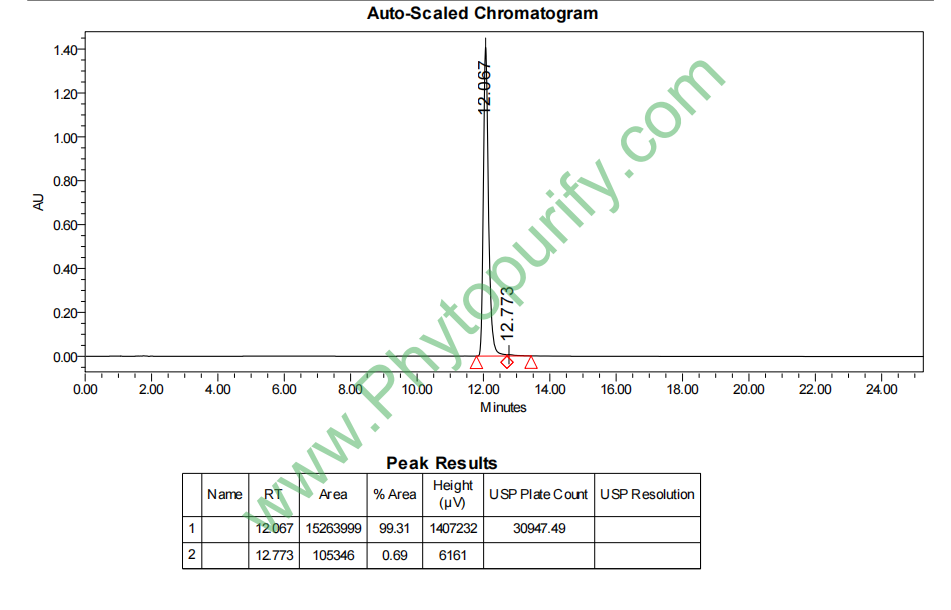
Purity: 95%~99%
Analysis Method: HPLC-DAD or/and HPLC-ELSD
Identification Method: Mass, NMR
Packing: Brown vial or HDPE plastic bottle
Can be supplied from milligrams to grams.
For Reference Standard and R&D, Not for Human Use Directly.
Inquire for bulk scale.
HPLC of Byakangelicol
Storage conditions:Short-term storage at 2~8℃, long-term storage at -20 ~ -80℃
Natural products, as an important source of drug discovery, have always played a pivotal role in the development of new drugs. Byakangelicol, a white triol compound isolated from the traditional Chinese medicine Angelica dahurica, has attracted widespread attention in recent years due to its significant anti-inflammatory and anti allergic activities. As a classic traditional Chinese medicine herb, Bai Zhi is mainly used for dispelling wind, dispelling cold, and relieving pain. Its active ingredients are diverse, and Bai Danggui Brain, as one of the representative ingredients, exhibits unique pharmacological value. This article aims to provide a systematic review of the chemical structure, physicochemical properties, plant sources, extraction methods, pharmacological activities, and mechanisms of action of Angelica sinensis brain. Combining drug evaluation and pharmacokinetics, it explores its clinical application prospects and future research directions.
Byakangelicol, molecular formula C17H20O6, molecular weight 300.31, CAS number 26091-79-2. Its structure is a white triol compound with multiple hydroxyl and phenolic functional groups, endowing it with good biological activity. The LogP value of Bai Danggui's brain is 2.81, indicating its moderate lipid solubility, which is beneficial for membrane penetration and bioavailability. The polar surface area (TPSA) is 77.58 Å ², indicating that it maintains a balance between molecular polarity and hydrophobicity, which facilitates binding to biological targets. Its hydrogen bond receptor number is 6, indicating that it may form a stable hydrogen bond network in its interaction with protein targets.
From the perspective of drug metabolism and safety, Bai Danggui has a high blood-brain barrier permeability, indicating that its potential central nervous system activity or toxicity risk is low. Toxicological evaluation shows that it has no hepatotoxicity or cardiotoxicity, and does not inhibit hERG channels. The Ames test result is negative, indicating good safety and low risk of genotoxicity. These physicochemical and safety parameters have laid a solid foundation for further drug development of Bai Danggui Brain.
The brain of Angelica dahurica mainly comes from the plant Angelica dahurica in the Umbelliferae family. This plant is widely distributed in East Asia, especially in China, South Korea, and Japan, and is widely used in traditional medicine. The roots of Angelica dahurica contain abundant volatile oils, coumarins, and polyphenols, among which Angelica dahurica brain, as one of the important components of leukotrienes, has significant biological activity.
The traditional method of extracting Angelica sinensis brain often uses solvent extraction combined with chromatographic separation technology. Generally, dried Bai Zhi roots are used as raw materials for reflux extraction with ethanol or methanol. After concentration, the extract is purified using silica gel column chromatography or high-performance liquid chromatography (HPLC). In recent years, the application of ultrasound assisted extraction and supercritical CO2 extraction technology has improved the extraction efficiency and purity of Angelica sinensis brain. In addition, the selective adsorption combined with molecular imprinting technology provides a new approach for the efficient separation of Angelica sinensis brain.
The optimization of extraction process not only improves the yield of Angelica sinensis brain, but also ensures the stability of its active ingredients, providing a reliable material basis for subsequent pharmacological research and drug formulation development.
The pharmacological activity of Bai Danggui's brain mainly focuses on anti-inflammatory and anti allergic fields. In vitro studies have shown that Bai Danggui Brain can significantly inhibit the release of prostaglandin E2 (PGE2) induced by interleukin-1 β (IL-1 β) in human lung adenocarcinoma cell line A549. This mechanism of action is mainly achieved by inhibiting the expression and activity of cyclooxygenase-2 (COX-2), reducing the synthesis of inflammatory mediators, and thus exerting anti-inflammatory effects.
In addition, Bai Danggui's brain exhibits potential regulatory effects in anti allergic reactions. Its targets include key molecules involved in allergic reactions, such as lipoxygenase 5 (ALOX5), histamine H1 receptor (HRH1), interleukin 4 (IL4), interleukin 5 (IL5), interleukin 13 (IL13), high affinity IgE receptor alpha chain (FCER1A), thromboxane A2 receptor (TBXA2R), signal transduction and transcription activator 6 (STAT6), and thymic stromal lymphopoietin (TSLP). The regulation of these targets helps to inhibit the release of allergic mediators and the activation of immune cells, reducing airway inflammation and allergic symptoms.
Animal model studies further confirmed the protective effect of Bai Danggui brain in airway inflammation, manifested by reducing airway hyperresponsiveness, inhibiting inflammatory cell infiltration, and lowering levels of inflammatory factors. Its dual anti-inflammatory and anti allergic activities make it a potential therapeutic candidate molecule for respiratory diseases, especially asthma and allergic rhinitis.
The main mechanism of action of Bai Danggui in the brain is focused on the regulation of inflammatory signaling pathways. By inhibiting the expression of COX-2 and reducing the production of PGE2, Bai Danggui brain effectively blocks the synthesis and release of inflammatory mediators, alleviating the inflammatory response of cells and tissues. COX-2, as a key enzyme in inflammatory response, is closely related to various inflammatory diseases due to its overexpression. The inhibitory effect of Bai Danggui Brain on COX-2 provides an important target for anti-inflammatory treatment.
In terms of anti allergic mechanisms, the brain of Bai Danggui works by regulating multiple key molecules and signaling pathways. ALOX5 is a fatty acid metabolizing enzyme that participates in the synthesis of leukotrienes. The regulation of ALOX5 by the brain of Angelica sinensis helps to inhibit the production of inflammatory mediators. The HRH1 receptor mediates histamine allergic reactions, and regulating its activity can alleviate allergic symptoms. Cytokines such as IL4, IL5, and IL13 play a central role in Th2 type immune responses, affecting the differentiation and activation of immune cells. Bai Danggui's brain suppresses allergic inflammation by downregulating the expression of these factors. FCER1A, as a high affinity receptor for IgE, regulates its activity to help block IgE mediated allergic reactions. The STAT6 signaling pathway is a key signaling pathway mediated by IL4/IL13, involved in regulating allergic inflammatory responses. The effect of Bai Danggui brain on STAT6 further reveals its immune regulatory function. TSLP, as a pro-inflammatory cytokine secreted by epithelial cells, plays an important role in allergic inflammation, and inhibition of its expression helps alleviate airway inflammation.
In summary, Bai Danggui's brain exhibits excellent anti-inflammatory and anti allergic potential by synergistically regulating inflammation and immune responses through multiple targets and pathways.
The pharmacological evaluation of Bai Danggui Brain shows that it has good potential for drug development. Its molecular weight is moderate (300.31), in accordance with Lipinski's rules, and is beneficial for oral absorption. A LogP value of 2.81 indicates moderate lipid solubility, ensuring membrane penetration and avoiding solubility issues caused by excessive lipid solubility. The TPSA is 77.58 Å ², indicating that it has moderate polarity, which is beneficial for binding to biological targets and in vivo distribution.
In terms of safety, Bai Danggui has no hepatotoxicity or cardiotoxicity, and does not inhibit hERG channels. The Ames test is negative, indicating a low risk of genotoxicity and good safety. The high blood-brain barrier permeability suggests that it may have central nervous system effects, but potential central toxicity also needs to be considered.
At present, pharmacokinetic studies on the brain of Angelica sinensis are relatively limited. Preliminary data indicate that its oral bioavailability is good and it is widely distributed in the body. The metabolic pathway may involve liver enzymes, but the specific metabolites and excretion mechanisms still need further research. The pharmacokinetic and toxicological studies of future systems will provide critical support for their clinical development.
Based on the significant anti-inflammatory and anti allergic activities of Bai Danggui Brain, its application prospects in airway inflammation related diseases are broad. Asthma, chronic obstructive pulmonary disease (COPD), allergic rhinitis and other diseases are closely related to airway inflammation and abnormal immune response. Bai Danggui's brain regulates inflammation and immune response through multiple targets, and is expected to become a new therapeutic drug.
In addition, Bai Danggui has good safety and good medicinal properties, making it suitable for further preclinical pharmacological, toxicological, and pharmacokinetic studies. Combining modern pharmaceutical formulation technologies such as nanocarriers and sustained-release systems is expected to enhance their bioavailability and targeting, and improve therapeutic efficacy.
Future research should focus on the in-depth analysis of the mechanism of action of Angelica sinensis in the brain, especially its regulation of immune cell function and its impact on signaling pathways. Meanwhile, the systematic evaluation of preclinical animal models and the development of early clinical trials will lay the foundation for their clinical translation. Combining multi omics techniques and systems pharmacology methods, explore its potential applications in various inflammatory and immune related diseases, and promote the transformation of Bai Danggui brain from a natural product to a clinical drug.
As an important active ingredient in Bai Zhi, Bai Danggui Brain has shown great potential for drug development due to its unique chemical structure and multi-target anti-inflammatory and anti allergic effects. It effectively alleviates airway inflammation by inhibiting COX-2 and regulating various immune inflammation related targets, and has broad clinical application prospects. In the future, it is necessary to strengthen the systematic pharmacology research, pharmacokinetics, and safety evaluation of Angelica sinensis brain, and promote its clinical translation process. The in-depth study of Bai Danggui's brain not only enriches the theoretical system of natural product pharmacology, but also provides important scientific basis and technical support for the development of new anti-inflammatory and anti allergic drugs.
