


Product name: Mogroside V
Synonym name:
Catalogue No.: BP0953
Cas No.: 88901-36-4
Formula: C60H102O29
Mol Weight: 1287.45
Botanical Source: Momordica grosvenorii and Siraitia siamensis; Luohanguo
Physical Description: Powder
Type of Compound: Triterpenoids
Purity: 95%~99%
Analysis Method: HPLC-DAD or/and HPLC-ELSD
Identification Method: Mass, NMR
Packing: Brown vial or HDPE plastic bottle
Storage: Store in a well closed container, protected from air and light. Put into refrigerate or freeze for long term storage.
Whenever possible, you should prepare and use solutions on the same day. However, if you need to make up stock solutions in advance, we recommend that you store the solution as aliquots in tightly sealed vials at -20℃. Generally, these will be useable for up to two weeks.
The product could be supplied from milligrams to grams, up to kilograms
Inquire for bulk scale.
Descriptions:
Mogroside V, a compound isolated from Momordica grosvenori Swingle, which belongs to the Cucurbitaceae, is a traditional Chinese medicine reported to have anti-inflammatory potential in murine macrophages and a murine ear edema model, mogroside V has the potential to protect against LPS-induced airway inflammation in a model of ALI.[1]
Mogroside V is a widely used sweetener. [2]
Mogroside V has in vitro AMPK activating effect.[3]
References:
[1] Shi D, Zheng M, Wang Y, et al. Pharm Biol, 2014, 52(6):729-34.
[2] Feng X, Li D P, Huang Z C, et al. J Pharm Biomedl Anal, 2015, 115(11):418-30.
[3] Luo Z, Qiu F, Zhang K, et al. Rsc Adv, 2016, 6(9):7034-41.
[4] Hu JY Ma SC Cheng X L, et al. Chinese Journal of Pharmaceutical Analysis, 2008(04):544-6.
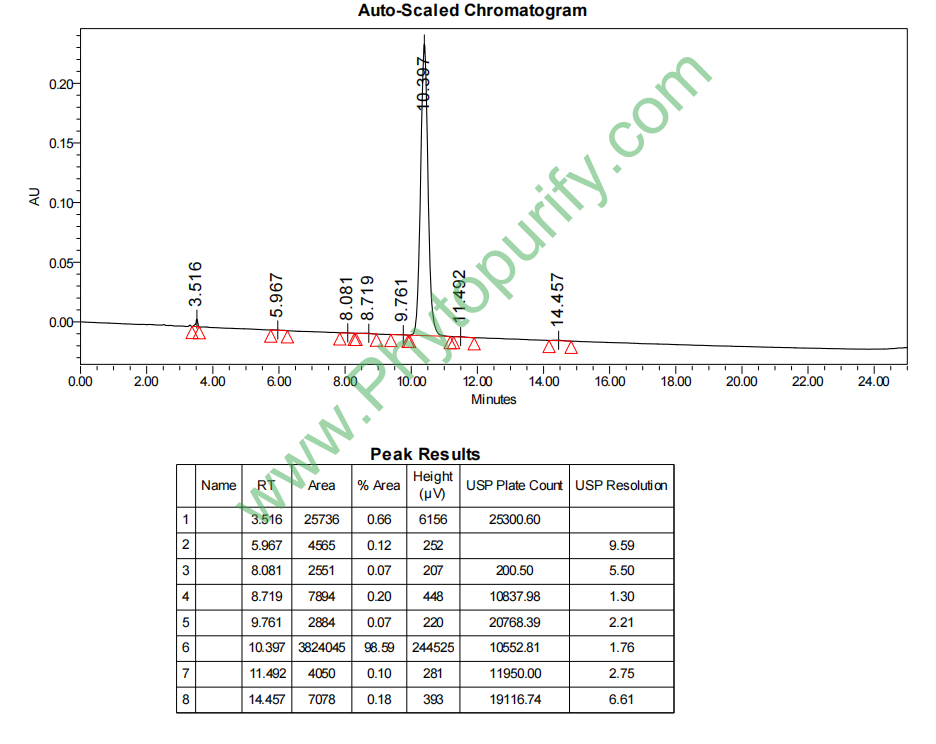
HPLC of Mogroside V
Storage conditions:Short-term storage at 2~8℃, long-term storage at -20 ~ -80℃
476.6700
.9952
.9950
.8511
.4007
.4084
Low
65.5863
7.4977
No
No
No
No
No
No
0.0
Yes
No
No
Yes
Mogroside V is a major active triterpene saponin compound isolated from the traditional Chinese medicine Siraitia grosvenorii. As the key sweet component of Siraitia grosvenorii, Siraitoside V not only has significant sweet properties, but also attracts much attention due to its diverse biological activities. In recent years, with the development of natural product pharmacology and molecular biological technology, the potential role of siraitin V in antioxidant, anti diabetes, anti-inflammatory, anti-tumor and other fields has been gradually revealed, and it has become an important candidate molecule in the research of diabetes and related metabolic diseases.
As a metabolic disease with a rapidly rising incidence rate worldwide, diabetes has a complex pathological mechanism, involving multiple links such as oxidative stress, inflammatory reaction, abnormal insulin signal transduction and cell energy metabolism disorder. Siraitin V shows good therapeutic potential by regulating the level of intracellular reactive oxygen species (ROS), enhancing mitochondrial function, and activating key metabolic regulatory targets such as AMPK (5 'AMP activated protein kinase). In addition, the safety and good pharmaceutical parameters of siraitin V provide basic support for its clinical transformation.
The purpose of this paper is to systematically review the chemical structure and physicochemical properties, plant origin and extraction methods, pharmacological activity and mechanism of action, pharmaceutical evaluation and pharmacokinetic characteristics of siraitin V, and explore its clinical application prospects in diabetes and related diseases, hoping to provide theoretical basis and reference for subsequent basic and clinical research.
Siraitoside V (CAS No.: 88901-36-4) is a triterpene saponin, with molecular formula of C60H102O29 and molecular weight of 1287.4470. The core of its structure is the pentacyclic triterpenoid mother nucleus, which connects multiple glucosidic groups to form a highly glycosylated saponin structure. This structure endows siraitin V with high polarity and water solubility, and its LogP value is about 0.9952, indicating that it has strong hydrophilicity and is suitable for biological activity in aqueous environment.
The topological polar surface area (TPSA) of mogroside V is 476.6700 ∨ ², and the large polar surface area reflects that there are a large number of polar groups on its molecular surface, especially hydroxyl and glycoside groups, which are conducive to binding with biological macromolecules such as enzymes and receptors. Its water solubility is 0.8511, showing good solubility in water and facilitating absorption and distribution in the body.
From the perspective of pharmacokinetics, the permeability of siraitin V to the blood-brain barrier is low, suggesting that its direct effect on the central nervous system is limited, reducing the risk of central side effects. The negative result of hERG channel inhibition experiment indicates a low risk of cardiac toxicity. Ames mutagenicity test result is 0, which shows that Arhat fruit glycoside V has no obvious genotoxicity and is safe.
Siraitia grosvenorii, a cucurbitaceae plant, is the main source of siraitia grosvenorii, which is native to Guangxi, Hunan and other places in China, and has always been used as traditional Chinese medicine and natural sweetener. Arhat grosvenorii fruit contains many kinds of Siraitia grosvenorii glycosides, of which Siraitia grosvenorii glycoside V is the highest, accounting for more than 60% of the total saponins.
Common methods for extracting siraitin V include water extraction, alcohol extraction and ultrasonic assisted extraction. The typical process flow is:
In recent years, ultrasound assisted extraction and microwave-assisted extraction technologies have been introduced to improve extraction efficiency and yield, while reducing solvent usage and energy consumption. The optimization of extraction process is very important to ensure the activity and product quality of siraitin V.
Oxidative stress is a key factor in the occurrence and development of various chronic diseases. Siraitin V can reduce the level of reactive oxygen species (ROS) in cells, alleviate oxidative damage and protect cell function. In vitro experiments showed that siraitin V could significantly eliminate free radicals, enhance the activity of cell antioxidant enzymes (such as superoxide dismutase SOD, glutathione peroxidase GPx), inhibit lipid peroxidation, and alleviate cell damage caused by oxidative stress.
In animal models, siraitin V shows good antioxidant potential by regulating Nrf2/ARE signaling pathway, promoting the expression of antioxidant genes, and enhancing the antioxidant defense ability of the body.
The pathological mechanism of diabetes involves insulin resistance, β - cell dysfunction and abnormal glucose metabolism. Siraitin V has been shown to regulate blood glucose, improve insulin sensitivity and protect pancreatic β cells in many studies.
In addition, siraitin V can reduce the level of ROS, alleviate diabetes related oxidative stress and inflammatory reaction, protect the function of pancreatic islet β cells, and delay the process of diabetes.
Siraitoside V has the activity of inhibiting proliferation, inducing apoptosis and blocking cell cycle in many cancer cell lines. Its anti-cancer mechanism includes:
Although most of the current anti-cancer research focuses on in vitro cell experiments, the anti-tumor potential of siraitin V makes it possible to use it as an adjuvant drug.
The pharmacological effects of siraitin V involve multiple signal pathways and multiple key molecular targets, mainly including:
Through multi target and multi pathway synergy, siraitin V achieves its comprehensive pharmacological effects, reflecting the advantages of natural products in multi target therapy.
The pharmaceutical parameters of siraitin V show that it has a good potential for drug development. Although the molecular weight of 1287.4470 is relatively large, its water solubility is good (0.8511), which is beneficial for dissolution and absorption after oral administration. The LogP value is close to 1, indicating a balance between its hydrophilic and lipophilic properties, which is conducive to transmembrane absorption.
Its high TPSA value (476.6700) may limit its passive diffusion ability, suggesting that siraitin V may rely on active transport or intestinal microbial metabolism to achieve absorption in vivo. Low blood-brain barrier permeability reduces the risk of central nervous system side effects, but also limits its application in central related diseases.
In terms of safety, Arhat fruit glycoside V did not show hERG channel inhibition and genotoxicity, showing a good safety basis. The existing pharmacokinetic studies show that the metabolism of siraitin V in vivo is mainly through the hydrolysis of glycosidic bonds by intestinal flora to produce a variety of active metabolites, and the metabolites may participate in its biological activity.
However, the oral bioavailability of siraitin V is low, and the half-life and distribution characteristics in vivo need further systematic study. In the future, through formulation optimization and structural modification, it is expected to enhance its pharmacokinetic performance and promote clinical translation.
Siraitin V, as a natural triterpene saponin, shows broad clinical application prospects with its remarkable antioxidant, anti diabetes and anti-cancer activities. Its potential in the treatment of diabetes is particularly prominent. It can not only be used as an auxiliary hypoglycemic agent, but also play a comprehensive effect by improving the function of pancreatic β cells and reducing the complications of diabetes.
At present, siraitin V has been widely used in the food industry as a natural sweetener, and its safety has been verified to a certain extent. In the future, with the in-depth analysis of pharmacological mechanism and the improvement of pharmacokinetics, mogroside V is expected to enter the preclinical drug development stage and carry out systematic pharmacodynamic and toxicological evaluation.
In addition, the research of siraitin V in the field of anti-inflammatory and anti-cancer is also advancing, especially in the multi-target regulation and combined drug strategy. By combining modern drug design technologies such as nanocarrier systems and targeted delivery, it is expected to overcome the limitations of low bioavailability and achieve precise treatment.
Future research needs to focus on:
Through interdisciplinary cooperation, siraitin V is expected to become a new natural drug for the treatment of diabetes and related metabolic diseases.
Siraitin V, as the main active triterpene saponin in Siraitia grosvenorii, has a unique chemical structure and good physical and chemical properties, showing significant antioxidant, anti diabetes and anti-cancer activities. Its mechanism of action involves multiple metabolic and signaling pathways, covering key targets such as AMPK activation, SGLT2 inhibition, and insulin signaling regulation, reflecting the advantages of natural product multi-target synergistic therapy.
The evaluation of drug completion shows that siraitin V has good safety. Although there are challenges such as low bioavailability, it is expected to be overcome through modern pharmaceutical technology. In the future, with the deepening of basic research and the advancement of clinical trials, siraitin V is expected to become an important natural drug in the treatment of diabetes and related diseases, providing new ideas and directions for the pharmacological research and clinical application of natural products.
