


Product name: Demethoxyyangonin
Synonym name:
Catalogue No.: BP0474
Cas No.: 15345-89-8
Formula: C14H12O3
Mol Weight: 228.247
Botanical Source: Piper methysticum Forst
Physical Description:
Type of Compound: Phenols
Purity: 95%~99%
Analysis Method: HPLC-DAD or/and HPLC-ELSD
Identification Method: Mass, NMR
Packing: Brown vial or HDPE plastic bottle
Storage: Store in a well closed container, protected from air and light. Put into refrigerate or freeze for long term storage.
Whenever possible, you should prepare and use solutions on the same day. However, if you need to make up stock solutions in advance, we recommend that you store the solution as aliquots in tightly sealed vials at -20℃. Generally, these will be useable for up to two weeks.
The product could be supplied from milligrams to grams
Inquire for bulk scale.
Description:
Desmethoxyyangonin is a reversible inhibitor of MAO-B, it may have important therapeutic value for treatment of neurodegenerative disorders and Parkinson's Disease. Desmethoxy yangonin protects LPS or LPS/D-GalN-induced damages in cell or liver tissues mainly through de-regulating IKK/NFκB and Jak2/STAT3 signaling pathways.
References:
PLoS One. 2013 Oct 15;8(10):e77626.
A plant kavalactone desmethoxy yangonin prevents inflammation and fulminant hepatitis in mice.
An active compound of the plant rhizomes, Desmethoxy yangonin (DMY), was identified in this study for its novel effect against endotoxin lipopolysaccharide (LPS)-stimulated inflammation in murine macrophages and LPS/D-galactosamine (LPS/D-GalN)-induced fulminant hepatitis in mice.
METHODS AND RESULTS:
Desmethoxy yangonin was observed to significantly inhibit proliferation and activation of T cells ex vivo and the activity of several pro-inflammatory mediators in vitro. Desmethoxy yangonin also protected LPS/D-GalN-induced acute hepatic damages in mice through inhibiting aminotransferases activities and infiltrations of inflammatory macrophages, neutrophils and pathogenic T cells into the liver tissues. In addition, pretreatment with Desmethoxy yangonin significantly improved the survival rate of LPS/D-GalN-treated mice to 90% (9/10), compared to LPS/D-GalN-treated group (40%, 4/10). UPLC/MS platform-based comparative metabolomics approach was used to explore the serum metabolic profile in fulminant hepatic failure (FHF) mice with or without the Desmethoxy yangonin pretreatment. The results showed that LPS/D-GalN-induced hepatic damage is likely through perturbing amino acid metabolism, which leads to decreased pyruvate formation via catalysis of aminotransferases, and Desmethoxy yangonin treatment can prevent to a certain degree of these alterations in metabolic network in mouse caused by LPS/D-GalN.
CONCLUSIONS:
Mechanistic investigation demonstrated that Desmethoxy yangonin protects LPS or LPS/D-GalN-induced damages in cell or liver tissues mainly through de-regulating IKK/NFκB and Jak2/STAT3 signaling pathways.
Planta Med., 2015, 81 - PB19
Isolation and characterization of desmethoxyyangonin from Renealmia alpinia as a selective reversible inhibitor of human Monoamine Oxidase B.
Renealmia alpinia (Zingiberaceae), a medicinal plant of tropical rainforests, is used to treat snakebites, as a febrifuge, analgesic, antiemetic, antiulcer, and anticonvulsant. The dichloromethane extract of R. alpinia leaves showed potent inhibition of recombinant human MAO-A and -B.
METHODS AND RESULTS:
Phytochemical studies yielded six known compounds including, pinostrobin, pinostrobin chalcone, sakuretin, sakuretin-4'-methyl, yashabushidiol, and Desmethoxy yangonin. Desmethoxy yangonin displayed strong inhibition of MAO-A and -B (Ki values 0.922 and 0.031μM, respectively), with about 30 fold more selectivity against MAO-B. The kinetic analysis of the inhibition and equilibrium dialysis dissociation assay of the enzyme-inhibitor complex showed reversible binding of
CONCLUSIONS:
Desmethoxy yangonin with MAO-A and -B. Selective reversible inhibitors of MAO-B have important therapeutic value for treatment of neurodegenerative disorders and Parkinson's Disease.
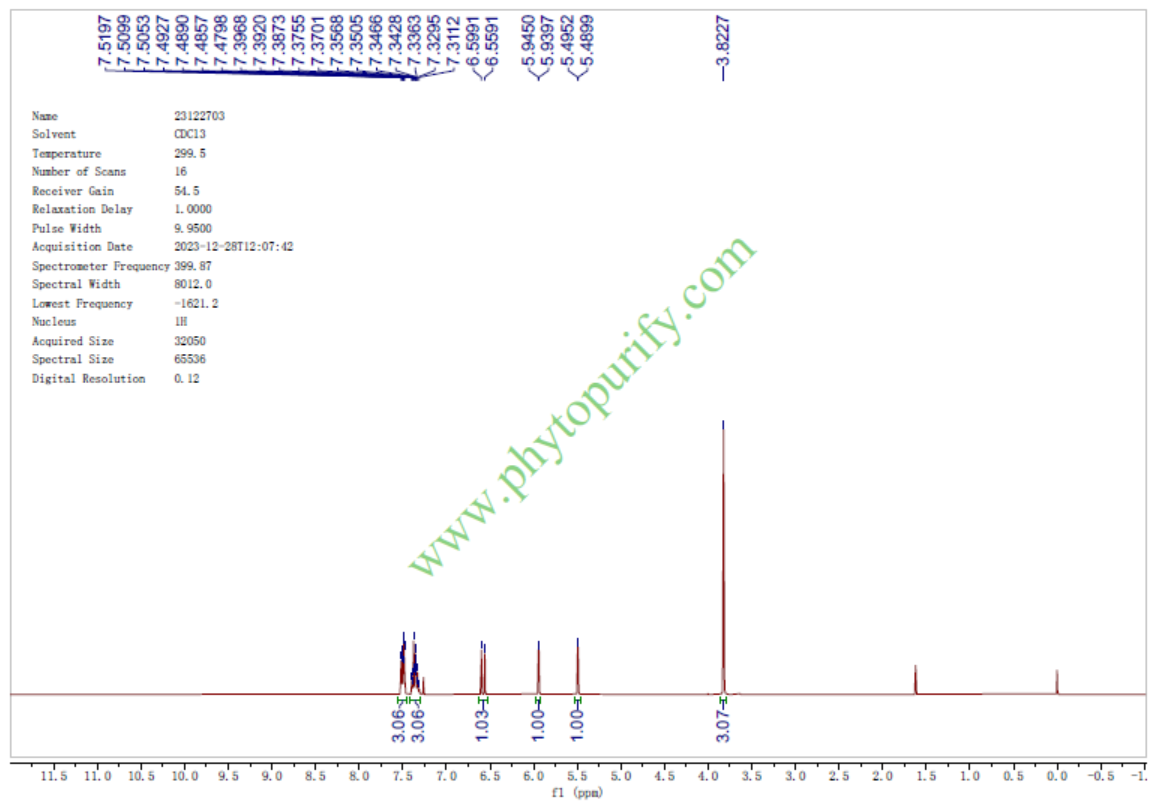
HNMR of Demethoxyyangonin
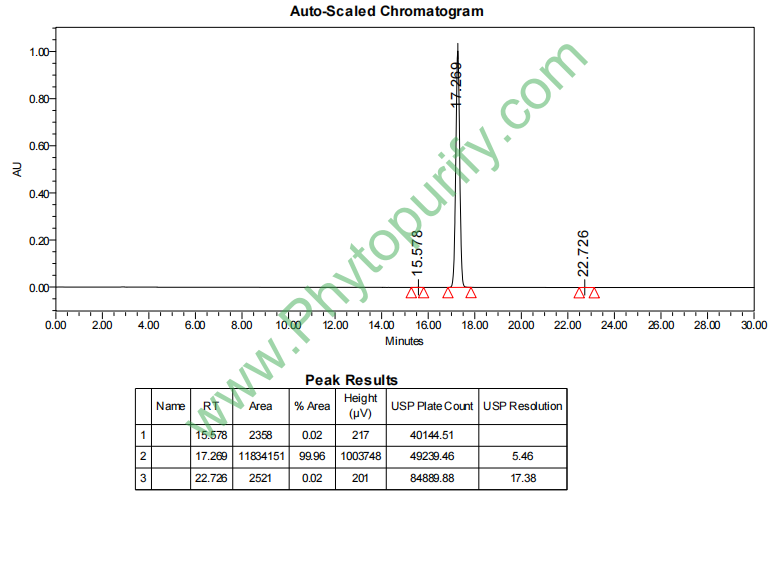
HPLC of Demethoxyyangonin
Storage conditions:Short-term storage at 2~8℃, long-term storage at -20 ~ -80℃
Demethoxyyangonin (CAS number: 15345-89-8) is a natural aromatic ether compound belonging to the 2-pyranone group. It was initially isolated from certain traditional medicinal plants and has attracted widespread attention in the field of natural product pharmacology in recent years due to its unique chemical structure and significant biological activity. Especially in terms of analgesic effects, demethoxy anesthetics have shown the potential for multi-target regulation, involving various molecular targets closely related to pain transmission and regulation such as TRPV1, CNR1, OPRD1, etc. With the in-depth study of its pharmacological mechanism, demethoxy anesthetics are considered promising candidate molecules for the development of new analgesic drugs.
This article aims to provide a systematic review of the chemical structure and physicochemical properties, plant sources and extraction methods, pharmacological activity and mechanism of action, pharmacological evaluation, and clinical application prospects of demethoxylated anesthetics. It is expected to provide comprehensive reference materials for researchers in related fields and promote its clinical translation.
The molecular formula of demethoxylated anesthetic pepper extract is C13H12O4, with a molecular weight of 228.2470. Its core structure is a 2-pyranone ring, connected with aromatic ether groups, endowing the molecule with unique chemical properties. The LogP value of this compound is 2.9229, indicating that it has moderate lipid solubility, which is beneficial for cell membrane penetration and in vivo distribution. The topological polar surface area (TPSA) is 39.44 Å ², and the lower polar surface area facilitates its passage through the blood-brain barrier (BBB), which has been validated in pharmacokinetic studies.
The low water solubility (0.0175 mg/mL) of demethoxylated anesthetics limits its solubility in aqueous phase, but its good lipid solubility makes it stable in lipid environment. The hERG channel inhibition experiment showed a negative result, indicating a low risk of cardiac toxicity. The Ames mutagenicity test score is 0.9, indicating that the genetic toxicity risk of the compound is low and meets the drug safety requirements.
The combination of the aromatic ether portion of the chemical structure and the 2-pyranone ring endows demethoxyanesthetics with the potential to interact with various protein targets at the molecular level, particularly in terms of binding affinity for nervous system related targets.
The main source of demethoxylated anesthetics is from certain traditional medicinal plants, especially the anesthetics in the pepper family (such as Piper plants), which are abundant in content. This type of plant is widely used in traditional medicine in Southeast Asia and South America for pain relief, anti-inflammatory, and neural regulation.
The common methods for extracting demethoxylated anesthetics include solvent extraction, liquid-liquid partitioning, and chromatographic separation. Ethanol or methanol is usually used as the initial extraction solvent, utilizing its good polarity range to dissolve various active ingredients in plants. Subsequently, through techniques such as silica gel column chromatography and reverse phase high performance liquid chromatography (RP-HPLC), combined with molecular screening and mass spectrometry identification, the purification and identification of demethoxyanesthetics were achieved.
In recent years, supercritical carbon dioxide extraction technology has also been attempted to be applied to the extraction of this compound. Due to its environmental friendliness, high efficiency, and ability to maintain the biological activity of the compound, it has gradually become a research hotspot for optimizing the extraction process.
The pharmacological activity of demethoxylated anesthetic pepper extract is mainly reflected in its analgesic effect. Multiple in vitro and in vivo experiments have shown that this compound can effectively alleviate various types of pain, including inflammatory pain, neuropathic pain, and acute pain models.
In the inflammatory pain models of mice and rats, demethoxy anesthetics have shown significant analgesic effects through oral or intraperitoneal injection, with a clear dose-dependent effect. Its analgesic effect is not limited to the peripheral nervous system, but also involves the regulation of the central nervous system, which is in line with its good blood-brain barrier penetration ability.
In addition, demethoxylated anesthetics also exhibit certain anti-inflammatory activity, which can inhibit the release of inflammatory mediators and alleviate tissue inflammatory reactions. This dual mechanism of action provides strong support for its analgesic effect.
Toxicological studies have shown that the acute toxicity of demethoxylated anesthetics is low, and long-term administration has not shown significant neurotoxicity or liver or kidney damage, indicating good safety.
The analgesic mechanism of demethoxylated anesthetics involves multiple molecular targets, mainly including:
TRPV1 (Transient receptor potential vanillic acid receptor 1)TRPV1 is a key ion channel in pain perception, involved in the transmission of thermal and chemical pain. Demethoxy anesthetics can regulate the activity of TRPV1, inhibit its overactivation, and alleviate the transmission of pain signals.
CNR1 (cannabinoid receptor 1)As an important regulatory factor in the central nervous system, CNR1 mediates various neuroprotective and analgesic effects. The interaction between demethoxylated anesthetics and CNR1 enhances the analgesic ability of the endogenous cannabinoid system.
OPRD1, OPRM1, OPRK1 (δ, μ, κ opioid receptors)These opioid receptors are classic analgesic targets. Demethoxy anesthetics can partially activate or regulate these receptors, exerting analgesic effects similar to opioid drugs, but with minimal side effects.
PTGS1, PTGS2 (cyclooxygenase 1 and 2)The PTGS enzyme system is a key enzyme involved in inflammation and pain production. Demethoxy anesthetics can alleviate inflammation related pain by inhibiting PTGS activity, reducing prostaglandin synthesis.
TRPA1 (Transient receptor potential vanillic acid receptor A1)TRPA1 is involved in the perception of chemical and mechanical pain, and the regulatory effect of demethoxy anesthetics can help alleviate complex pain states.
SLC6A4 (Serotonin Transporter)By regulating serotonin reuptake, demethoxy anesthetics may affect the emotional and cognitive dimensions of pain.
DRD2 (dopamine D2 receptor)The dopamine system plays an important role in pain regulation, and the effect of demethoxyanesthetics on DRD2 may enhance its analgesic effect and improve pain related emotional disorders.
In summary, the synergistic effect of demethoxylated anesthetics on pain through multiple targets and pathways demonstrates its unique advantages as a natural analgesic.
The pharmacological evaluation of demethoxylated anesthetics shows that it has good potential for drug development. Its molecular weight is moderate (228.2470), in accordance with Lipinski's rules, and is beneficial for oral absorption. The LogP value is 2.9229, indicating moderate lipid solubility that facilitates membrane penetration and in vivo distribution.
The TPSA is 39.44 Å ², and its low polar surface area supports its efficient crossing of the blood-brain barrier, promoting the efficacy of the central nervous system. Low water solubility (0.0175 mg/mL) may limit its bioavailability, but it can be effectively improved through drug formulation techniques such as nanocarriers and liposome encapsulation.
The hERG channel inhibition experiment was negative, indicating a low risk of cardiac toxicity and good safety. The Ames test score is 0.9, indicating a low risk of genetic toxicity and meeting clinical drug safety standards.
Pharmacokinetic studies have shown that demethoxy anesthetics have good absorption and distribution characteristics in the body, with a moderate half-life. The metabolic pathway is mainly through the liver enzyme system, and the metabolites have no significant toxicity. Its efficient blood-brain barrier penetration ability gives it significant advantages in the field of central analgesia.
With a deeper understanding of the pharmacological mechanism of action of demethoxylated anesthetic pepper extract, its clinical application prospects in the field of analgesic therapy are gradually becoming clear. Compared to traditional opioid analgesics, demethoxy anesthetics have multi-target properties, which may reduce dependency and drug resistance risks, minimize side effects, and meet the urgent clinical demand for safe and effective analgesic drugs.
Future clinical research can focus on its potential application in refractory pain such as chronic pain, neuropathic pain, and cancer pain. In addition, optimizing its bioavailability and targeting with modern drug delivery systems will further enhance its clinical value.
In addition to pain relief, the anti-inflammatory and neuroprotective effects of demethoxylated anesthetics also provide possibilities for its expansion into fields such as neurodegenerative diseases and inflammatory diseases. The multi-target and multifunctional pharmacological properties make it a model for the development of natural product drugs.
However, the clinical research on demethoxylated anesthetics is still in its infancy, and there is an urgent need for systematic preclinical safety evaluation and clinical trial validation to promote its translation into clinical applications.
As a natural product with a unique chemical structure and multi-target analgesic mechanism, demethoxy anesthetics have demonstrated broad pharmacological activity and good pharmacological properties. Its potential in pain relief and related disease treatment provides a new direction for natural product pharmacology research.
Future research should focus on in-depth analysis of its mechanism of action, optimization of pharmacokinetics, and systematic evaluation of preclinical safety and efficacy. Through interdisciplinary collaboration, demethoxylated anesthetics have the potential to become a new generation of safe and efficient analgesic drugs, bringing innovation to clinical pain management.
In summary, demethoxylated anesthetics not only enrich the pharmacological knowledge system of natural products, but also provide valuable research examples for the modern development of natural medicines, which are worthy of continuous attention and in-depth exploration.
