


Synonym name: Marindinin
Catalogue No.: BP0495
Cas No.: 587-63-3
Formula: C14H16O3
Mol Weight: 232.279
Botanical Source: Root of Piper methysticum and Aniba gigantifolia
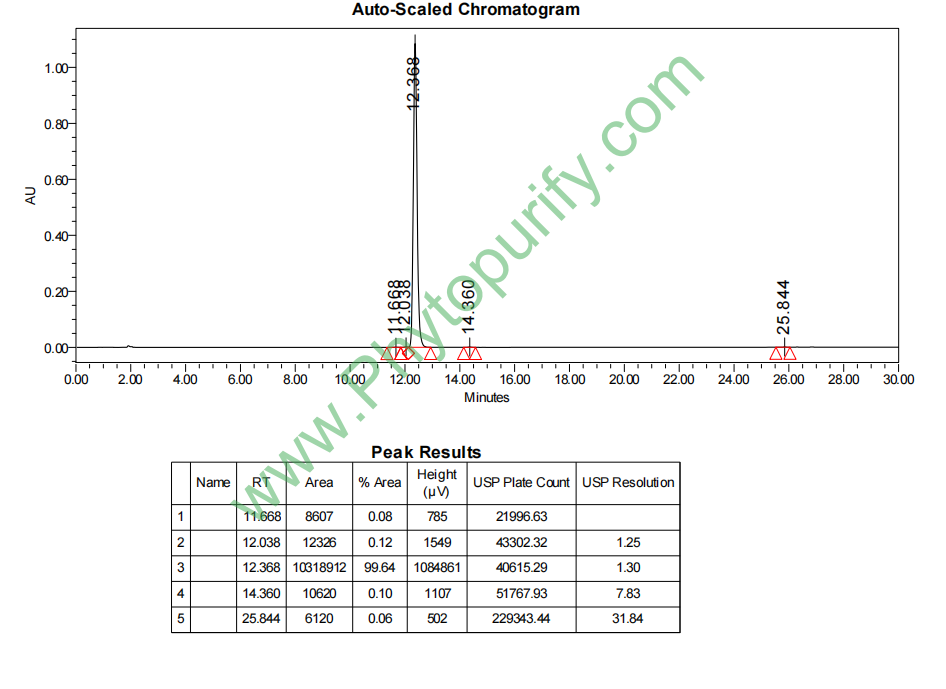
Purity: 95%~99%
Analysis Method: HPLC-DAD or/and HPLC-ELSD
Identification Method: Mass, NMR
Packing: Brown vial or HDPE plastic bottle
Can be supplied from milligrams to grams.
For Reference Standard and R&D, Not for Human Use Directly.
Inquire for bulk scale.
Description:
Dihydrokavain may play an important role in regulation of GABAergic neurotransmission, it non-competitively inhibits the specific binding of [3H]-batrachotoxinin-A 20-alpha-benzoate to receptor site 2 of voltage-gated Na+ channels. Dihydrokavain may treat sleep disturbances, as well as stress and anxiety.
References:
Planta Med. 2002 Dec;68(12):1092-6.
Kavalactones and dihydrokavain modulate GABAergic activity in a rat gastric-brainstem preparation.
METHODS AND RESULTS:
Using an in vitro neonatal rat gastric-brainstem preparation, the activity of majority neurons recorded in the nucleus tractus solitarius (NTS) of the brainstem were significantly inhibited by GABA A receptor agonist, muscimol (30 microM), and this inhibition was reversed by selective GABA A receptor antagonist, bicuculline (10 microM). Application of kavalactones (300 microg/ml) and Dihydrokavain (300 microM) into the brainstem compartment of the preparation also significantly reduced the discharge rate of these NTS neurons (39 % and 32 %, respectively, compared to the control level), and this reduction was partially reversed by bicuculline (10 microM). Kavalactones or Dihydrokavain induced inhibitory effects were not reduced after co-application of saclofen (10 microM; a selective GABA B receptor antagonist) or naloxone (100 nM; an opioid receptor antagonist). Pretreatment with kavalactones (300 microg/ml) or Dihydrokavain (300 microM) significantly decreased the NTS inhibitory effects induced by muscimol (30 microM), approximately from 51 % to 36 %.
CONCLUSIONS:
Our results demonstrated modulation of brainstem GABAergic mechanism by kavalactones and Dihydrokavain, and suggested that these compounds may play an important role in regulation of GABAergic neurotransmission.
HPLC of Dihydrokawain
Storage conditions:Short-term storage at 2~8℃, long-term storage at -20 ~ -80℃
Dihydrokawain (CAS number: 587-63-3) is a naturally occurring aromatic ether compound belonging to the 2-pyranone group. As one of the main active ingredients in Piper methicum plants, dihydroquercetin has received widespread attention in recent years due to its significant biological activity, especially its potential application in anti-inflammatory fields. Inflammatory response is a key link in the occurrence and development of various chronic diseases, and the development of natural product drugs targeting inflammation related targets has become an important direction in current pharmacological research. This article aims to systematically review the chemical structure and physicochemical properties, plant sources and extraction methods, pharmacological activity and mechanism of action, pharmacological evaluation, pharmacokinetic characteristics, and clinical application prospects of dihydroquercetin. It is expected to provide a theoretical basis and research direction for the future drug development of dihydroquercetin.
The molecular formula of dihydrocoumarin is C14H16O3, with a molecular weight of 232.2790. Its structural core is a 2-pyranone ring, connected to an aromatic ether group, and the overall molecule exhibits moderate lipid solubility (LogP=2.9992), indicating its good membrane permeability. The polar surface area (TPSA) is 35.53 Å ², indicating that its molecular polarity is low and conducive to membrane penetration. Low water solubility (0.1797 mg/mL) suggests limited solubility in aqueous phase, but suitable for lipid media environment.
From the perspective of drug safety, dihydroquercetin did not exhibit hERG channel inhibition, reducing the risk of cardiac toxicity; The Ames test result is 0.0, indicating no significant mutagenicity. In addition, the compound has a high blood-brain barrier permeability, suggesting that it may play a role in the central nervous system.
Dihydroquercetin is mainly found in the traditional medicinal plant Piper methylsticum in the Pacific region. Kava is a perennial shrub with rich active ingredients in its roots, traditionally used to make sedatives, anti anxiety, and anti-inflammatory drinks. Dihydroquercetin, as one of the main 2-pyranone compounds in kava, directly affects the efficacy of kava products in terms of its content and extraction purity.
The common methods for extracting dihydroquercetin include solvent extraction, liquid-liquid distribution, and column chromatography purification. Generally, ethanol or methanol is used as the extraction solvent, and ultrasound assisted extraction or reflux extraction is used to improve efficiency. Subsequently, separation and purification were carried out using silica gel column chromatography or high-performance liquid chromatography (HPLC) to obtain high-purity dihydroquercetin. In recent years, supercritical CO2 extraction technology has also been applied to the extraction of dihydroquercetin from kava, which has the advantages of environmental protection and high efficiency.
The anti-inflammatory effect of dihydroquercetin is one of its most significant pharmacological activities. Multiple in vitro and in vivo experiments have shown that dihydroquercetin can significantly inhibit the production of inflammatory mediators and the activation of inflammatory signaling pathways. Its main manifestation is to inhibit the expression of pro-inflammatory cytokines such as tumor necrosis factor (TNF) and interleukin-6 (IL-6), reduce the activity of cyclooxygenase (PTGS1 and PTGS2), and thus decrease the synthesis of prostaglandins.
In addition, dihydroquercetin can regulate inflammation related transcription factors NF - κ B (NFKB1) and signal transduction and transcriptional activation factor 3 (STAT3), inhibit their nuclear translocation and gene transcription activity, and alleviate inflammatory responses. Its regulatory effect on the inflammasome component CASP1 has also been reported, indicating that it may reduce the release of pro-inflammatory cytokine IL-1 β by inhibiting inflammasome activation.
Due to the high blood-brain barrier permeability of dihydroquercetin, its pharmacological effects in the central nervous system are gradually being revealed. Research has shown that dihydroquercetin can regulate two ion channels closely related to pain perception, TRPV1 and TRPA1, exhibiting analgesic and neuroprotective effects. By regulating the activity of these channels, dihydroquercetin reduces neuroinflammation and pain signal transduction, and has potential therapeutic value for neuropathic pain.
Some studies have also found that dihydroquercetin has antioxidant activity, can scavenge free radicals, and alleviate oxidative stress damage to cells. In addition, its regulatory effect on nitric oxide synthase type 2 (NOS2) suggests that it may play a role in regulating immune response and vascular function.
The anti-inflammatory and analgesic effects of dihydroquercetin are mainly achieved through multi-target and multi pathway synergistic regulation. Its key targets include:
IL-6 and TNF As pro-inflammatory cytokines, IL-6 and TNF play a central role in the inflammatory response. Dihydroquercetin reduces inflammation by inhibiting its expression and secretion.
STAT3 and NFKB1 These two transcription factors are key nodes in inflammation signal transduction. Dihydroquercetin can inhibit its activation and block the transcription of inflammation related genes.
CASP1 The core component of inflammasomes, involved in the maturation and release of IL-1 β. The inhibitory effect of dihydroquercetin on CASP1 reduces the release of pro-inflammatory cytokines.
TRPV1 and TRPA1 These two ion channels are involved in pain and inflammation signaling. Dihydroquercetin exerts analgesic and anti-inflammatory effects by regulating its activity.
PTGS1 and PTGS2 Cyclooxygenase enzyme system catalyzes the synthesis of prostaglandins. Dihydroquercetin inhibits its activity and reduces the production of inflammatory mediators.
NOS2 Inducible nitric oxide synthase is involved in inflammation and immune responses. Dihydroquercetin regulates NOS2 expression and reduces inflammatory damage.
In summary, dihydroquercetin exerts significant anti-inflammatory and analgesic effects by synergistically regulating the inflammatory signaling pathway through multiple targets.
The pharmacological parameters of dihydroquercetin show that it has good potential for drug development. The molecular weight is moderate, with a LogP value close to 3, which conforms to Lipinski's rule and is beneficial for oral absorption. The lower polar surface area and moderate water solubility support its good distribution in vivo. The high blood-brain barrier permeability provides the possibility for the application of the central nervous system.
In terms of safety, dihydroquercetin has no hERG channel inhibition or mutagenic risk, reducing concerns about cardiac toxicity and genetic toxicity. Preliminary pharmacokinetic studies have shown that dihydrocoumarin has good bioavailability and distribution characteristics in vivo, but its metabolic pathway and excretion mechanism still need further research.
In addition, the low water solubility of dihydroquercetin may affect its bioavailability in oral formulations. Therefore, in future drug development, solubility improvement strategies such as nanocarriers and solid dispersions need to be considered.
Based on the significant activities of dihydroquercetin in anti-inflammatory, analgesic, and neuroprotective aspects, its application prospects in various inflammation related diseases are broad. In the fields of chronic inflammatory diseases such as rheumatoid arthritis, inflammatory bowel disease, and neuropathic pain, dihydroquercetin is expected to become a new natural drug candidate molecule.
In addition, considering its good blood-brain barrier permeability, the potential protective effect of dihydroquercetin in neurodegenerative diseases such as Alzheimer's disease and Parkinson's disease deserves further exploration. Future research should strengthen its in vivo pharmacokinetics, toxicology evaluation, and mechanism studies to promote its clinical translation.
Combining modern pharmaceutical formulation technology, optimizing the drug properties of dihydroquercetin, improving its bioavailability and targeting, will further promote its clinical application development. The multi-target mechanism of action also provides a theoretical basis for combination therapy strategies, which helps to improve treatment efficacy and reduce side effects.
Dihydroquercetin, as a 2-pyranone aromatic ether compound derived from the traditional medicinal plant kava, exhibits significant anti-inflammatory, analgesic, and neuroprotective activities. Its multi-target and multi pathway mechanism of action provides a valuable example for the pharmacological research of natural products. Good pharmacokinetic parameters and safety evaluation have laid the foundation for its drug development.
In the future, by combining modern medicinal chemistry, pharmacology, and pharmaceutical technology, a deeper understanding of the mechanism of action and metabolic characteristics of dihydroquercetin will help promote its clinical application and meet new demands for the treatment of inflammation and neurological diseases. Dihydroquercetin is undoubtedly a promising star compound in the field of natural product pharmacology.
