


Synonym name:
Catalogue No.: BP1109
Cas No.: 94-62-2
Formula: C17H19NO3
Mol Weight: 285.343
Botanical Source: pepper (Piper nigrum) and many other Piper spp., Mentha piperata and Ulocladium sp. Prod. by a Periconia sp. Piper longum
Purity: 95%~99%
Analysis Method: HPLC-DAD or/and HPLC-ELSD
Identification Method: Mass, NMR
Packing: Brown vial or HDPE plastic bottle
Can be supplied from milligrams to grams.
For Reference Standard and R&D, Not for Human Use Directly.
Inquire for bulk scale.
HPLC of Piperine
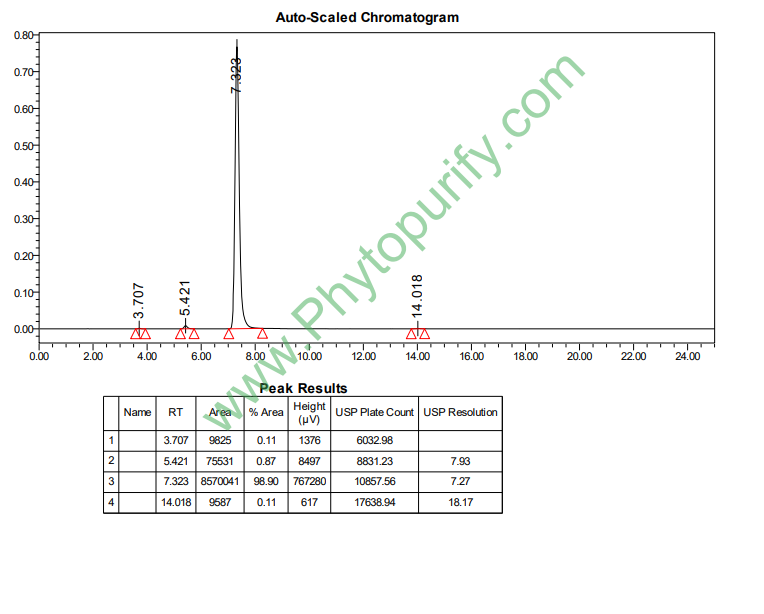
Storage conditions:Short-term storage at 2~8℃, long-term storage at -20 ~ -80℃
38.7700
2.4748
2.4746
.0595
4.8363
15.1787
High
91.6643
2.3443
No
Yes
Yes
No
No
Yes
0.3
No
Yes
Yes
Yes
Natural products have long been an important treasure trove for innovative drug discovery, among which alkaloids have attracted much attention due to their significant biological activity. Piperine, as a classic amide alkaloid isolated from pepper plants, not only endows black pepper with(Piper nigrum L. The main component of the unique spicy flavor is a lead compound with multiple biological activities. Its CAS number is 94-62-2. In traditional medicine, pepper is used to treat pain, inflammation, and digestive system diseases. Modern pharmacological research is gradually revealing the scientific connotations behind these traditional effects. Of particular importance, piperine has been found to be an effective inhibitor of P-glycoprotein (P-gp) and cytochrome P450 3A4 (CYP3A4), which demonstrates enormous potential in regulating drug metabolism, overcoming tumor multidrug resistance, and improving the bioavailability of other drugs. In addition, its cytotoxicity towards HeLa cell lines (IC50 of 61.94 ± 0.054 μ g/mL) suggests its potential anti-tumor activity. This article aims to systematically review the chemical properties, pharmacological activities, multi-target mechanisms of action, medicinal properties, and clinical application prospects of piperine, in order to provide a comprehensive scientific perspective for the deep development and utilization of this natural product.
The chemical name of piperine is (2E, 4E) -5- (1,3-benzodioxolan-5-yl) -1-piperidinyl-2,4-pentadien-1-one, with a molecular formula of C17H19NO3 and a molecular weight of 285.3430. Its structural feature is that a pyridine ring is connected to a polyene chain through an amide bond, and the end of the polyene chain is connected to a methylenedioxybenzene ring. This unique structure makes it a typical amide alkaloid.
In terms of physical and chemical properties, piperine exhibits monoclinic prismatic crystals with a melting point of approximately 128-130 ℃. Its lipid water partition coefficient (LogP) is 2.4748, indicating moderate lipophilicity. The topologically polar surface area (TPSA) is 38.7700 Å ², which is relatively small and conducive to its transmembrane permeation. Its water solubility is poor, about 0.0595 mg/mL, which to some extent limits its direct development as an aqueous formulation. However, its good lipid solubility makes it easy to penetrate biological membranes, and its high blood-brain barrier permeability prediction provides a structural basis for its action on central nervous system targets. Preliminary safety assessment shows that it has low mutagenicity in Ames test (result 0.3) and no significant hERG potassium channel inhibitory activity, indicating a low risk of cardiac toxicity and providing favorable early safety data for its drug development.
Piperine mainly comes from plants in the Piperaceae family, including black pepper(Piper nigrum L. The content of white pepper and white pepper is the most abundant, usually accounting for 5% to 9% of its dry weight. In addition, long pepper(Piper longum L. Other pepper plants are also important sources of it.
There are various traditional and modern methods for extracting piperine from plant materials. Soxhlet extraction is a classic method that often uses organic solvents such as ethanol, methanol, or dichloromethane for continuous reflux extraction. Ultrasound assisted extraction and microwave-assisted extraction are more efficient modern technologies that utilize physical fields to accelerate solvent penetration and compound dissolution, significantly reducing extraction time and improving yield. Supercritical fluid extraction, especially using carbon dioxide as a solvent, has become one of the preferred methods for obtaining high-purity piperine due to its advantages such as green color, no solvent residue, and good selectivity. The crude extract after extraction is usually separated and purified by techniques such as silica gel column chromatography and preparative high-performance liquid chromatography to obtain high-purity piperine monomers for in-depth pharmacological and pharmacokinetic studies.
Numerous preclinical studies have confirmed that piperine has broad and significant pharmacological activities.
1. Analgesic and anti-inflammatory activity: This is one of the most highly regarded activities of piperine. Piperine exhibits dose-dependent analgesic effects in various animal pain models, such as acetic acid writhing test, formalin test, and hot plate test. Its anti-inflammatory effect has also been validated in acute and chronic inflammation models induced by carrageenan and cotton ball granuloma. Its strength of action is often comparable to some classic nonsteroidal anti-inflammatory drugs.
2. Antidepressant and neuroprotective activity: Research has shown that piperine can significantly improve the behavioral performance of depression model animals such as chronic unpredictable mild stress and forced swimming. Its mechanism involves regulating levels of monoamine neurotransmitters, reducing oxidative stress, and inhibiting neuroinflammation. In addition, it has shown protective effects in animal models of neurodegenerative diseases such as Alzheimer's disease and Parkinson's disease, possibly by inhibiting acetylcholinesterase, reducing β - amyloid deposition, and Tau protein hyperphosphorylation.
3. Enhancing bioavailability: Piperine is a natural first pass effect inhibitor. It can non competitively inhibit CYP3A4, one of the most important drug metabolizing enzymes in the human liver and intestine, responsible for metabolizing about 50% of commonly used clinical drugs. Meanwhile, it can inhibit the drug efflux pump P-glycoprotein on intestinal epithelial cells. Through these two mechanisms, piperine can significantly increase the blood drug concentration and bioavailability of many co administered drugs, such as curcumin, resveratrol, certain antiepileptic drugs, and chemotherapy drugs.
4. Antitumor activity: In addition to its cytotoxicity to HeLa cells, piperine has growth inhibition and apoptosis promoting effects on a variety of tumor cell lines (such as breast cancer MCF-7, prostate cancer PC-3, colon cancer HT-29, etc.). Its anti-tumor mechanism is complex, including inducing cell cycle arrest, activating caspase cascade reaction, inhibiting nuclear factor kappa B (NF - κ B) signaling pathway, and reversing multidrug resistance as mentioned above.
5. Other activities: Piperine also has antioxidant, antiparasitic (such as Leishmania parasites), lipid metabolism regulation, and insulin resistance improvement activities, demonstrating multiple health benefits.
The diverse pharmacological effects of piperine stem from its interactions with multiple molecular targets, forming a "multi-target" network of action, particularly in the field of analgesia.
Core target group related to analgesia:
* Transient receptor potential channel: Piperine is an agonist of TRPV1 (vanillic acid receptor 1) and TRPA1 (anchoring protein 1). Activating these cation channels located on nociceptive sensory neurons initially causes a burning sensation (which is the source of pepper spiciness), but later leads to channel desensitization and calcium ion influx imbalance, resulting in long-lasting analgesic and desensitization effects.
* Endogenous cannabinoid system and opioid system: Research suggests that piperine may indirectly affect the function of endogenous cannabinoid CB1 receptor (CNR1) and regulate downstream analgesic pathways. Meanwhile, there is evidence to suggest that it can regulate the expression or function of μ - (OPRM1), δ - (OPRD1), and κ - (OPRK1) opioid receptors, enhancing the effects of endogenous opioid peptides, but it is not a typical direct agonist of opioid receptors.
* Cyclooxygenase and monoamine transporters: Piperine can inhibit the activity of cyclooxygenase COX-1 (PTGS1) and COX-2 (PTGS2), and reduce the production of pain and inflammatory mediators such as prostaglandins. In addition, it can inhibit the serotonin transporter (SLC6A4) and increase the concentration of serotonin in the synaptic cleft, which is related to its antidepressant and analgesic effects.
* Dopamine receptors: The regulation of dopamine D2 receptor (DRD2) may be involved in its ability to alleviate emotional disorders and reward effects associated with pain.
Other important mechanism targets:
* Metabolic enzymes and transporters: The direct inhibition of CYP3A4 and P-glycoprotein is the molecular basis for its role as a "bioavailability enhancer".
* Cellular signaling pathways: By inhibiting NF - κ B, activating Nrf2, and regulating MAPK/PI3K/Akt pathways, it mediates its anti-inflammatory, antioxidant, anti apoptotic (for normal cells), and pro apoptotic (for tumor cells) effects.
The characteristic of multi-target synergistic effect of piperine may provide better comprehensive efficacy and lower resistance risk in the treatment of complex diseases such as chronic pain and neurodegenerative diseases than single target drugs.
Although piperine has a wide range of pharmacological activities, its medicinal properties still face some challenges.
Pharmacokinetic characteristics: Piperine is rapidly absorbed after oral administration, but due to its significant first pass effect, its absolute bioavailability is relatively low (about 20% -50%). It is widely distributed in the body and can effectively enter the central nervous system due to its high lipid solubility and blood-brain barrier permeability. Piperine is mainly metabolized in the liver through a combination of glucuronidation and sulfation reactions, rather than the CYP450 enzyme system (as it is a strong inhibitor), and there are very few prototype drugs. It is mainly excreted through the kidneys. Its half-life is relatively short and may require multiple daily doses or the use of sustained-release formulations to maintain effective blood drug concentrations.
Advantages and challenges of pharmaceutical properties:
* Advantage: The molecular weight is moderate, and the LogP value is within the ideal range (2-3), which meets the basic requirements of the five principles of generic drugs. Natural source with good safety record (long-term consumption as a spice). Clear P-gp and CYP3A4 inhibitory activities provide unique advantages for the development of adjuvant drugs.
* Challenge: Poor water solubility is the main bottleneck in the development of formulations. Its spicy taste and gastrointestinal irritation may affect patient compliance. As a strong inhibitor of CYP3A4, there is a wide risk of drug drug interactions, and extreme caution should be exercised when combined with drugs with narrow therapeutic windows metabolized by this enzyme, such as certain anticoagulants, immunosuppressants, and antiarrhythmic drugs.
Formulation strategy: To improve its pharmacological properties, researchers have developed various strategies, including the production of phospholipid complexes, cyclodextrin inclusion complexes, solid dispersions, nanoemulsions, liposomes, and nanoparticles. These new drug delivery systems can significantly improve the solubility, stability, and oral bioavailability of piperine, and may alleviate its local irritation.
The clinical application prospects of piperine are broad, mainly reflected in the following directions:
1. As an analgesic adjuvant or a novel analgesic lead compound: Based on its multi-target analgesic mechanism, compound formulations or novel drugs can be developed for the treatment of refractory pain such as neuropathic pain and chronic inflammatory pain. Combining it with low-dose opioid drugs may enhance analgesic effects and reduce opioid use and addiction risk.
2. As a bioavailability enhancer: This is currently the field closest to practical application. Several dietary supplements containing piperine have been launched to enhance the absorption of health products such as curcumin. In the field of prescription drugs, designing fixed dose compound formulations containing low-dose piperine to improve the efficacy of the main drug (especially drugs with low bioavailability) is an important research and development direction, but drug interactions need to be strictly evaluated.
3. Anti tumor adjuvant therapy: By utilizing its ability to reverse multidrug resistance and radiosensitize, combined with conventional chemotherapy or radiotherapy, it may improve the treatment efficacy of certain malignant tumors, reduce the dosage and toxic side effects of chemotherapy drugs.
4. Treatment of neurological and psychiatric disorders: Based on its antidepressant, anti anxiety, and neuroprotective effects, the development of drugs or functional foods for the adjuvant treatment of mild to moderate depression and Alzheimer's disease has the potential.
Future prospects: Future research should focus on: ① Through structural modification, while retaining its core pharmacological activity, improving water solubility, reducing CYP inhibitory activity and irritability, and obtaining derivatives with better drug properties. ② Conduct more high-quality, large sample randomized controlled clinical trials to confirm its exact efficacy and safety in specific diseases such as chronic pain and depression. ③ Further explore new mechanisms such as epigenetic regulation and gut microbiota regulation. ④ Develop targeted delivery systems using modern formulation technology to improve the specificity and efficiency of their treatment.
Piperine, a natural alkaloid derived from everyday spices, has evolved from a simple seasoning ingredient to a highly valuable pharmacological star molecule. Its chemical structure is unique and has moderate medicinal properties. The extensive pharmacological activity, especially its analgesic effect produced by acting on multiple targets such as TRPV1, endocannabinoid system, cyclooxygenase, and its unique function as a P-gp and CYP3A4 inhibitor, has laid a solid scientific foundation for its application in pain management, tumor adjuvant therapy, neuroprotection, and as a bioavailability enhancer in multiple fields. Although it faces challenges in terms of solubility and drug interaction risk, these obstacles are gradually being overcome through the optimization of modern medicinal chemistry and pharmacology methods. With the continuous deepening of basic and clinical research, piperine and its derivatives are expected to transform from the wisdom crystallization of traditional medicine into modern drugs with clear therapeutic effects and unique advantages, making important contributions to human health. The continuous and in-depth research on it perfectly interprets the innovative drug development paradigm from the dining table to the laboratory and then to the hospital bed.
