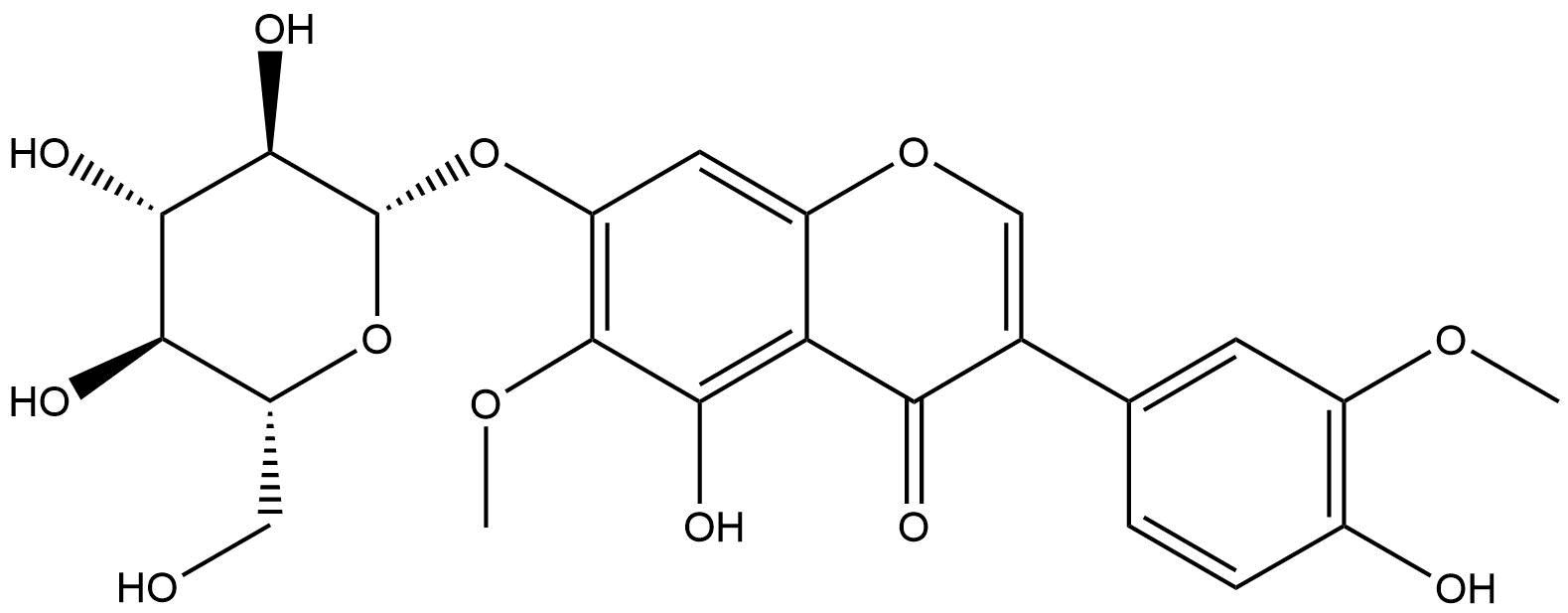


Product name: Iristectorin B
Synonym name: Iristectrigenin A 7-glucoside
Catalogue No.: BP4180
Cas No.: 94396-09-5
Formula: C23H24O12
Mol Weight: 492.433
Botanical Source: Belamcanda chinensis (L.)DC.
Physical Description: 射干
Type of Compound: Flavonoids
Purity: 95%~99%
Analysis Method: HPLC-DAD or/and HPLC-ELSD
Identification Method: Mass, NMR
Packing: Brown vial or HDPE plastic bottle
Storage: Store in a well closed container, protected from air and light. Put into refrigerate or freeze for long term storage.
Whenever possible, you should prepare and use solutions on the same day. However, if you need to make up stock solutions in advance, we recommend that you store the solution as aliquots in tightly sealed vials at -20℃. Generally, these will be useable for up to two weeks.
The product could be supplied from milligrams to grams
Inquire for bulk scale.
For Reference Standard and R&D, Not for Human Use Directly.
Storage conditions:Short-term storage at 2~8℃, long-term storage at -20 ~ -80℃
188.5100
.1459
.1143
1.4019
.6423
.5297
Low
80.7346
4.0126
Yes
No
Yes
No
Yes
No
0.6
Yes
No
Yes
No
Iristectorin B is a natural flavonoid product isolated from the Iris tectorum plant, which has attracted much attention due to its significant biological activity. As a natural compound with multiple pharmacological activities, iris glycoside not only shows the potential of anti breast cancer, but also shows good anti-inflammatory activity, involving multiple key inflammatory signaling pathways and molecular targets. In recent years, with the deepening development of natural product pharmacology, the structural characteristics, mechanism of action, and pharmacological evaluation of iridoid glycosides have gradually become clear, laying a solid foundation for their application in the field of drug development.
The purpose of this review is to systematically summarize the chemical structure and physicochemical properties, plant sources, and extraction methods of iridoid glycosides, with a focus on their pharmacological activity and mechanism of action. A comprehensive evaluation will be conducted based on their pharmacological parameters to explore their clinical application prospects and future research directions. The aim is to provide theoretical basis and practical guidance for the development of natural product drugs.
Iristectin B (CAS number: 94396-09-5) is an isoflavone compound with the molecular formula C27H28O9 and a molecular weight of 492.4330. Its structural core is a typical isoflavone skeleton, containing multiple hydroxyl and glycosidic groups, giving it high polarity and water solubility. The LogP value is 0.1459, indicating strong hydrophilicity, and the TPSA (topological polar surface area) is 188.5100, indicating high molecular polarity that may affect its cell membrane penetration ability and bioavailability.
The water solubility of iridoid glycoside is 1.4019, which is beneficial for its absorption and distribution in vivo, but may also limit its ability to pass through lipid membranes. The low permeability of the blood-brain barrier suggests its limited role in the central nervous system. The hERG channel inhibition test was negative, indicating a low risk of cardiac toxicity. The Ames test result is 0.6, indicating that its genotoxicity is weak and has a good safety basis.
The presence of polyhydroxy and glycosidic groups in the chemical structure not only affects its physicochemical properties, but may also have important effects on its binding affinity and pharmacological activity with biological targets. Its isoflavone skeleton endows it with multiple biological activity bases such as antioxidant, anti-inflammatory, and anti-tumor.
Irisin is mainly extracted from the Iris tectorum Maxim. plant in the Iris genus. Iris tectorum is a perennial herbaceous plant widely distributed in East Asia, and its rhizome is commonly used in traditional Chinese medicine to treat various diseases. This plant contains abundant isoflavone compounds, among which iridoid glycoside is one of the representative components.
The extraction process usually uses ethanol or methanol as solvents to obtain crude extracts through reflux extraction or ultrasound assisted extraction. Subsequently, high-purity iridoid glycoside was obtained through separation and purification techniques such as liquid-liquid distribution, column chromatography (such as silica gel column, reverse phase C18 column), and high performance liquid chromatography (HPLC). Modern extraction techniques such as supercritical fluid extraction and microwave-assisted extraction have also been gradually applied to improve extraction efficiency and purity.
The key parameters during the extraction process include solvent polarity, extraction time, temperature, and pH value, which directly affect the yield and purity of iridoid glycoside. The optimization research on the extraction of iridoid glycoside will help achieve its large-scale production and provide a stable material basis for subsequent pharmacological research and clinical development.
The pharmacological activity research of iris glycoside mainly focuses on its anti breast cancer and anti-inflammatory effects, showing a good multi target regulation ability.
A number of in vitro cell experiments showed that iris glycoside had a significant inhibitory effect on breast cancer cells. Its mechanism involves inducing cell cycle arrest, promoting cancer cell apoptosis, and inhibiting tumor cell migration and invasion. Irisin B exhibits potential anti-tumor activity by regulating multiple signaling pathways and intervening in the proliferation and survival of cancer cells.
In addition, iridoid glycosides can regulate oxidative stress levels, alleviate inflammation in the tumor microenvironment, and enhance anti-cancer effects. Its low toxicity and good safety provide favorable conditions for its use as a candidate drug for anti breast cancer.
Iris glycoside exhibits multi-target regulation in anti-inflammatory research. Its targets include key inflammation related molecules such as IL-6, STAT3, CASP1, TRPV1, PTGS1, TNF, TRPA1, NOS2, PTGS2, and NFKB1. These targets play a central role in the initiation, maintenance, and amplification of inflammatory responses.
Irisin can significantly inhibit the expression of pro-inflammatory factors such as IL-6 and TNF - α, block the activation of STAT3 and NF - κ B signaling pathways, reduce the release of inflammatory mediators, and thus alleviate inflammatory responses. Its regulation of CASP1 helps to inhibit the activation of inflammasomes, reduce cell apoptosis, and decrease the release of inflammatory factors.
In addition, the regulatory effect of iridoid glycoside on TRPV1 and TRPA1 may alleviate neuroinflammation and pain, demonstrating its potential application value in chronic inflammation and neuropathic pain.
The pharmacological mechanism of iridoid glycoside is complex, involving the coordinated regulation of multiple signaling pathways and molecular targets.
IL-6 is a typical pro-inflammatory cytokine that promotes inflammation and tumor cell survival by activating STAT3 transcription factor. Irisin can inhibit the expression of IL-6 and its mediated STAT3 phosphorylation, block signal transduction, and suppress inflammation and tumor cell proliferation.
NF - κ B is a key regulatory factor in inflammation and immune response. Irisin B exerts anti-inflammatory effects by inhibiting the activation of NFKB1, reducing the expression of pro-inflammatory genes such as TNF - α and PTGS2 (COX-2), and decreasing the production of inflammatory mediators.
CASP1 is a key component of inflammasomes, involved in the maturation and release of pro-inflammatory cytokine IL-1 β. The inhibitory effect of iridoid glycoside on CASP1 helps alleviate inflammasome mediated inflammatory response, prevent excessive inflammation and tissue damage.
Irisin B regulates TRPV1 and TRPA1, which helps alleviate inflammation related neuropathic pain. TRPV1 and TRPA1 act as ion channels in sensory nerve endings, involved in the transmission of pain signals and inflammatory responses.
Irisin B regulates the activity of NOS2 (inducible nitric oxide synthase), reduces excessive NO production, lowers oxidative stress levels, protects tissues from free radical damage, and enhances their anti-inflammatory and anti-tumor effects.
The pharmacological parameters of iridoid glycoside indicate that it has certain potential for development.
At present, there is limited pharmacokinetic data on iridoid glycoside, and it is preliminarily speculated that its oral bioavailability is limited. It may be necessary to improve absorption and stability through drug carriers or structural modifications. Further research is needed on the metabolic pathways and excretion methods in the body to clarify its behavior and safety.
As a natural isoflavone with multiple biological activities, iris glycoside shows good anti breast cancer and anti-inflammatory potential, and has the basis to become a new natural drug or drug lead compound.
In view of its inhibitory effect on breast cancer cells, iris glycoside is expected to be used as an adjuvant drug to improve the efficacy and reduce side effects in combination with existing chemotherapy drugs. In the future, it is necessary to conduct systematic in vivo anti-tumor activity evaluation and toxicology research to clarify its safe dosage and treatment window.
The role of iridoid glycoside in regulating multi-target inflammatory signaling pathways endows it with the potential to treat chronic inflammatory diseases (such as rheumatoid arthritis, inflammatory bowel disease) and neuroinflammation related pain. Its low toxicity and multi-target properties make it suitable for development as a natural anti-inflammatory drug or adjuvant therapy.
To overcome the issues of bioavailability and in vivo stability of iridoid glycoside, future strategies such as structural modification, nanocarrier encapsulation, and combination therapy can be used to optimize its pharmacokinetic properties. Further pharmacological and toxicological studies, as well as preclinical animal model validation, are key to promoting its clinical translation.
In addition, based on modern molecular docking and network pharmacology methods, in-depth analysis of the action network and potential targets of iridoid glycosides can help discover more pharmacological effects and indications.
As a natural isoflavone product from Iris tectorum, Iris glycoside exhibits multiple biological functions such as anti breast cancer and anti inflammation by virtue of its unique chemical structure and multi-target pharmacological activity. Its mechanism of action involves key molecular pathways such as IL-6/STAT3, NF - κ B, inflammasomes, and TRP channels, reflecting the complex and intricate regulatory network of natural products.
Although the pharmacokinetics and clinical research of iridoid glycoside are still in their infancy, its good safety and multi-target properties provide strong support for its development as a new natural medicine. In the future, through interdisciplinary collaboration, optimizing its drug properties and clarifying its mechanism of action, it is expected to promote the clinical application of iridoid glycosides in anti-cancer and anti-inflammatory fields, and achieve the successful transformation of natural products into clinical drugs.
