


Product name: Tectoridin
Synonym name: Tectorigenin 7-glucoside; Shekanin; Shekkanin
Catalogue No.: BP1368
Cas No.: 611-40-5
Formula: C22H22O11
Mol Weight: 462.407
Botanical Source: Belamcanda chinensis (L.)DC.
Physical Description:
Type of Compound: Flavonoids
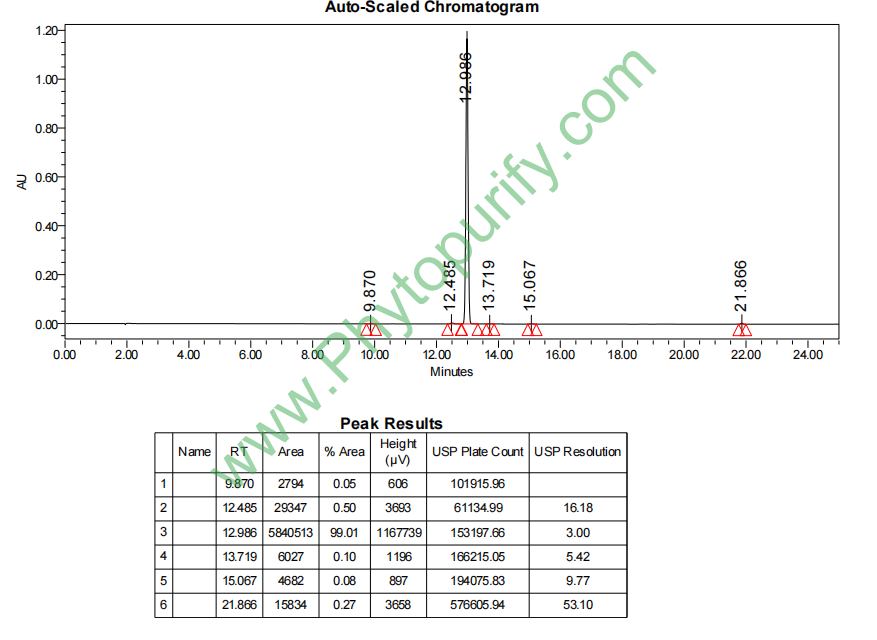
Purity: 95%~99%
Analysis Method: HPLC-DAD or/and HPLC-ELSD
Identification Method: Mass, NMR
Packing: Brown vial or HDPE plastic bottle
Storage: Store in a well closed container, protected from air and light. Put into refrigerate or freeze for long term storage.
Whenever possible, you should prepare and use solutions on the same day. However, if you need to make up stock solutions in advance, we recommend that you store the solution as aliquots in tightly sealed vials at -20℃. Generally, these will be useable for up to two weeks.
The product could be supplied from milligrams to grams
Inquire for bulk scale.
Chengdu Biopurify Phytochemicals Ltd. is a leading company in the research, development, manufacture and marketing of High Quality Phytochemicals and Extracts(especially Active Ingredients from Traditional Chinese Medicine,TCM), Natural Active Pharmaceutical Ingredients worldwide.
The main services:
A. Supply active ingredients and reference standards of TCM, from mgs to kgs scale
B. Custom extraction and purification, target Herb Active Ingredients
C. Custom synthesis and semi-synthesis for Natural Active Ingredients
D. CR(contract research), CM(contract manufacture) and PD(process development) services from lab scale, pilot scale to commercial scale(GMP is also available)
E. TCM compounds library for drug screen,more than 3000 compounds available, many of them are rare and unique.
HPLC of Tectoridin
Storage conditions:Short-term storage at 2~8℃, long-term storage at -20 ~ -80℃
Tectolidin, also known as irisin, is a typical natural flavonoid product that was initially isolated from the leguminous plant Maackia amurensis. As a type of phytoestrogen, Shegan glycoside has attracted widespread attention in the field of natural product pharmacology in recent years due to its unique biological activity and multi-target regulatory effects. Shegan glycoside not only activates the classical estrogen receptor (ER) pathway, but also mediates non genomic signaling through the G protein coupled receptor GPR30, demonstrating a complex regulatory network. In addition, Shegan glycoside has shown potential therapeutic value in various pharmacological effects such as anti-inflammatory, antioxidant, and anti-tumor, especially in the intervention of inflammation related diseases, demonstrating significant activity.
This article will provide a systematic review of the chemical structure and physicochemical properties, plant sources, and extraction methods of Shegan glycoside, with a focus on analyzing its pharmacological activity and mechanism of action, evaluating its pharmacological parameters and pharmacokinetic characteristics, and finally exploring its clinical application prospects and future research directions. The aim is to provide theoretical basis and scientific reference for the drug development and clinical translation of Shegan glycoside.
The molecular formula of Shegan glycoside is C22H22O11, with a molecular weight of 462.4070. Its chemical structure belongs to the isoflavone glycoside class, specifically the isoflavone skeleton is connected to the glucoside part through glycosidic bonds. The structure contains multiple hydroxyl and methoxy groups, giving it high polarity and water solubility. According to the physicochemical parameters, the LogP value of Shegan glycoside is 0.0294, indicating its strong hydrophilicity. The TPSA (topological polar surface area) is as high as 179.2800, further supporting its good water solubility (solubility of approximately 1.0867 mg/mL). These properties suggest that the absorption of Shegan glycoside in vivo may be limited by cell membrane permeability, but its hydrophilicity is beneficial for its distribution in the blood.
Shegan glycoside has good chemical stability, is not easily degraded spontaneously, and does not have hERG channel inhibitory activity, reducing the risk of cardiac toxicity. The Ames mutagenicity test results showed low mutagenicity (value of about 1.2), indicating high safety. The low blood-brain barrier permeability of Shegan glycoside indicates its limited distribution in the central nervous system, which may reduce central side effects.
Shegan glycoside was initially isolated from the leguminous plant Maackia amurensis, which is widely distributed in Northeast Asia, especially in Northeast China and the Russian Far East. Maackia amurensis contains abundant isoflavones, and one of its main components, saikosaponin, is commonly used in medicine and scientific research.
The common methods for extracting Shegan glycoside include solvent extraction, column chromatography separation, and high-performance liquid chromatography (HPLC) purification. Ethanol or methanol are generally used as extraction solvents, combined with ultrasound assisted extraction technology to improve extraction efficiency. After concentration, separation, and purification, the extract is separated by silica gel column chromatography or reverse phase C18 column, and the purity is finally identified by HPLC. In recent years, supercritical CO2 extraction and membrane separation technologies have also been attempted to be applied to the extraction of Shegan glycosides, in order to achieve green and efficient industrial production.
Shegan glycoside exhibits significant anti-inflammatory activity in various inflammatory models. Its main mechanism includes inhibiting the expression of pro-inflammatory cytokines such as IL-6 and TNF - α, regulating key molecules STAT3 and NFKB1 in the inflammatory signaling pathway, and thereby reducing the inflammatory response. Shegan glycoside can also inhibit the synthesis of inflammatory mediators PTGS1 (COX-1) and PTGS2 (COX-2), reduce the production of prostaglandins, and alleviate inflammatory symptoms. In addition, Shegan glycoside has a regulatory effect on inflammation related ion channels TRPV1 and TRPA1, affecting inflammation perception and pain transmission.
Shegan glycoside reduces oxidative stress-induced cell damage by regulating the expression of NOS2 (inducible nitric oxide synthase). Its antioxidant activity helps to protect tissues from free radical damage and delay the degenerative changes of inflammation related tissues.
As a plant estrogen, Shegan glycoside can activate estrogen receptors ER α and ER β, regulate estrogen dependent gene expression, and exert biological effects similar to estrogen. Meanwhile, Shegan glycoside can also activate thyroid hormone receptors, affecting metabolism and growth and development processes. Through non genomic pathways, Shegan glycoside activates GPR30 receptors, rapidly regulates cell signal transduction, and regulates cell proliferation, apoptosis, and metabolism.
Some studies have shown that Shegan glycoside has anti-tumor potential, which can inhibit tumor cell proliferation and induce apoptosis, but the relevant mechanisms still need to be further explored. In addition, Shegan glycoside also exhibits certain activities in immune regulation and neuroprotection, indicating its potential application in multi system diseases.
The biological activity of Shegan glycoside depends on its multi-target and multi pathway regulatory mechanisms. Its main mechanism of action includes:
ER dependent genomic pathway
As a plant estrogen, Shegan glycoside binds to the estrogen receptors ER α and ER β in the nucleus, inducing conformational changes in the receptors, promoting their binding to estrogen response elements on DNA, and regulating the transcriptional expression of target genes. This pathway affects the expression of genes related to cell cycle regulation, metabolic regulation, and inflammatory response.
GPR30 dependent non genomic pathway
Shegan glycoside activates the GPR30 receptor on the membrane surface, rapidly initiating intracellular signal transduction such as cAMP, PI3K/Akt, and MAPK pathways, regulating cell proliferation, apoptosis, and metabolic activity. This non genomic mechanism of action enables Shegan glycoside to quickly respond to changes in the cellular environment and exert diverse biological effects.
Regulation of anti-inflammatory signaling pathway
Shegan glycoside inhibits the NFKB1 signaling pathway, reduces the expression of pro-inflammatory factors such as TNF - α and IL-6, lowers the activation of STAT3, and thus suppresses the inflammatory cascade reaction. The regulatory effect of CASP1 reduces the release of inflammatory mediators and alleviates tissue damage.
Ion channel regulation
The regulation of TRPV1 and TRPA1 channels by Shegan glycoside affects the transmission of pain and inflammatory signals, and has dual analgesic and anti-inflammatory effects.
The pharmacological parameters of Shegan glycoside indicate that it has certain potential for drug development. Moderate molecular weight and good water solubility are beneficial for the development of oral formulations. Low LogP values and high TPSA suggest lower cell membrane permeability, which may limit oral absorption rate but also reduce non-specific lipophilic toxicity.
Low blood-brain barrier permeability reduces the risk of central nervous system side effects. Lack of hERG channel inhibitory activity may reduce cardiac toxicity. The Ames test results showed low mutagenicity and good safety.
In terms of pharmacokinetics, existing studies have shown that Shegan glycoside is metabolically stable in vivo, mainly converted through the liver metabolic enzyme system, and the metabolites are mostly deglycosylated isoflavone active ingredients. The half-life of Shegan glycoside is moderate, and its plasma protein binding rate is high, indicating its wide distribution in the body. However, the specific absorption, distribution, metabolism, and excretion (ADME) characteristics still need further systematic research.
As a multifunctional plant estrogen, Shegan glycoside has broad clinical application potential. Its significant anti-inflammatory effect makes it potentially therapeutic in chronic inflammatory diseases such as rheumatoid arthritis, inflammatory bowel disease, skin inflammation, etc. By regulating estrogen and thyroid hormone receptors, Shegan glycoside may have a positive impact on hormone related diseases such as menopausal syndrome, osteoporosis, and metabolic syndrome.
In addition, the antioxidant and cell protective effects of Shegan glycoside provide the possibility for adjuvant therapy of neurodegenerative diseases and cardiovascular diseases. Its low toxicity and good safety lay the foundation for long-term medication.
Future research should focus on the pharmacokinetic optimization, formulation development, and clinical efficacy validation of Shegan glycoside. Combining modern drug delivery systems such as nanocarriers and targeted agents is expected to enhance their bioavailability and therapeutic efficacy. At the same time, in-depth analysis of its molecular mechanism, especially its interaction with inflammation and hormone signaling pathways, will provide scientific basis for the precise treatment strategy of Shegan glycoside.
As a natural flavonoid product with a clear source and unique structure, Shegan glycoside exhibits a wide range of pharmacological activities and good drug properties due to its ability to activate estrogen and thyroid hormone receptors and multi-target anti-inflammatory effects. Its potential in anti-inflammatory, hormone regulation, and cell protection provides valuable resources for the development of new natural medicines. Although the research on Shegan glycoside is still in the basic and preliminary application stage, its good safety and multifunctionality indicate broad clinical application prospects. In the future, through systematic pharmacological mechanism analysis and clinical research, Shegan glycoside is expected to become an important candidate molecule for the development of natural product drugs, bringing new hope for the treatment of related diseases.
