


Product name: Iridin
Synonym name:
Catalogue No.: BP0766
Cas No.: 491-74-7
Formula: C24H26O13
Mol Weight: 522.459
Botanical Source: Belamcanda chinensis (L.)DC.
Physical Description:
Type of Compound: Flavonoids
Purity: 95%~99%
Analysis Method: HPLC-DAD or/and HPLC-ELSD
Identification Method: Mass, NMR
Packing: Brown vial or HDPE plastic bottle
Storage: Store in a well closed container, protected from air and light. Put into refrigerate or freeze for long term storage.
Whenever possible, you should prepare and use solutions on the same day. However, if you need to make up stock solutions in advance, we recommend that you store the solution as aliquots in tightly sealed vials at -20℃. Generally, these will be useable for up to two weeks.
The product could be supplied from milligrams to grams
Inquire for bulk scale.
Chengdu Biopurify Phytochemicals Ltd. is a leading company in the research, development, manufacture and marketing of High Quality Phytochemicals and Extracts(especially Active Ingredients from Traditional Chinese Medicine,TCM), Natural Active Pharmaceutical Ingredients worldwide.
The main services:
A. Supply active ingredients and reference standards of TCM, from mgs to kgs scale
B. Custom extraction and purification, target Herb Active Ingredients
C. Custom synthesis and semi-synthesis for Natural Active Ingredients
D. CR(contract research), CM(contract manufacture) and PD(process development) services from lab scale, pilot scale to commercial scale(GMP is also available)
E. TCM compounds library for drug screen,more than 3000 compounds available, many of them are rare and unique.
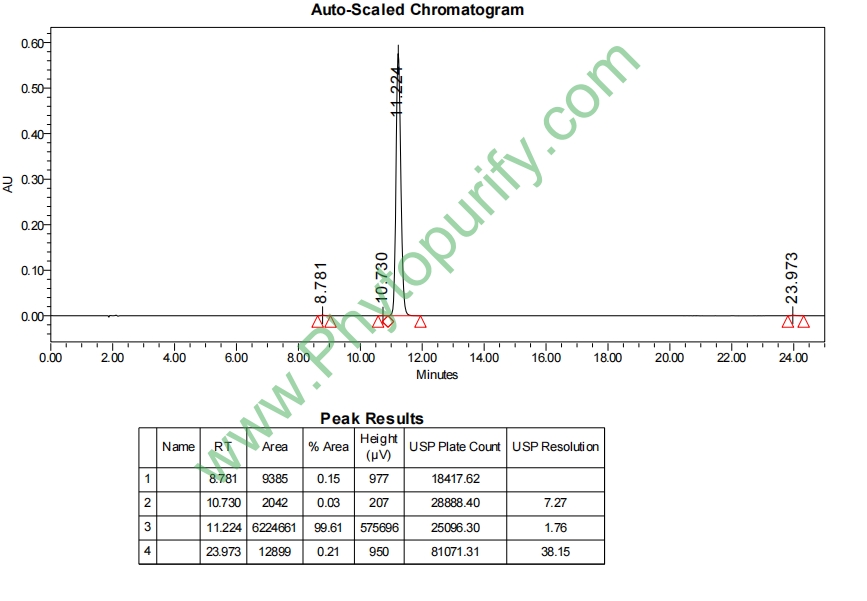
HPLC of Iridin
Storage conditions:Short-term storage at 2~8℃, long-term storage at -20 ~ -80℃
Iridin (CAS number: 491-74-7) is a natural flavonoid product isolated from the Iris milisii plant in the Iridaceae family, belonging to the glycosylated flavonoid family. As a derivative formed by the glycosylation of β - D-glucopyranose residues at the 7th hydroxyl group of irisin, wild irisin occupies a unique position in plant metabolites. Isoflavones have become a hot topic in natural product pharmacology research in recent years due to their diverse biological activities and potential medicinal value. Wild irisin not only has a typical isoflavone skeleton structure, but also exhibits physicochemical properties and biological activities different from those of the mother nucleus due to its glycosylation modification.
In recent years, with the in-depth study of the molecular mechanisms of malignant tumors such as liver cancer, wild irisin has gradually attracted attention from the academic community due to its potential regulatory effects on various liver cancer-related targets, such as BCL2, STAT3, TOP1, MAPK1, TERT, PIK3CA, MMP9, EGFR, PTGS2, TP53, etc. This article provides a systematic review of the latest research progress on the chemical structure and physicochemical properties, plant sources and extraction methods, pharmacological activity and mechanism of action, pharmacological evaluation, and clinical application prospects of wild irisin, aiming to provide theoretical basis and research direction for its further drug development and clinical application.
The chemical structure of wild irisin is based on the flavonoid core, specifically the 4 '- methoxy isoflavone structure, and a β - D-glucopyranose residue is connected to the 7th hydroxyl group through a glycosidic bond. Its molecular formula is C25H26O12, with a molecular weight of 522.4590 Da. Structurally, irisin belongs to the 7-O - β - D-glucoside type isoflavone, and the introduction of sugar groups significantly affects its water solubility, bioavailability, and interaction with biological targets.
In terms of physical and chemical properties, the LogP value of wild irisin is 0.1710, indicating its strong hydrophilicity and good water solubility (1.6545 mg/mL, unit: water solubility). Its topological polar surface area (TPSA) is 197.74 Å ², and a higher polarity surface area is usually associated with poorer cell membrane permeability, which may limit its ability to pass through the blood-brain barrier, consistent with its low blood-brain barrier permeability. In addition, wild irisin does not have hERG channel inhibitory activity, indicating a low risk of cardiac toxicity. The Ames test result is 0.6, indicating a low risk of genetic toxicity.
The glycosylation modification of chemical structure not only improves its water solubility, but also may regulate its biological activity by changing its molecular conformation and binding mode with target proteins. As a member of 4 '- methoxyflavone, 7-hydroxyflavone 7-O - β - D-glucoside, hydroxyflavone, and monosaccharide derivatives, wild irisin embodies the typical characteristics of natural product diversity.
Wild irisin is mainly extracted from the Iris milisii plant in the Iridaceae family. Iris milisii is distributed in some parts of Asia and is an important resource for traditional herbs and ornamental plants. The rhizome and aboveground parts of this plant contain abundant flavonoids, especially irisin.
The extraction method usually uses polar solvents such as methanol, ethanol, or their aqueous solutions to reflux or ultrasound assisted extraction of dried plant materials. After filtration and concentration of the extract, multiple separation and purification techniques such as liquid-liquid distribution, silica gel column chromatography, and reverse phase high performance liquid chromatography (RP-HPLC) were used to obtain high-purity wild irisin. In recent years, supercritical fluid extraction and microwave-assisted extraction techniques have also been applied to improve extraction efficiency and purity.
The optimization of extraction process mainly focuses on solvent selection, extraction time, temperature, and pH conditions to maximize the retention of active ingredients in wild irisin and reduce degradation and transformation. During the purification process, glycoside compounds have high polarity, and it is necessary to design a reasonable mobile phase system and chromatographic conditions to achieve effective separation.
The pharmacological activity research of wild irisin mainly focuses on anti-tumor, anti-inflammatory, antioxidant, and liver protection aspects, especially showing significant potential in the field of liver cancer.
Multiple in vitro cell experiments have shown that irisin can inhibit the proliferation and migration of liver cancer cell lines (such as HepG2, Huh7, etc.), induce cell cycle arrest and apoptosis. Its anti-tumor activity is closely related to regulating multiple signaling pathways, including inhibiting the STAT3 and PI3K/AKT pathways, reducing the expression of anti apoptotic protein BCL2, and promoting the activation of apoptosis related proteins.
In addition, wild irisin can inhibit the activity of tumor associated protease MMP9, reducing the invasion and metastasis ability of tumor cells. Its regulatory effect on TOP1 (topoisomerase I) suggests that it may affect DNA replication and repair processes, further enhancing anti-tumor efficacy.
Wild iris glycoside exhibits significant anti-inflammatory activity, which can downregulate the expression of PTGS2 (COX-2), reduce the generation of inflammatory mediators, and alleviate inflammatory reactions. Its antioxidant capacity is exerted by clearing free radicals and increasing endogenous antioxidant enzyme activity, which helps alleviate oxidative stress damage to the liver and other tissues.
Wild irisin has shown protective effects in various liver injury models, reducing liver cell damage induced by chemical drugs or toxins and improving liver function indicators. The mechanism may involve inhibiting hepatocyte apoptosis, regulating inflammatory response, and promoting hepatocyte regeneration.
The mechanism of action of wild irisin involves synergistic regulation of multiple targets and pathways, reflecting the characteristics of multi-target pharmacology of natural products.
BCL2, as an anti apoptotic protein, plays a crucial role in the survival of liver cancer cells. Wild irisin reduces BCL2 expression, disrupts intracellular anti apoptotic balance, and promotes mitochondrial mediated apoptosis.
STAT3 is an important transcription factor for the proliferation and immune escape of various tumor cells. Wild irisin can inhibit the phosphorylation and nuclear translocation of STAT3, block the expression of downstream oncogenes, and inhibit tumor growth and metastasis.
TOP1 participates in the regulation of DNA supercoils and is a key enzyme for rapid proliferation of tumor cells. The inhibitory effect of wild irisin on TOP1 may lead to DNA damage accumulation and induce tumor cell death.
MAPK1 (ERK2) and PIK3CA (catalytic subunits of PI3K) are core signaling molecules for cell proliferation and survival. Wild irisin enhances anti-tumor effects by regulating these two pathways, affecting cell cycle progression and apoptosis signaling.
Wild iris glycoside also has regulatory effects on multiple molecules such as TERT (telomerase reverse transcriptase), MMP9 (matrix metalloproteinase 9), EGFR (epidermal growth factor receptor), PTGS2 (cyclooxygenase-2), and TP53 (tumor suppressor protein), reflecting its multi-target synergistic anti-cancer mechanism.
From the perspective of medicinal properties, wild irisin has certain advantages and challenges.
The molecular weight of wild irisin is relatively high (522.4590 Da) and the TPSA is high (197.74 Å ²), indicating that its oral bioavailability may be limited, especially due to poor cell membrane permeability, making it difficult to effectively penetrate the blood-brain barrier. Its LogP value is 0.1710, indicating that the molecule is hydrophilic, facilitating dissolution and distribution in body fluids, but may limit intracellular accumulation.
Wild irisin does not inhibit hERG channels, reducing the risk of cardiac toxicity. The Ames test results show that its genetic toxicity is low and its safety is good. High water solubility is beneficial for formulation development and in vivo distribution.
At present, there is limited research on the in vivo metabolism of wild irisin, and it is speculated that its glycoside portion may be hydrolyzed into irisin under the action of gut microbiota, which has high biological activity. Further research is needed on the pharmacological effects and toxicity of metabolites.
Due to its action on multiple signaling pathways, wild irisin may exhibit synergistic or antagonistic effects with other drugs, especially those targeting tumor related pathways. In the future, the risk of drug interactions needs to be evaluated.
Wild iris glycoside, as a natural isoflavone glycoside, exhibits good anti liver cancer potential and multiple biological activities, and has high clinical application value.
Liver cancer, as a highly prevalent malignant tumor worldwide, has limited treatment options and significant side effects. Wild irisin provides a new therapeutic approach by regulating tumor cell proliferation, apoptosis, and metastasis through multiple targets. Its combination with existing chemotherapy drugs or targeted drugs may achieve synergistic effects and reduce the risk of drug resistance.
The anti-inflammatory and liver protective effects of wild irisin suggest its potential applications in chronic liver disease, liver fibrosis, and inflammatory diseases. In the future, it can be expanded to research on metabolic diseases and neurodegenerative diseases.
The high polarity and large molecular weight of wild irisin limit its oral absorption and in vivo distribution, and its pharmacokinetic performance needs to be improved through drug carrier technology (such as nanoparticles, liposomes) or chemical modification (such as deglycosylation, esterification). In addition, the toxicological evaluation and preclinical research of the system are key steps in its transformation into clinical drugs.
Wild iris glycoside, as a typical isoflavone glycoside, has excellent water solubility and multi-target regulatory ability, demonstrating a wide range of pharmacological activities, especially in the field of liver cancer treatment, with significant potential. The multi-target and multi pathway mechanism of action provides new ideas for the development of natural anti-tumor drugs. Although its pharmacokinetic performance and clinical translation still face certain challenges, with the development of extraction and purification technologies and drug delivery systems, wild irisin is expected to become an important candidate molecule for natural anti-tumor drugs. In the future, through systematic pharmacological mechanism research and preclinical evaluation, a solid foundation will be laid for its clinical application, promoting the innovative development of natural products in the treatment of liver cancer.
