


Synonym name:
Catalogue No.: BP0769
Cas No.: 41743-73-1
Formula: C20H18O8
Mol Weight: 386.356
Botanical Source: Iris florentina, Iris germanica and Iris tingitana
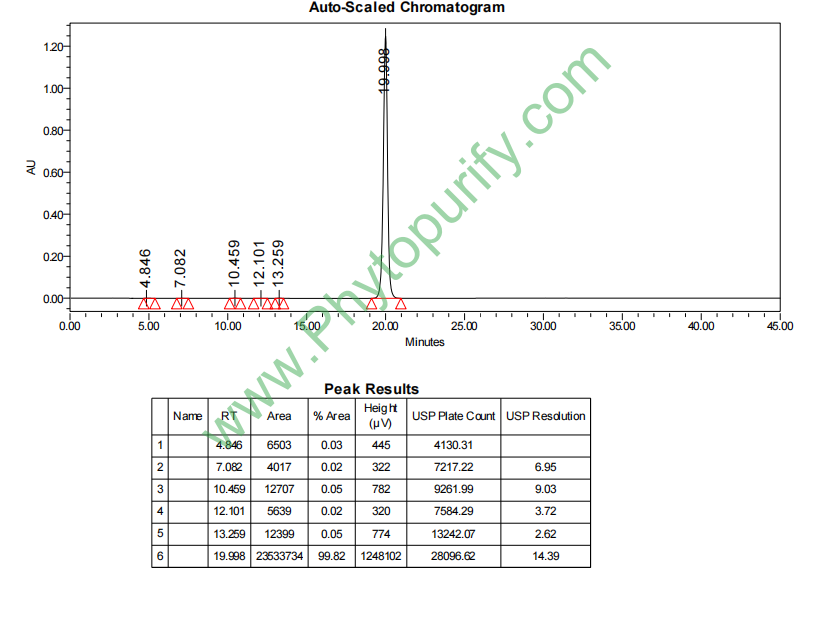
Purity: 95%~99%
Analysis Method: HPLC-DAD or/and HPLC-ELSD
Identification Method: Mass, NMR
Packing: Brown vial or HDPE plastic bottle
Can be supplied from milligrams to grams.
For Reference Standard and R&D, Not for Human Use Directly.
Inquire for bulk scale.
HPLC of Irisflorentin
Storage conditions:Short-term storage at 2~8℃, long-term storage at -20 ~ -80℃
Irisflorentin (CAS number: 41743-73-1) is a natural flavonoid compound mainly found in the traditional Chinese medicine Belamcanda chinensis. As an important active ingredient in Shegan, Irisin has attracted widespread attention due to its diverse biological activities. In recent years, with the in-depth development of natural product pharmacology, secondary iris flavin has shown unique pharmacological potential in anti-inflammatory, anti-tumor and other fields, especially in the treatment of breast cancer and other malignant tumors. This article will provide a systematic review of the chemical structure and physicochemical properties, plant sources and extraction methods, pharmacological activity and mechanism of action, pharmacological evaluation and pharmacokinetic characteristics of iridoid, and explore its clinical application prospects and future research directions, aiming to provide scientific basis and theoretical support for the development and utilization of this natural product.
Irisin belongs to the class of isoflavones, with a molecular formula of C23H22O6 and a molecular weight of 386.3560. Its structural feature is a typical isoflavone skeleton, which includes a benzene ring, an isoflavone core, and multiple hydroxyl and methoxy substituents. These functional groups endow them with unique physicochemical properties and biological activity.
In terms of physicochemical properties, the LogP value of Irisin is 2.2666, indicating its moderate lipid solubility, which is beneficial for cell membrane penetration and in vivo distribution. The polar surface area (TPSA) is 85.59 Å ², indicating that it has a certain polarity that facilitates binding with biomolecules. The low water solubility (0.0029 mg/mL) suggests limited solubility in the aqueous phase, which poses a certain challenge for the development of its formulations. The high penetration ability of the blood-brain barrier indicates that it may affect central nervous system related diseases. The hERG channel inhibition experiment showed a negative result, indicating a low risk of cardiac toxicity. The Ames test value is 2.1, indicating a low risk of genotoxicity and meeting safety requirements.
Irisin is mainly found in the Iridaceae plant Belamcanda chinensis, which is a perennial herbaceous plant widely distributed in China, Japan, and the Korean Peninsula. Shegan rhizome is an important traditional Chinese medicine herb, which has the effects of clearing heat and detoxifying, resolving phlegm and stopping cough. As one of the main active ingredients in Shegan, the content and extraction purity of irisin directly affect the efficacy of the medicine.
The extraction methods mainly include solvent extraction and chromatographic separation. The commonly used solvents are methanol, ethanol, and their aqueous solutions. Ultrasonic assisted extraction or reflux extraction techniques are used to improve extraction efficiency. The extract was concentrated, separated, purified by silica gel column chromatography and high performance liquid chromatography (HPLC) to obtain high-purity irisin. In recent years, the application of supercritical fluid extraction and membrane separation technology has provided new ideas for improving extraction efficiency and purity. In addition, the seasonal and geographical differences in plant sources have a significant impact on the content of irisin in the secondary field, which needs to be controlled and optimized.
The pharmacological activities of Iris secundum flavin include anti-inflammatory, anti-tumor, antioxidant and immune regulation, especially in the study of breast cancer.
anti-inflammatory effect
Irisin can significantly inhibit the transcription and translation of inducible nitric oxide synthase (iNOS), reduce the production of nitric oxide (NO), and alleviate inflammatory reactions. Its anti-inflammatory mechanism is closely related to the regulation of the NF - κ B signaling pathway, which can inhibit the expression of pro-inflammatory factors and alleviate tissue inflammatory damage.
Antitumor activity
In the breast cancer cell model, iristein showed the effects of inhibiting cell proliferation, inducing apoptosis and inhibiting tumor metastasis. Its anti-tumor effect involves the regulation of multiple signaling pathways, including activating the AMPK (PRKAA1) pathway, inhibiting the expression of STAT3 and BCL2, regulating the activity of estrogen receptor beta (ESR2), inhibiting multidrug resistance related proteins ABCB1 and ABCG2, reducing protein kinase C alpha (PRKCA) and matrix metalloproteinase 2 (MMP2) activity, inhibiting microtubule associated protein Tau (MAPT) and lymphocyte specific protein tyrosine kinase (LCK) expression, thus exerting a comprehensive anti-cancer effect.
Antioxidant and immune regulation
Irisin can alleviate oxidative stress damage by clearing free radicals and enhancing antioxidant enzyme activity. At the same time, it has a regulatory effect on immune cell function, promotes immune system homeostasis, and contributes to disease prevention and treatment.
The multi-target mechanism of action of Irisin provides a molecular basis for its pharmacological activity. Research on breast cancer has revealed its key targets and signaling pathways:
In addition, Irisin can inhibit the production of iNOS and NO, alleviate the inflammatory microenvironment, and help block the inflammatory driving process of tumors.
The secondary wild irisin has a good medicinal basis. Its molecular weight is moderate (386.3560), meeting the drug affinity requirements of Lipinski rule. The LogP value is 2.2666, indicating moderate lipid solubility, which is beneficial for cell membrane penetration and in vivo distribution. The TPSA is 85.59 Å ², indicating that its polarity is moderate and favorable for binding to target proteins.
The low water solubility (0.0029 mg/mL) is the main bottleneck in the development of its formulation, and its bioavailability needs to be improved through techniques such as nanocarriers, liposomes, or solid dispersions. The high penetration ability of the blood-brain barrier suggests its potential use in the treatment of central nervous system diseases, but at the same time, attention should be paid to potential central toxicity risks.
In terms of safety, the hERG channel inhibition test was negative, indicating a low risk of cardiac toxicity. The Ames test results show low genotoxicity risk and meet drug safety requirements. There is limited research on the pharmacokinetics of Irisin in vivo, and preliminary data suggests that its oral bioavailability is limited. Metabolism in vivo mainly occurs through the liver enzyme system, and the metabolites and their activities still need further investigation.
As a natural flavonoid with multiple targets and functions, Irisin has broad clinical application potential. Its anti-tumor activity is particularly prominent in the treatment of breast cancer. In the future, it can be used as an auxiliary treatment drug, combined with existing chemotherapy or targeted drugs, to overcome drug resistance and improve the therapeutic effect. In addition, its anti-inflammatory and immune regulatory effects provide new ideas for the treatment of chronic inflammatory diseases and immune related diseases.
In the process of clinical translation, it is necessary to focus on addressing the low water solubility and bioavailability of secondary irisin, and to improve its in vivo stability and targeting through innovative drug formulations. Meanwhile, pharmacokinetic and toxicological studies of the system are the foundation of clinical applications, requiring large-scale animal experiments and preclinical research.
Future research should focus on:
1. The mechanism of interaction between secondary iris flavin and key targets of breast cancer, using structural biology and computational simulation to deepen understanding;
2. Optimize the extraction and purification process to ensure the quality of raw materials and batch consistency;
3. Develop efficient and safe drug delivery systems to improve drug delivery efficiency;
4. Evaluate its therapeutic potential in other types of tumors and inflammatory diseases;
5. Conduct clinical trials to verify its safety and effectiveness.
As an important flavonoid active ingredient in Shegan, Irisin has shown great potential for drug development due to its multi-target regulation and significant anti-inflammatory and anti-tumor activities. Its unique molecular structure and physicochemical properties provide the basis for pharmacological effects, and pharmacological evaluation shows that it has the potential to become a clinical candidate drug. In the future, through in-depth mechanism research, preparation optimization and clinical verification, ciwild iris flavin is expected to become a new natural drug for the treatment of breast cancer and related diseases, and make an important contribution to the development of natural product pharmacology.
