


Product name: irigenin
Synonym name: 3′,5,7-Trihydroxy-4′,5′,6-trimethoxyisoflavone
Catalogue No.: BP0767
Cas No.: 548-76-5
Formula: C18H16O8
Mol Weight: 360.318
Botanical Source: Belamcanda chinensis (L.)DC.
Physical Description:
Type of Compound: Flavonoids
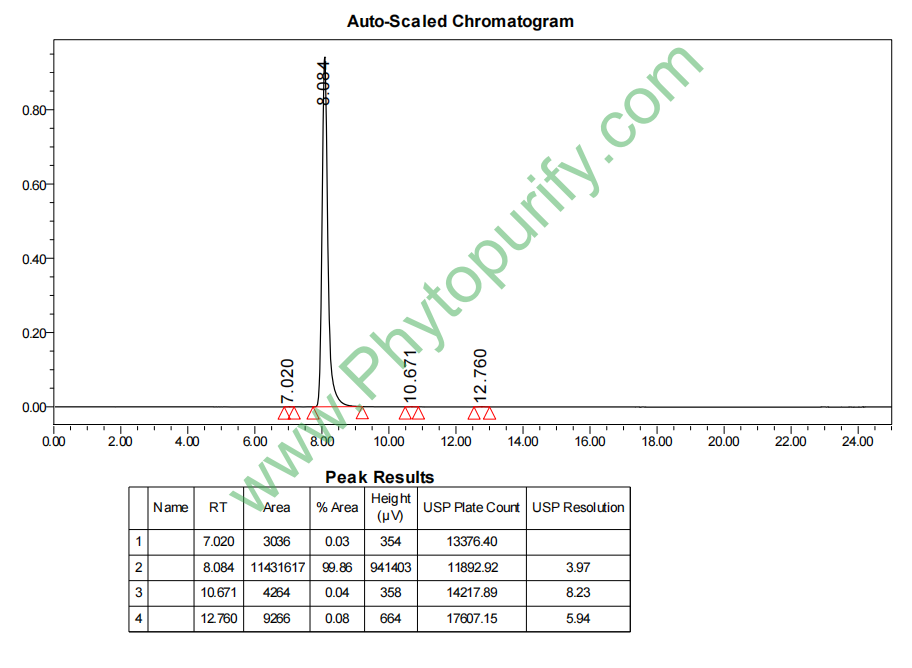
Purity: 95%~99%
Analysis Method: HPLC-DAD or/and HPLC-ELSD
Identification Method: Mass, NMR
Packing: Brown vial or HDPE plastic bottle
Storage: Store in a well closed container, protected from air and light. Put into refrigerate or freeze for long term storage.
Whenever possible, you should prepare and use solutions on the same day. However, if you need to make up stock solutions in advance, we recommend that you store the solution as aliquots in tightly sealed vials at -20℃. Generally, these will be useable for up to two weeks.
The product could be supplied from milligrams to grams
Inquire for bulk scale.
Chengdu Biopurify Phytochemicals Ltd. is a leading company in the research, development, manufacture and marketing of High Quality Phytochemicals and Extracts(especially Active Ingredients from Traditional Chinese Medicine,TCM), Natural Active Pharmaceutical Ingredients worldwide.
The main services:
A. Supply active ingredients and reference standards of TCM, from mgs to kgs scale
B. Custom extraction and purification, target Herb Active Ingredients
C. Custom synthesis and semi-synthesis for Natural Active Ingredients
D. CR(contract research), CM(contract manufacture) and PD(process development) services from lab scale, pilot scale to commercial scale(GMP is also available)
E. TCM compounds library for drug screen,more than 3000 compounds available, many of them are rare and unique.
HPLC of irigenin
Storage conditions:Short-term storage at 2~8℃, long-term storage at -20 ~ -80℃
118.5900
2.1208
1.8033
.0211
4.2188
35.4888
Low
89.6383
2.6731
Yes
No
Yes
No
Yes
Yes
1.2
No
No
No
No
Irigenin (CAS number: 548-76-5) is a natural flavonoid compound with significant biological activity, mainly isolated from plants in the Iridaceae family. In recent years, with the development of natural product pharmacology, irisin has gradually become a research hotspot in the field of anti-cancer drug development due to its unique molecular structure and multi-target regulatory ability. Especially in inhibiting tumor metastasis and promoting tumor cell apoptosis, it has shown great potential, demonstrating its value as an anti-cancer lead compound.
This review systematically summarizes the chemical structure and physicochemical properties, plant sources and extraction methods, pharmacological activity and mechanism of action, pharmacological evaluation and pharmacokinetic characteristics of wild irisin, and explores its potential prospects in clinical applications, aiming to provide theoretical basis and reference for further research and development of this compound.
Irisin belongs to the flavonoid class, with a molecular formula of C20H16O7 and a molecular weight of 360.3180. Its structural features include a typical flavonoid skeleton with multiple hydroxyl and methoxy substituents, endowing it with strong biological activity. Wild irisin exerts its anti metastatic effect by specifically and selectively blocking the α 9 β 1 and α 4 β 1 integrin binding sites on the C-C loop of the Extra Domain A (EDA) domain.
In terms of physicochemical properties, the LogP value of wild irisin is 2.1208, indicating that it has moderate lipid solubility and is beneficial for cell membrane permeability. Its topological polar surface area (TPSA) is 118.5900, indicating strong polarity characteristics that may affect its absorption and distribution. Low water solubility (0.0211 mg/mL) suggests limited solubility in vivo and may need to be improved through pharmaceutical methods. The low permeability of the blood-brain barrier suggests its limited distribution in the central nervous system. The negative result of hERG channel inhibition experiment indicates a low risk of cardiac toxicity. The Ames test result is 1.2, indicating a low risk of genotoxicity.
Wild kite tail flavonoids are mainly found in plants of the Iridaceae family, such as the rhizomes and flowers of the wild iris (Iris spp.). Traditional Chinese medicine plants of the Iris genus are widely used due to their diverse medicinal values, and modern research has found that one of their active ingredients is wild irisin.
The extraction method often uses solvent extraction combined with column chromatography separation technology. The general steps include:
In recent years, the application of supercritical CO2 extraction and membrane separation technology has also provided new ideas for the efficient extraction of wild irisin, significantly improving the extraction purity and yield.
Wild kite tail flavonoids exhibit significant anti-cancer activity in various tumor models. Its main functions include inhibiting tumor cell proliferation, inducing apoptosis, inhibiting tumor metastasis, and enhancing chemotherapy sensitivity.
Promotion of apoptosis in gastric cancer cells
Research has shown that wild irisin significantly increases the apoptosis rate induced by TRAIL (tumor necrosis factor related apoptosis inducing ligand) by enhancing the expression of pro apoptotic molecules in gastric cancer cells. The mechanism involves activating the mitochondrial pathway, regulating the balance of Bcl-2 family proteins, and promoting programmed cell death.
Tumor metastasis inhibition
Wild irisin specifically blocks the binding sites of α 9 β 1 and α 4 β 1 integrins in the EDA domain, inhibiting the interaction between tumor cells and matrix, blocking cell migration and invasion processes, and exerting anti metastatic effects.
Regulation of lung cancer-related targets
In lung cancer models, wild irisin regulates multiple key molecular targets, including anti apoptotic protein BCL2, transporter protein ABCA1, immune regulatory receptor TLR4, signal transduction factor STAT3, estrogen receptor ESR2, microtubule associated protein MAPT, matrix metalloproteinase MMP2, PI3K family member PIK3CG, transcription factor RELA, and MAPK1, synergistically regulating the survival, proliferation, and metastasis of tumor cells.
In addition to anti-cancer effects, wild irisin also exhibits certain anti-inflammatory and antioxidant activities, which may provide support for its multi-target and multifunctional pharmacological properties by regulating immune response and oxidative stress pathways.
The anticancer mechanism of wild irisin is complex and diverse, mainly involving the following aspects:
Inhibition of integrin signaling pathway
Wild irisin specifically blocks the binding sites of α 9 β 1 and α 4 β 1 integrins on the C-C loop of the EDA domain, inhibiting adhesion and signal transduction between tumor cells and extracellular matrix, blocking cell migration and invasion, and suppressing tumor metastasis.
Activation of pro apoptotic signals
By upregulating pro apoptotic proteins (such as Bax and Caspase family) and downregulating anti apoptotic proteins (such as Bcl-2), irisin activates the mitochondrial pathway, enhances TRAIL induced cell apoptosis, and promotes programmed cell death of tumor cells.
Multi target signaling pathway regulation
Irisin regulates signaling pathways such as STAT3, MAPK1, and RELA (NF - κ B subunit), inhibits tumor cell proliferation and inflammatory response, and reduces the expression of oncogenes in the tumor microenvironment.
Inhibition of matrix degrading enzymes
Inhibit the activity of MMP2, reduce extracellular matrix degradation, and block tumor cell invasion and metastasis processes.
Immune regulatory effect
By regulating the TLR4 signaling pathway, irisin may modulate tumor associated immune responses and enhance anti-tumor immune surveillance.
The pharmacological parameters of wild irisin indicate that it has certain potential for development:
At present, there is limited pharmacokinetic data on wild irisin. Preliminary studies have shown that its oral absorption is slow, its bioavailability is limited, and its metabolism in vivo is mainly through the liver enzyme system. Metabolites still need further identification. In the future, systematic pharmacokinetic and toxicological studies are needed to improve its drug development data.
Wild irisin, as a multi-target anti-cancer natural product, has broad clinical application potential. Its anti-tumor activity and metastasis inhibition in solid tumors such as gastric cancer and lung cancer provide a solid foundation for its development as an anti-cancer drug. Especially its ability to enhance TRAIL induced apoptosis provides the possibility for combination therapy strategies.
Future research directions include:
Optimization of dosage form and exploration of administration route
By using new formulation technologies such as nanocarriers and liposomes, the water solubility and bioavailability of the drug can be improved, and the drug release characteristics can be optimized.
Systematic pharmacokinetic and toxicological evaluation
Clarify its absorption, distribution, metabolism, and excretion (ADME) characteristics in the body and evaluate long-term safety.
Advance preclinical and clinical research
Using animal tumor models to verify its anti-tumor effect and safety, gradually conducting clinical trials to explore the therapeutic effects of monotherapy and combination therapy.
In depth analysis of molecular mechanisms
Utilize multi omics techniques to reveal its functional network, explore potential biomarkers, and guide personalized treatment.
Expansion of indications for multiple diseases
Explore its potential applications in other types of cancer and inflammation related diseases.
In summary, wild irisin has the potential to become a new type of anti-cancer drug, and in the future, multidisciplinary collaboration is needed to promote its transition from laboratory to clinical application.
Wild irisin, as a natural flavonoid compound derived from plants in the Iridaceae family, exhibits excellent pharmacological activity and potential for drug development due to its unique structure and multi-target anticancer mechanism. It blocks the binding site of EDA domain integrin, inhibits tumor metastasis, enhances the expression of pro apoptotic molecules, promotes tumor cell apoptosis, and provides new ideas and strategies for anti-cancer therapy.
Although preliminary progress has been made in the research of wild irisin, its pharmacokinetic characteristics, long-term safety, and clinical efficacy still need further systematic evaluation. In the future, through dosage form improvement, mechanism research, and clinical validation, it is expected to promote wild irisin as a new anti-cancer drug for clinical application, bringing new treatment options for cancer patients.
With the continuous advancement of natural product pharmacology and modern drug development technology, the research on wild irisin will provide valuable experience and theoretical support for the development of natural product anticancer drugs, and help achieve the successful transformation of natural products into clinical drugs.
