


Synonym name:
Catalogue No.: BP0758
Cas No.: 56725-99-6
Formula: C27H30O11
Mol Weight: 530.526
Botanical Source: Epimedium grandiflorum and Epimedium macranthum
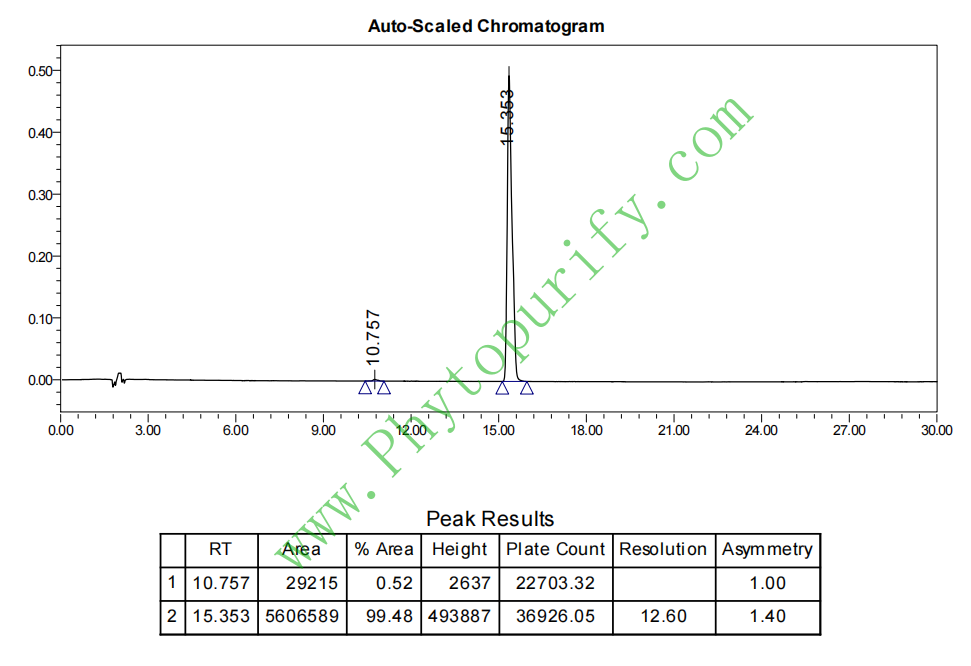
Purity: 95%~99%
Analysis Method: HPLC-DAD or/and HPLC-ELSD
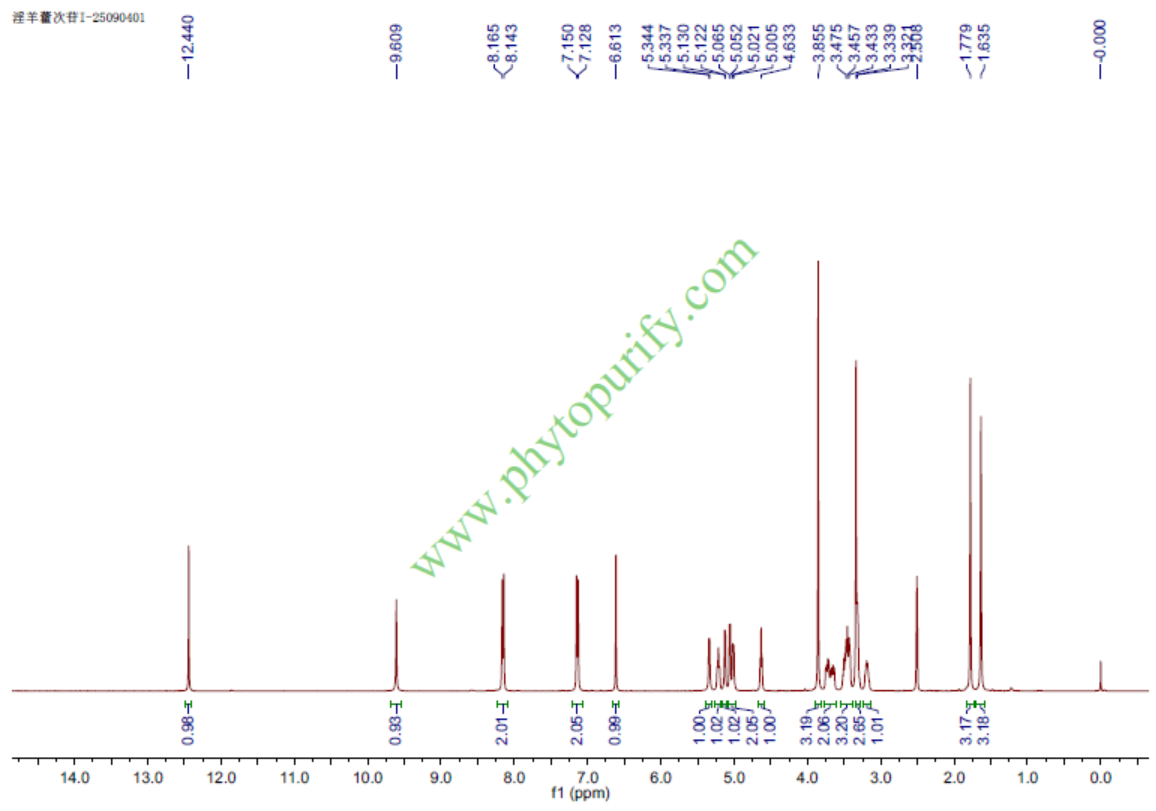
Identification Method: Mass, NMR
Packing: Brown vial or HDPE plastic bottle
Can be supplied from milligrams to grams.
For Reference Standard and R&D, Not for Human Use Directly.
Inquire for bulk scale.
Description:
Icariside I is a metabolite product of Icariin.
References:
J Cell Physiol. 2013 Mar;228(3):513-21.
Functions and action mechanisms of flavonoids genistein and icariin in regulating bone remodeling.
METHODS AND RESULTS:
Icariin, a prenylated flavonol glycoside isolated from Epimedium herb, stimulates osteogenic differentiation of BMSCs and inhibits bone resorption activity of osteoclasts. Icariin, whose metabolites include Icariside I, Icariside II, icaritin, and desmethylicaritin, has no estrogenic activity. However, icariin is more potent than genistein in promoting osteogenic differentiation and maturation of osteoblasts. The existence of a prenyl group on C-8 of icariin molecular structure has been suggested to be the reason why icariin is more potent than genistein in osteogenic activity.
CONCLUSIONS:
Thus, the prenylflavonoids may represent a class of flavonoids with a higher osteogenic activity.
HPLC of Icariside I
HNMR of Icariside I
Storage conditions:Short-term storage at 2~8℃, long-term storage at -20 ~ -80℃
179.2800
1.6018
1.5396
.6693
.6011
.2542
Low
85.9195
4.1687
Yes
No
Yes
No
No
No
0.6
Yes
No
Yes
No
Osteoporosis is a systemic bone disease characterized by reduced bone mass, destruction of bone microstructure, and increased bone fragility. It is the main cause of increased fracture risk in middle-aged and elderly people, especially postmenopausal women. With the increasing aging of the global population, osteoporosis and related fractures have become a major public health issue. At present, although first-line treatment drugs such as bisphosphonates and selective estrogen receptor modulators are effective, long-term use may be accompanied by side effects such as mandibular necrosis, atypical femoral fractures, and cardiovascular risks. Therefore, the development of new, safe, and multi-target anti osteoporosis drugs is currently a hot research topic.
Natural products have always been an important treasure trove for drug discovery due to their structural diversity and multi-target properties. Epimedium spp., as a traditional Chinese medicine for tonifying the kidneys and strengthening bones, has been widely proven to have anti osteoporosis activity. Icariin is the main active flavonol glycoside component of Epimedium, but its oral bioavailability is low. It needs to be metabolized by gut microbiota and liver to become more active secondary glycosides or aglycones in vivo. Icariside I (CAS: 56725-99-6) is one of the key intestinal metabolites of icariin, which has attracted much attention in recent years due to its excellent oral bioavailability and significant multi effect pharmacological activity. Research shows that icariin I not only inherits the dual anti osteoporosis effect of parent compound to promote bone formation and inhibit bone absorption, but also shows regulatory potential in breast cancer, hepatotoxic mechanism, tumor immune escape and other fields, becoming a star small molecule compound connecting the wisdom of traditional Chinese medicine with modern molecular pharmacology. This article aims to systematically review the chemical characteristics, pharmacological activity, mechanism of action, and pharmacological properties of icariin I, providing a comprehensive scientific perspective for its in-depth research and clinical translation.
Epimedium glycoside I, chemical name 3,5,7-trihydroxy-4 '- methoxy-8- (3-methyl-2-butenyl) - flavone-3-O - α - L-rhamnoside, molecular formula C27H30O11, molecular weight 530.5260. Its structure can be regarded as the product of Icariin removing a glucose group, which is composed of a flavonoid glycoside element (Icariin) substituted with an isopentenyl group and a rhamnose linked by a glycosidic bond. This structural change significantly affects its physicochemical properties.
From the perspective of drug related parameters, its lipid water partition coefficient (LogP) is 1.6018, indicating that it has moderate lipophilicity and is conducive to transmembrane absorption. The topologically polar surface area (TPSA) is 179.2800 Å ², which is relatively high and mainly attributed to multiple hydroxyl groups and oxygen atoms on the sugar ring in the molecule, suggesting that it may have moderate membrane permeability. Its water solubility is 0.6693 mg/mL, which belongs to the category of slight solubility. This may limit its distribution in the body at high concentrations to some extent, but it also suggests that it has a certain hydrophilicity, which is beneficial for transport in body fluids. The molecular weight is slightly higher than 500, but still within the boundary range of the "five rules" of drug like substances. Overall, the physicochemical properties of icariin I are between hydrophilic and lipophilic. Compared to icariin, which has a larger molecular weight and stronger polarity, its smaller molecular weight and moderate LogP value are considered the key structural basis for its significantly improved oral bioavailability.
Epimedium glycoside I is not the original high content component in Epimedium plants, but mainly exists in trace amounts in the dried stems and leaves of Epimedium (such as Epimedium koreanum, Epimedium E. brevicornu, etc.). However, it is an important product of the metabolic transformation of its main active ingredient icariin both in vivo and in vitro.
There are mainly two ways to extract and prepare:
1. Direct extraction and separation of plants Extract from Epimedium herb. Usually, crude extracts are obtained by ethanol or methanol reflux extraction, ultrasound assisted extraction, and other methods. Then, technologies such as macroporous adsorption resin column chromatography, silica gel column chromatography, and preparative high-performance liquid chromatography (HPLC) are comprehensively used for separation and purification. Due to its extremely low content, this method has high cost and low yield, and is mainly used for the preparation of standard samples.
2. Biotransformation and Chemical Synthesis This is a more efficient and promising method for obtaining icariin I.
* biotransformation Using specific intestinal bacteria (such as certain strains of Bacteroidetes) or commercial enzymes (such as β - glucosidase) for selective deglycosylation of icariin, the terminal glucose group is hydrolyzed to efficiently and specifically prepare icariin I. This method has mild conditions, good stereoselectivity, and conforms to the concept of green chemistry.
* chemical synthesis Using icariin or simple flavonoids as starting materials, isopentenyl and rhamnose groups are introduced through chemical methods for total or semi synthesis. Chemical synthesis can achieve large-scale production, but the steps may be cumbersome and require addressing issues such as regioselectivity and stereoselectivity.
At present, the biotransformation method based on icariin is the main research direction for laboratory and potential industrial production of icariin I.
Epimedium glycoside I exhibits a wide and diverse range of pharmacological activities, and its research has expanded from the initial skeletal system to the fields of tumors, immunity, and metabolic diseases.
Anti osteoporosis activity This is the most core and distinctive pharmacological effect of icariin I. In a postmenopausal osteoporosis rat model induced by ovariectomy (OVX), oral administration of icariin I can significantly increase bone density, improve bone microstructure (such as increasing the number and thickness of bone trabeculae and reducing separation), and enhance biomechanical strength (such as maximum load and elastic modulus). Its function is characterized by "bidirectional regulation": on the one hand Promote osteoblast differentiation and bone formation Enhance the activity of osteoblasts and increase the expression of osteogenic markers such as osteocalcin and type I collagen; on the other hand Inhibit osteoclast differentiation and bone resorption Reduce the number of osteoclasts and decrease the area of bone resorption cavities. This dual mechanism of promoting formation and inhibiting absorption makes it theoretically superior to drugs with a single target of action.
Antitumor activity Epimedium I can inhibit proliferation, induce apoptosis and block invasion and metastasis of many tumor cells, especially breast cancer cells. In the study of breast cancer, it can effectively inhibit the proliferation and cloning of cell lines such as MCF-7 and MDA-MB-231 in vitro, and induce cell cycle arrest (such as G0/G1 phase) and apoptosis mediated by mitochondrial pathway. In addition, it can significantly reduce the migration and invasion of breast cancer cells, inhibit the growth of transplanted tumors and lung metastasis in vivo.
Immune regulation and tumor immune escape intervention The latest research has found that icariin I is Kyn AhR pathway of canine urea amino acid aromatic hydrocarbon receptor Effective inhibitors. Tumor cells metabolize tryptophan into kynurenine by overexpressing indoleamine 2,3-dioxygenase 1 (IDO1), which activates AhR on immune cells (such as T cells) in the tumor microenvironment, leading to depletion of effector T cell function and expansion of regulatory T cells (Treg), thereby mediating immune escape. Epimedium glycoside I reverses the immunosuppressive microenvironment and enhances anti-tumor immune response by blocking this pathway, providing a new strategy for immune adjuvant therapy.
Complex regulation of inflammasomes and hepatotoxicity Research suggests that icariin I has Dual role Under specific conditions (such as ATP or Nigericin stimulation), it can promote the production of mitochondrial reactive oxygen species (mtROS), which in turn Activate NLRP3 inflammasome, leading to the mature release of pro-inflammatory cytokines such as IL-1 β, which may be related to the reported Ultra heterogeneous hepatotoxicity Potential relevance. It is worth noting that this activation is specific and does not affect NLRC4 or AIM2 inflammasomes. This reveals the complexity of the action of icariin I, suggesting that its potential inflammatory risks and benefits need to be carefully evaluated in clinical applications.
The multiple pharmacological effects of icariin I stem from its networked regulation of multiple signaling pathways and molecular targets.
Core molecular network for anti osteoporosis:
Anti breast cancer action pathway: Its anti breast cancer effect is mainly related to inhibition IL-6/STAT3 The signaling pathway is closely related. Epimedium glycoside I can downregulate the production of IL-6, inhibit the phosphorylation (activation) and nuclear translocation of STAT3, thereby suppressing the expression of downstream pro proliferative (such as Cyclin D1), anti apoptotic (such as Bcl-2, Survivor), and pro metastatic (such as MMP-2, MMP-9, VEGF) genes regulated by STAT3.
Precise targets for immune regulation As mentioned earlier, icariin I directly or indirectly Inhibit the activation of AhR It may release AhR mediated immune suppression, restore the killing function of CD8+T cells, and inhibit the immunosuppressive activity of Treg cells by competitively binding to AhR or interfering with the production and signaling of upstream Kyn.
Potential mechanism of inflammasome activation Its promoting effect on NLRP3 inflammasome activation may be related to its interference with mitochondrial function and increased mtROS Release related. MtROS, as an important danger signal, can directly trigger the oligomerization and activation of NLRP3. This mechanism is an important molecular basis for its potential hepatotoxicity, but it may also be re examined in certain pathological contexts that require immune activation, such as anti infection.
Epimedium glycoside I exhibits significant advantages in medicinal properties, especially in comparison to the parent compound icariin.
Epimedium glycoside I, as a multi-target, orally effective natural small molecule, has broad clinical application prospects but also faces challenges.
Main application directions:
Challenges faced and future research directions:
Epimedium glycoside I, as a key in vivo metabolite of the active ingredient of traditional Chinese medicine Epimedium, is a successful example of modern Chinese medicine research. It successfully links traditional benefits (kidney tonifying and bone strengthening) with modern molecular pathology (osteoporosis, tumors, immune evasion). Its outstanding oral activity, clear dual anti osteoporosis effect, and emerging anti-tumor immune regulatory function make it a highly valuable candidate drug molecule for development. However, the complexity of its mechanism of action, particularly the potential hepatotoxicity risk associated with NLRP3 inflammasome activation, has sounded an alarm for future research. The value of scientific research lies not only in revealing its therapeutic potential, but also in comprehensively and objectively understanding its risks. In the future, through interdisciplinary cooperation, we will deeply analyze the "double-edged sword" characteristics of icariin I and optimize its drug delivery strategy, which is expected to transform it into a safe and effective new therapeutic drug, providing new options for the prevention and treatment of major diseases such as osteoporosis and breast cancer, and also providing important ideas for the research and development of innovative drugs based on natural product metabolites.
