Introduction/Overview
Natural products have long been an important treasure trove for innovative drug discovery, among which pentacyclic triterpenoids have attracted much attention due to their wide range of biological activities. Lupeol acetate (CAS number: 1617-68-1), as an acetylated derivative of lupeol, is an important member of this family. Fendouchun is widely present in various fruits, vegetables, and medicinal plants, and has been proven to have multiple pharmacological activities such as anti-inflammatory, antioxidant, antibacterial, and anti-tumor effects. However, structural modifications such as acetylation of lupinol can often significantly alter its physicochemical properties and biological activity, and even endow it with new characteristics that its parent compound does not possess.
Fenfanol acetate is such a derivative with unique value. Research has shown that it not only retains some of the beneficial activities of coumarin, but also exhibits stronger efficacy or unique mechanisms in anti-inflammatory, antibacterial, antiparasitic (such as Trypanosoma), and anti-tumor effects. What is particularly noteworthy is its significant therapeutic effect in autoimmune inflammatory disease models such as rheumatoid arthritis, as well as its reversible inhibitory effect on the male reproductive system, which opens up potential therapeutic applications and new directions for contraceptive research. Despite the challenges in developing its pharmacological properties, in-depth exploration of its multi-target mechanism of action is expected to provide key lead compounds for the development of novel, efficient, and low toxicity therapeutic drugs. This article aims to provide a systematic review of the chemical properties, plant sources, pharmacological activities, mechanisms of action, and medicinal properties of coumarin acetate, and to explore its clinical application prospects.
Chemical structure and physicochemical properties
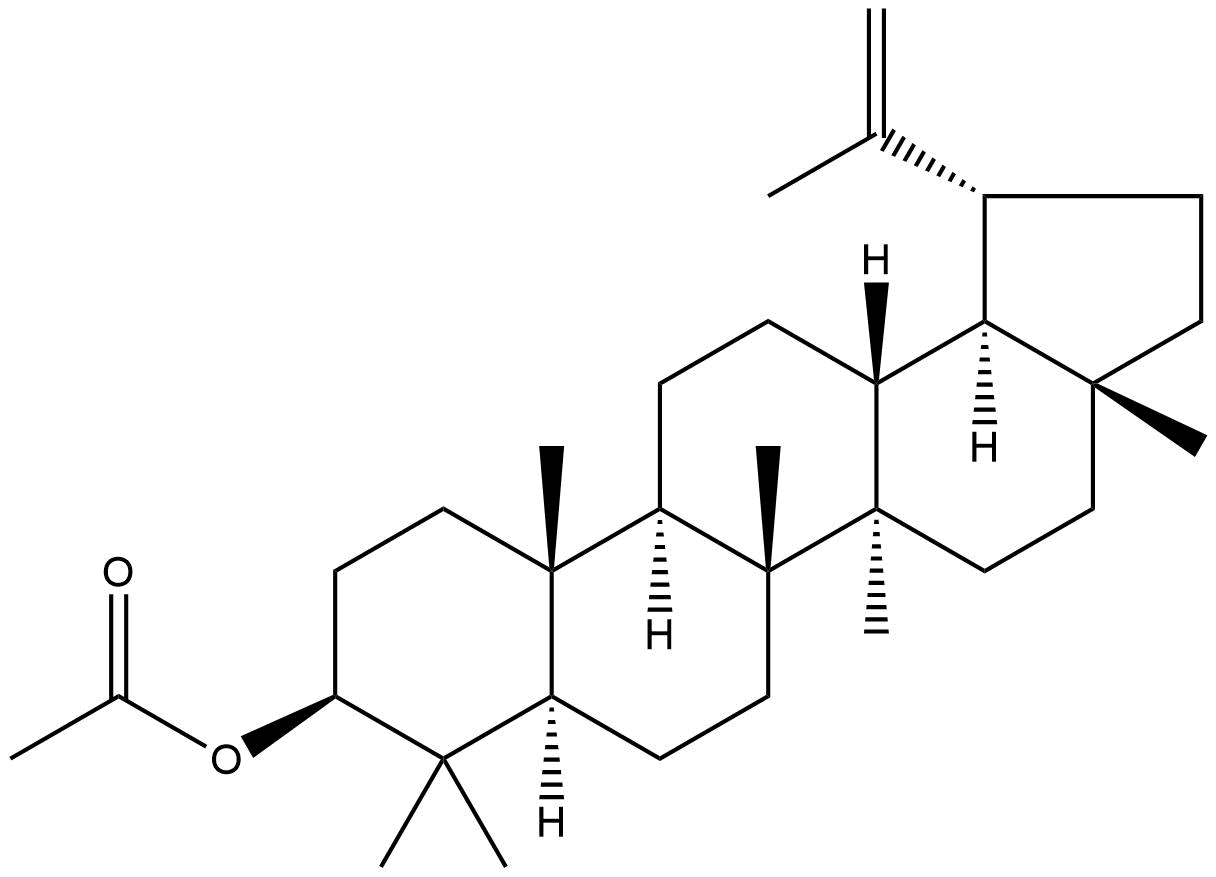
The chemical name of lupenol acetate is (3 β) - Lup-20 (29) - en-3-yl acetate, with a molecular formula of C ∝₂ H ₅₂ O ₂ and a molecular weight of 468.7660. Its chemical structure is based on the Lupane type pentacyclic triterpenoid skeleton, with a core structure consisting of five fused rings (four hexagonal rings and one pentagonal ring). Compared with coumarin, its structural feature is that the hydroxyl group (- OH) at the C-3 position is replaced by an acetoxy group (- OCOCH ∝). This seemingly minor modification has a profound impact on its physicochemical properties and biological activity.
From the analysis of physical and chemical properties, coumarin acetate exhibits typical lipophilic characteristics. Its calculated lipid water partition coefficient (LogP) is as high as 8.7471, indicating its strong hydrophobicity. The topologically polar surface area (TPSA) is only 26.30 Å ², further confirming its low molecular polarity. These data directly determine its extremely low water solubility, about 0.0002 mg/mL, which belongs to compounds that are almost insoluble in water. High lipophilicity also means that it is easy to penetrate cell membranes and may have a higher tissue distribution volume. It is worth noting that its blood-brain barrier (BBB) penetration is predicted to be "high", indicating that the compound may act on central nervous system targets, providing a chemical basis for its application in neuropathic pain or central nervous system related inflammatory diseases. In the preliminary safety screening, the hERG inhibition prediction was "no", and the Ames test prediction value was 0.0, indicating a low potential risk of arrhythmia and genetic toxicity, providing favorable early safety signals for its further development.
Plant sources and extraction methods
Fenfanol acetate is not a widely abundant natural product, but is commonly found in various plants as a byproduct or transformation product of Fenfanol. The main sources of plants include:
1. Leguminous plants Like the feather bean genus(Lupinus Plant (spp.) is one of the sources of its name.
2. Solanaceae plants Like chili peppers(Capsicum annuum)The fruit.
3. Euphorbiaceae plants Like various Euphorbia species(Euphorbia)Plants.
4. Other medicinal plants In Mango(Mangifera indica)Skin, birch bark, and some traditional medicinal plants such as Crateva nurvala There have also been reports in waiting.
The extraction of coumarin acetate from plant materials usually follows the general extraction and separation process for natural triterpenoids. The main steps include:
1. Extract Organic solvent cold impregnation, hot reflux, or Soxhlet extraction methods are commonly used. Due to the strong lipophilicity of the target compound, commonly used solvents include chloroform, dichloromethane, ethyl acetate, or methanol chloroform mixed solvents in different proportions. Modern technologies such as ultrasound assisted extraction and microwave-assisted extraction can improve extraction efficiency.
2. Separation and Purification After the crude extract is preliminarily enriched by solvent stepwise extraction (commonly using n-hexane, ethyl acetate, etc.), it mainly relies on chromatographic techniques for separation. Silica gel column chromatography is the most commonly used method for separation using solvent systems of different polarities, such as n-hexane ethyl acetate gradient elution. Thin layer chromatography (TLC) is used to monitor the separation process. To further obtain high-purity samples, it is often necessary to perform repeated column chromatography or use high-performance liquid chromatography (HPLC), especially preparative HPLC.
3. appraisal The purified compound was structurally confirmed by nuclear magnetic resonance (¹ H NMR, ¹ ³ C NMR), mass spectrometry (MS), infrared spectroscopy (IR), and comparison with standard samples (such as Rf value of TLC and HPLC retention time).
In addition, considering the relatively abundant resources of coumarin, the chemical semi synthesis method using coumarin as raw material and esterification reaction with acetic anhydride or acetyl chloride under alkaline conditions is a more direct and controllable way to obtain coumarin acetate.
Pharmacological activity research
A large number of in vitro and in vivo pharmacological studies have revealed a broad spectrum of biological activities of coumarin acetate, with its core activities focused on anti-inflammatory, anti infective, and anti-tumor fields.
-
anti-inflammatory activity This is one of the most extensively studied activities of lupine alcohol acetate. In various animal models of acute and chronic inflammation, such as carrageenan induced paw edema in rats, cotton ball induced granulomas, and Freund's complete adjuvant (CFA) - induced arthritis models, coumarin acetate has shown significant anti-inflammatory effects, often superior to its parent compound coumarin. It can effectively reduce tissue swelling, inflammatory cell infiltration, and joint damage.
-
Antibacterial and antiparasitic activity Research has shown that coumarin acetate has inhibitory effects on various Gram positive and Gram negative bacteria. What is more noteworthy is its anti trypanosomal activity, which can cause Chagas disease in vitro against Trypanosoma cruzi(Trypanosoma cruzi)And the Brucella parasite that causes African sleeping sickness(Trypanosoma brucei)It exhibits inhibitory effects, indicating its potential as a lead structure for novel antiparasitic drugs.
-
Antitumor activity Lupin alcohol acetate has growth inhibition and apoptosis promoting effects on a variety of cancer cell lines, including breast cancer, prostate cancer, colon cancer and leukemia cells. Its function involves inhibiting cell proliferation, inducing cell cycle arrest, and activating apoptotic pathways.
-
The impact on the reproductive system A unique pharmacological discovery is that coumarin acetate can significantly inhibit spermatogenesis in male rats. Long term administration can lead to changes in the structure of testicular seminiferous tubules, a decrease in sperm quantity and quality, and ultimately reversible infertility. This effect makes it a potential candidate molecule for studying male contraceptive pills.
-
Other activities There are also studies reporting its analgesic, antioxidant, and liver protective activities.
Mechanism of action and molecular targets
The multiple pharmacological activities of coumarin acetate stem from its regulation of multiple signaling pathways within cells, and its mechanism of action exhibits multi-target characteristics, especially in the field of anti-inflammatory mechanism research, which is relatively systematic.
-
Regulating inflammatory signaling pathways:
- Inhibition of NF - κ B pathway NF - κ B is the core transcription factor of inflammatory response. Fenfanol acetate can inhibit IKBKB (I κ B kinase β), prevent phosphorylation and degradation of I κ B protein, thereby inhibiting nuclear translocation of NF - κ B subunit RELA (p65), and ultimately downregulating gene expression of various pro-inflammatory factors (such as TNF - α, IL-6) and enzymes (such as NOS2/iNOS, PTGS1/COX-1).
- Regulating the JAK/STAT pathway This pathway is crucial in chronic inflammation and autoimmune diseases. Fenfanol acetate can inhibit the phosphorylation of STAT3 activated by cytokines such as IL-6, blocking the downstream transmission of pro-inflammatory and pro proliferative signals.
- Inhibit inflammasome activation Research has shown that it can inhibit the activation of CASP1 (cysteine protease-1). CASP1 is a key effector protein of NLRP3 inflammasome, responsible for cleaving IL-1 β and IL-18 precursors into active forms, playing a critical role in diseases such as rheumatoid arthritis.
- Affects pain perception Its analgesic effect may be related to regulating transient receptor potential channels, such as inhibiting the activity of TRPV1 and TRPA1 channels, which are involved in signal transduction of inflammatory and neuropathic pain.
-
Mechanism of anti-tumor action:
- In addition to creating a microenvironment that is detrimental to tumor growth through anti-inflammatory mechanisms such as inhibition of NF - κ B and STAT3, coumarin acetate can also directly induce tumor cell apoptosis, which may involve activation of mitochondrial and death receptor pathways.
- It can also inhibit the expression of vascular endothelial growth factor (VEGF), which may suppress tumor angiogenesis.
-
Mechanisms affecting spermatogenesis:
- The specific molecular targets that lead to male infertility are not fully understood, but may involve interfering with hormone levels in the hypothalamic pituitary gonadal axis, or directly acting on testicular Sertoli cells and stromal cells, affecting testosterone synthesis and the reproductive microenvironment. It may also be achieved by inducing apoptosis of germ cells.
In summary, coumarin acetate forms a synergistic network by acting on multiple targets such as IL-6, STAT3, CASP1, TRPV1, RELA, PTGS1, TNF, TRPA1, IKBKB, NOS2, etc., thereby exerting strong anti-inflammatory and immune regulatory effects.
Evaluation of drug properties and pharmacokinetics
Although the pharmacological activity of coumarin acetate is significant, its medicinal properties face clear challenges, mainly due to its extreme physicochemical properties.
-
Absorption, distribution, metabolism, excretion (ADME):
- absorb High lipophilicity (high LogP) is beneficial for its passive transmembrane absorption, but its extremely low water solubility severely limits its dissolution in gastrointestinal fluids, which may lead to low and unstable oral bioavailability.
- distribution High lipophilicity and predicted high blood-brain barrier penetration mean that it is easily distributed to organs such as adipose tissue, liver, and brain, and may have a large distribution volume.
- Metabolism As an ester compound, coumarin acetate is likely to be rapidly hydrolyzed by esterases (such as carboxylesterases) in the body, converting into coumarin and acetic acid. This is its main metabolic pathway and a key factor in the complexity of its pharmacological and pharmacokinetic behavior. Its pharmacological effects may be partially attributed to its prototype and partially attributed to its metabolite, coumarin.
- excretion Metabolites may be excreted through bile or urine. There is limited research on the excretion pathways of prototype drugs.
-
Challenges and Strategies in Drug Development:
- Main challenges The extremely low water solubility and potential metabolic instability are the two major bottlenecks restricting its development. Low solubility affects formulation development and in vivo exposure levels; Easy hydrolysis by esterases may lead to strong first pass effects, short half-life, and difficulty in distinguishing whether the efficacy comes from the prototype drug or metabolites.
- improvement strategy:
- Formulation technology The adoption of advanced drug delivery systems is the key to improving its drug efficacy. For example, the production of nanocrystals, liposomes, micelles, or solid dispersions can significantly increase their solubility and dissolution rate, thereby improving oral bioavailability.
- Structural modification On the premise of retaining core pharmacological activity, further modifications can be made to the molecule, such as introducing hydrophilic groups or preparing prodrugs, to optimize its LogP and water solubility, or designing stable derivatives that can resist esterase hydrolysis.
- route of administration Developing local drug delivery formulations (such as intra-articular injections or transdermal formulations for arthritis) or injectable emulsions can bypass barriers to oral absorption and first pass metabolism.
At present, there is still a relative lack of complete preclinical pharmacokinetic research data on the lupine acetate system, which is an urgent gap that needs to be filled in its drug conversion process.
Clinical application prospects and prospects
The multi-target and multi activity properties of lupine alcohol acetate bring potential application prospects in multiple therapeutic fields, but also indicate the direction of future research.
-
Potential clinical applications:
- Chronic inflammatory diseases Based on its powerful multi-target anti-inflammatory mechanism, it has outstanding potential in the treatment of diseases such as rheumatoid arthritis, osteoarthritis, and inflammatory bowel disease. Its inhibitory effect on osteoclastogenesis is particularly beneficial for preventing and treating bone destruction in arthritis.
- pain management By acting on pain related ion channels such as TRPV1/TRPA1, new analgesics can be developed for the treatment of inflammatory pain and neuropathic pain.
- neoadjuvant therapy Can be used as an adjuvant to chemotherapy or radiotherapy, utilizing its anti-inflammatory, anti proliferative, and pro apoptotic properties to enhance efficacy or reduce treatment-related side effects. Its inhibition of tumor stem cell related pathways such as STAT3 is also worthy of attention.
- Male contraception The reversible inhibition of spermatogenesis provides a unique research direction for the development of non hormonal male contraceptives.
- anti-infection In the field of treating drug-resistant bacterial infections and parasitic diseases (such as trypanosomiasis), it can serve as a new lead compound for in-depth development.
-
Future research prospects:
- Deep exploration of mechanisms Further use of chemical biology methods (such as affinity fishing, molecular docking and validation) is needed to clarify its direct target proteins and draw more accurate signal network maps.
- Comprehensive preclinical development Systematic pharmacokinetic and toxicological studies must be conducted to clarify its therapeutic window, long-term toxicity, and reproductive toxicity (with particular attention to the reversibility and safety details of its contraceptive effects).
- Formulation innovation Developing new formulations that can achieve stable delivery and improve bioavailability in response to its physical and chemical defects is the core step in promoting its clinical application.
- structural optimization Using coumarin acetate as the lead, a rational structural optimization was carried out with the aim of maintaining or enhancing activity while significantly improving its water solubility and metabolic stability, in order to obtain more drug candidates.
- Explore combination therapy Studying its synergistic effect with existing standard therapeutic drugs may lead to the discovery of more effective treatment plans.
Conclusion
As a pentacyclic triterpenoid derivative derived from natural products, coumarin acetate has become an attractive lead compound for drugs due to its extensive pharmacological activities, especially its strong anti-inflammatory and immune regulatory abilities demonstrated by acting on multiple pathways such as NF - κ B, STAT3, and inflammasomes. Its significant therapeutic efficacy in rheumatoid arthritis models, as well as its special effects on the male reproductive system, reveal its diverse therapeutic potential. However, its extreme lipophilicity, low water solubility, and susceptibility to esterase metabolism constitute the main obstacles to its conversion into drugs. Future research should focus on overcoming these drug bottlenecks through pharmaceutical innovation and rational drug chemical modifications, supplemented by in-depth mechanism of action studies and systematic preclinical evaluations. Only in this way can lupine acetate be truly transformed from a potential natural molecule into a new type of drug that can be used for clinical treatment, providing new treatment options for inflammatory diseases, tumors, reproductive health, and other fields.