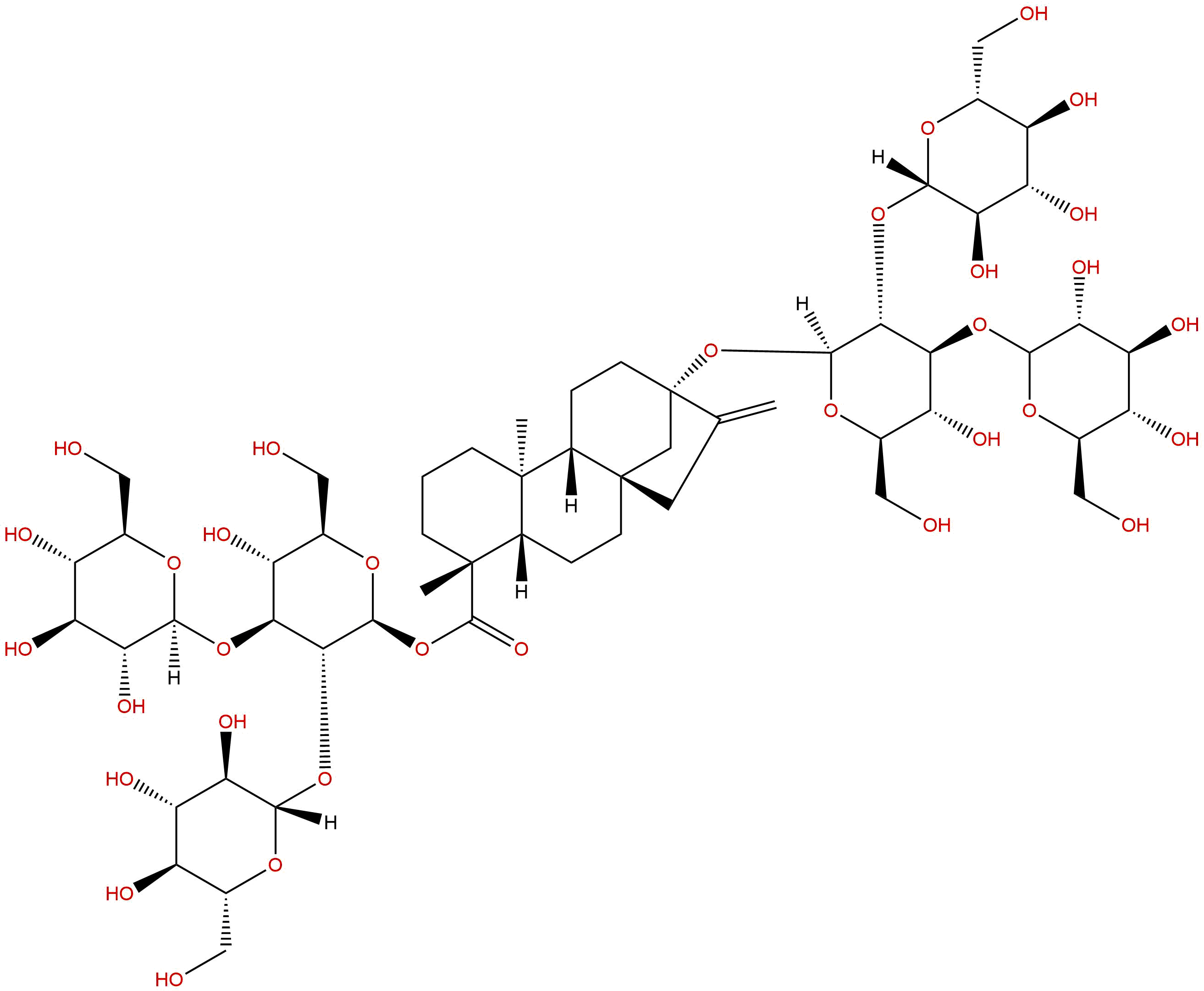


Product name: Rebaudioside M
Synonym name:
Catalogue No.: BP4071
Cas No.: 1220616-44-3
Formula: C56H90O33
Mol Weight: 1291.3
Botanical Source: Stevia rebaudiana (Bertoni) Hemsl.
Physical Description:
Type of Compound: Diterpenoids
Purity: 95%~99%
Analysis Method: HPLC-DAD or/and HPLC-ELSD
Identification Method: Mass, NMR
Packing: Brown vial or HDPE plastic bottle
The product could be supplied from milligrams to grams, up to kilograms.
Inquire for bulk scale.
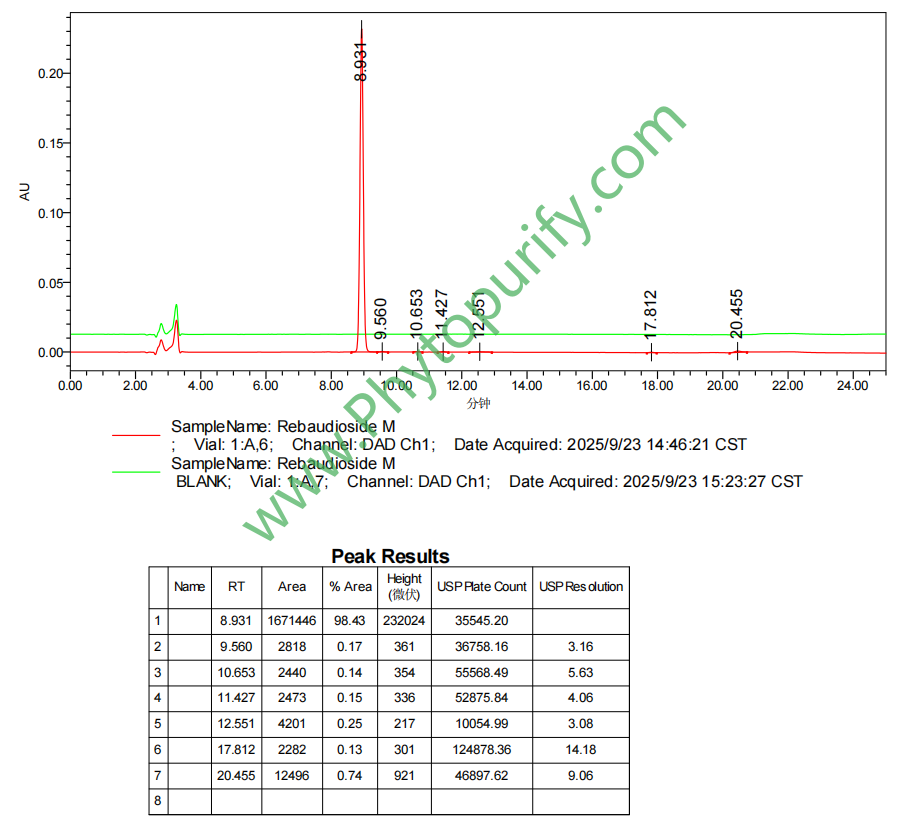
HPLC of Rebaudioside M
Storage conditions:Short-term storage at 2~8℃, long-term storage at -20 ~ -80℃
Rebaudioside M (hereinafter referred to as Rebaudioside M) is a type of sweetener derived from Stevia rebaudiana(Stevia rebaudiana)The natural sweetener obtained from the separation belongs to the group of pentadiene diterpenoid glycosides. As an important member of the steviol glycoside family, Rui M has received widespread attention in the food industry and pharmaceutical fields in recent years due to its extremely high sweetness (over 350 times that of sucrose), low calorie properties, and diverse pharmacological activities. In addition to replacing traditional sugars as a natural sweetener, Rui M also has multiple biological effects such as anti diabetes, lowering blood pressure, anti inflammation, anti-oxidation, anti caries and anti-cancer, showing its potential application value in the prevention and treatment of metabolic diseases and chronic diseases.
This article will provide a systematic review of the chemical structure and physicochemical properties, plant sources and extraction methods, pharmacological activity and mechanism of action, pharmacological evaluation and pharmacokinetic characteristics of rebaudin M, and explore its clinical application prospects, aiming to provide theoretical basis and research direction for subsequent basic research and product development.
The chemical structure of Ruibaodi glycoside M belongs to the glycoside class of pentadiene diterpenoid glycosides, with a molecular formula of C ₆₀ H ₁₀₂ O ∝₇ and a molecular weight of 1291.3030. Its core structure is an ent kaurene type diterpene skeleton, which connects multiple glucose residues to form a complex polysaccharide structure. The LogP value of RuiM is -1.4439, indicating strong hydrophilicity and a water solubility index of 5.6678, demonstrating good water solubility. Its topological polar surface area (TPSA) is as high as 532.43 Å ², indicating that the molecular polarity is high and difficult to pass through the blood-brain barrier (BBB), which is consistent with its low BBB permeability.
RuiM does not exhibit hERG channel inhibitory activity and the Ames mutagenicity test result is negative, indicating its high safety and low risk of genetic toxicity. Its physicochemical properties determine the absorption and distribution characteristics of Rem in vivo, especially its high polarity and high molecular weight limit its oral bioavailability. However, its low toxicity and good water solubility provide favorable conditions for the application of food additives and pharmaceutical excipients.
Ribadine M is mainly present in the leaves of stevia, a perennial herbaceous plant native to South America that is widely cultivated and utilized for its sweet taste. Stevia leaves contain various sweet glycosides, mainly including rebaudin A, rebaudin D, rebaudin M, etc. Among them, rebaudin M has a relatively low content, accounting for about 1% -2% of the total sweet glycosides.
The extraction of Rui M usually includes the following steps:
In recent years, with the optimization of extraction processes, green technologies such as supercritical CO ₂ extraction and enzymatic assisted extraction have also been introduced into the extraction of RuiM, significantly improving yield and purity and reducing production costs. In addition, genetic engineering and metabolic engineering methods have been used to regulate the biosynthesis pathway of RuiM in sweet leaved chrysanthemums, providing new ideas for efficient production of RuiM in the future.
As a natural sweetener, Rui Baodi glycoside M not only has excellent sweet taste characteristics, but its pharmacological activity is gradually being revealed, mainly including the following aspects:
Rui M exhibits significant hypoglycemic effects by regulating blood glucose metabolism related pathways through multiple targets. In vitro and animal model studies have shown that Rem can promote pancreatic beta cell function, enhance insulin sensitivity, regulate the expression of glucose metabolism related genes, and improve glucose metabolism disorders. Its targets involve key molecules such as glucokinase (GCK), peroxisome proliferator activated receptor gamma (PPARG), dipeptidyl peptidase-4 (DPP4), insulin receptor substrate 1 (IRS1), glucose transporter 4 (SLC2A4), and insulin receptor (INSR), synergistically regulating the insulin signaling pathway and glucose uptake.
Rui M improves vascular function and lowers blood pressure by regulating vasodilators and inhibiting vasoconstrictors. Animal experiments have shown that Rem can inhibit the activity of angiotensin-converting enzyme (ACE), alleviate endothelial damage, and exert anti hypertensive effects.
RuiM has significant anti-inflammatory activity, which can inhibit the expression of pro-inflammatory cytokines such as TNF - α and IL-6, and alleviate inflammatory reactions. Meanwhile, RuiM can eliminate free radicals, enhance antioxidant enzyme activity, alleviate oxidative stress damage, and protect cells from oxidative damage.
Rui M treats oral cariogenic bacteria such as Streptococcus mutans Has inhibitory effects, reduces plaque formation and acid production, thereby reducing the incidence of dental caries. Its sugar free properties make it an ideal oral health sweetener.
Preliminary in vitro studies have shown that Rem can exert certain anti-tumor activity by inducing cancer cell apoptosis, inhibiting tumor cell proliferation and migration. The specific mechanism still needs to be further explored.
The multiple pharmacological effects of Ribadine M are attributed to its regulation of multiple signaling pathways and molecular targets, particularly in metabolic diseases.
Rui M inhibits the NF - κ B signaling pathway, reduces the expression of pro-inflammatory factors, and alleviates inflammatory responses. At the same time, activating the Nrf2 ARE antioxidant pathway enhances the activity of intracellular antioxidant enzymes (such as superoxide dismutase and glutathione peroxidase) to resist oxidative stress.
RuiM inhibits ACE activity, reduces angiotensin II production, promotes nitric oxide (NO) synthesis, dilates blood vessels, and reduces peripheral resistance.
RuiM induces cancer cell cycle arrest and apoptosis, possibly by regulating the PI3K/Akt and MAPK signaling pathways, inhibiting tumor cell proliferation and migration.
The pharmacological evaluation of rabidicin M shows that it has good safety and low toxicity. Its high molecular weight and strong polarity result in low oral bioavailability and difficulty in penetrating the blood-brain barrier, reducing the risk of central nervous system side effects. RuiM does not inhibit hERG channels, reducing the risk of cardiac toxicity. A negative Ames test indicates no genetic toxicity.
In terms of pharmacokinetics, Rem is mainly absorbed through the intestine and metabolized by the liver, with some being broken down by gut microbiota into Remdesidine and other metabolites. It has a long elimination half-life and is suitable for daily use as a food additive. Due to its good water solubility, the distribution of Rem in the body is mainly limited to blood and peripheral tissues, with very little entry into brain tissue.
In the future, the development of drug delivery systems such as nanocarriers and liposomes is expected to improve the oral absorption and targeting of Rem, enhancing its efficacy.
As a high sweetness, low calorie natural sweetener, Ribadine M has been widely used in the food and beverage industry to meet consumers' demand for a healthy diet. Its multiple pharmacological activities show a good prospect in the adjuvant treatment of metabolic syndrome, diabetes, hypertension, chronic inflammation and other diseases.
In the future, with the in-depth study of the biological mechanism of action of RuiM and the combination of modern drug development technology, RuiM is expected to be developed into a multifunctional health product and drug lead compound. Especially in the prevention and treatment of diabetes and related metabolic diseases, Rui M may provide new treatment strategies through multi target synergy.
In addition, the anti caries properties of RuiM provide a new direction for the development of oral health products. The preliminary discovery of anti-cancer potential also suggests its application value in adjuvant therapy for tumors, but more preclinical and clinical research is needed to verify it.
In terms of production processes, the optimization of green and environmentally friendly extraction and purification technologies and biosynthetic methods will promote the industrialization process of RuiM, reduce costs, and increase production.
As an important natural sweetener in Stevia rebaudiana, Ribadine M not only meets the needs of the food industry with its excellent sweetness characteristics, but also attracts high attention in the fields of pharmacology and drug development due to its extensive pharmacological activity. Its multiple biological effects in anti diabetes, lowering blood pressure, anti inflammation, anti-oxidation, anti caries, anti-cancer and other aspects reveal its great potential as a functional natural product.
Although the clinical research of RuiM is still in its early stages, its safety is good and its target of action is clear, laying a solid foundation for the development of new natural medicines and health products in the future. With the continuous advancement of extraction technology and drug delivery systems, Rem is expected to play a more important role in the prevention and treatment of metabolic diseases and related chronic diseases.
In summary, rebaudin M is not only a star compound in the field of natural sweeteners, but also a multifunctional natural active ingredient with broad application prospects, which deserves further in-depth research and development.
