


Product name: Ginsenoside Rh4
Synonym name:
Catalogue No.: BP0670
Cas No.: 174721-08-5
Formula: C36H60O8
Mol Weight: 620.868
Botanical Source: Ginseng Radix Et Rhizoma
Physical Description:
Type of Compound: Triterpenoids
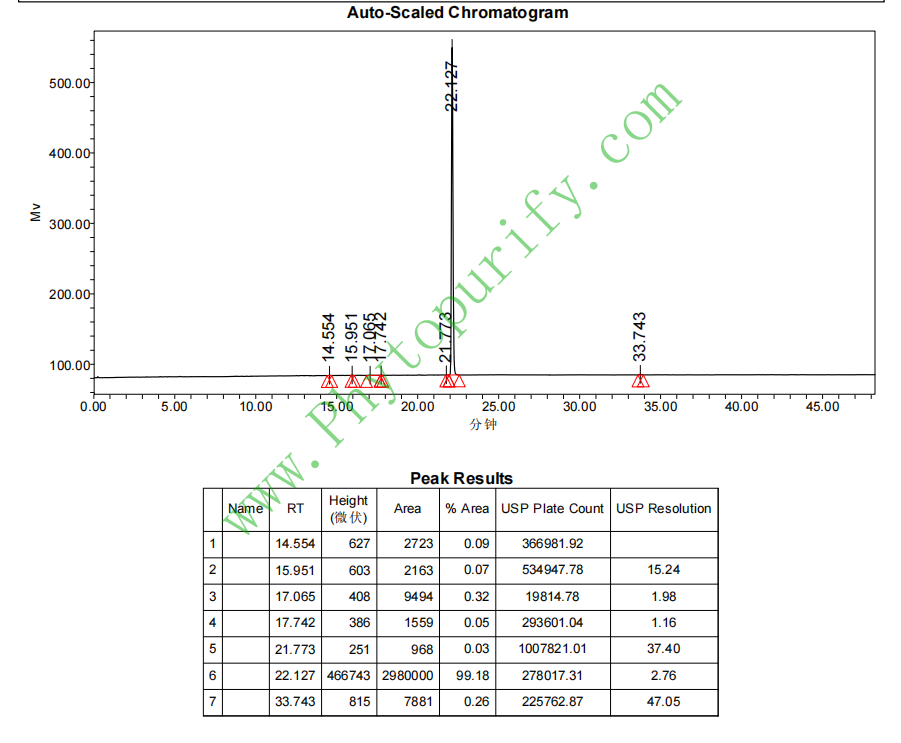
Purity: 95%~99%
Analysis Method: HPLC-DAD or/and HPLC-ELSD
Identification Method: Mass, NMR
Packing: Brown vial or HDPE plastic bottle
Storage: Store in a well closed container, protected from air and light. Put into refrigerate or freeze for long term storage.
Whenever possible, you should prepare and use solutions on the same day. However, if you need to make up stock solutions in advance, we recommend that you store the solution as aliquots in tightly sealed vials at -20℃. Generally, these will be useable for up to two weeks.
The product could be supplied from milligrams to grams
Inquire for bulk scale.
Chengdu Biopurify Phytochemicals Ltd. is a leading company in the research, development, manufacture and marketing of High Quality Phytochemicals and Extracts(especially Active Ingredients from Traditional Chinese Medicine,TCM), Natural Active Pharmaceutical Ingredients worldwide.
The main services:
A. Supply active ingredients and reference standards of TCM, from mgs to kgs scale
B. Custom extraction and purification, target Herb Active Ingredients
C. Custom synthesis and semi-synthesis for Natural Active Ingredients
D. CR(contract research), CM(contract manufacture) and PD(process development) services from lab scale, pilot scale to commercial scale(GMP is also available)
E. TCM compounds library for drug screen,more than 3000 compounds available, many of them are rare and unique.
HPLC of Ginsenoside Rh4
Storage conditions:Short-term storage at 2~8℃, long-term storage at -20 ~ -80℃
139.8400
4.1097
4.1100
.0102
.6860
.6994
Low
82.2541
5.5234
No
No
No
No
No
No
0.0
Yes
No
No
No
Ginseng, as a traditional precious Chinese medicinal herb, has attracted much attention for its pharmacological activity and health value. The research on its core active ingredient, ginsenosides, has become a hot topic in the field of natural product pharmacology. There are various types of ginsenosides, which are mainly classified into protopanaxadiol type (PPD type), protopanaxatriol type (PPT type), and oleanolic acid type based on their glycoside structures. Among them, ginsenoside Rh4 is a compound derived from Panax notoginseng(Panax notoginseng)The rare PPD type saponins isolated from the middle have received widespread attention in recent years due to their significant biological activities in anti-tumor, metabolic regulation, and neuroprotection. Compared with common saponins, Rh4 has a unique structure and its pharmacological mechanism exhibits multi-target and multi pathway characteristics. Research has shown that ginsenoside Rh4 can exert anti proliferative effects in various tumor cells by activating apoptosis related proteins (such as Bax, Caspase family) and inducing autophagy. More noteworthy is its enormous potential in the prevention and treatment of metabolic diseases, especially hyperglycemia and its complications, involving the regulation of multiple key targets such as EHMT2, AMPK, SGLT2, BACE1, etc. This article aims to systematically review the chemical properties, plant sources, pharmacological activities, molecular mechanisms of action, pharmacological evaluation, and clinical application prospects of ginsenoside Rh4, in order to provide comprehensive scientific references for the in-depth research and development of this rare saponin.
The chemical name of ginsenoside Rh4 is (3 β, 12 β) -12,20-dihydroxydamam-24-en-3-yl β - D-glucopyranose, and its CAS number is 174721-08-5. Structurally, Rh4 belongs to the protopanaxadiol type saponin, with a aglycone of 20 (S) - protopanaxadiol. Its sugar chain is connected to a single β - D-glucopyranose group at the C-3 position, which is a key feature that distinguishes it from other common diol saponins such as Rb1, Rc, Rd, etc. This relatively simplified glycosylation structure may be closely related to its unique biological activity and physicochemical properties.
In terms of physicochemical properties, the molecular weight of ginsenoside Rh4 is 620.8680, which belongs to the category of medium molecular weight compounds. Its lipid water partition coefficient (LogP) is 4.1097, indicating that the compound has good lipophilicity, which is beneficial for its penetration of cell membranes, but may also affect its solubility and distribution in the aqueous phase. Its topological polar surface area (TPSA) is 139.8400 Å ², reflecting the surface area occupied by polar atoms (mainly oxygen atoms on sugar groups) in the molecule. The water solubility data shows that its solubility is relatively low (about 0.0102 mg/mL), which is a common problem faced by most ginsenoside compounds and one of the main factors limiting their bioavailability. These basic physicochemical parameters provide important basis for subsequent formulation research and structural modification.
Ginsenoside Rh4 is mainly derived from plants of the Panax genus in the Araliaceae family, including Panax notoginseng(Panax notoginseng)As the main source. With American ginseng(Panax quinquefolius)And ginseng(Panax ginseng)Compared to other rare saponins, the content of certain rare saponins in Panax notoginseng is relatively high, but the natural content of Rh4 in Panax notoginseng is still very low, which belongs to rare saponins. This directly leads to high acquisition costs and limits large-scale pharmacological research.
Traditional extraction methods mainly rely on organic solvents such as methanol, ethanol, or n-butanol for extraction, combined with silica gel column chromatography, reverse phase column chromatography, high performance liquid chromatography (HPLC), and preparative thin-layer chromatography for separation and purification. These methods have cumbersome steps, low yields, and consume a large amount of organic solvents. In order to efficiently and greenly obtain Rh4, modern research mainly adopts two strategies: one is biotransformation, which uses microorganisms or enzymes (such as β - glucosidase, cellulase) to perform specific deglycosylation reactions on abundant prototype saponins (such as ginsenoside Rg3, Rd, etc.), and directionally convert them into Rh4. This method has high selectivity and mild conditions, making it an effective approach for large-scale preparation of Rh4. The second approach is synthetic biology, which involves analyzing the biosynthetic pathway of ginsenosides and constructing cell factories in microorganisms such as yeast to achieve heterologous de novo synthesis of Rh4. This is a highly promising future development direction.
Numerous in vitro and in vivo pharmacological studies have shown that ginsenoside Rh4 has a wide range of biological activities, mainly manifested in anti-tumor, glucose metabolism regulation, and potential neuroprotective effects.
1. Antitumor activity: Ginsenoside Rh4 showed significant growth inhibition and apoptosis promoting effects on a variety of human cancer cell lines, including lung cancer, liver cancer, colon cancer, breast cancer and ovarian cancer cells. Its anti-tumor effect is not limited to inducing cell apoptosis, but also involves inducing autophagic cell death. Research has shown that Rh4 treatment can upregulate the expression of pro apoptotic protein Bax and downregulate the expression of anti apoptotic protein Bcl-2, leading to a decrease in mitochondrial membrane potential, release of cytochrome C, and activation of downstream executive proteins such as Caspase-9 and Caspase-3, initiating a mitochondrial dependent apoptotic pathway. Meanwhile, Rh4 can also activate Caspase-8 related to the death receptor pathway. In addition, Rh4 can significantly increase the level of autophagy marker LC3-II in cells and promote autophagosome formation, indicating its strong autophagy induction ability. In certain tumor models, induction of autophagy may occur prior to apoptosis or synergistically inhibit tumor growth.
2. Regulating glucose metabolism and anti hyperglycemic activity: This is an emerging pharmacological field that has received much attention in recent years for ginsenoside Rh4. In the study of hyperglycemia or diabetes models, Rh4 shows good potential to reduce blood sugar and improve insulin resistance. Its function may involve multiple aspects: promoting the uptake and utilization of glucose by peripheral tissues (such as muscles and fat); Inhibit hepatic gluconeogenesis; Protect the function of pancreatic beta cells; And improve the disorder of lipid metabolism related to diabetes. These effects suggest that Rh4 has potential value in the treatment of type 2 diabetes and its complications.
3. Other activities: Preliminary studies also suggest that ginsenoside Rh4 may have anti-inflammatory, antioxidant, and neuroprotective effects. Its anti-inflammatory effect may be related to the inhibition of inflammatory signaling pathways such as NF - κ B. And its potential neuroprotective effects, especially in Alzheimer's disease-related models, may be related to its impact on APP processing and BACE1 activity, which is worth further exploration.
The multiple pharmacological activities of ginsenoside Rh4 stem from its regulation of multiple intracellular signaling pathways and its effects on multiple key molecular targets. In response to its outstanding anti hyperglycemic activity, research has revealed a series of related targets:
In terms of anti-tumor mechanisms, in addition to apoptosis (Bax, Caspase-3/8/9) and autophagy related pathways mentioned above, Rh4 may also affect signaling pathways closely related to cell proliferation and survival, such as PI3K/Akt, MAPK, STAT3, etc.
Based on its physicochemical properties and preliminary pharmacological parameters, the development of ginsenoside Rh4 faces both challenges and opportunities.
Advantage: The molecular weight is moderate, and the LogP value shows that it has good membrane permeability potential. The key toxicity warning indicators are relatively ideal: the risk of hERG inhibition is "no", indicating a low risk of causing QT interval prolongation in the heart; The Ames test result is 0.0, indicating no significant genetic toxicity risk, which lays a good foundation for its safety.
Challenge: The main challenge lies in its poor solubility and low oral bioavailability. High LogP values and low water solubility make it difficult to absorb in the gastrointestinal tract and may experience strong first pass effects. In addition, its blood-brain barrier permeability is predicted to be "low", which is a disadvantageous factor for treating central nervous system related diseases such as Alzheimer's disease, but may also reduce its potential side effects on the central nervous system.
Pharmacokinetic (PK) studies: At present, there are relatively limited reports on pharmacokinetic studies of the ginsenoside Rh4 system. Based on the research experience of similar ginsenosides (such as Rg3, Rh2), it is speculated that Rh4 may undergo deglycosylation and other transformations under the action of gut microbiota after oral administration, and its prototype drug absorption rate may not be high. Rh4 entering the body is mainly metabolized by the liver and excreted through bile and urine. The key PK parameters such as half-life, distribution volume, and protein binding rate in the body need to be clarified through more in-depth in vivo studies.
Formulation strategy: To improve the bioavailability of Rh4, modern pharmaceutical technology can provide various solutions, including: making phospholipid complexes, cyclodextrin inclusion complexes; Preparation of nano drug delivery systems such as nanocrystals, liposomes, and micelles; Or develop new drug delivery systems such as self microemulsions and solid dispersions. These technologies can effectively improve its solubility, stability, and intestinal absorption.
Ginsenoside Rh4, as a natural active molecule with multiple targets and effects, has broad clinical application prospects, but the road ahead is long.
Potential application directions:
1. Antitumor adjuvant therapy: Given its clear role in inducing apoptosis and autophagy in tumor cells, Rh4 is expected to be developed as an anti-tumor adjuvant drug or tumor chemopreventive agent, which may be used in combination with conventional chemotherapy/radiotherapy to enhance sensitivity and reduce toxicity.
2. Treatment of type 2 diabetes and its complications: This is one of the most promising directions. Rh4 can not only reduce blood glucose, but also improve insulin resistance, protect pancreatic islet function, regulate lipid metabolism, and prevent and treat complications such as diabetes nephropathy, retinopathy, and neuropathy through the synergistic effect of multiple targets such as AMPK, SGLT2, and PTP1B. Its multi-target characteristics may be superior to single target hypoglycemic drugs.
3. Diseases related to metabolic syndrome: Its regulation of glucose and lipid metabolism and anti-inflammatory effects are also applicable for the prevention and treatment of metabolic syndrome components such as non-alcoholic fatty liver disease and obesity.
4. Neurodegenerative diseases: Rh4 may have a place in the prevention and early intervention of neurodegenerative diseases such as Alzheimer's disease due to its potential BACE1 inhibition and neuroprotective activity.
Future research prospects:
1. In depth mechanism research: It is necessary to use techniques such as gene knockout/knockdown, proteomics, metabolomics, etc. to more accurately elucidate the primary target and core signaling network of Rh4 in specific disease models.
2. System drug optimization: Comprehensive preclinical pharmacokinetic and toxicological studies must be conducted. The key is to solve the bottleneck of low bioavailability, and optimize it through reasonable structural modification (preparation of prodrugs) or advanced delivery systems.
3. Clinical translational studies: Based on sufficient preclinical research, design rigorous clinical trials to evaluate their safety, efficacy, and optimal dosing regimen in humans.
4. Sustainable source development: Continue to optimize biotransformation and synthetic biology processes to achieve green, low-cost, and large-scale production of Rh4, in order to meet the needs of future research and applications.
Ginsenoside Rh4, as a rare active ingredient discovered from traditional Chinese medicine Sanqi, has become a new star in natural product pharmacology research due to its unique chemical structure and extensive pharmacological activity. Its mechanism of action in inducing tumor cell apoptosis and autophagy has been preliminarily clarified, and its multi-target characteristics in regulating glucose metabolism and improving insulin resistance have shown great potential in the prevention and treatment of major chronic diseases such as diabetes. Despite facing challenges such as poor solubility and low bioavailability in drug development, modern medicinal chemistry and pharmaceutical technology provide multiple feasible solutions for this. In the future, through in-depth interdisciplinary cooperation, on the basis of clarifying its precise molecular mechanism, optimizing its pharmacokinetic properties, and ensuring its safety and effectiveness, ginsenoside Rh4 is expected to move from the laboratory to clinical practice, and develop into a new type of multi-target therapeutic drug derived from traditional wisdom, contributing to the cause of human health.
