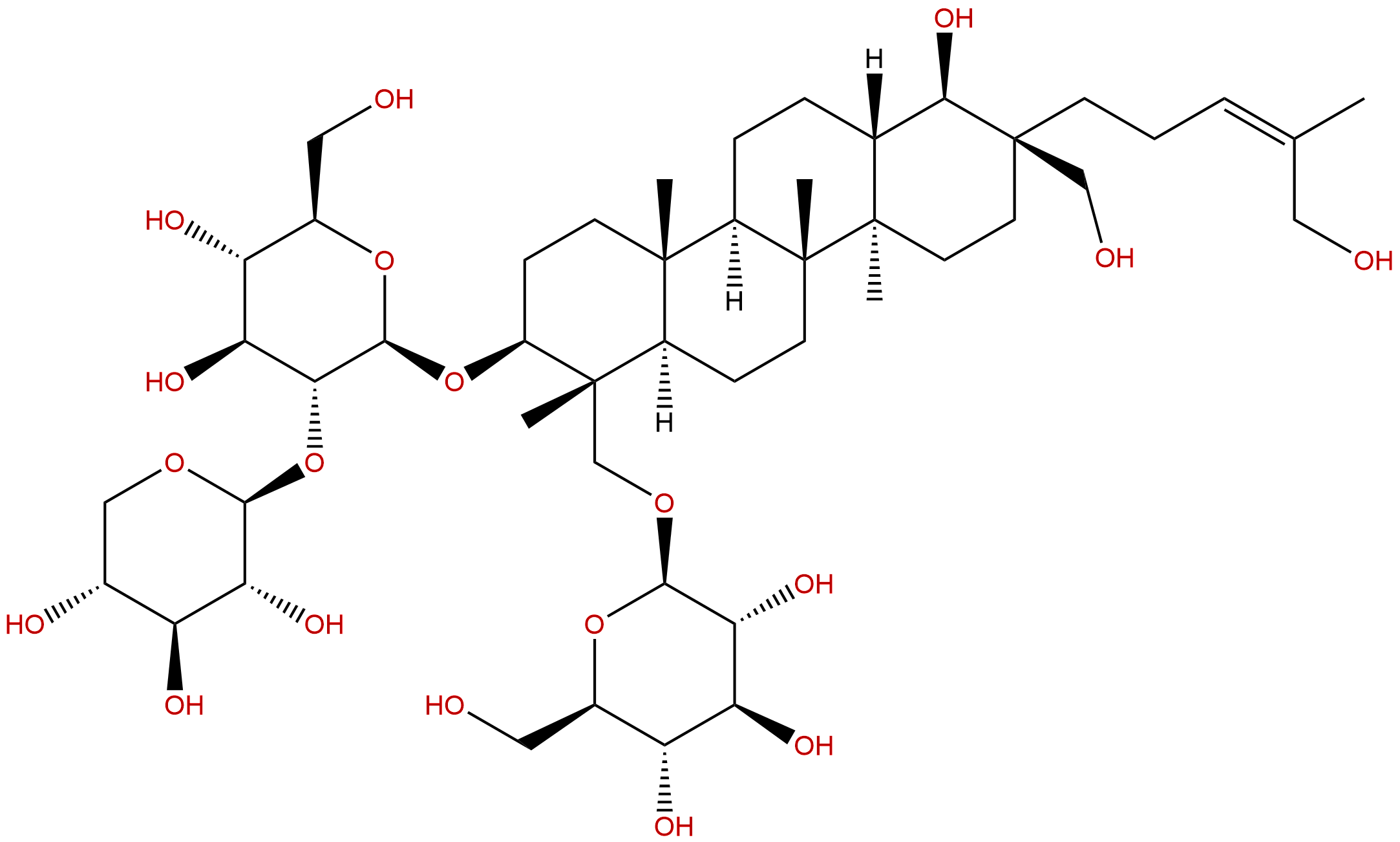


Product name: Hosenkoside G
Synonym name:
Catalogue No.: BP3191
Cas No.: 160896-46-8
Formula: C47H80O19
Mol Weight: 949.138
Botanical Source:
Physical Description:
Type of Compound: Triterpenoids
Purity: 95%~99%
Analysis Method: HPLC-DAD or/and HPLC-ELSD
Identification Method: Mass, NMR
Packing: Brown vial or HDPE plastic bottle
The product could be supplied from milligrams to grams. Inquire for bulk scale.
We provide solution to improve the water-solubility of compounds, thereby facilitating the variety of activity tests and clinic uses.
For Reference Standard and R&D, Not for Human Use Directly.
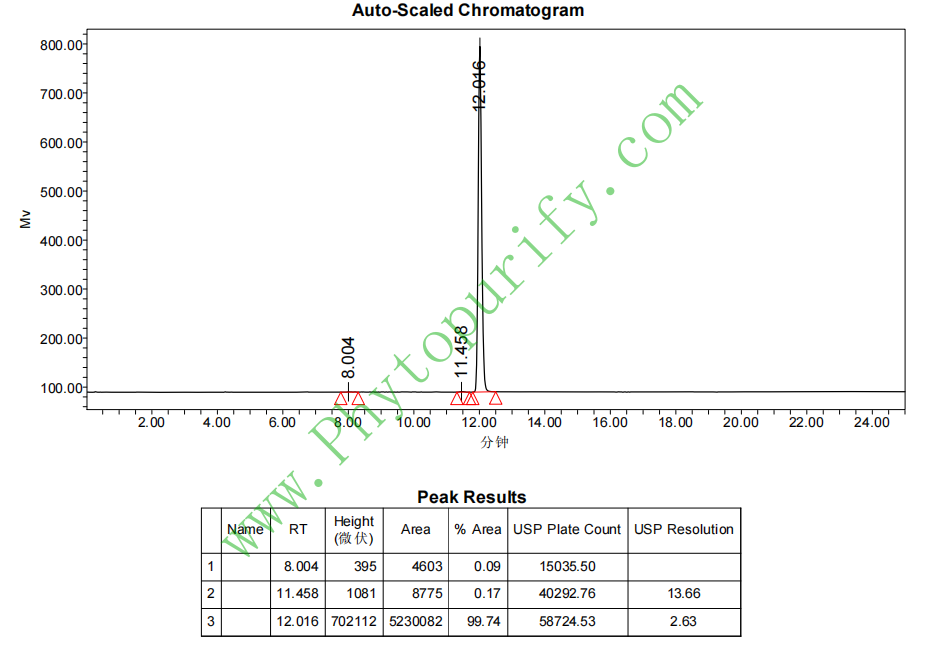
HPLC of Hosenkoside G
Storage conditions:Short-term storage at 2~8℃, long-term storage at -20 ~ -80℃
318.3700
1.4088
1.4084
.1537
.4573
.2585
Low
74.0002
6.5179
Yes
No
No
No
No
No
0.0
Yes
No
No
No
Natural products have always been an important source of innovative drug discovery, and their structural diversity and rich biological activity provide valuable lead compounds for the treatment of various complex diseases. Impatiens flower(Impatiens Balsamina L.)As a traditional medicinal plant, it is commonly used in Asian folk medicine to treat rheumatism, pain, and skin diseases. In recent years, the chemical composition and pharmacological activity of its seeds have gradually become a research hotspot. Among them, Hosenkoside G (CAS number: 160896-46-8), a natural product isolated from Impatiens seeds, has attracted much attention due to its significant anti-tumor activity. Further research has revealed that this compound has great potential in the treatment of complex diseases such as neurodegenerative diseases, and its effects involve multiple key targets such as AMPK, BCL2, ABCA1, APP, BACE1, TLR4, STAT3, MAOA, ESR2, etc. This article aims to provide a systematic review of the chemical structure, plant origin, pharmacological activity, mechanism of action, pharmacological evaluation, and clinical application prospects of Balsaminaceae terpenoid glycoside G, in order to provide comprehensive scientific references for the in-depth research and development of this compound.
Fengxian terpenoid tetraol glycoside G is a structurally complex natural triterpenoid saponin compound. The molecular formula of this compound is C ₄₈ H ₇₆ O ₁₉, with a molecular weight of 949.1380 Da. The core structure of this compound is an oleane type pentacyclic triterpenoid parent nucleus, with multiple hydroxyl (- OH) and sugar groups connected at different positions of the parent nucleus. Its sugar chain is usually composed of monosaccharides such as glucose and xylose, and the specific connection mode and position of these sugar groups are important determinants of its biological activity, which also makes it highly polar.
From the analysis of physical and chemical properties, the theoretical lipid water partition coefficient (LogP) of Balsaminaceae terpenoid glycoside G is 1.4088, indicating that it has a certain degree of lipophilicity, but overall it still leans towards hydrophilicity. Its topological polar surface area (TPSA) is as high as 318.3700 Å ², mainly attributed to the numerous hydroxyl and glycosidic oxygen atoms in the molecule, which are potential hydrogen bond donors and acceptors. High TPSA values are usually associated with lower membrane permeability. Its water solubility value is 0.1537 (usually measured in mg/mL or log mol/L, relative here), indicating limited solubility in water and belonging to slightly soluble or poorly soluble compounds. These physical and chemical parameters collectively determine its poor membrane permeability, especially its ability to penetrate the blood-brain barrier (BBB) is predicted to be "low", which poses a challenge for its action on central nervous system targets. However, its molecular weight is close to 1000 Da, making it a macromolecular compound, which to some extent limits its passive diffusion.
Balsaminaceae terpenoid tetraol glycoside G is mainly derived from Balsaminaceae flowers(Impatiens Balsamina L.)The seeds. Impatiens is an annual herbaceous plant in the Impatiens family, widely distributed in Asia and Africa. Its seeds have been applied in traditional medicine, and modern plant chemistry research has confirmed that they are rich in various active ingredients such as triterpenoid saponins, flavonoids, coumarins, etc.
The extraction and separation of triterpenoid glycoside G from plant materials usually follow the following process: first, dry Impatiens seeds are crushed and subjected to reflux extraction or ultrasound assisted extraction with polar solvents (such as methanol, ethanol, or methanol water mixture) to fully extract the saponin components. Subsequently, crude extract was obtained by vacuum concentration. Crude extracts are often subjected to liquid-liquid distribution using solvents such as petroleum ether and ethyl acetate to remove lipophilic impurities and enrich the polar saponin fraction. Further purification mainly relies on column chromatography technology, often using methods such as silica gel column chromatography, reverse phase silica gel (such as ODS) column chromatography, and high performance liquid chromatography (HPLC) for repeated separation and purification. Among them, reverse phase HPLC, due to its high resolution, is a key step in obtaining high-purity triterpenoid glycoside G monomer. During the separation process, thin-layer chromatography (TLC), mass spectrometry (MS), nuclear magnetic resonance (NMR) and other spectroscopic techniques are often combined for tracking and structural identification.
The pharmacological activity research of Fengxian terpenoid tetraol glycoside G initially focused on its anti-tumor effect. In vitro experiments showed that the compound had significant proliferation inhibition and apoptosis inducing activity on a variety of human tumor cell lines, such as liver cancer, breast cancer, lung cancer, etc. Its anti-tumor effect shows a certain concentration and time dependence.
In recent years, the research perspective has expanded to the field of neurodegenerative diseases, demonstrating broader application potential. In cell and animal models related to Alzheimer's disease (AD), Impatiens triterpenoid glycoside G exhibits neuroprotective effects. It can alleviate the neuronal toxicity induced by β - amyloid protein (A β) and improve cognitive dysfunction in model animals. In addition, research suggests that it may have a positive effect in regulating central inflammation and alleviating oxidative stress. These multifaceted pharmacological activities make it a potential multi-target drug candidate molecule for the treatment of neurodegenerative diseases.
The pharmacological effects of Fengxian terpenoid tetraol glycoside G, especially its neuroprotective effects, are achieved by regulating a complex molecular network involving multiple key targets closely related to neurodegenerative diseases
In summary, Fengxian terpenoid glycoside G exerts its potential therapeutic effect on neurodegenerative diseases through multi-target and multi pathway synergistic effects, reducing A β production and deposition, inhibiting neuroinflammation, anti neuronal apoptosis, regulating energy metabolism and neurotransmitters, and other aspects.
Based on the provided pharmacological parameters, a preliminary evaluation was conducted on the triterpenoid glycoside G of Impatiens balsamina
As a natural compound with multi-target activity, Fengxian terpenoid tetraol glycoside G has broad development prospects in the following areas:
Balsaminaceae triterpenoid glycoside G is a triterpenoid saponin with important biological activity isolated from the traditional medicinal plant Balsaminaceae. Research has shown that it not only has anti-tumor activity, but also demonstrates the potential to exert neuroprotective effects in neurodegenerative disease models by regulating multiple targets such as AMPK, BCL2, ABCA1, APP/ACE1, TLR4/STAT3, MAOA, and ESR2. Although its current pharmacological parameters, such as high molecular weight and low blood-brain barrier permeability due to high polarity, pose challenges for development, its multi-target mechanism of action and good preliminary safety characteristics make it a highly valuable lead compound. Future research should focus on thoroughly elucidating its detailed in vivo mechanism of action, systematically evaluating its pharmacokinetic and toxicological properties, and actively utilizing medicinal chemistry and novel drug delivery technologies for structural optimization and dosage form improvement. Through interdisciplinary collaboration, the triterpenoid glycoside G of Impatiens is expected to evolve from an interesting natural product into an innovative drug for treating major diseases such as neurodegenerative disorders, benefiting human health.
