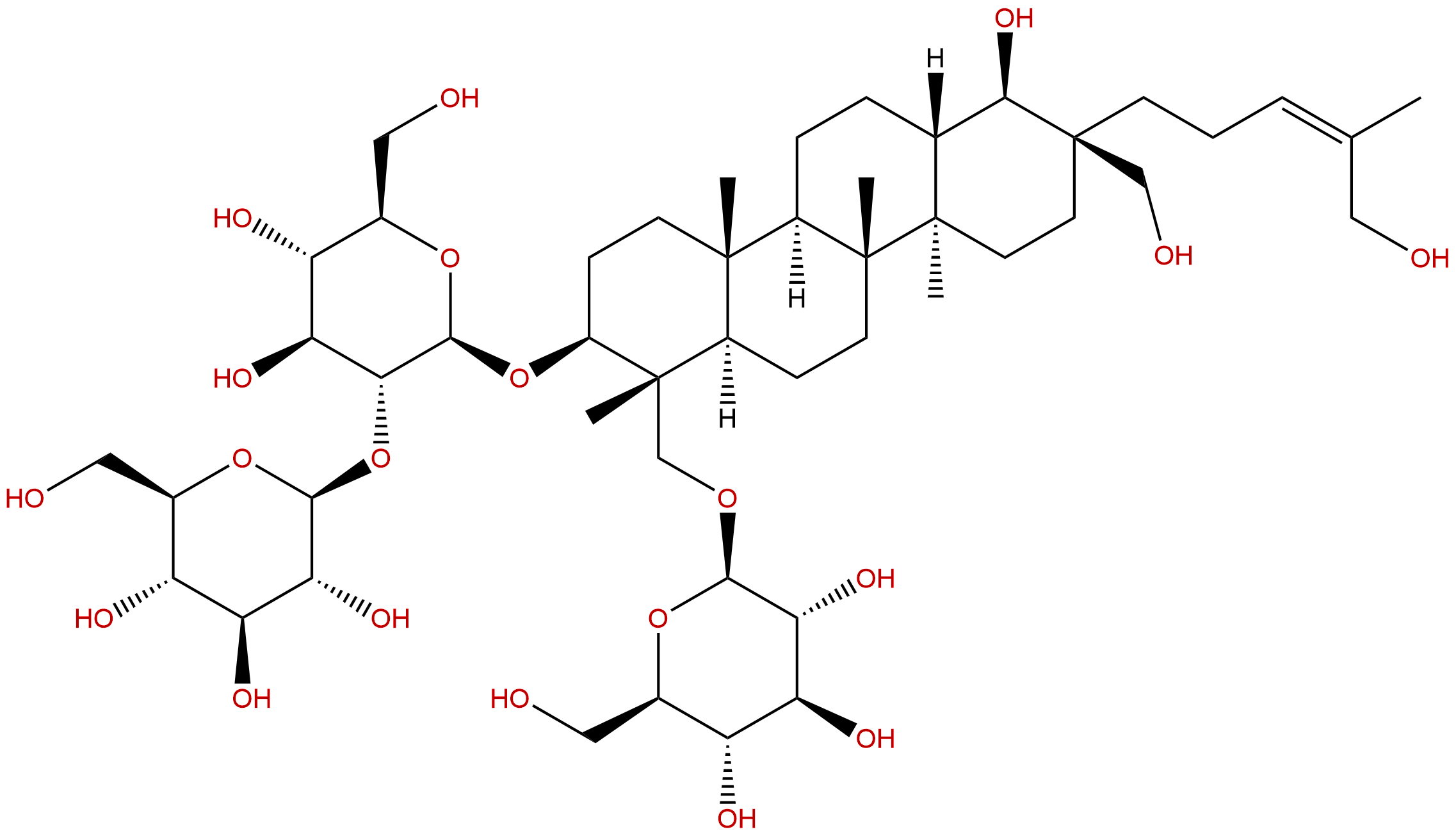


Product name: Hosenkoside C
Synonym name:
Catalogue No.: BP3189
Cas No.: 156764-83-9
Formula: C48H82O20
Mol Weight: 979.164
Botanical Source:
Physical Description:
Type of Compound: Triterpenoids
Purity: 95%~99%
Analysis Method: HPLC-DAD or/and HPLC-ELSD
Identification Method: Mass, NMR
Packing: Brown vial or HDPE plastic bottle
The product could be supplied from milligrams to grams. Inquire for bulk scale.
We provide solution to improve the water-solubility of compounds, thereby facilitating the variety of activity tests and clinic uses.
For Reference Standard and R&D, Not for Human Use Directly.
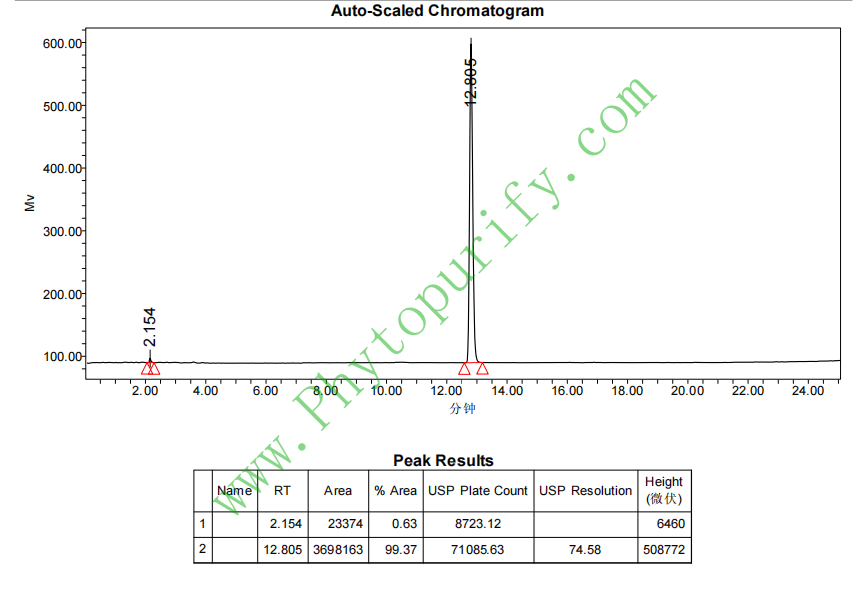
HPLC of Hosenkoside C
Storage conditions:Short-term storage at 2~8℃, long-term storage at -20 ~ -80℃
338.6000
1.2631
1.2631
.2132
.4346
.2847
Low
71.4452
6.5591
Yes
No
No
No
No
No
0.0
Yes
No
No
No
Natural products have always been an important treasure trove for innovative drug discovery, with their structural diversity and wide range of biological activities providing unique molecular frameworks and lead compounds for addressing various diseases. Hosenkoside C, a specific chemical component isolated from traditional medicinal plants, has attracted the attention of pharmacological researchers in recent years due to its potential antiviral activity. This compound belongs to the baccharane type triterpenoid saponin, and its unique chemical structure suggests that it may have novel mechanisms of action. With the continuous threat of viral diseases worldwide, especially the public health challenges caused by herpes virus, human immunodeficiency virus, etc., it is particularly urgent to develop new, efficient, and low toxicity antiviral drugs. Traditional antiviral drugs often face problems such as drug resistance and toxic side effects, therefore, it is of great strategic significance to search for new antiviral candidate molecules from natural products. This article aims to provide a systematic review of the chemical properties, plant sources, pharmacological activities, mechanisms of action, potential for medicinal properties, and future application prospects of Balsaminaceae terpenoid glycoside C, in order to provide comprehensive academic references for the in-depth research and development of this compound.
The chemical structure of the triterpenoid glycoside C in Impatiens is the material basis for its biological activity. Its CAS number is 156764-83-9, its molecular formula is C ₄₈ H ₈₂ O ₂ ₀, and its molecular weight is 979.1640 Da. This compound belongs to the Bacharane type pentacyclic triterpenoid saponin, and its glycoside part is the hesenkol, which has a four ring structure with Bacharane skeleton characteristics. At different hydroxyl positions of the aglycone, multiple sugar groups are connected, usually including glucose, rhamnose, etc., forming complex oligosaccharide chains. This highly glycosylated structure is a key determinant of its water solubility and biometric properties.
From the analysis of physical and chemical properties, the lipid water partition coefficient (LogP) of Balsaminaceae terpenoid glycoside C is 1.2631, indicating that it has a certain degree of lipophilicity, but overall it still leans towards amphiphilic properties. Its topological polar surface area (TPSA) is as high as 338.6000 Å ², mainly attributed to the abundant hydroxyl groups and oxygen atoms on the sugar ring in the molecule, which are potential hydrogen bond donors and acceptors crucial for the interaction between drugs and target proteins. The calculated water solubility value is 0.2132, indicating that it has a moderately low solubility in water, which may be due to its hydrophilic glycoside structure but high molecular weight. These basic physicochemical parameters provide preliminary basis for subsequent formulation research and pharmacokinetic optimization.
Balsaminaceae terpenoid tetraol glycoside C is mainly derived from the Balsaminaceae plant Balsaminaceae(Impatiens balsamina L. The seeds. Impatiens, as a widely distributed ornamental and medicinal plant, is commonly used in traditional medicine in many Asian countries to treat rheumatism, pain, bacterial or fungal infections, etc. Its seeds are considered as enriched sites for active ingredients.
The extraction and separation of triterpenoid glycoside C from plant materials usually follow the classic process of natural product chemistry. Firstly, the dried Impatiens seeds are crushed and subjected to reflux extraction or ultrasound assisted extraction using methanol, ethanol, or methanol water mixed solvents to maximize the extraction of polar saponin components. After vacuum concentration, the crude extract obtained was subjected to liquid-liquid distribution extraction using organic solvents such as petroleum ether, ethyl acetate, and n-butanol. Due to its strong polarity and glycosidic structure, the triterpenoid glycoside C was mainly enriched in the n-butanol extraction site.
Further purification relies on modern chromatographic techniques. Silica gel column chromatography is commonly used for preliminary separation, with different ratios of chloroform methanol gradient elution. Subsequently, fine purification was carried out using reverse phase silica gel (such as ODS) column chromatography, high performance liquid chromatography (HPLC), or preparative thin layer chromatography (PTLC) to ultimately obtain high-purity Balsaminaceae terpenoid glycoside C monomer compound. Structural identification involves the comprehensive use of nuclear magnetic resonance (NMR, including ¹ H-NMR, ¹ ³ C-NMR, 2D-NMR), mass spectrometry (MS), and optical rotation spectroscopy to confirm its planar structure and relative configuration.
At present, research on the pharmacological activity of Balsaminaceae terpenoid glycoside C mainly focuses on the field of antiviral activity, and in vitro experimental evidence has shown that it exhibits inhibitory potential against various viruses.
1. Antiherpesvirus activity: Research has shown that triterpenoid glycoside C from Impatiens has a significant inhibitory effect on herpes simplex virus type 1 (HSV-1). Its function may involve multiple stages of the virus lifecycle. In addition, its related target cues may also have an impact on members of the herpesvirus family such as cytomegalovirus (CMV).
2. Anti human immunodeficiency virus (HIV) activity: This is another highly anticipated direction of activity for the triterpenoid glycoside C in Impatiens balsamina. As key co receptors for HIV invasion into host cells, CCR5 and CXCR4 are important targets for the development of novel anti HIV drugs. Preliminary studies suggest that the triterpenoid glycoside C of Impatiens may interfere with the binding of virus envelope protein gp120 to these co receptors, thereby blocking virus entry into cells. Meanwhile, its potential association with HIV-1 protease (HIV1-PR) and integrase (INT) suggests that it may have the ability to inhibit the later stages of viral replication, but its specific efficacy and mechanism need further verification.
3. Potential multi-target characteristics: In addition to the direct antiviral effects mentioned above, its association with myeloperoxidase (MPO) deserves attention. MPO is a key enzyme in neutrophil inflammatory response, playing an important role in excessive inflammation and tissue damage caused by various viral diseases. If the triterpenoid glycoside C of Impatiens can regulate MPO activity, it may have dual antiviral and anti-inflammatory effects, which is of positive significance for controlling the comprehensive pathological process of viral infection.
It should be pointed out that most of the existing pharmacological activity data come from in vitro studies at the cellular level, and their in vivo antiviral efficacy, dose-response relationship, and therapeutic index still need to be systematically evaluated through animal model experiments.
The antiviral mechanism of Fengxian terpenoid glycoside C may exhibit multi-target and multi link characteristics, which is in line with the concept of modern multi-target drug design. Based on its related molecular targets, the potential mechanism of action can be speculated as follows:
1. Inhibit the virus from entering the stage: The targets CCR5 and CXCR4 are the "gateways" for HIV invasion. Fengxian terpenoid tetraol glycoside C may act as a conformational regulator or competitive antagonist of these chemokine receptors, preventing HIV gp120 from binding to the receptors and effectively blocking the infection of R5, X4, or dual tropic virus strains on cells.
2. Interference with viral gene replication and expression: For herpes virus, targets such as UL42 (DNA polymerase helper subunit), UL54 (DNA polymerase catalytic subunit), ICP27 (immediate early regulatory protein), and TK (thymidine kinase) are key proteins for virus DNA synthesis and gene expression regulation. Fengxian terpenoid tetraol glycoside C may inhibit viral genome replication and late protein synthesis by directly binding or indirectly affecting the function of these proteins, thereby suppressing virus proliferation in host cells.
3. Inhibit viral enzyme activity: The targets HIV1-PR and INT are essential enzymes in the HIV replication cycle. HIV1-PR is responsible for cleaving viral precursor proteins to produce mature viral particles, while INT is responsible for integrating viral cDNA into the host genome. If the triterpenoid glycoside C of Impatiens can inhibit the activity of these two enzymes, it will effectively block the maturation and integration process of HIV.
4. Impact on virus particle assembly and release: The target gD is an important envelope glycoprotein of HSV-1, mediating the fusion of the virus with the cell membrane and intercellular transmission. Intervening in the function of gD may simultaneously affect the entry of viruses and intercellular spread.
5. Regulating host immunity and inflammatory response: By affecting the activity of MPO, the triterpenoid glycoside C of Impatiens may regulate neutrophil mediated oxidative burst and inflammatory response, alleviate immunopathological damage associated with viral infection, which is a unique host directed antiviral strategy.
The correlation between these targets is mostly based on computational predictions or preliminary biochemical experiments. The exact direct action targets, binding modes (such as binding pockets, binding constants), and downstream signaling pathways need to be further elucidated through experimental techniques such as surface plasmon resonance (SPR), isothermal titration calorimetry (ITC), co crystallization, gene knockout/knockdown, etc.
Based on the provided parameters and its chemical structure, a preliminary evaluation of the pharmacological properties of Balsaminaceae terpenoid glycoside C is conducted
1. Drug like properties and absorption distribution:
- Molecular weight (979 Da)Significantly exceeding the usual upper limit of the "Five Rules for Drug Classes" (MW<500 Da), which may pose challenges to its oral absorption and transmembrane transport. Large molecule glycosides are usually absorbed through active transport or endocytosis by intestinal epithelial cells, and their bioavailability may be low.
- LogP and TPSA The LogP value of 1.26 binds to a very high TPSA (338.6 Å ²), which is consistent with the characteristics of polar molecules. High TPSA is usually not conducive to passive transmembrane diffusion, especially through the blood-brain barrier.
- Blood-brain barrier permeability Predicted as' low '. This is a limitation for the treatment of central nervous system viral infections, but it may have certain advantages in avoiding central nervous system side effects when treating peripheral system viral infections.
2. Preliminary safety prediction:
- HERG inhibition Predicted as' no ', this is a positive signal indicating a low risk of potential cardiac toxicity (inducing long QT syndrome), but experimental verification is needed.
- Ames test The predicted value is 0.0, indicating that it may not be mutagenic and has a low risk of genetic toxicity, but it still needs to be confirmed through in vitro and in vivo experiments.
3. Pharmacokinetic challenges and optimization directions:
- Water solubility Moderate to low solubility may affect the development and in vivo absorption of its formulations. It can be improved by making salt forms, using solubilizers, or developing new delivery systems such as nanomaterials and liposomes.
- Metabolism and stability As glycoside compounds, they are easily hydrolyzed by glycosidases in the gastrointestinal tract and liver, leading to exposure of glycosides and potentially altering their activity, toxicity, and metabolic profile. It is crucial to study its stability in gastrointestinal fluids and liver microsomes.
- excretion Expected to be mainly excreted through the kidneys, but due to its high molecular weight, it may also be excreted through bile.
At present, there have been no public reports on the pharmacokinetic studies of the C system of triterpenoid glycosides in Impatiens, such as the in vivo processes of absorption, distribution, metabolism, and excretion. This is a key data gap that must be filled as it moves towards drug development.
As a natural saponin with multi-target antiviral potential, Fengxian terpenoid tetraol glycoside C has broad clinical application prospects, but also faces many challenges.
Potential application directions:
1. Components of anti HIV combination therapy Given that it may act on virus entry (CCR5/CXCR4) and post replication processes (PR, INT), if its activity is confirmed, it is expected to form a new cocktail therapy with existing reverse transcriptase inhibitors, especially for drug-resistant strains.
2. Local anti herpesvirus preparation: For HSV-1 induced skin and mucous membrane infections (such as herpes labialis), the development of topical gel or cream can avoid the shortcomings of poor oral absorption and directly affect the focus.
3. Combination therapy of antiviral and anti-inflammatory therapy By utilizing its potential MPO regulatory effect, it may have a dual protective effect of "antiviral+anti-inflammatory" in the treatment of viral infections such as influenza and COVID-19 that can cause "cytokine storms".
Challenges and future research directions:
1. Validation of Activity and Mechanism The primary task is to use standardized virological experiments to confirm its in vitro and in vivo antiviral efficacy in different cell and animal models (such as mouse HSV infection model, humanized mouse HIV model), and clarify its primary target and precise molecular mechanism.
2. Optimization of drug properties The high molecular weight and complex glycosidic structure are the main obstacles to the development of oral drugs. Future research may consider:
- Structural modification Semi synthetic modifications are carried out through medicinal chemical methods, such as simplifying sugar chains and derivatizing glycosides, to improve lipid solubility and molecular size while maintaining activity.
- Prodrug strategy Mask the glycosidic bonds to make prodrugs to improve oral bioavailability, and then hydrolyze and release active molecules in vivo.
- Innovative delivery system Develop targeted delivery systems based on nanotechnology to improve their stability, targeting, and bioavailability.
3. Security system evaluation Complete comprehensive preclinical toxicology studies, including acute toxicity, long-term toxicity, reproductive toxicity, etc., to ensure their safety window.
4. Resource sustainability The yield of direct extraction from plants is limited, and it is necessary to develop plant cell culture, synthetic biology, or full/semi chemical synthesis routes to meet possible future scaling needs.
Fengxian terpenoid tetraol glycoside C is a triterpenoid saponin with a unique bacharane skeleton discovered from the traditional medicinal plant Fengxian flowers. The existing bioinformatics predictions and preliminary pharmacological studies have revealed its broad-spectrum antiviral potential, especially against HIV and herpes virus, and its multi-target action characteristics are particularly noteworthy. However, the road from natural active molecules to candidate drugs is long and challenging. At present, research on this compound is still in its early stages, and its exact in vivo efficacy, detailed mechanism of action, systematic pharmacokinetics, and toxicological characteristics all need to be further explored. In the future, through interdisciplinary collaboration and integration of research methods in natural product chemistry, virology, medicinal chemistry, pharmacy, and pharmacology, it is expected to overcome the bottleneck in drug development and fully unleash its therapeutic potential. The study of Fengxian terpenoid tetraol glycoside C may not only add a new member to the antiviral drug library, but also provide valuable examples for discovering lead compounds from complex natural glycosides.
