


Product name: Tectorigenin
Synonym name:
Catalogue No.: BP1369
Cas No.: 548-77-6
Formula: C16H12O6
Mol Weight: 300.266
Botanical Source: Baptisia spp., Centrosema spp., Dalbergia spp. and Ononis spinosa (all Leguminosae, Papilionoideae) and also Iris germanica
Physical Description: Yellow cryst.
Type of Compound: Flavonoids
Purity: 95%~99%
Analysis Method: HPLC-DAD or/and HPLC-ELSD
Identification Method: Mass, NMR
Packing: Brown vial or HDPE plastic bottle
Storage: Store in a well closed container, protected from air and light. Put into refrigerate or freeze for long term storage.
Whenever possible, you should prepare and use solutions on the same day. However, if you need to make up stock solutions in advance, we recommend that you store the solution as aliquots in tightly sealed vials at -20℃. Generally, these will be useable for up to two weeks.
The product could be supplied from milligrams to grams, up to kilograms
Inquire for bulk scale.
Descriptions:
Tectorigenin (Tg) and tectoridin (Td) are the major compounds isolated from the rhizomes of iridaceous plant Belamcanda chinensis which is well known as a chinese traditional medicine for the treatment of inflammatory diseases; Tectorigenin inhibits IFN-γ/LPS-induced inflammatory responses in murine macrophage RAW 264.7 cells, it appears to have the potential to prevent inflammation.[1]
Tectorigenin and several other phytochemicals downregulate PDEF, PSA and IGF-1 receptor mRNA expression in vitro, the downregulation of PDEF, PSA, hTERT and IGF-1 receptor gene expression by tectorigenin demonstrates the antiproliferative potential of these agents, they might be new and established targets for therapies in prostate cancer.[2]
Tectorigenin and kaikasaponin III have hypoglycemic and hypolipidemic effects in the streptozotocin-induced diabetic rat and their antioxidant activity.[3]
Tectorigenin-paclitaxel-induces nuclear translocation of NFκB and the phosphorylation of IκB and IKK, suggests that tectorigenin could sensitize paclitaxel-resistant human ovarian cancer cells through inactivation of the Akt/IKK/IκB/NFκB signaling pathway, and promise a new intervention to chemosensitize paclitaxel-induced cytotoxicity in ovarian cancer.[4]
Tectorigenin has inhibitory effect of the activities of plasma ALT, the effects is much more potent than that of a commercially available dimethyl diphenyl bicarboxylate; Orally administered tectoridin shows hepatoprotective activity; tectorigenin also protects against the cytotoxicity of HepG2 cells induced by t-BHP, this protection may have originated from the inhibition of apoptosis; tectorigenin may be hepatoprotective and tectoridin should be a prodrug that is transformed to tectorigenin.[5]
Tectorigenin inhibits the in vitro proliferation and enhances miR-338* expression of pulmonary fibroblasts in rats with idiopathic pulmonary fibrosis.[6]
References:
[1] Pan C H, Kim E S, Sang H J, et al. Arch Pharm Res, 2008, 31(11):1447-56.
[2] Thelen P, Scharf J G, Burfeind P, et al. Carcinogenesis, 2005, 26(8):1360-7.
[3] Lee K T, Sohn I C, Dong H K, et al. Arch Pharm Res, 2000, 23(5):461-6.
[4] Genead R, Fischer H, Hussain A, et al. Carcinogenesis, 2012, 33(12):2488-98.
[5] Lee H U, Bae E A, Kim D H. J Pharmacol Sci, 2005, 97(97):541-4.
[6] Zhang H, Liu X, Shi C, et al. J Ethnopharmacol, 2010, 131(1):165-73.
[7] Zhao N, Liu D, Wang Y P, et al. J Pharm Practice, 2012, 3.
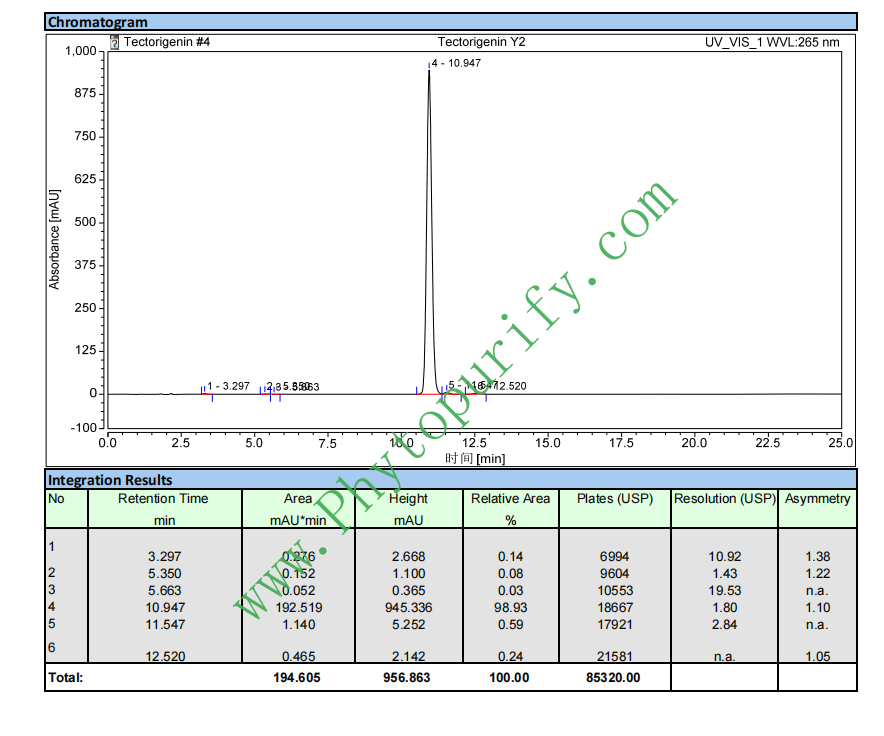
HPLC of Tectorigenin
Storage conditions:Short-term storage at 2~8℃, long-term storage at -20 ~ -80℃
Tectorigenin (CAS number: 548-77-6) is a naturally occurring methoxyflavone compound, which was first isolated from dried flowers of traditional Chinese medicine Gegen decoction. As an important member of the isoflavone family, irisin has attracted widespread attention in the field of natural product pharmacology in recent years due to its unique chemical structure and diverse biological activities. Research has shown that irisin not only has significant anti-inflammatory, antioxidant, and anti-tumor activities, but also exhibits potential pharmacological value in regulating cell signaling pathways, inhibiting tumor cell proliferation, and inducing cell apoptosis. This article aims to systematically review the chemical structure and physicochemical properties, plant sources and extraction methods, pharmacological activity and mechanism of action, pharmacological evaluation and pharmacokinetic characteristics of irisin, and explore its clinical application prospects and future research directions, in order to provide theoretical basis and research reference for the drug development of this compound.
The chemical name of irisin is 5,7,4 '- trihydroxy-6-methoxyflavone, with a molecular formula of C17H12O6 and a molecular weight of 300.2660. Its chemical structure is characterized by a typical isoflavone skeleton, with methoxy substituted at position 6 and hydroxyl functional groups at positions 5, 7, and 4 ', respectively. This structure endows irisin with strong polarity and a certain degree of lipophilicity, giving it excellent cell membrane penetration ability in living organisms.
In terms of physicochemical properties, the LogP value of irisin is 1.9839, indicating that it has moderate lipid solubility, which is beneficial for in vivo distribution and cellular uptake. The topological polar surface area (TPSA) is 100.13 Å ², indicating that it has certain polarity and hydrogen bond donor/acceptor ability, which is helpful for binding to biomolecule targets. The low water solubility (0.0387 mg/mL) to some extent limits its oral bioavailability. The low blood-brain barrier permeability of irisin suggests its limited role in the central nervous system. Toxicological evaluation shows that it does not have hERG channel inhibitory activity, with an Ames test value of 1.8, indicating a low risk of genotoxicity and a good safety basis.
Irisin is mainly found in various traditional Chinese medicinal materials, especially in flavonoid rich plants represented by the Iridaceae family and leguminous plants. The compound was initially isolated from dried flowers in Ge Gen Tang. In addition, irisin is also present in traditional medicinal plants such as Iris, Scutellaria baicalensis, and Coptis chinensis. Its content is influenced by multiple factors such as plant species, growth environment, harvesting time, and processing methods.
The extraction method mainly adopts organic solvent extraction combined with chromatographic separation technology. Common extraction solvents include methanol, ethanol, and their aqueous solutions, as they have good solubility for isoflavone compounds. The extraction process usually includes:
1. Crush and dry plant materials;
2. Use reflux or ultrasound assisted extraction;
3. Remove impurities through liquid-liquid distribution;
4. Purification was carried out using methods such as silica gel column chromatography and reverse phase high performance liquid chromatography (RP-HPLC);
5. Finally, the structure and purity were confirmed through techniques such as mass spectrometry and nuclear magnetic resonance (NMR).
In recent years, supercritical CO2 extraction and microwave-assisted extraction techniques have also been used to improve the extraction efficiency and purity of irisin, reduce the use of organic solvents, and comply with the concept of green chemistry.
The pharmacological activities of irisin are diverse, covering multiple aspects such as anti-tumor, anti-inflammatory, antioxidant, antibacterial, and metabolic regulation.
Irisin has shown significant inhibitory effects in various tumor models. In vitro experiments showed that it can inhibit the proliferation of many tumor cell lines, including breast cancer, lung cancer, liver cancer and colorectal cancer cells. Its anti-tumor mechanism involves inducing cell cycle arrest, promoting cell apoptosis, and inhibiting tumor cell migration and invasion. In vivo animal models, irisin significantly reduces tumor volume and weight, and prolongs the survival of experimental animals.
Irisin reduces inflammation by inhibiting the production and release of inflammatory mediators. It can downregulate the expression of pro-inflammatory cytokines such as TNF - α, IL-6, and IL-1 β, inhibit the activation of the NF - κ B signaling pathway, and alleviate inflammatory tissue damage. Related studies have shown that irisin exhibits good therapeutic effects in various inflammatory disease models.
Irisin has the ability to clear free radicals and inhibit oxidative stress, which can protect cells from oxidative damage. Its antioxidant effect is achieved by enhancing the activity of endogenous antioxidant enzymes such as superoxide dismutase (SOD) and glutathione peroxidase (GSH Px), reducing reactive oxygen species (ROS) levels, and maintaining cellular homeostasis.
Irisin also exhibits potential effects such as antibacterial activity, regulation of glucose and lipid metabolism, and neuroprotection, but related research is still in the preliminary stage and needs further validation.
The pharmacological effects of irisin are mainly achieved through the synergistic action of multiple targets and pathways. Its anti-tumor activity involves multiple key proteins and signaling pathways:
In addition, irisin also exerts its anti-inflammatory and antioxidant effects by regulating signaling pathways such as NF - κ B, PI3K/Akt, and Nrf2. Its multi-target properties make it a natural compound with broad-spectrum pharmacological activity.
The pharmacological parameters of irisin indicate that it has certain potential for drug development. Moderate molecular weight and LogP value are beneficial for its in vivo absorption and distribution. The TPSA value suggests that it may enter cells through passive diffusion, but its lower water solubility limits its oral absorption efficiency. The low permeability of the blood-brain barrier indicates limited application in the central nervous system.
Toxicological evaluation shows that irisin does not inhibit hERG channels and reduces the risk of cardiac toxicity. Ames test results indicate that its genotoxicity is low and its safety is good. Pharmacokinetic studies in vivo have shown that the bioavailability of irisin is limited after oral administration, mainly through liver metabolism, with metabolic pathways including hydroxylation and methylation. Its half-life is moderate and suitable for multiple administrations to maintain blood drug concentration.
To overcome the problems of poor water solubility and low bioavailability, researchers have attempted to use techniques such as nanocarriers, liposome encapsulation, and drug co crystallization to improve the solubility and in vivo stability of irisin, enhancing its efficacy and safety.
Irisin, as a multifunctional natural isoflavone, has a wide range of pharmacological activities and good safety, demonstrating good clinical application potential. Its research in the field of anti-tumor is particularly outstanding, and it is expected to develop into a natural anti-cancer drug that can assist or replace traditional chemotherapy in the future. In addition, the anti-inflammatory and antioxidant effects of irisin provide a theoretical basis for its application in chronic inflammatory diseases, metabolic syndrome, and neurodegenerative diseases.
However, clinical research on irisin is still in its infancy and lacks systematic clinical trial data. Future research should focus on pharmacokinetic optimization, formulation development, and safety evaluation, combined with modern drug design techniques, to deeply analyze its mechanism of action and expand its indications. At the same time, by combining multi omics techniques and network pharmacology, the system reveals its multi-target action network, providing support for precision therapy.
Irisin, as a natural methoxy isoflavone with unique structure and diverse biological activities, has shown broad prospects in pharmacological research and drug development. Its significant activities in anti-tumor, anti-inflammatory, and antioxidant aspects, combined with good safety and pharmacological parameters, provide valuable research examples for the field of natural product pharmacology. In the future, with the optimization of extraction processes, improvement of pharmacokinetics, and advancement of clinical research, irisin is expected to become an important member of the new generation of natural medicines, contributing new strength to the treatment of human diseases.
