


Product name: Bakuchiol
Synonym name:
Catalogue No.: BP0235
Cas No.: 10309-37-2
Formula: C18H24O
Mol Weight: 256.389
Botanical Source: Psoralea corylifolia, Psoralea drupacea, Psoralea glandulosa and Otholobium pubescens
Physical Description: Oil
Type of Compound: Phenols
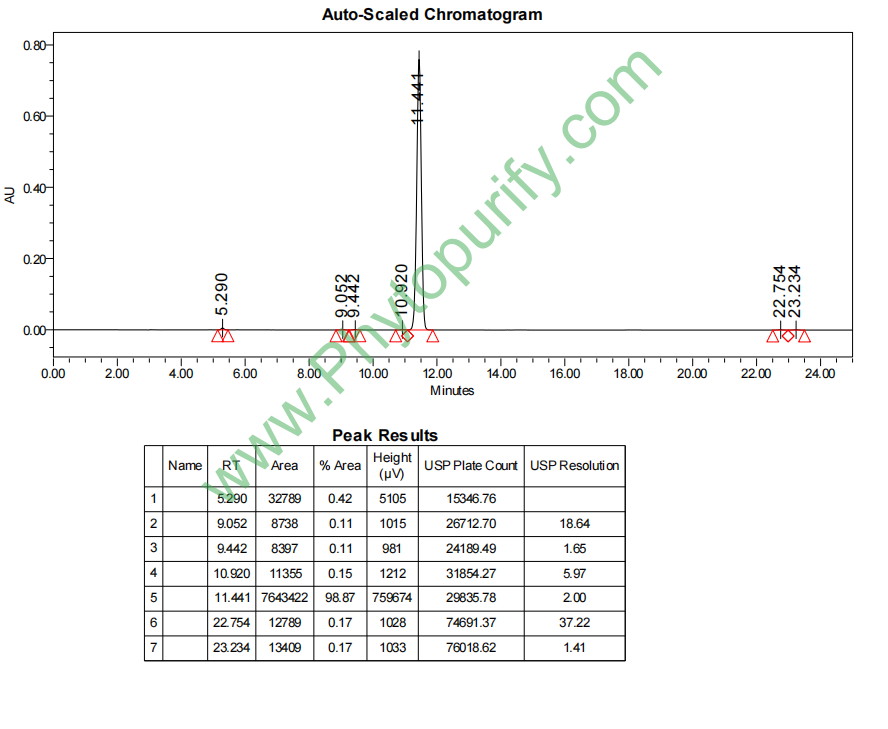
Purity: 95%~99%
Analysis Method: HPLC-DAD or/and HPLC-ELSD
Identification Method: Mass, NMR
Packing: Brown vial or HDPE plastic bottle
The product could be supplied from milligrams to grams, up to kilograms
Inquire for bulk scale.
Descriptions:
Bakuchiol is isolated from the seeds of Psoralea corylifolia, a tree native to China with various uses in traditional medicine, it shows bactericidal effects against all bacteria tested, including S. mutans, Streptococcus sanguis, Streptococcus salivarius, Streptococcus sobrinus, Enterococcus faecalis, Enterococcus faecium, Lactobacillus acidophilus, Lactobacillus casei, Lactobacillus plantarum, Actinomyces viscosus, and Porphyromonas gingivalis, with MICs ranging from 1 to 4 microg/ml and the sterilizing concentration for 15 min ranging from 5 to 20 microg/ml; furthermore, bakuchiol is also effective against adherent cells of S. mutans in water-insoluble glucan in the presence of sucrose and inhibited the reduction of pH in the broth; thus, bakuchiol would be a useful compound for development of antibacterial agents against oral pathogens and has great potential for use in food additives and mouthwash for preventing and treating dental caries.[1]
Bakuchiol analogs, especiallyΔ3,2-hydroxybakuchiol, are monoamine transporter inhibitors involved in regulating dopaminergic and noradrenergic neurotransmission and may have represented potential pharmacotherapies for disorders such as Parkinson's disease, depression, and cocaine addiction.[2]
Bakuchiol and Psoralea corylifolia L. (PCE) treatments reduce postmenopausal bone loss by increasing alkaline phosphatase, Ca concentrations, serum E2 concentration and bone mineral density, and by decreasing the inorganic P level, indicates that bakuchiol and PCE treatments could protect against bone loss.[3]
Bakuchiol is a phenolic isoprenoid with novel enantiomer-selective anti-Influenza A virus activity involving Nrf2 activation.[4]
Bakuchiol is a hepatoprotective compound of psoralea corylifolia on tacrine-induced cytotoxicity in Hep G2 cells.[5]
Bakuchiol derivatives are novel and potent cytotoxic agents.[6]
References:
[1] Katsura H, Tsukiyama R I, Suzuki A, et al.Antimicrob Agents Ch, 2001, 45(11):3009-13.
[2] Zhao G, Zang S Y, Zheng X W, et al. Biochem Pharmacol, 2008, 75(9):1835-47.
[3] Lim S H, Ha T Y, Kim S R, et al. Brit J Nut, 2009, 101(7):1031-9.
[4] Shoji M, Arakaki Y, Esumi T, et al. J Biol Chem, 2015, 290(46):28001-17.
[5] Cho H, Jun J Y, Song E K, et al. Planta Med, 2001, 67(8): 750-1.
[6] Majeed R, Reddy M V, Chinthakindi P K, et al. Eur J Med Chem, 2012, 49(1):55-67.
[7] Jeong M, Hong T, Lee K, et al. J Aoac Int, 2015, 98(4):902-6.
HPLC of Bakuchiol
Storage conditions:Short-term storage at 2~8℃, long-term storage at -20 ~ -80℃
Bakuchiol (CAS number: 10309-37-2), as a natural plant estrogen, was first isolated from the seeds of the traditional Chinese medicine Psoralea corylifolia L. In recent years, with the deepening of research on the pharmacological activity of natural products, psoralen has attracted widespread attention due to its multi-target and multifunctional biological activities. It has shown significant potential in anti-inflammatory, antibacterial, anti-tumor, and drug metabolism regulation, especially in regulating targets related to hyperglycemia, demonstrating unique advantages. In addition, psoralen has good pharmacological parameters and safety, laying a solid foundation for its clinical translation. This article will provide a systematic review of the chemical structure, sources, pharmacological activity, mechanism of action, pharmacological properties, and clinical application prospects of psoralen, aiming to provide theoretical support and reference for related research and applications.
The molecular formula of psoralen is C18H24O, with a molecular weight of 258.38, and it belongs to the monoterpene phenolic compounds. Its structural characteristics include a phenolic hydroxyl group and a long allyl side chain, possessing certain hydrophobicity and aromaticity. Its LogP value is about 4.7, indicating strong lipid solubility, which is beneficial for membrane penetration and in vivo distribution. The topological polar surface area (TPSA) of psoralen is 20.23 Å ², and the number of hydrogen bond receptors is 1, indicating that its molecular structure is relatively simple, with low polarity, which is conducive to oral absorption and blood-brain barrier penetration. Pharmacological studies have shown that psoralen has high blood-brain barrier permeability and no significant hepatotoxicity, cardiotoxicity, or hERG channel inhibition. The Ames test results are negative, indicating a low risk of genetic toxicity and good safety.
Psoralen mainly comes from the seeds of Psoralea corylifolia L., a dried and mature seed of the legume plant, and is a commonly used medicinal herb in traditional Chinese medicine. Psoralol content accounts for a relatively high proportion in Psoralea seeds, and its content is greatly affected by growth environment, harvesting time, and processing technology.
In terms of extraction methods, traditional organic solvent extraction methods such as ethanol or methanol extraction, combined with ultrasound assisted extraction or reflux extraction techniques, can effectively improve the extraction efficiency of psoralen. In recent years, supercritical CO2 extraction technology has gradually become a research hotspot for the extraction of psoralen phenols due to its advantages of green environmental protection, high efficiency and strong selectivity. After extraction, purification is carried out through methods such as silica gel column chromatography and high-performance liquid chromatography (HPLC) to ensure the acquisition of high-purity samples of psoralen, meeting the needs of pharmacological research and formulation development.
Psoralen has a wide and diverse pharmacological activity, covering multiple fields such as anti-inflammatory, antibacterial, anti-tumor, antioxidant, and regulation of drug metabolism.
Psoralen can significantly inhibit the production and release of inflammatory mediators, such as tumor necrosis factor - α (TNF - α), interleukin-6 (IL-6), and nitric oxide (NO). It reduces inflammation by regulating the nuclear factor kappa B (NF - κ B) signaling pathway, inhibiting the expression of pro-inflammatory genes. Both in vivo and in vitro experiments have confirmed that psoralen exhibits good anti-inflammatory effects in inflammation models, suggesting its potential application value in the treatment of inflammation related diseases.
Psoralen has inhibitory effects on various bacteria and fungi, especially on common pathogenic bacteria such as Staphylococcus aureus, Escherichia coli, and Candida albicans, with strong antibacterial activity. Its antibacterial mechanism may involve disrupting cell membrane integrity, inhibiting cell wall synthesis, and interfering with cellular metabolic processes. The antibacterial properties of psoralen provide a theoretical basis for its development as a natural antibacterial agent.
Psoralen has shown inhibitory effects on cell proliferation, induction of apoptosis, and inhibition of tumor metastasis in various tumor cell lines. Research has shown that psoralen can exert anti-tumor effects by regulating cell cycle proteins, activating mitochondrial apoptosis pathways, and inhibiting tumor related signaling pathways such as PI3K/Akt and MAPK. In addition, psoralen can enhance the sensitivity of radiotherapy and chemotherapy, and has potential adjuvant therapeutic value.
Psoralol has been proven to be a non competitive inhibitor of various enzymes, particularly UDP glucuronosyltransferase 2B7 (UGT2B7) and human carboxylesterase 2 (hCE2), with IC50 values of 40.9 μ M and 7.28 μ M, respectively. This indicates that psoralen may regulate the biotransformation and clearance of drugs during drug metabolism, affecting the efficacy and toxicity of drugs, suggesting its potential role in drug interactions and pharmacokinetic regulation.
The multi-target mechanism of action of psoralen is the basis for its broad pharmacological activity. The research on targets related to hyperglycemia is particularly prominent. Psoralol can regulate the following key targets:
Psoralol can comprehensively improve glucose metabolism abnormalities and alleviate symptoms of hyperglycemia by regulating the above-mentioned targets. In addition, psoralen also exerts anti-inflammatory and anti-tumor effects by regulating signaling pathways such as NF - κ B, MAPK, PI3K/Akt, demonstrating its multi-target and multi pathway pharmacological characteristics.
The pharmacological parameters of psoralen demonstrate its excellent potential for drug development. Moderate molecular weight (258.38) and high lipid solubility (LogP=4.7) are beneficial for oral absorption and cell membrane penetration. The low TPSA value (20.23 Å ²) and the number of hydrogen bond receptors (1) further support its good bioavailability and blood-brain barrier penetration ability.
Toxicological evaluation shows that psoralen has no significant hepatotoxicity, cardiotoxicity, or hERG channel inhibition effect, and the Ames mutagenicity test is negative, indicating its high safety and suitability for long-term use. Pharmacokinetic studies have shown that psoralen is rapidly absorbed and widely distributed after oral administration, especially at high concentrations in the central nervous system, indicating its potential application in neurological diseases.
The inhibitory effect of psoralen on metabolic enzymes such as UGT2B7 and hCE2 suggests that it may affect the metabolism of other drugs, and potential drug interactions need to be monitored in clinical applications.
Psoralol, as a multifunctional natural product, has broad clinical application potential. In the treatment of hyperglycemia, it can improve the abnormal glucose metabolism by regulating a variety of key targets, showing the possibility of becoming a new anti diabetes drug. At the same time, the anti-inflammatory, antibacterial, and anti-tumor activities of psoralen provide new ideas for its adjuvant therapy in inflammatory diseases, infections, and tumors.
In addition, the good safety and pharmacological properties of psoralen provide assurance for the development of oral and topical formulations. Especially in the fields of skin disease treatment and beauty, psoralen has been widely used in anti-aging and skin repair products due to its estrogenic activity and antioxidant properties.
Future research should focus on the clinical pharmacokinetics, dose optimization, and long-term safety evaluation of psoralen, combined with modern drug design techniques, to develop structurally modified derivatives to enhance its activity and selectivity. In addition, in-depth analysis of its molecular mechanism of action and multi-target synergistic effects will help promote the clinical translation of psoralen.
As a natural plant estrogen with a clear source and unique structure, psoralen has shown broad research and application prospects due to its multi-target and multifunctional pharmacological activities. Its potential in anti-inflammatory, antibacterial, anti-tumor, and hyperglycemic treatment, combined with good drug properties and safety, makes it an important research object in the field of natural product pharmacology. In the future, with further elucidation of pharmacological mechanisms and advancement of clinical research, psoralen is expected to become an important candidate molecule for the development of new natural medicines, providing new strategies and means for the prevention and treatment of related diseases.
