


Synonym name:
Catalogue No.: BP0068
Cas No.: 4339-72-4
Formula: C32H50O4
Mol Weight: 498.748
Botanical Source: Fairly widespread in plants
Purity: 95%~99%
Analysis Method: HPLC-DAD or/and HPLC-ELSD
Identification Method: Mass, NMR
Packing: Brown vial or HDPE plastic bottle
Can be supplied from milligrams to grams.
For Reference Standard and R&D, Not for Human Use Directly.
Inquire for bulk scale.
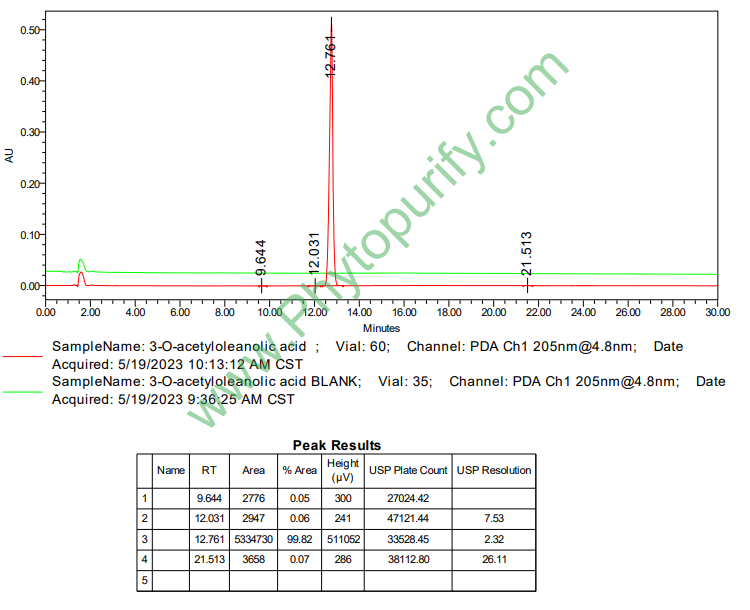
HPLC of 3-O-acetyloleanolic acid
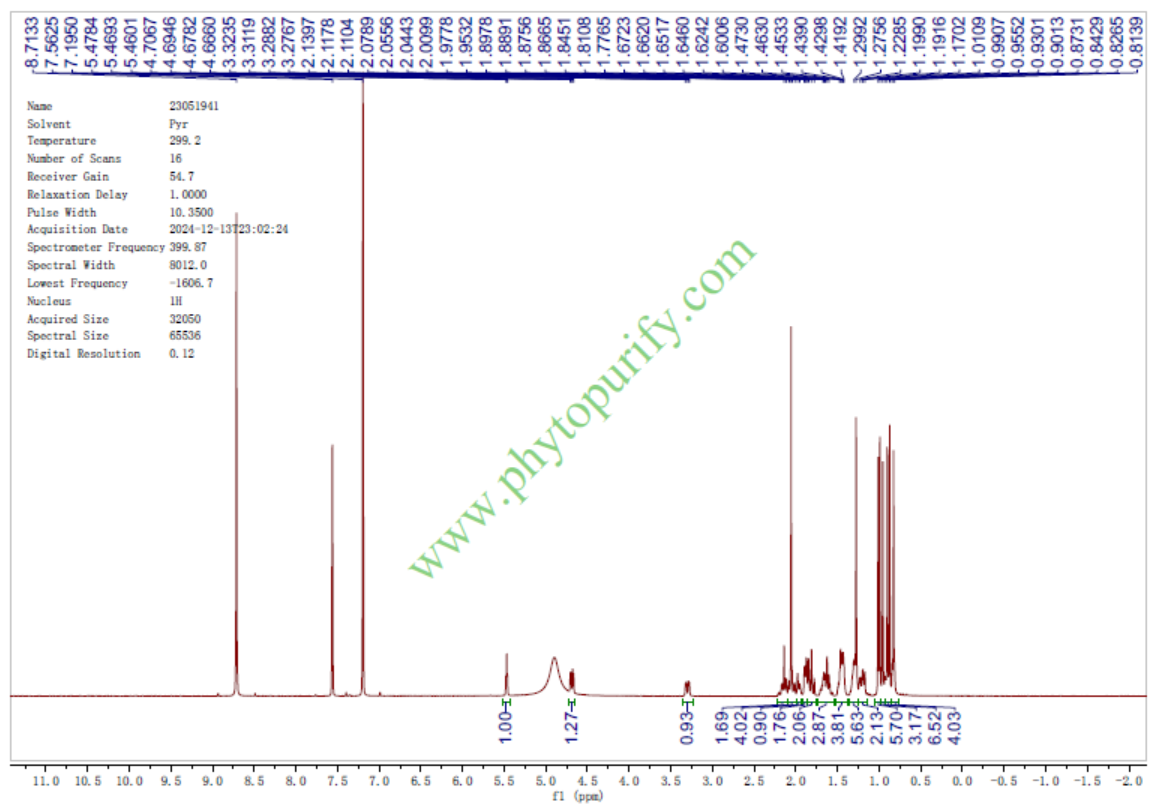
HNMR of 3-O-acetyloleanolic acid
Storage conditions:Short-term storage at 2~8℃, long-term storage at -20 ~ -80℃
63.6000
6.8000
Low
Unknown
Unknown
Unknown
Unknown
No
Unknown
3-O-acetyloleanolic acid (CAS number: 4339-72-4) is a natural product of oleanolic acid isolated from the seeds of the plant Vigna sinensis K. As a derivative of oleanolic acid compounds, 3-O-acetyloleanolic acid has received widespread attention in the field of natural product pharmacology in recent years due to its unique chemical structure and diverse biological activities. Previous studies have shown that this compound has significant anti angiogenic effects and can dose dependently inhibit the proliferation, migration, and tube formation of human umbilical vein endothelial cells (HUVECs). In addition, 3-O-acetyloleanolic acid exhibits the ability to inhibit vascular endothelial growth factor A (VEGF-A) - induced lymphangiogenesis and lymph node metastasis in an animal model of oral squamous cell carcinoma. More importantly, the compound also showed the potential to regulate blood glucose levels, significantly reducing blood glucose levels in the streptozotocin (STZ) - induced diabetes rat model, suggesting its application prospects in the treatment of hyperglycemia and diabetes. This article aims to systematically review the chemical structure and physicochemical properties, plant sources and extraction methods, pharmacological activity, mechanism of action, pharmacological evaluation, and clinical application potential of 3-O-acetyloleanolic acid, in order to provide theoretical basis and research direction for its further development.
3-O-Acetyloleanolic acid is an acetylated derivative of oleanolic acid, with a molecular formula of C32H50O5 and a molecular weight of 498.70. Structurally, 3-O-acetyloleanolic acid introduces an acetyl group (- COCH3) at the 3rd hydroxyl site of oleanolic acid, which not only affects its polarity and lipophilicity, but may also alter its binding affinity with biological targets. The LogP value of this compound is 6.8, indicating high lipid solubility, suggesting its good cell membrane penetration ability, but it may also face challenges in terms of bioavailability and solubility. Its topological polar surface area (TPSA) is 63.6 Å ², and the number of hydrogen bond acceptors is 4, indicating that it has certain polarity characteristics in intermolecular interactions. The low permeability of the blood-brain barrier suggests its limited distribution in the central nervous system. There are currently no detailed reports on safety indicators such as hepatotoxicity, cardiotoxicity, hERG channel inhibition, and genotoxicity (Ames test), and further systematic evaluation is needed.
3-O-Acetyloleanolic acid is mainly extracted from the seeds of Vigna sinensis K., a leguminous plant. Vigna sinensis is widely distributed in tropical regions of Asia and Africa, and is an important food and feed crop. Its seeds are rich in various triterpenoids, especially oleanolic acid and its derivatives. During the extraction process, organic solvents such as ethanol, methanol, or ethyl acetate are usually used for extraction, followed by liquid-liquid distribution and column chromatography (silica gel, C18 reverse phase column) for separation and purification. High performance liquid chromatography (HPLC) and mass spectrometry (MS) techniques are commonly used for component identification and purity detection. Acetylated 3-O-acetyloleanolic acid can be obtained through chemical acetylation or directly isolated from natural extracts. In recent years, the application of ultrasound assisted extraction and microwave-assisted extraction technologies has improved extraction efficiency and purity, laying the foundation for large-scale production.
One of the most significant pharmacological activities of 3-O-acetyloleanolic acid is its anti angiogenic ability. In vitro experiments have shown that the compound inhibits the proliferation, migration, and tubular structure formation of human umbilical vein endothelial cells (HUVECs) in a dose-dependent manner, and key steps block the generation of tumor neovascularization. In vivo animal models, especially oral squamous cell carcinoma models, 3-O-acetyloleanolic acid effectively inhibits VEGF-A-induced lymphangiogenesis and lymph node metastasis, significantly slowing down tumor progression. These results indicate its potential application value in anti-tumor therapy, especially in inhibiting tumor metastasis and invasion.
In addition to anti angiogenesis, 3-O-acetyloleanolic acid can also induce apoptosis in various cancer cell lines. The mechanism of inducing cell apoptosis involves mitochondrial pathway activation, cell cycle arrest, and upregulation of pro apoptotic protein expression. Related studies have shown that the compound exhibits certain cytotoxicity towards oral cancer, liver cancer, and lung cancer cells, indicating its potential as a candidate molecule for anti-tumor drugs.
The research on 3-O-acetyloleanolic acid in the field of metabolic diseases is gradually expanding. In the STZ induced diabetes rat model, oral 3-O-acetyloleanolic acid significantly reduced blood glucose levels and improved glucose metabolism disorders. This compound may exert its effects by regulating the AMPK signaling pathway, inhibiting the activity of glucose transporter SGLT2, and affecting insulin sensitivity related targets. In addition, it may also regulate EHMT2, UBP2, PAI1 and other molecules related to glucose metabolism and inflammatory reaction, and reduce diabetes related complications.
The multi-target mechanism of action of 3-O-acetyloleanolic acid is the basis for its diverse pharmacological activities. The anti angiogenic effect is mainly achieved by inhibiting the VEGF-A signaling pathway, blocking the proliferation and migration of endothelial cells, and inhibiting neovascularization and lymphangiogenesis. The specific mechanism may involve downregulating VEGFR-2 expression, inhibiting the PI3K/Akt and MAPK signaling pathways, and reducing the secretion of angiogenic factors.
In terms of anti-tumor effects, the induction of cancer cell apoptosis by 3-O-acetyloleanolic acid is closely related to the loss of mitochondrial membrane potential and activation of the caspase family (such as caspase-3, caspase-9). In addition, it can regulate the expression of Bcl-2 family proteins, promote the upregulation of pro apoptotic protein Bax, inhibit anti apoptotic protein Bcl-2, and induce programmed cell death.
Regarding hyperglycemia, 3-O-acetyloleanolic acid regulates multiple key targets, including:
The synergistic regulation of these targets makes 3-O-acetyloleanolic acid show multiple roles in improving glucose metabolism and preventing and treating complications of diabetes.
The pharmacological analysis of 3-O-acetyloleanolic acid shows that its high lipid solubility (LogP=6.8) is beneficial for cell membrane penetration, but may lead to poor water solubility and affect oral bioavailability. The TPSA is 63.6 Å ², and moderate polarity facilitates the binding of molecules to targets. The number of hydrogen bond receptors is 4, which meets some requirements of Lipinski's rule, but the overall molecular weight is close to 500, indicating the need to pay attention to pharmacokinetic properties.
The low permeability of the blood-brain barrier indicates limited distribution in the central nervous system, which may reduce central side effects, but limits its application in neurological diseases. The safety indicators such as hepatotoxicity, cardiotoxicity, and hERG channel inhibition are not yet clear and need to be further evaluated through in vitro and in vivo experiments. There is a lack of genetic toxicity (Ames test) data, and safety evaluation still needs to be improved.
In terms of pharmacokinetics, there is currently a lack of systematic in vivo absorption, distribution, metabolism, and excretion (ADME) data. Considering its high lipid solubility, there may be first pass effects and metabolic stability issues. Future research should focus on optimizing formulations, improving solubility and bioavailability, as well as clarifying metabolic pathways and potential drug interactions.
3-O-Acetyloleanolic acid has demonstrated broad clinical application potential due to its multiple pharmacological activities such as anti angiogenesis, anti-tumor, and hypoglycemic effects. In the field of tumor treatment, especially for oral squamous cell carcinoma and other solid tumors, its ability to inhibit tumor angiogenesis and lymphatic metastasis provides new ideas for the development of anti-tumor drugs. Based on its ability to induce apoptosis in cancer cells, 3-O-acetyloleanolic acid is expected to be a candidate molecule for monotherapy or combination therapy.
In the field of metabolic diseases, 3-O-acetyloleanolic acid regulates blood glucose metabolism through multiple targets, providing a potential new strategy for the treatment of diabetes and its complications. In the future, modern drug design technology can be combined to optimize its pharmacokinetic properties, enhance oral bioavailability, and further promote clinical translation.
However, current research is mostly focused on in vitro and animal models, lacking systematic preclinical safety evaluations and human trial data. In the future, toxicology research needs to be strengthened to clarify the long-term safety and potential side effects of medication. At the same time, in-depth analysis of its molecular mechanism of action and target network will help to accurately locate indications and guide clinical applications.
3-O-Acetyloleanolic acid, as a natural triterpenoid compound derived from Vigna sinensis K. seeds, has shown great potential for drug development due to its unique chemical structure and diverse biological activities. Its anti angiogenic, anti-tumor, and hypoglycemic effects provide new possibilities for the treatment of various diseases. Although there are still certain challenges in drug development, safety, and pharmacokinetics, with the deepening of extraction and purification techniques, structural modification strategies, and pharmacological mechanism research, 3-O-acetyloleanolic acid is expected to become an important candidate molecule in the development of natural product drugs. Future research should focus on systematic preclinical evaluation, mechanism analysis, and formulation optimization to promote its translation into clinical applications and benefit patients.
