
| Catalog No | Package | Original Price | Price | Inventory | Quantity | Operating |
|---|---|---|---|---|---|---|
| BP0681-100mg | 100mg | $30.00 | Sign in |
|


Product name: Glycyrrhetinic acid
Synonym name: Rhetinic acid; Uralenic acid
Catalogue No.: BP0681
Cas No.: 471-53-4
Formula: C30H46O4
Mol Weight: 470.694
Botanical Source: hexacoral Echinopora lamellosa. Aglycone from licorice (Glycyrrhiza glabra) and some other plants
Physical Description: Powder
Type of Compound: Triterpenoids
Purity: 95%~99%
Analysis Method: HPLC-DAD or/and HPLC-ELSD
Identification Method: Mass, NMR
Packing: Brown vial or HDPE plastic bottle
Storage: Store in a well closed container, protected from air and light. Put into refrigerate or freeze for long term storage.
Whenever possible, you should prepare and use solutions on the same day. However, if you need to make up stock solutions in advance, we recommend that you store the solution as aliquots in tightly sealed vials at -20℃. Generally, these will be useable for up to two weeks.
The product could be supplied from milligrams to grams, up to kilograms
Inquire for bulk scale.
Descriptions:
Glycyrrhetinic acid, a hydrolysis product of one of the main constituents of licorice, the triterpene glycoside of glycyrrhizic acid, when added to rat liver mitochondria at micromolar concentrations induces swelling, loss of membrane potential, pyridine nucleotide oxidation, and release of cytochrome c and apoptosis inducing factor; indicates that glycyrrhetinic acid is a potent inducer of mitochondrial permeability transition and can trigger the pro-apoptotic pathway.[1]
Glycyrrhetinic acid and some of its derivatives have anti-inflammatory activities.[2]
Glycyrrhizic acid shows no significant affinity for mineralocorticoid or glucocorticoid kidney receptor sites, has a low but definite affinity for mineralocorticoid receptors and thus appears to have a direct mineralocorticoid action. [3]
Glycyrrhetinic acid inhibits renal 11beta-hydroxysteroid dehydrogenase type 2 (11beta-HSD2) and by that mechanism increases access of cortisol to the mineralocorticoid receptor that causes renal sodium retention and potassium loss, decreases plasma potassium concentrations in patients with anuria, and confers Na(+)-retaining properties on glucocorticoids and amplifies those of aldosterone and deoxycorticosterone. [4,5]
Glycyrrhetinic acid has antileukaemic activity.[6]
Glycyrrhetinic acid (10 microM) induces actin disruption and has tumor cell-selective toxic properties, and that its selectivity is superior to those of all the clinically available antitumor agents tested, suggests that it could be utilized as a promising chemopreventive and therapeutic antitumor agent. [7]
References:
[1] Salvi M, Fiore C D, Toninello A. Biochem Pharmacol, 2003, 66(66):2375-9.
[2] Finney R S H, ? G F S. J Pharm Pharmacol, 2011, 10(1):613-20.
[3] Ulmann A, Menard J, Corvol P. Endocrinology, 1975, 97(1):46-51.
[4] Morris D J, Semafuko W E, Latif S A, et al. Hypertension, 1992, 20(3):356-60.
[5] Serra A, Uehlinger D E, Ferrari P, et al. J Am Soc Nephrol, 2002, 13(1):191-6.
[6] Logemann W, Lauria F, Cudkowicz G, et al. Nature, 1960, 187(187):607-8.
[7] Yamaguchi H, Noshita T, Yu T. Eur J Med Chem, 2010, 45(7):2943-8.
[8] Ren P, Sun G, Ren P, et al. Asian J Trad Med, 2008(3):110-6.
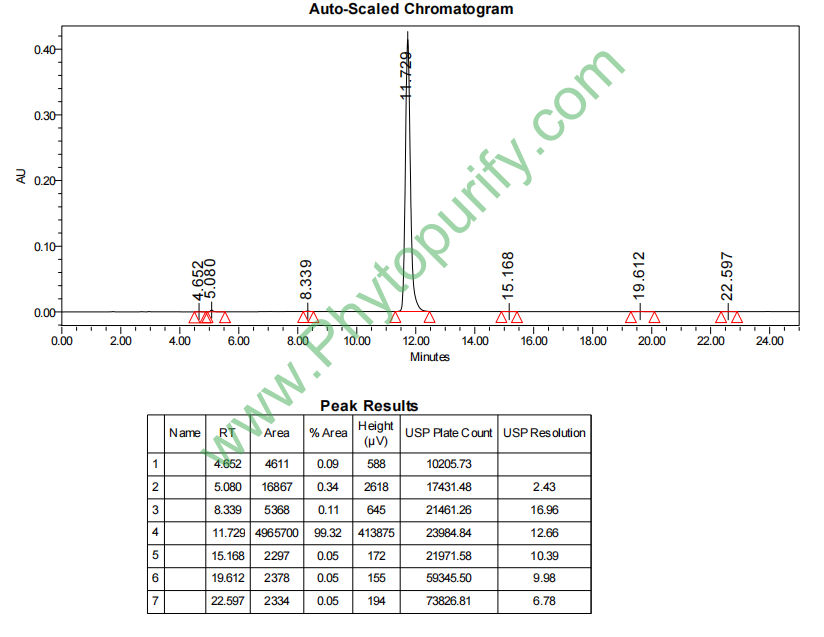
HPLC of Glycyrrhetinic acid
Storage conditions:Short-term storage at 2~8℃, long-term storage at -20 ~ -80℃
74.6000
5.3389
3.4655
.0014
5.2857
13.8698
Low
91.8908
4.7641
No
No
No
No
No
No
0.0
No
No
Yes
No
Glycyrrhetinic acid (GA), CAS number 471-53-4, is a traditional Chinese medicine called licorice(Glycyrrhiza uralensis One of the most important active ingredients in Fisch et al. is pentacyclic triterpenoids. As a traditional Chinese medicine, licorice is largely attributed to glycyrrhetinic acid and its aglycone glycyrrhetinic acid for its modern pharmacological basis of "harmonizing various medicines," "detoxifying," and "tonifying the spleen and qi. Glycyrrhetinic acid is not only the main metabolite of glycyrrhetinic acid in the body, but also exhibits extensive and significant biological activity, especially in the treatment of digestive system diseases, which has attracted much attention. With the development of modern molecular pharmacology and structural biology, the multiple pharmacological effects and complex molecular mechanisms of glycyrrhetinic acid, such as anti ulcer, anti-inflammatory, and immune regulation, have gradually been revealed. This article aims to systematically review the chemical properties and pharmacological activities of glycyrrhetinic acid, especially its molecular target network for anti ulcer effects, and evaluate its pharmacological properties and clinical application prospects, in order to provide scientific reference for the deep development and clinical application of this natural product.
Glycyrrhetinic acid is a pentacyclic triterpenoid compound of oleanane type, with the chemical name 3 β - hydroxy-11-oxoolean-12-ene-30-oic acid. Its parent nucleus is oleanane, substituted by a hydroxyl group with a β - configuration at position 3, a carbonyl (oxo) group at position 11, a double bond at position 12, and a carboxyl group at position 30. This unique structure is the material basis for its biological activity.
The pharmacological parameters show that the molecular weight is 470.6940, and the calculated lipid water partition coefficient (LogP) is 5.3389, indicating that the compound has high lipophilicity. The topological polar surface area (TPSA) is 74.6000 Å ², which is relatively low. The water solubility is extremely poor, only 0.0014 mg/mL, which directly affects its oral bioavailability and formulation development. Pharmacokinetic predictions indicate that its ability to penetrate the blood-brain barrier is low, suggesting a lower risk of central nervous system related side effects. In early safety screening, the hERG channel inhibition risk was negative, and the Ames test result was also 0.0, indicating a low risk of mutagenicity and a relatively good safety starting point. However, high LogP and low water solubility are the key physical and chemical bottlenecks that need to be overcome in its pharmaceutical process.
Glycyrrhetinic acid mainly comes from various plants of the genus Glycyrrhiza in the legume family, such as Ural licorice(Glycyrrhiza uralensis)Light fruit licorice(G. glabra)And swollen fruit licorice(G. inflata)Dry roots and rhizomes. In plants, glycyrrhetinic acid often exists in the form of potassium and calcium salts, and forms glucuronide with its 3-hydroxyl group, also known as glycyrrhizic acid (glycyrrhizin). Glycyrrhetinic acid content can reach 4% -20% of dry weight, which is the main source of sweet taste in licorice.
The extraction process usually starts with obtaining glycyrrhetinic acid, and then hydrolyzes it to obtain glycyrrhetinic acid. The regular process includes: 1)Extract Soak or reflux extract licorice medicinal materials with water or dilute alcohol; 2)Concentration and acidification Concentrate the extract and acidify it with acid to precipitate glycyrrhetinic acid; 3)refined Obtaining relatively pure glycyrrhetinic acid through methods such as recrystallization; 4)hydrolysis Heating and hydrolyzing glycyrrhetinic acid under acidic conditions (such as hydrochloric acid, sulfuric acid) to break its glucuronide bond, producing glycyrrhetinic acid and two molecules of glucuronic acid; 5)Separation and purification The hydrolysis product is extracted with organic solvents (such as ethyl acetate, chloroform) and separated by column chromatography (silica gel, reverse phase C18, etc.) to obtain high-purity glycyrrhetinic acid. Modern technologies such as ultrasound assisted extraction, microwave-assisted extraction, supercritical CO ₂ extraction, and high-speed countercurrent chromatography have also been applied to improve extraction efficiency and product purity.
Glycyrrhetinic acid has a wide range of pharmacological activities, mainly including:
1. Anti ulcer and gastric mucosal protective effects This is the most classic and extensively studied activity of glycyrrhetinic acid. It can significantly alleviate gastric mucosal damage caused by various experimental models such as pyloric ligation, stress, indomethacin or ethanol induction, and promote ulcer healing.
2. Anti inflammatory and immune regulatory effects Glycyrrhetinic acid inhibits inflammatory responses through multiple pathways, such as inhibiting phospholipase A2 and cyclooxygenase/lipoxygenase pathways, reducing the production of inflammatory mediators such as prostaglandins and leukotrienes, and regulating the function of immune cells such as macrophages and T lymphocytes.
3. Antiviral effect It has inhibitory effects on various viruses such as hepatitis virus, herpes simplex virus, human immunodeficiency virus, etc., and its mechanism may be related to changes in viral membrane fluidity, inhibition of key viral replication enzymes, etc.
4. Hepatoprotective effect To combat liver damage caused by various liver toxins such as CCl ₄ and acetaminophen, reduce serum transaminase levels, alleviate liver cell necrosis and steatosis.
5. Corticosteroid like effects in the adrenal cortex Due to its structural similarity to steroid hormones, it can simulate partial glucocorticoid activity, but long-term or excessive use may also lead to side effects similar to aldosteronism, such as edema, hypertension, and hypokalemia.
6. antitumor activity Recent studies have shown that glycyrrhetinic acid has inhibitory effects on the proliferation, induction of apoptosis, and inhibition of invasion and metastasis of various tumor cells. However, its specific mechanism and in vivo effectiveness still need to be further studied.
The pharmacological effects of glycyrrhetinic acid, especially its excellent anti ulcer activity, stem from its synergistic regulation of multiple targets and pathways, forming a complex network. Its core targets and mechanisms are as follows:
Inhibiting gastric acid secretion and enhancing mucosal defense:
Regulating inflammation and immune microenvironment:
Other potential targets:
In summary, the anti ulcer effect of glycyrrhetinic acid is not achieved through a single target, but through Inhibition of attack factors (gastric acid, inflammation)and Enhance defense factors (mucus, repair)The dual strategy works synergistically on a wide target network from hormone receptors (SST, HRH2, CCKBR), key enzymes (H+/K+- ATPase, PTGS1/2) to growth factors (TGF α) and structural proteins (MUC5AC), thereby achieving comprehensive gastric mucosal protection and ulcer healing promotion effects.
Although glycyrrhetinic acid has a wide range of activities, its medicinal properties face challenges. Its extremely low water solubility and high lipid solubility result in irregular oral absorption and low bioavailability. Animal pharmacokinetic studies have shown that glycyrrhetinic acid is slowly absorbed orally, widely distributed in the body, and has a high binding rate with plasma proteins. Its main metabolic pathway is hydroxylation and other reactions in the liver through the CYP450 enzyme system (such as CYP3A4), ultimately forming glucuronic acid complexes, which are excreted through bile and kidneys. Its half-life is relatively long.
To improve its medicinal properties, researchers have adopted various strategies:
1. Structural modification Esterification, salt formation, amide formation, or introduction of hydrophilic groups on its 30th carboxyl group, 3rd hydroxyl group, or A ring to improve solubility and activity. Glycyrrhetinic acid aluminum (glycyrrhetinic acid) is its complex with aluminum, which was once used for anti ulcer treatment, but has been rarely used due to the potential toxicity and absorption issues of its aluminum ions. Glycyrrhetinic acid derivatives such as 18 β - glycyrrhetinic acid-3-O-succinate disodium salt (gastric ketone) have been used clinically.
2. Formulation technology By utilizing drug delivery systems such as solid dispersions, cyclodextrin inclusion complexes, liposomes, nanoparticles, and self microemulsions, the dissolution rate, stability, and bioavailability are significantly improved. For example, new formulations such as glycyrrhetinic acid phospholipid complex and glycyrrhetinic acid nanocrystals have shown better pharmacological effects.
3. Prodrug design Prepare glycyrrhetinic acid as a prodrug that is activated at specific sites (such as inflammation or tumor microenvironment) to enhance targeting and reduce systemic side effects.
At present, drugs that directly use glycyrrhetinic acid as a single ingredient are rare in the mainstream market, but its structural value and application potential as the active core are still enormous.
Future research should focus on: ① using computational chemistry and structural biology methods to accurately analyze the interaction mode between glycyrrhetinic acid and key targets (such as PTGS1/2, 11 β - HSD2), guiding the design of highly selective derivatives; ② Deeply explore the molecular mechanisms of its new activities such as anti-tumor and anti fibrosis; ③ Accelerate the development and clinical translation of formulations based on new drug delivery systems, overcoming their physical and chemical property shortcomings; ④ Conduct high-quality prospective clinical studies to confirm its efficacy and safety in specific diseases, such as specific types of gastritis, oral ulcers, etc.
Glycyrrhetinic acid, as a classic pentacyclic triterpenoid compound derived from licorice, has undergone decades of research and its rich pharmacological activity and complex multi-target mechanism of action have been continuously elucidated. From the traditional anti ulcer "star molecule" to the modern multidisciplinary pharmacological research "versatile", glycyrrhetinic acid demonstrates the enduring charm of natural products as a source of drug discovery. Although its own water solubility and aldosterone like side effects limit direct drug development, these challenges have precisely driven advances in related disciplines such as medicinal chemistry and pharmacy in their derivative design and formulation innovation. With the development of systems biology, precision medicine, and intelligent delivery technology, the understanding of glycyrrhetinic acid will deepen from "one compound, multiple targets" to "one core structure, multiple precision tools". In the future, new therapeutic drugs developed based on the structure skeleton of glycyrrhetinic acid are expected to achieve breakthroughs in digestive system diseases, inflammatory and immune diseases, and even tumors, continuing the vitality of this ancient molecule in modern medicine.
