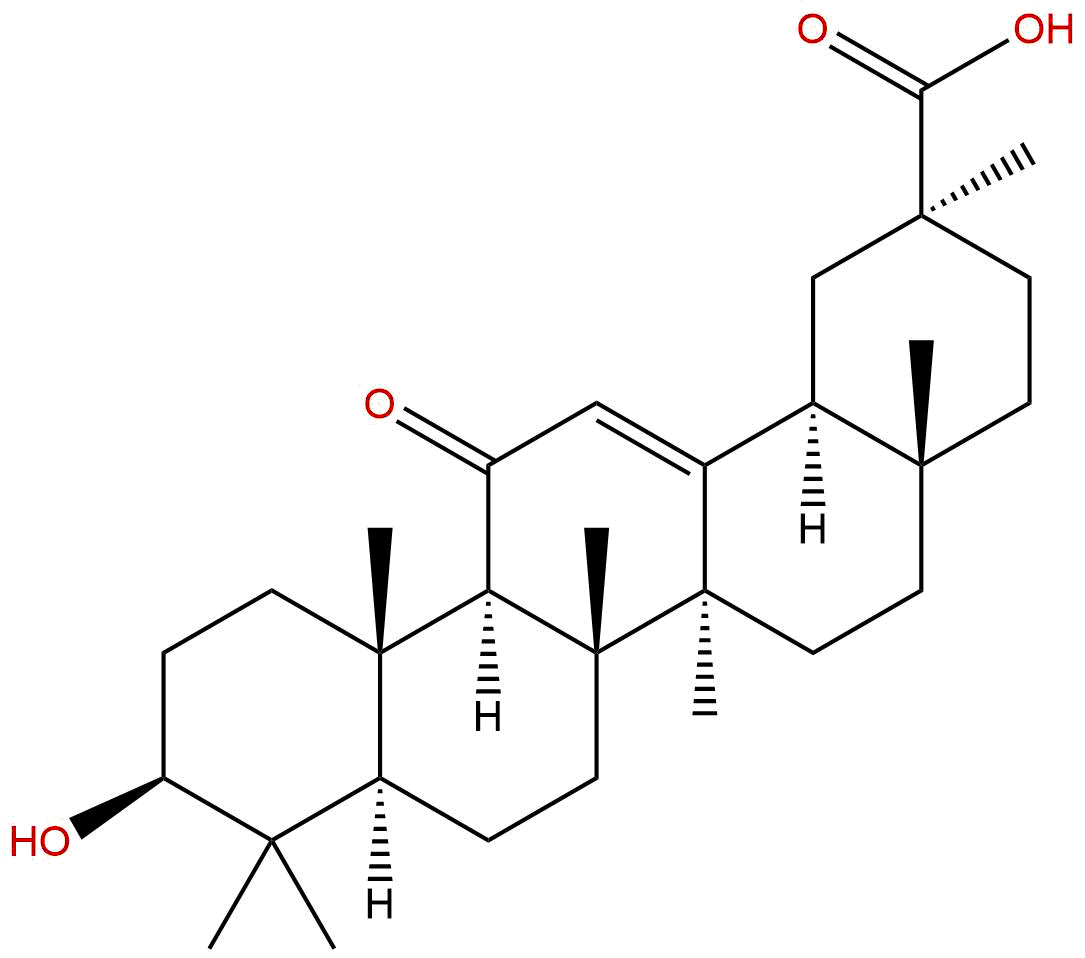


Product name: 18α-Glycyrrhetic acid
Synonym name:
Catalogue No.: BP2125
Cas No.: 1449-05-4
Formula: C30H46O4
Mol Weight: 470.694
Botanical Source: Glycyrrhiza Radix Et Rhizoma
Type of Compound: Triterpenoids
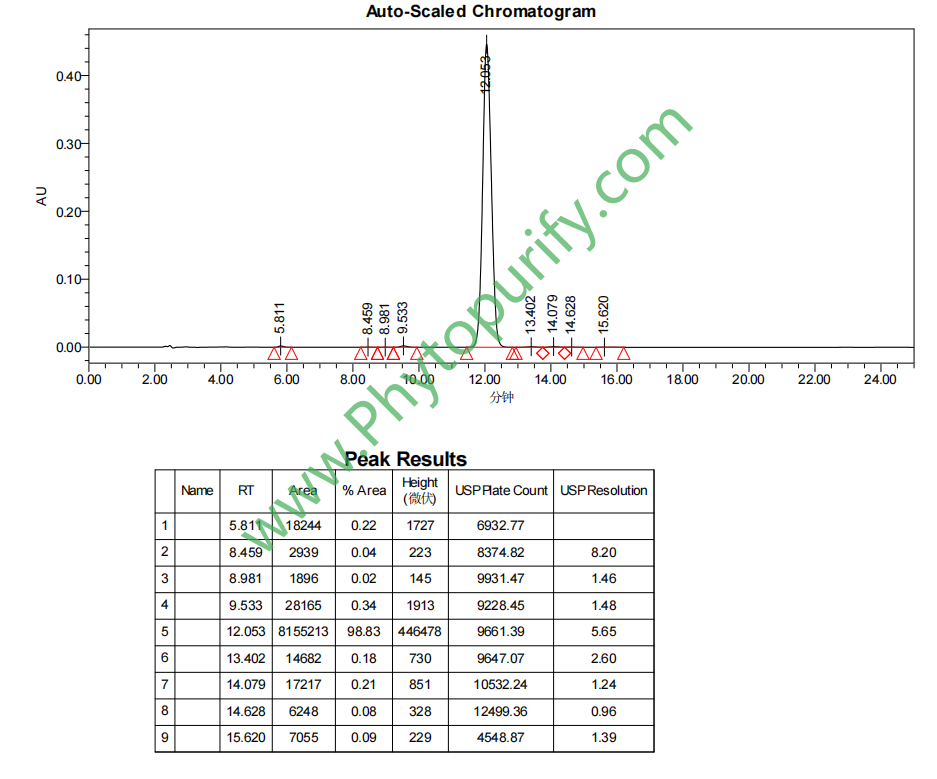
Purity: 95%~99%
Analysis Method: HPLC-DAD or/and HPLC-ELSD
Identification Method: Mass, NMR
Packing: Brown vial or HDPE plastic bottle
Storage: Store in a well closed container, protected from air and light. Put into refrigerate or freeze for long term storage.
Whenever possible, you should prepare and use solutions on the same day. However, if you need to make up stock solutions in advance, we recommend that you store the solution as aliquots in tightly sealed vials at -20℃. Generally, these will be useable for up to two weeks.
The product could be supplied from milligrams to grams
Inquire for bulk scale.
For Reference Standard and R&D, Not for Human Use Directly.
HPLC of 18α-Glycyrrhetic acid
Storage conditions:Short-term storage at 2~8℃, long-term storage at -20 ~ -80℃
74.6000
5.3328
3.4594
.0014
5.2921
13.8626
Low
91.9575
4.7641
No
No
No
No
No
No
0.0
No
No
Yes
No
18 α - Glycyrrhetinic acid (CAS number: 1449-05-4) is one of the important triterpenoid active ingredients in licorice (Glycyrrhiza spp.). As the main metabolite of glycyrrhetinic acid hydrolysis, 18 α - Glycyrrhetinic acid has received widespread attention in the field of natural product pharmacology. Its unique chemical structure endows it with diverse biological activities, especially showing significant potential in antiviral, anti-inflammatory, and immune regulation. In recent years, with the in-depth study of the infection mechanism of viral diseases, especially herpes simplex virus (HSV), 18 α - glycyrrhetinic acid has become a hot candidate molecule for antiviral drug development due to its inhibitory effect on multiple key targets of HSV.
This article reviews the chemical structure and physicochemical properties, plant sources, and extraction methods of 18 α - glycyrrhetinic acid. It systematically summarizes its pharmacological activity and mechanism of action, focuses on analyzing its intervention effect on HSV related targets, evaluates its pharmacological parameters and pharmacokinetic characteristics, and looks forward to its potential and future development direction in clinical applications. The aim is to provide comprehensive and systematic reference materials for researchers in related fields.
18 α - glycyrrhetinic acid belongs to the pentacyclic triterpenoid class, with a molecular formula of C30H46O4 and a molecular weight of 470.6940. Its structure is based on the skeleton of glycyrrhetinic acid, which is different from 18 β - glycyrrhetinic acid. The stereoconfiguration of 18 α - glycyrrhetinic acid at the C18 position is alpha shaped, resulting in differences in its spatial conformation and biological activity. This molecule contains multiple hydroxyl and carboxyl groups, giving it a certain polarity, but the overall structure has strong hydrophobicity.
In terms of physicochemical properties, the LogP value of 18 α - glycyrrhetinic acid is 5.3328, indicating its high lipid solubility, which facilitates cell membrane penetration but may affect water solubility and bioavailability. Its topological polar surface area (TPSA) is 74.6 Å ², indicating that its molecular polarity is moderate and conducive to binding with protein targets. The extremely low water solubility (0.0014 mg/mL) limits the development of its direct oral formulations. The low permeability of the blood-brain barrier suggests its limited distribution in the central nervous system. In terms of safety, 18 α - glycyrrhetinic acid did not show hERG channel inhibition, and the Ames mutagenicity test result was negative, indicating that it has a good safety basis.
18 α - glycyrrhetinic acid mainly exists in the roots and rhizomes of licorice, and plants of the licorice genus (such as Glycyrrhiza glabra and Glycyrrhiza uralensis) are widely used in traditional Chinese medicine. Glycyrrhetinic acid, as the main triterpenoid saponin in licorice, generates 18 α - glycyrrhetinic acid through in vitro and in vivo hydrolysis.
The common methods for extracting 18 α - glycyrrhetinic acid include:
Water extraction and alcohol precipitation method Firstly, extract glycyrrhetinic acid substances from licorice roots using water or ethanol, then convert glycyrrhetinic acid into 18 α - glycyrrhetinic acid through alkaline hydrolysis or enzymatic hydrolysis, and finally purify it using alcohol precipitation method.
Acid-base hydrolysis method Hydrolysis of glycyrrhetinic acid under alkaline conditions releases 18 α - glycyrrhetinic acid, which is then purified by liquid-liquid extraction and chromatographic separation.
Column chromatography separation Purification and quantitative analysis were performed using silica gel or reverse phase C18 column chromatography combined with high-performance liquid chromatography (HPLC).
Modern extraction techniques Ultrasonic assisted extraction, microwave-assisted extraction, and supercritical fluid extraction methods are used to improve extraction efficiency and purity, while reducing solvent usage.
During the extraction process, attention should be paid to controlling the pH value and temperature to prevent degradation of the target compound. Purified 18 α - glycyrrhetinic acid is commonly used for pharmacological activity evaluation and structural modification research.
18 α - glycyrrhetinic acid exhibits multiple pharmacological activities, especially in the fields of antiviral, anti-inflammatory, immune regulation, and anti-tumor, showing potential application value.
Research on HSV has shown that 18 α - glycyrrhetinic acid can significantly inhibit the replication and infection process of HSV. Its role involves multiple key stages of the virus lifecycle, including virus attachment, membrane penetration, gene expression, and virus assembly. In vitro cell models, 18 α - glycyrrhetinic acid showed inhibitory effects on both HSV-1 and HSV-2, with no significant cytotoxicity.
In addition, 18 α - glycyrrhetinic acid also has a certain inhibitory effect on other viruses such as hepatitis B virus (HBV), human immunodeficiency virus (HIV), etc., but its specificity and inhibitory effect on HSV are more prominent.
18 α - glycyrrhetinic acid exerts significant anti-inflammatory effects by regulating the nuclear factor kappa B (NF - κ B) and MAPK signaling pathways, inhibiting the expression of pro-inflammatory factors such as TNF - α, IL-6, and IL-1 β. Its immune regulatory function is reflected in enhancing macrophage phagocytic activity and regulating T cell subpopulation balance, promoting immune homeostasis in the body.
This compound can scavenge free radicals, alleviate oxidative stress damage, protect cells from oxidative induced apoptosis, and has potential neuroprotective and cardiovascular protective effects.
The study also found that 18 α - glycyrrhetinic acid has anti-tumor activity, which can induce cancer cell apoptosis and inhibit tumor cell proliferation. In addition, its potential for liver protection, anti fibrosis, and regulation of glucose and lipid metabolism is gradually being revealed.
The antiviral mechanism of 18 α - glycyrrhetinic acid on HSV involves multiple virus related targets, including:
UL42 As a DNA polymerase cofactor, UL42 promotes viral DNA replication. 18 α - glycyrrhetinic acid blocks virus replication by interfering with the binding of UL42 to viral DNA.
ICP27 Early viral proteins regulate viral gene expression. This compound inhibits the expression of ICP27 and reduces viral transcriptional activity.
TK (thymidine kinase)Involved in viral nucleotide metabolism, 18 α - glycyrrhetinic acid inhibits TK activity and affects viral DNA synthesis.
GD (glycoprotein D)Mediating the binding and invasion of viruses and host cells, 18 α - glycyrrhetinic acid interferes with the binding of gD to receptors, preventing virus invasion.
UL30 Encoding the catalytic subunit of viral DNA polymerase, 18 α - glycyrrhetinic acid inhibits its enzymatic activity and blocks viral replication.
UL39 Encoding viral thymidylate synthase, involved in viral DNA synthesis, and inhibited by this compound.
UL23 Encoding viral thymidine kinase, which functions similarly to TK and is regulated by 18 α - glycyrrhetinic acid.
ICP4 The main viral transcription activator regulates viral gene expression, and 18 α - glycyrrhetinic acid inhibits its function, reducing viral protein synthesis.
Through the synergistic effect of multiple targets, 18 α - glycyrrhetinic acid effectively blocks the replication cycle of HSV, reducing viral load and infection spread. In addition, the compound can regulate the host immune response and enhance antiviral defense capabilities.
The pharmacological parameters of 18 α - glycyrrhetinic acid provide important references for its clinical development:
Molecular weight (470.6940)Moderate, meeting the basic requirements of Lipinski's rules.
LogP(5.3328)Higher lipid solubility is beneficial for cell membrane penetration, but may affect water solubility and oral absorption.
TPSA(74.6 Ų)Suitable for binding to targets and beneficial for oral absorption.
Water solubility (0.0014 mg/mL)Extremely low, limiting the bioavailability of oral administration, requiring formulation improvements such as nanocarriers, liposomes, etc. to enhance dissolution.
Blood-brain barrier permeability Low, indicating limited distribution in the central nervous system, suitable for the treatment of peripheral viral infections.
HERG inhibition None, indicating good cardiac safety.
Ames test Negative, indicating no risk of mutagenicity.
Pharmacokinetic studies have shown that the absorption of 18 α - glycyrrhetinic acid is slow after oral administration, and its bioavailability is limited. It is mainly metabolized through the liver, and the activity of its metabolites needs further investigation. Its half-life is moderate and suitable for daily administration. The distribution in the body is mainly concentrated in the liver and kidneys, and the excretion pathways are mainly bile and urine.
To overcome its poor water solubility and low bioavailability, current research focuses on the development of novel drug delivery systems, such as solid dispersions, lipid nanoparticles, microemulsions, and drug co crystals, to enhance their clinical application potential.
Given the multi-target effect and good safety of 18 α - glycyrrhetinic acid in the treatment of HSV virus, its development prospects as an antiviral drug are broad. The current treatment of HSV infection mainly relies on nucleoside analogues such as acyclovir, but the problem of drug resistance is becoming increasingly prominent, and new mechanisms of antiviral drugs are urgently needed. Due to its unique mechanism of action, 18 α - glycyrrhetinic acid is expected to become an effective supplement or alternative to nucleoside drugs.
In addition, its anti-inflammatory and immune regulatory functions provide dual advantages for treating viral induced inflammatory reactions, making it suitable for comprehensive treatment of recurrent HSV infections and related complications.
Future research should focus on:
Preclinical efficacy and safety evaluation Verify its anti HSV activity and toxicological characteristics through animal models of the system.
Optimization of drug formulations Improve water solubility and bioavailability, and improve administration routes.
Combination therapy strategy Evaluation of synergistic effects and resistance effects in combination with existing antiviral drugs.
In depth analysis of the mechanism Using molecular biology and structural biology techniques, clarify its binding mode with viral targets and downstream signal regulation.
Clinical trial design Conduct early clinical studies to evaluate its safety, pharmacokinetics, and preliminary efficacy.
In addition, the potential of 18 α - glycyrrhetinic acid in the treatment of other viral infections, inflammatory diseases, and tumors is also worth further exploration to broaden its clinical application scope.
18 α - glycyrrhetinic acid, as an important triterpenoid active ingredient in licorice, has shown significant pharmacological potential, especially in the field of anti HSV virus, due to its unique chemical structure and diverse biological activities. Its multi-target mechanism of action provides new ideas for the development of antiviral drugs, and its good safety and drug parameters lay the foundation for clinical translation. However, poor water solubility and low bioavailability remain the main bottlenecks in its clinical application, which urgently need to be addressed through formulation innovation and drug design.
In the future, by combining modern drug development technology, deeply analyzing its mechanism of action, optimizing pharmacokinetic characteristics, and conducting systematic preclinical and clinical research, 18 α - glycyrrhetinic acid is expected to become an innovative drug in the field of antiviral therapy, promoting the application of natural products in modern medicine.
